Infographic

Smartphones, refrigerators, and the power of connection

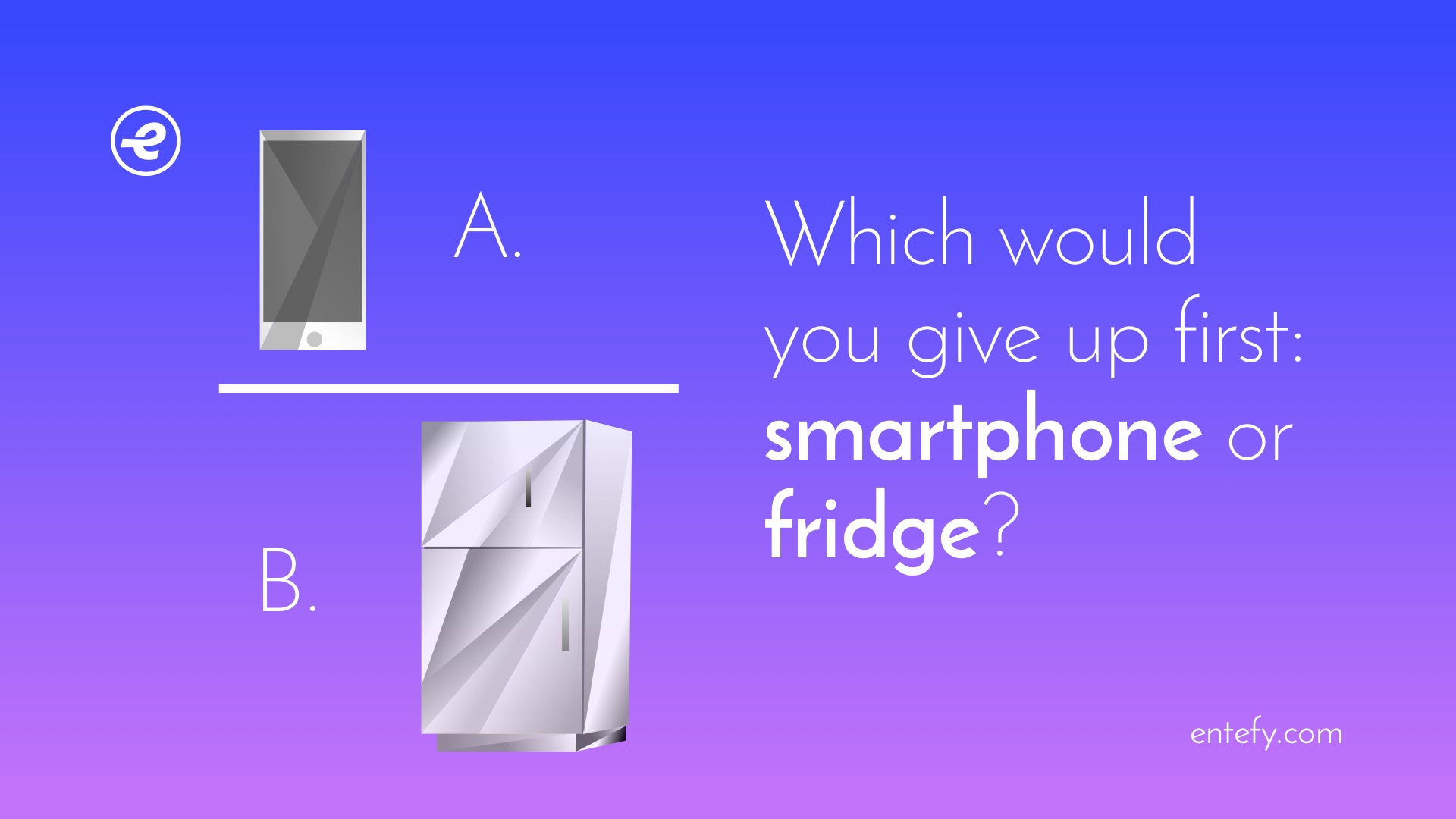
The average smartphone can use as much electricity in a year as the average refrigerator. A smartphone’s power consumption is driven primarily by the phone’s screen and the amount of data it processes and transfers. Refrigerators have become far more energy efficient over time, but still account for about 14% of a household’s energy use.

The smartphone and the refrigerator are essential parts of our lives. One provides communication, connection, entertainment, information. The other preserves the food that nourishes us. And we expect both to be available 24/7. Entefy’s technology can’t keep your leftovers fresh (at least not yet), but it does provide round-the-clock access to your digital world of people, smart devices, and services.

Watch the video version of this enFact here.

Entefyers

5 lessons smart teams can learn from smart devices

You can learn a lot about effective teams from a smart thermostat. One of the first home appliances enhanced with Internet connectivity, the thermostat has become a cornerstone in home automation systems. But there is still a long way to go before these systems attain the vision of an interconnected, intelligent whole. As it stands today, individual smart devices—thermostats, dimmers, window shades, alarms, wall switches—work well independently but lack unity, the harmonizing force that turns an array of standalone devices into a coordinated system.

Entefy does a lot of work redefining how people interact with the Internet of Things. Which is how we realized that smart devices, working together seamlessly, show us how teams can best be organized for efficiency and impact. And how they can make better, smarter, faster decisions when they’re operating in productive harmony.

Here are 5 insights to get you thinking:

1. Trust the thermostat to do its thing. Trust among team members is a critical prerequisite to effective brainstorming and problem-solving. When team members know they have their team’s support and trust, they feel more comfortable taking risks. This fosters an environment for cognitive leaps, unexpected ideas, and creative problem-solving.

2. The dimmer needs to know when to adjust. Harmony can’t exist without information flow. Teams need communication channels for each team member to share what they’re doing, thinking, and planning. This sets the stage for efficient and effective decision-making, reduces duplicated effort, and boosts productivity.

3. Temperature up, shades down, dimmer up. Process is the heart of collaboration. Harmonized teams have mutually agreed-upon processes and mechanisms for adjusting those processes when needed. Process is how team members know who to ask what, when to make a decision, and how to evaluate their own effectiveness.

4. Dependability makes the alarm useful. Dependability is a cornerstone of any effective teamwork. It has multiple facets: responsibility, consistency, reliability, timeliness, and attention to detail. There is even the added dimension that dependable colleagues can contribute to a lower-stress environment.

5. Let the lamp lead when its dark. Team leadership should be fluid, with subject matter experts taking center stage while the team is focused on matters related to that area of expertise. This leverages individual strengths and helps team members prioritize the success of the group over personal achievement.

Teams and teamwork are essential to any endeavor. So when you’re assembling a team, leading a team, or participating in a team effort, keep the smart thermostat in mind. Individuals can get the job done, and making them part of a harmonized ecosystem positions everyone to make a real impact.


Infographic

We write as much in a day online as all the books in the Library of Congress combined

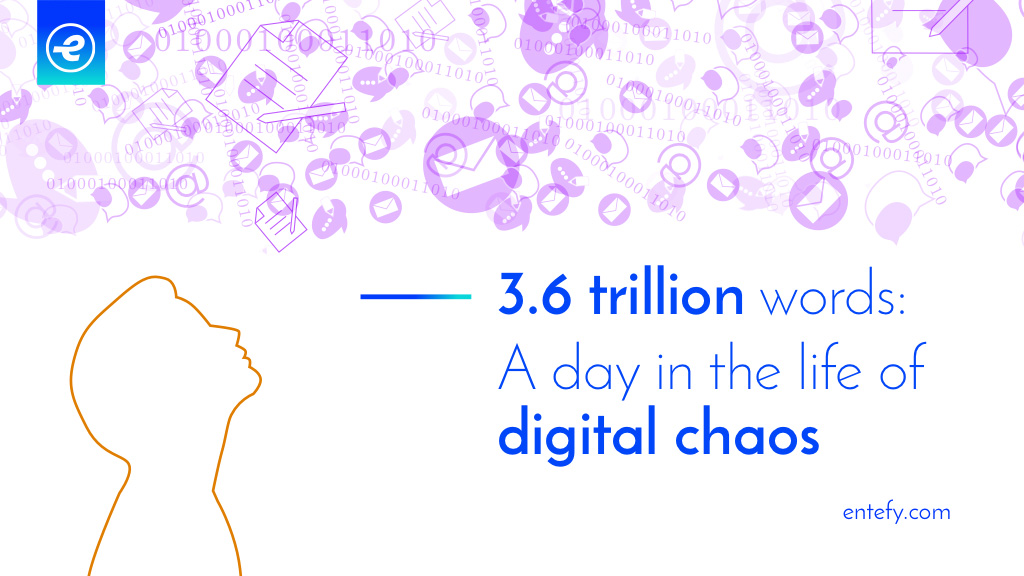
Every day in the U.S., 3.6 trillion words are transmitted online in the form of emails, texts, social media shares, blogs, and comments. This is the equivalent of nearly 36 million new books. To put this figure in perspective, the U.S. Library of Congress, the largest library in the world, has collected 38 million books and other print materials since its founding in 1800.

In this digital age, more and more people are finding their voices and sharing their thoughts online. But all of this expression creates challenges, too. Finding what you’re looking for when you need it becomes harder with each passing day. Digital technology created this new world of information overload, and we’re going to need advanced technology like Entefy to stay ahead of this curve.

Team Entefy

Lessons on fulfillment from my first day at Entefy

Silicon Valley runs at fast-forward speed and it’s easy to let health fall by the wayside in order to squeeze in extra hours at the office. And that’s before time spent commuting, parenting, caring for pets, or maintaining a social life.

Before joining Entefy, I was an independent consultant. I liked how it let me manage my schedule to fit in a daytime exercise class or a leisurely client lunch at a vegetarian restaurant. It was easy to maintain a healthy routine. When I decided to go back to work for a company, I assumed that my new role would disrupt my good habits. Entefy taught me that didn’t have to be the case. But that’s because Entefy is no ordinary company.

Before walking in on my first day, I was given the opportunity to come in at 10:00 a.m. That gave me time to eat breakfast, go on a jog with my Goldendoodle, and set personal goals for the day before leaving for the office. I started my day feeling accomplished.

Once I entered the office, I immediately noticed Entefy’s active stance towards healthy living. The company has created an environment that fosters personal connections, allows relaxation and renewal, and promotes nutritious diets, all at the same time.

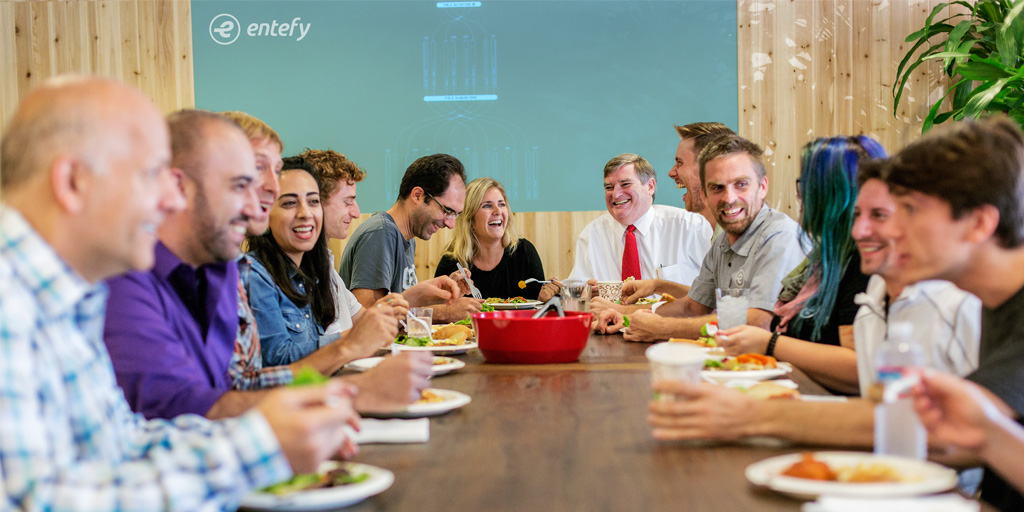
There is a small (and growing) group of us at our headquarters on any given day. Arwen, our office manager and fairy godmother, manages a complex combination of dietary requirements yet still selects foods that are both nourishing and tasty. She always makes sure that we have a selection of meat options, salads, gluten-free items, and vegetarian dishes. We feel comfortable being able to choose what we eat. And by eating together communally, away from our screens, we do so mindfully.

Entefy made choices early on to establish an environment of healthy living. Work hours are flexible, letting team members fit life’s obligations into their schedules. The company also provides full health care benefits for employees and, equally important, their families. And then there are the family-friendly events where we all get together at a park to share a sunny day.

It’s no surprise Entefyers refer to ourselves as a family. I feel the closeness, camaraderie, and mutual support. It turns out that hard work and personal fulfillment can go hand-in-hand.

To your health,
Meghan

Infographic

Yeast, mice, and the uniqueness of you

It is said that we are all connected. But what does that mean? How much similarity is there among the creatures of Earth?

We turn to genetic science for answers. 100% of all humans have the same genes, but some of these genes contain the sequence differences that make each person unique. There is only a 2% DNA difference between humans and chimpanzees. There is an 8% DNA difference between humans and mice, but there is a 74% difference between humans and yeast.

The American philosopher William James wrote in an essay, The Importance of Individuals:

An unlearned carpenter of my acquaintance once said in my hearing: “There is very little difference between one man and another; but what little there is, is very important.”

Relatively small differences in DNA make a tremendous difference to the outcome.

Trillions of digital messages fly around the world every year, from person to person. The words we use may be similar, yet the messages we write can uniquely define each of us.

6909

You say hello, I say…

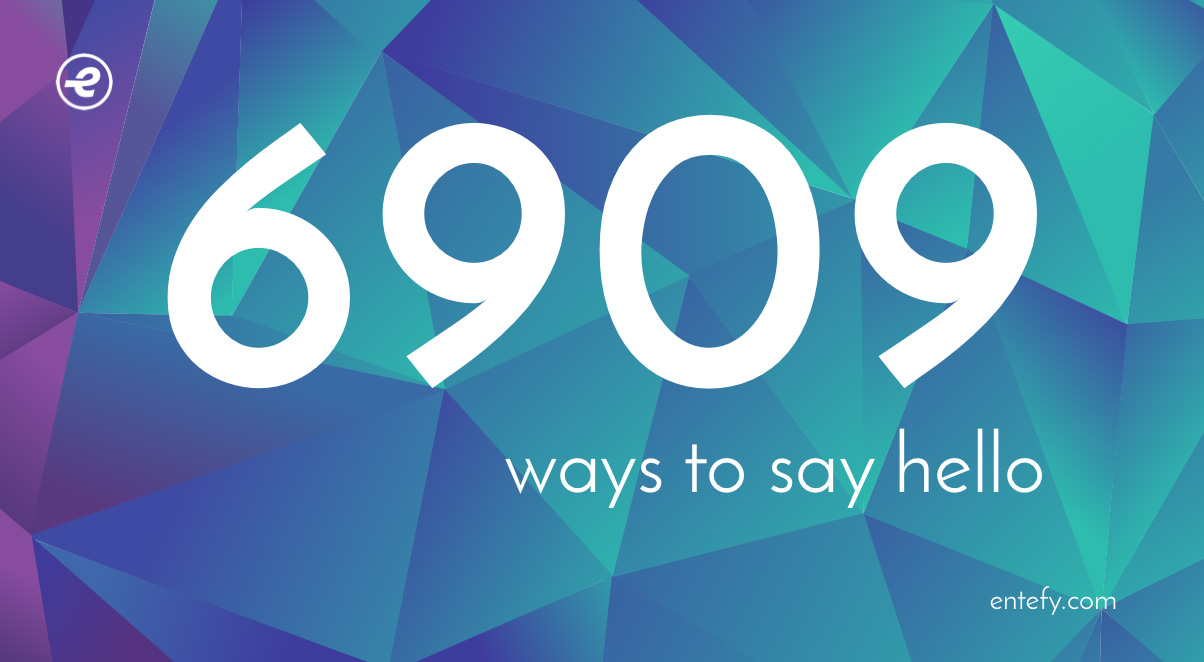
There are 6,909 languages spoken among the 7 billion people of Earth today. 25% of those languages are spoken by fewer than 1,000 people while just one, Mandarin Chinese, has 873 million native speakers.

Clearly there is great variance in language density. Europe has 230 languages spoken in its geographical territory while Asia has 2,197. The country with the greatest linguistic diversity is Papua-New Guinea, which has 832 languages spoken by its 4 million people—an average of around 4,500 speakers per language.

Even in France, there are probably more languages than you might expect. In addition to French, there are Breton, Alsatian, Basque, Gasçon, Provençal, Corsican, Ligurian, Catalan, Picard, and Occitan.

Languages add great diversity to our communication environment but they also represent barriers to expression and connection. We’re building Entefy to bring together your digital communication streams into your “language.”

Watch the video version of this enFact here.

Infographic

A worm’s-eye view of the world

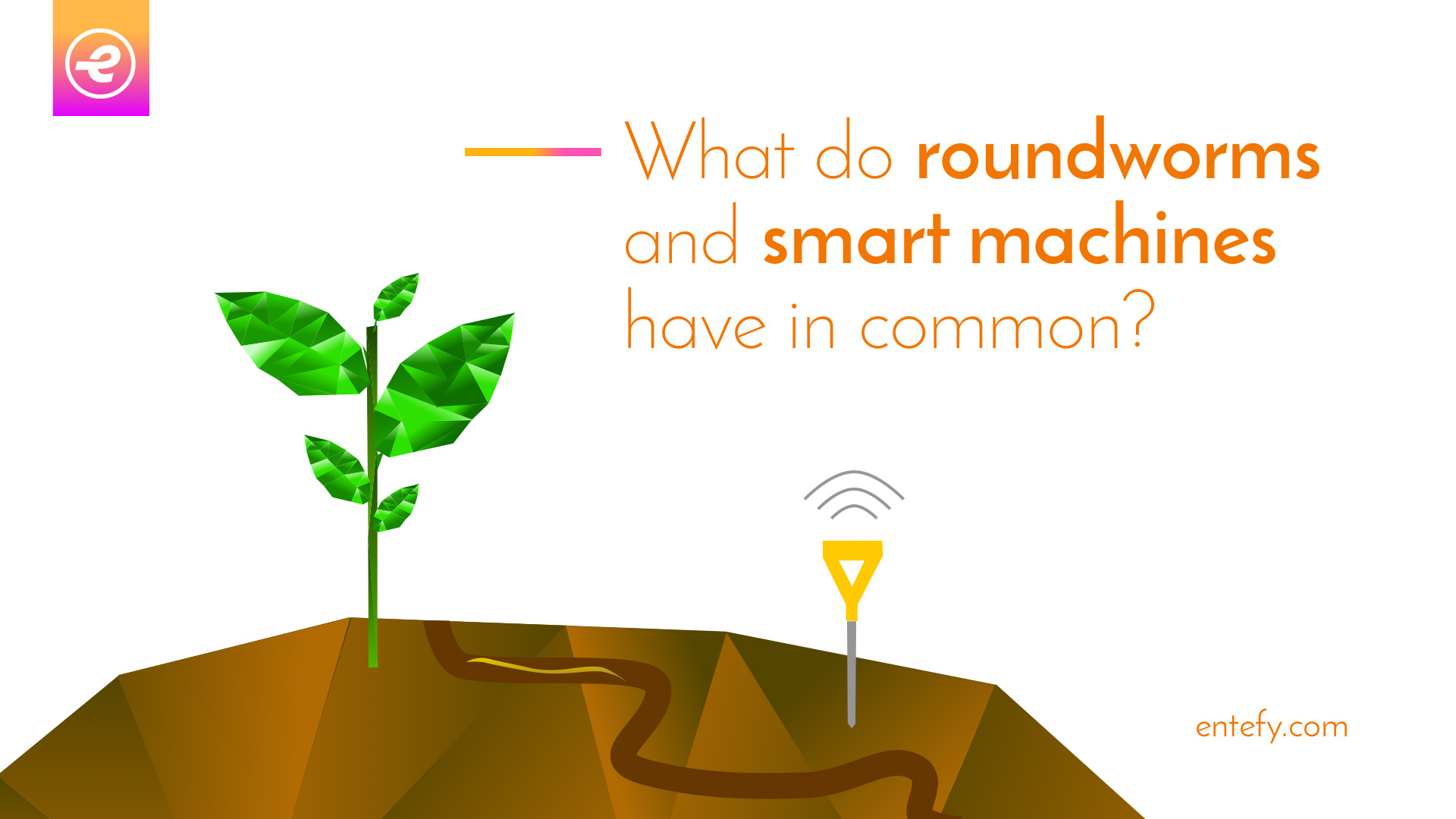
Caenorhabditis elegans (also known as the “roundworm”) has 302 neurons, while an average human brain contains 86 billion neurons. Thus, human processing capacity is exponentially greater than that of a roundworm.

Among the roundworm’s notable attributes are that the majority of them are hermaphroditic, they emit a blue florescence at death, and they are one of the most primitive organisms to display sleep-like states. Even 302 neurons get tired.

Market research group, International Data Corporation (IDC), forecasts growth from 2 billion Internet of Things (IoT) devices and smart machines in 2006 to 200 billion in 2020. While some of these devices are massive in capacity, most are humble units with a few FLOPs and minimal memory measured in kilobytes and megabytes. Much like C. elegans.

Roundworms and earthworms might seem insignificant but they are actually critical to the ecological health of the earth. The evolutionary scientist Charles Darwin wrote about this in his last book, Vegetable Mould and Earth-Worms: The Formation of Vegetable Mould Through the Action of Worms With Observations on Their Habits. It was Darwin who first formally demonstrated that worms weren’t a pest (as many had considered them) but were integral to the health and sustenance of agricultural soil.

There’s a parallel here with simple, low-capacity worms having a tremendous ecological impact on their environment because of their large numbers. Similarly, individual IoT devices might not have a lot of capacity (memory and processing) on their own, but in aggregate they are predicted to have a huge impact (e.g. $11 trillion per year in economic value by 2025).

With growth in IoT comes greater complexity: challenges with interoperability, privacy, and security. With this level of complexity, sophisticated technology like Entefy is needed to overcome these challenges.

Watch the video version of this enFact here.

Infographic

Magic number: 7, more or less

Humans can retain just 7 (plus or minus 2) items in short-term memory. Yet Homer’s Odyssey and Iliad were recited long before they were written down. We carry on conversations that take place over hours. We write long essays. We deliver speeches. We rocket to the moon. We perform hours-long operas.

If we carry only 5-9 items in our short-term memory, how is that even possible?

This limit was explored and quantified in the late 1950s by George A. Miller of Harvard University. As a consequence of his research, he was able to identify the 5-9 capacity range in his descriptive paper, The Magical Number Seven, Plus or Minus Two: Some Limits on our Capacity for Processing Information (1956). His “Magical Number” findings became known as Miller’s Law.

Psychologists and neurologists have discovered a wide range of strategies and techniques humans have developed to circumvent the limitation of 5-9 items. One adaption is that we break things into chunks. A home phone number of (555) 374-6377 might look like a random string of 10 items. But not to our brains. It breaks this into three easy-to-remember chunks: the area code, the three-digit prefix, and the four-digit number. By “chunking,” we get around the Magical Number constraint.

Humans do amazing things that defy biological constraint. And technology like Entefy provides the tools to do even more. The next time you’re singing along to your favorite song, look for signs of how your brain is using the Magical Number to help you remember all of those lyrics.

Watch the video version of this enFact here.

Infographic

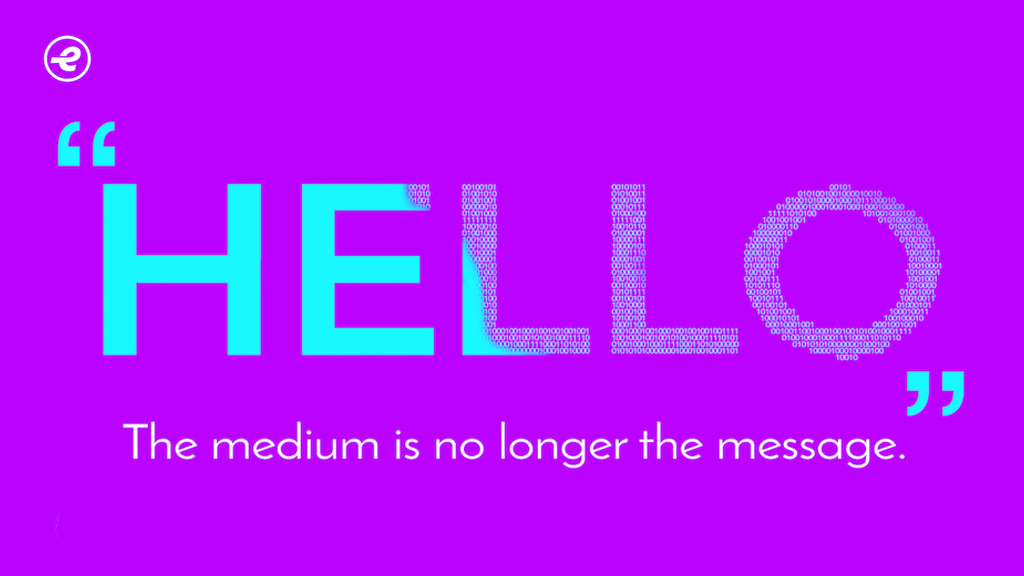
The medium is no longer the message

In 1963—before the Internet, before the desktop computer, and when “mobile device” often meant roller skates—Marshall McLuhan dropped a bombshell on the world of communication: “The medium,” he proposed, “is the message.” In time, and after much head-scratching, nail-biting, and soul-searching, many people grudgingly conceded that how a message is transmitted is at least as important as the message itself.

But things are beginning to change.

McLuhan made the daring claim that (loosely translated from the Canadian) the real content of any medium is the change of scale or pace or pattern that it introduces into human affairs. The content of television is not the antics of suburban families or the exploits of superheroes, but the hours reserved for passively watching them. The content of e-mail (he would say) is not the reminder of a dental appointment but the fact that we check it 150 times a day. The content of a Tweet is not an epigraphic editorial, but the fact that our heads are permanently cocked at a 45° angle looking at our phones.

The implication of all this is inescapable. As McLuhan rather bluntly put it, the notion that technology is neutral and what matters is what we do with it is “the numb stance of the technological idiot.” That’s actually a pretty fair characterization of where things now stand, but maybe we have reached an inflection point. Maybe, after a long technological interlude, we are finally poised to reverse that fateful course and return the hardware to the back room from whence it came, and make the software disappear.

At Entefy we see McLuhan’s famous dictum not as a fact to be accepted, but a challenge to be overcome. We are developing technologies that will return the human being to center stage, and restore the immediacy of face-to-face, person-to-person communication. Ideas, information, inspiration, intimacy—isn’t this really what we are after?

Alston

Andrew Jackson and the Battle of New Orleans

The Battle of New Orleans was fought between forces under American General Andrew Jackson (later President Jackson) and British General Sir Edward Pakenham on January 8, 1815.

What neither Jackson or Pakenham knew was that the U.S. and Britain had already agreed to peace terms and signed the Treaty of Ghent two weeks earlier. Because of that delay, the battle was fought and, regrettably, 2,096 soldiers were injured or killed.

We often take for granted the speed and accuracy of communication, but history reminds us of just how consequential delays can be.

Watch the video version of this enFact here.