
Infographic

A worm’s-eye view of the world

Caenorhabditis elegans (also known as the “roundworm”) has 302 neurons, while an average human brain contains 86 billion neurons. Thus, human processing capacity is exponentially greater than that of a roundworm.

Among the roundworm’s notable attributes are that the majority of them are hermaphroditic, they emit a blue florescence at death, and they are one of the most primitive organisms to display sleep-like states. Even 302 neurons get tired.

Market research group, International Data Corporation (IDC), forecasts growth from 2 billion Internet of Things (IoT) devices and smart machines in 2006 to 200 billion in 2020. While some of these devices are massive in capacity, most are humble units with a few FLOPs and minimal memory measured in kilobytes and megabytes. Much like C. elegans.

Roundworms and earthworms might seem insignificant but they are actually critical to the ecological health of the earth. The evolutionary scientist Charles Darwin wrote about this in his last book, Vegetable Mould and Earth-Worms: The Formation of Vegetable Mould Through the Action of Worms With Observations on Their Habits. It was Darwin who first formally demonstrated that worms weren’t a pest (as many had considered them) but were integral to the health and sustenance of agricultural soil.

There’s a parallel here with simple, low-capacity worms having a tremendous ecological impact on their environment because of their large numbers. Similarly, individual IoT devices might not have a lot of capacity (memory and processing) on their own, but in aggregate they are predicted to have a huge impact (e.g. $11 trillion per year in economic value by 2025).

With growth in IoT comes greater complexity: challenges with interoperability, privacy, and security. With this level of complexity, sophisticated technology like Entefy is needed to overcome these challenges.

Watch the video version of this enFact here.
Infographic

Magic number: 7, more or less

Humans can retain just 7 (plus or minus 2) items in short-term memory. Yet Homer’s Odyssey and Iliad were recited long before they were written down. We carry on conversations that take place over hours. We write long essays. We deliver speeches. We rocket to the moon. We perform hours-long operas.

If we carry only 5-9 items in our short-term memory, how is that even possible?

This limit was explored and quantified in the late 1950s by George A. Miller of Harvard University. As a consequence of his research, he was able to identify the 5-9 capacity range in his descriptive paper, The Magical Number Seven, Plus or Minus Two: Some Limits on our Capacity for Processing Information (1956). His “Magical Number” findings became known as Miller’s Law.

Psychologists and neurologists have discovered a wide range of strategies and techniques humans have developed to circumvent the limitation of 5-9 items. One adaption is that we break things into chunks. A home phone number of (555) 374-6377 might look like a random string of 10 items. But not to our brains. It breaks this into three easy-to-remember chunks: the area code, the three-digit prefix, and the four-digit number. By “chunking,” we get around the Magical Number constraint.

Humans do amazing things that defy biological constraint. And technology like Entefy provides the tools to do even more. The next time you’re singing along to your favorite song, look for signs of how your brain is using the Magical Number to help you remember all of those lyrics.

Watch the video version of this enFact here.
Infographic

The medium is no longer the message

In 1963—before the Internet, before the desktop computer, and when “mobile device” often meant roller skates—Marshall McLuhan dropped a bombshell on the world of communication: “The medium,” he proposed, “is the message.” In time, and after much head-scratching, nail-biting, and soul-searching, many people grudgingly conceded that how a message is transmitted is at least as important as the message itself.

But things are beginning to change.

McLuhan made the daring claim that (loosely translated from the Canadian) the real content of any medium is the change of scale or pace or pattern that it introduces into human affairs. The content of television is not the antics of suburban families or the exploits of superheroes, but the hours reserved for passively watching them. The content of e-mail (he would say) is not the reminder of a dental appointment but the fact that we check it 150 times a day. The content of a Tweet is not an epigraphic editorial, but the fact that our heads are permanently cocked at a 45° angle looking at our phones.

The implication of all this is inescapable. As McLuhan rather bluntly put it, the notion that technology is neutral and what matters is what we do with it is “the numb stance of the technological idiot.” That’s actually a pretty fair characterization of where things now stand, but maybe we have reached an inflection point. Maybe, after a long technological interlude, we are finally poised to reverse that fateful course and return the hardware to the back room from whence it came, and make the software disappear.

At Entefy we see McLuhan’s famous dictum not as a fact to be accepted, but a challenge to be overcome. We are developing technologies that will return the human being to center stage, and restore the immediacy of face-to-face, person-to-person communication. Ideas, information, inspiration, intimacy—isn’t this really what we are after?

Alston

Andrew Jackson and the Battle of New Orleans

The Battle of New Orleans was fought between forces under American General Andrew Jackson (later President Jackson) and British General Sir Edward Pakenham on January 8, 1815.

What neither Jackson or Pakenham knew was that the U.S. and Britain had already agreed to peace terms and signed the Treaty of Ghent two weeks earlier. Because of that delay, the battle was fought and, regrettably, 2,096 soldiers were injured or killed.

We often take for granted the speed and accuracy of communication, but history reminds us of just how consequential delays can be.

Watch the video version of this enFact here.
Infographic

Digital overload is here…for now

There were 100+ trillion emails, texts, and IMs sent and received last year. That’s one with a bunch of zeros: 100,000,000,000,000.

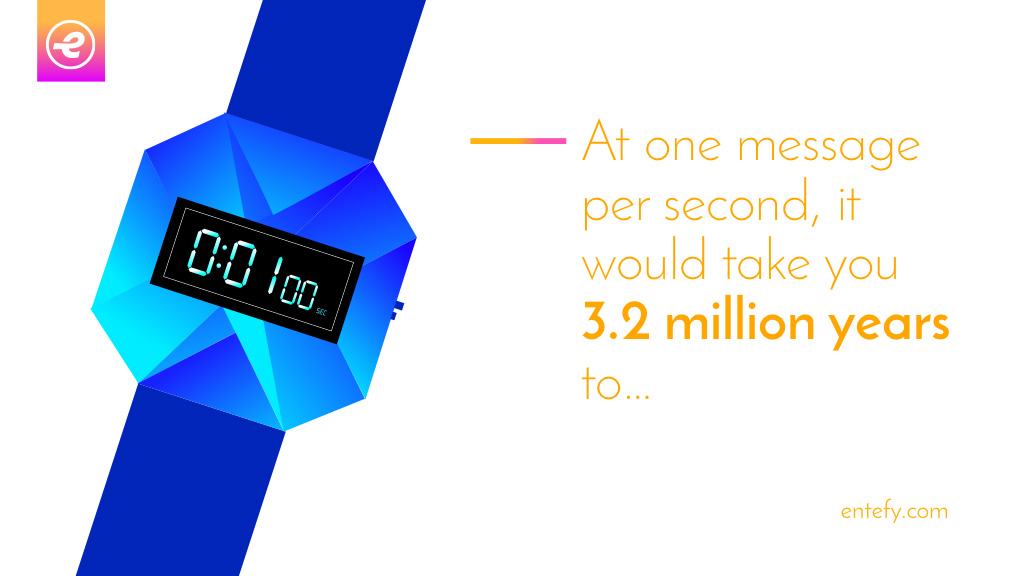
How long would it take for someone to read all of those messages? Even if you could read one every second, 100 trillion seconds would take you 3.2 million years. So I wouldn’t make any plans this weekend…or any weekend.

One of the challenges Entefy is tackling is information overload. Keeping track of all of the digital information that comes our way is becoming a serious challenge—and one that is taking up more and more of our time. But don’t worry: help is on the way.

Watch the video version of this enFact here.
Infographic

The longest-distance call: 12.5 billion miles away

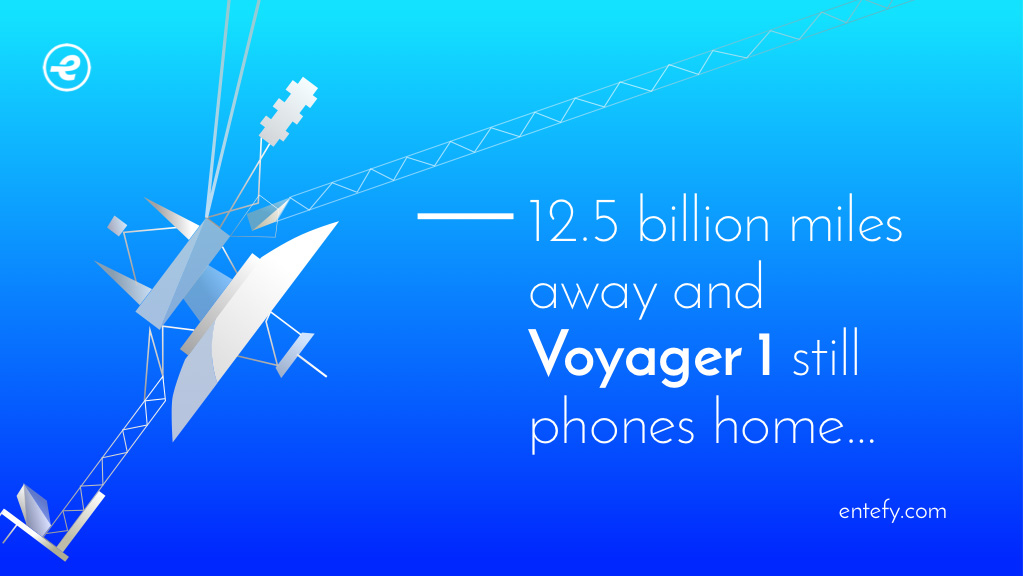
Voyager 1 is a space probe launched by NASA in 1977. After travelling 12.5 billion miles—and counting—it is the most distant man-made object from earth. It has been in continuous operation for 39 years and one month. Voyager 1 left our solar system in 2013 and is now in interstellar space. The spacecraft still communicates with NASA to receive routine commands and transmit data.

Imagine if Voyager 1 were to encounter other living organisms in space. Is there an intergalactic communication app that translates alien?

Infographic

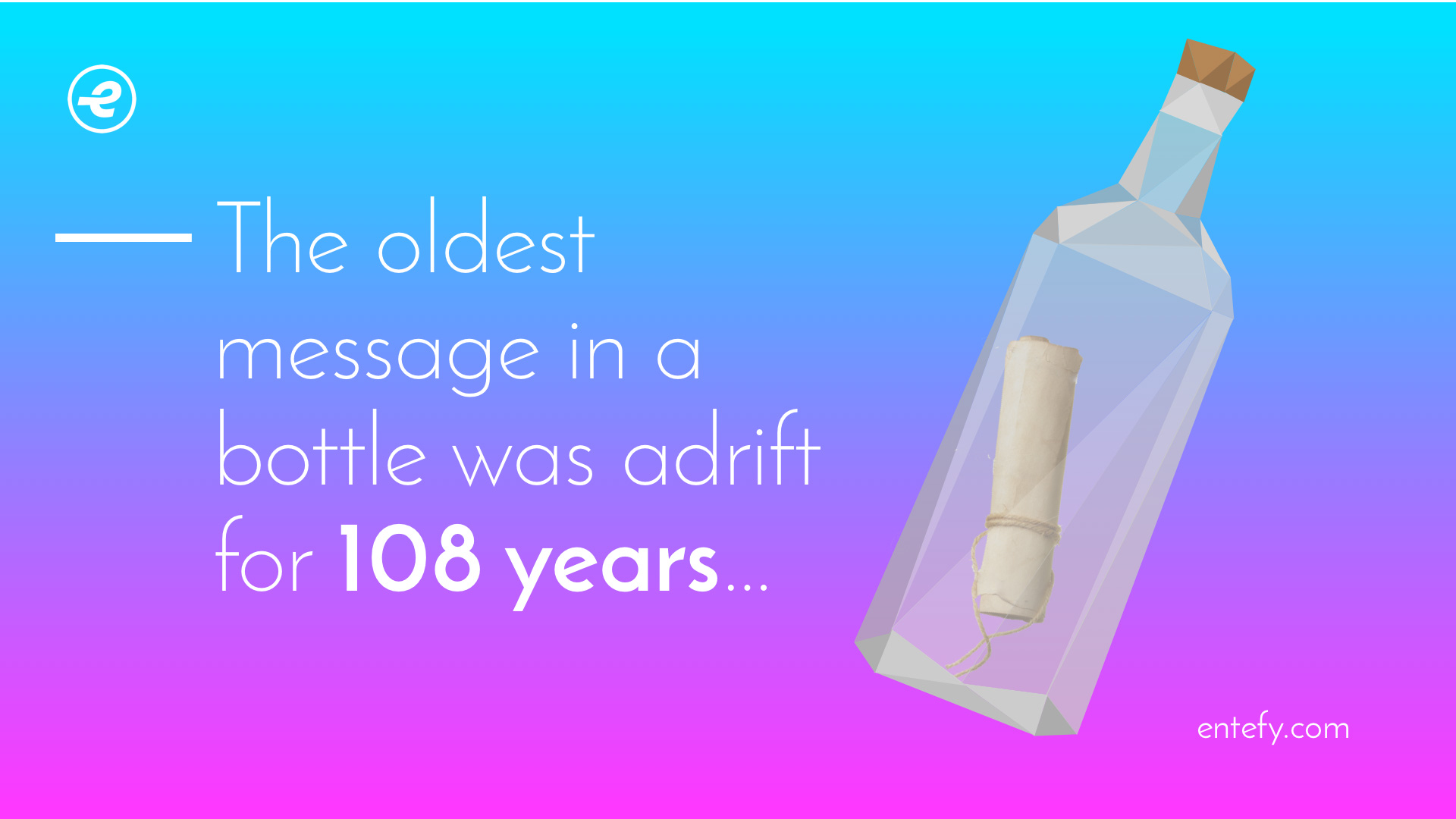
108-year-old message in a bottle discovered

A British marine scientist, George Parker Bidder, dropped a bottle with a message into the North Sea on November 30, 1906 in an attempt to map the flow of currents. The message was received 108 years, 4 months, and 18 days later when Marianne Winkler found it on Amrum Island off the coast of Germany in 2015.

Communication has always brought people together. Although not quite timely, Bidder was clever in his unique attempt to send a message. Today, technology allows for instant communication. But what would happen if we didn’t have digital communication? With a postal system in flux and shrinking number of people who can write in cursive, it is hard to predict how human beings would pass along information without technology on our side.

Watch the video version of this enFact here.
Infographic

Carrier pigeon awarded medal for message shorter than a tweet

The carrier pigeon Cher Ami was awarded the Croix de Guerre medal for his services and wounds received while delivering a message from the American Lost Battalion, cut off behind enemy lines during the Battle of Argonne in 1918. He helped save 194 survivors by flying a note in a canister on his left leg that read:

“We are along the road parallel to 276.4. 
Our own artillery is dropping a barrage directly on us. 
For heaven’s sake, stop it.”

Cher Ami’s message may have been shorter than a tweet, but boy did it have life-saving significance.

Watch the video version of this enFact here.
Infographic

In English, the same 135 words are used 50% of the time

Zipf’s law explains that the usage frequency of any word is inversely proportional to its rank in the frequency table, so the most frequently used word will occur approximately twice as often as the second most frequently used word, three times as often as the third, and so on. This means that, on average, just 135 words account for 50% of everything we say. Here’s Oxford’s top 7 most frequently used words in the English language:

1. the
2. be
3. to
4. of
5. and
6. a
7. in

Communication is at the heart of what makes us human. What do you make of the fact that “one” ranks at 35 but “two” at 84? And “I” ranks at 10 and “we” at 27?

Alston

Entefy hosts healthy living ambassadors making Silicon Valley tour

Entefy hosted a healthy lifestyle group from the Netherlands and Belgium. The visitors were entrepreneurs and innovation professionals from a broad list of industries including food and beverages, public health, technology, and consumer products. Their weeklong visit to Silicon Valley focused on discovering emerging trends in nutrition and healthy living. After a week of yoga, health-conscious dining, and a visit to Stanford’s d.school, Entefy was the final stop on the their tour.

Entefyers welcomed the guests with handshakes, hugs, and a selection of all-natural snacks. Sara Pieters, creativity and innovation coach, kicked off the discussion with a question for our CEO, Alston, on how Entefy’s technology can support healthy living.

Alston responded that Entefy is a platform that “shapes itself around people’s lives, and not the other way around. By making apps and services accessible in one place, the user doesn’t feel bogged down or stressed out managing devices and information.” Alston continued, “Entefy creates time that can be devoted to healthy living.”

After a wide-ranging discussion, the meeting wrapped up with our team’s warm wishes for safe travels back to Europe.

Entefy supports the exchange of ideas and information with like-minded groups around the world. We welcome the opportunity to host entrepreneurial and innovation–focused groups in the future.