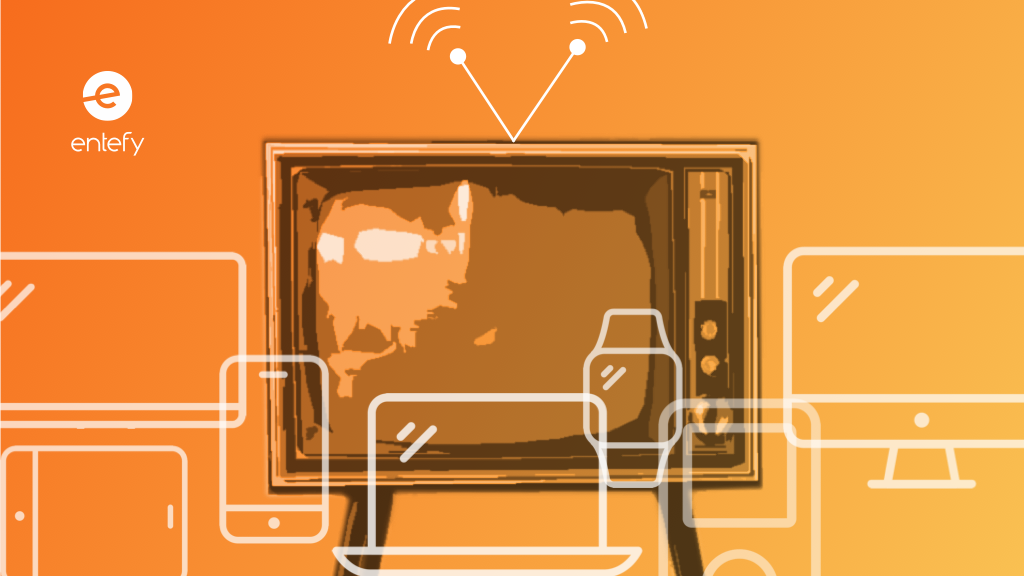
In 1950, only 9% of households had a TV, though that number exceeded 50% within just 4 years, by 1954. The standard setup was one TV in the living room for everyone in the household to watch at the same time. By 2010, there were nearly three TVs per household (2.93), with 55% of households owning 3 or more sets. In that same year, there were 2.58 people per household, which means that there was more than one TV for every person in the U.S. on average. These choices are wonderfully broad and diverse but that rich diversity comes with a meaningful cost: complexity.
These days you don’t have to have a TV to watch TV anymore. You can watch TV shows on your phone, on your tablet, on your computer. When you add the use of 3.4 computing devices per person to the 2.9 TVs in each home you have more than 6 devices that can be used to watch TV. Today 226 million people in the U.S. watch TV, live, recorded, or time-shifted.
That’s not all. In 1950, there were only 3 networks, ABC, NBC, and CBS, which distributed almost all television content. Residents in large cities might get these 3 and maybe 1 or 2 local channels. If you lived outside of a city, your viewing options were much more limited. In 1950 there were only 98 commercial TV stations in the entire country; by 2015 that figure had risen to 1,780. By the 2000s, cable or satellite subscribers had access to 500 or more channels.
In 1950, the average household viewership was 4.5 hours a day. By 2009 that had risen to nearly 8.5 hours per day.
Television’s broadcast technology evolved from over-the-air analog to analog cable to digital cable and satellite to Internet Protocol television. Not to mention the supplemental technologies like VCRs, Betamax, LaserDiscs, DVRs, and DVDs. Half a dozen satellite TV companies, dozens of cable companies, hundreds of channels, more than a thousand TV stations.
Fifty years ago, your television choices were simple because they were limited. You could choose among 3 or 4 channels with a limited line-up of shows. After you purchased your TV, you paid nothing further because over-the-air was entirely supported by advertising. You decided whether to watch and, if so, what channel. That’s a straightforward and limited decision portfolio.
No longer. Your choices have not just multiplied, they have exploded. What show, on what device, from which platform, via which subscription package, from which cable company? Tablets, digital streaming, asynchronous storage, subscription packages, on-demand shows, smartphone, tablet, computer? How much time, how much money? How do you integrate all these services? Where can you find the specific show you’re interested in? Can you watch it on your laptop while you’re travelling? And on and on.
Over the years, something that was once seemingly simple has now transformed into a complex ecosystem. Television entertainment is ubiquitous, so we perhaps take this complexity for granted. But the complexity of television is just one of many areas where an everyday activity is defined by an extremely long list of choices, platforms, and protocols. And while each one of these choices may be quite light, in aggregate they are nonetheless weighty. We see similar dynamics in other technologies, everything from communication systems to mobile apps to home automation. Simple ideas that quickly become complex. But isn’t the job of technology to simplify our lives rather than complicate them?
Professionals make hundreds or thousands of choices every day. Most seem pressing but are ultimately inconsequential. Many carry great significance and urgency. The circumstances of your career determine how many decisions you are called upon to make, and the more complex your work, the more decisions you face.
One thing that seems pretty universal of work today is that there’s a lot going on all the time. Just look at a typical large-scale project. There are in-house team members from different departments and different offices. There are consultants and freelancers working locally or remotely. Team members may be in different countries speaking multiple languages. Communication takes place in-person and by phone, email, and video conferencing. Scheduling a meeting can require an advanced degree.
Much of our work these days shares this complexity. Which means that much of our work involves making decisions on everything from the inconsequential to the significant. The tricky part is learning how to make smart decisions quickly. Just think of your day at work yesterday. How many decisions would you guess you made? How much time did you spend deliberating on those decisions?
If your answers are something like “a lot” and “way too much,” read on.
Make decisions like a President
Dwight D. Eisenhower was a Five-Star General who led the Allied forces in Europe to victory in World War II, served as the first Supreme Commander of the newly formed NATO, and, in 1952, was elected President of the United States. It’s safe to assume that he kept himself pretty busy.
In 1954 he gave a convocation speech to Northwestern University in which he shared a piece of wisdom about time management: “I have two kinds of problems, the urgent and the important. The urgent are not important, and the important are never urgent.” This idea has been developed into a useful decision-making tool known as the Eisenhower Matrix, a framework for evaluating and prioritizing tasks. Its value lies in how it reminds us to be purposeful about our expenditure of scarce resources like time.
The Eisenhower Matrix offers another powerful insight: being busy is not the same as being productive. When our work days are defined by decision after decision, it is too easy to fall into the habit of thinking that because you are acting on multiple urgent requests, you are being productive and effective. As the Matrix will demonstrate, this isn’t always correct.
The Eisenhower Matrix, square by square
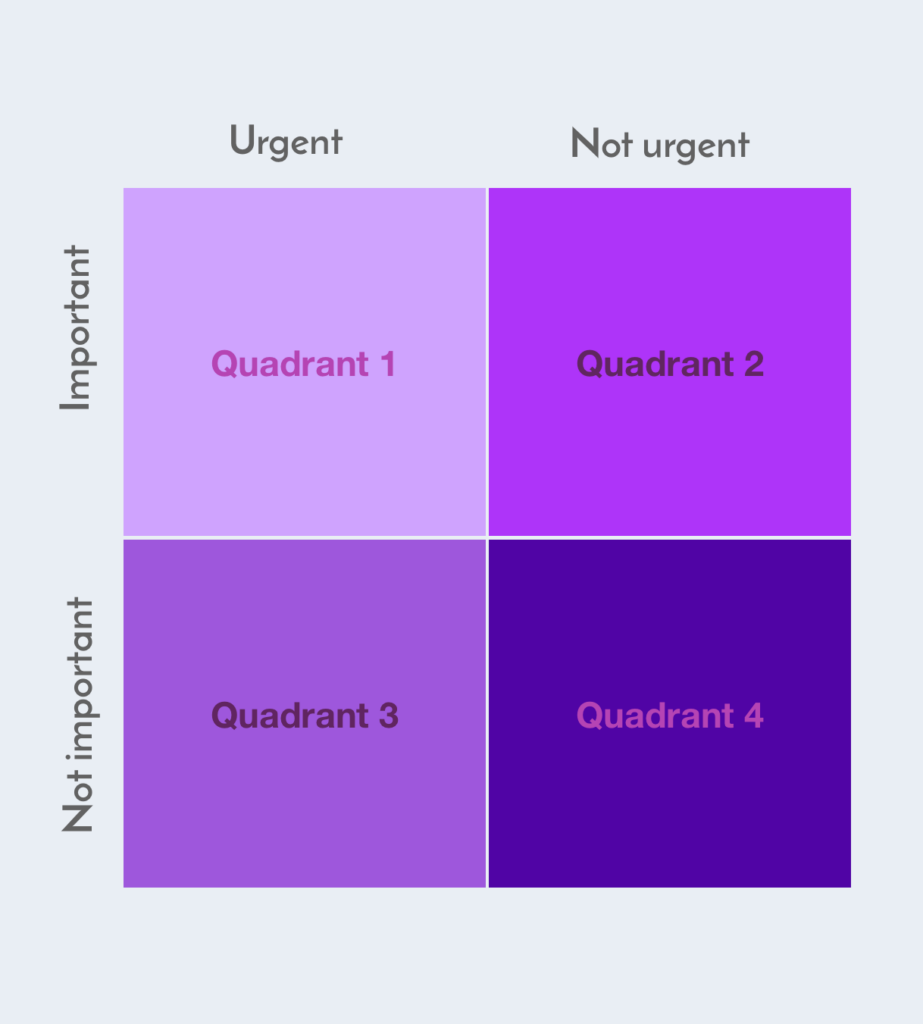
The Eisenhower Matrix prompts us to ask about every decision that lands on our real or virtual desks: Is this task important to my goals? And is it urgent? If it is just urgent, then perhaps it is time to shed some non-urgent, unimportant activities in order to focus on deeper strategic goals to put your scarce time to better use.
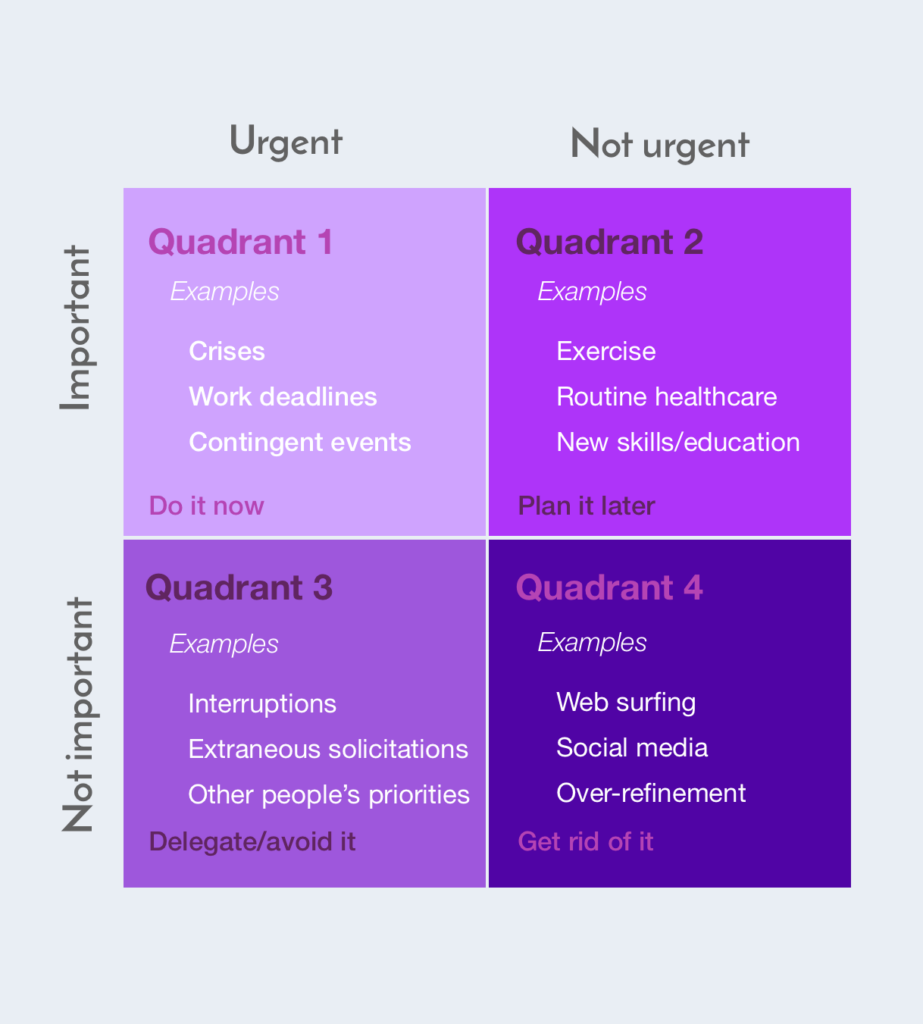
The Eisenhower Matrix is divided into quadrants comprising the possible combinations of two factors, the important/not important and the urgent/not urgent. Here’s how to determine what quadrant a new tasks belongs in, and what to do in response.
Quadrant 1: Important and urgent
Recommended action: Do it now
Tasks that fall into Quadrant 1 are both urgent and important. A colleague calls in sick on a project and you need to pitch in. A routine deadline has to be met (whether or not the project itself qualifies as important). Your child is sick and needs to be picked up from school. This combination of important and urgent means that you need to focus on these tasks immediately and complete them as quickly as possible.
The insight here is that you cannot control other people or the external environment, so you need to build redundancy into your processes to reduce the number of times unexpected events occur. The fewer items in Quadrant 1, the better.
Quadrant 2: Important but not urgent
Recommended action: Schedule it later
Quadrant 2 describes tasks that are inconsequential in the short run but important in the long term. This includes everything from exercise and visits to the dentist, to setting goals and engaging in self-reflection. These items should be prioritized behind Quadrant 1 tasks and scheduled for completion at a later date.
The important insight with Quadrant 2 is that these things need to be completed, just not immediately. You can set aside time for Quadrant 2 activities each day or week, but you shouldn’t put aside anything strategic (Quadrant 1) to get them done. Things that support your long-term success should be treated flexibly for short-term scheduling purposes.
Quadrant 3: Not important but urgent
Recommended action: Delegate or avoid it
Your work day is probably filled with Quadrant 3 tasks. These are the requests that carry urgency but that aren’t important to you or your mission. This latter part is the key to recognizing tasks that fall into this category; they’re urgent to someone but getting them done doesn’t contribute to your personal priorities. Tasks that seem urgent but are not of true strategic consequence include:
Answering a ringing phone even though you can see the display says “Unknown Caller”
Checking your device when you hear a new message notification even when you aren’t expecting an important message
Helping someone who is asking for advice about something not related to your own deliverables
Quadrant 3 decisions have something in common: their urgency is created by someone else’s priorities. And when you allow these tasks to take priority over your own, you’re allowing someone else’s priorities to supersede your own. Which is often considerate but, when taken to the extreme, self-defeating. The problem is that it is hard to know when to say no, no matter how much you might need to.
There are two actions appropriate for Quadrant 3 distractions: avoid or delegate. Avoiding often comes down to resisting the temptation. Don’t answer the call, let it go to voicemail. Keep your smartphone out of reach or turned off. Keep your door closed when you’re trying to get urgent and important work done. You may also be in a position to delegate Quadrant 3 tasks. These tasks are, after all, important to someone so contributing to their completion can be beneficial. When appropriate, handing off these tasks to a colleague or assistant is a best-of-both-worlds solution.
Quadrant 4: Not important and not urgent
Recommended action: Get rid of it
Quadrant 4 activities are neither urgent nor important. They’re entirely under your direct control. This quadrant describes activities that are essentially recreational and optional. These are the things we do that we don’t need to, and the things that somehow end up eating productive time. Think browsing social media or pricing air fares for an exotic vacation in three years. Everyone needs a break now and again, but these are the things that start as 5-minute distractions and then turn into 50-minute time sinks. The best thing to do with tasks in this category is to avoid them in the first place.
Know your tools
As with any tool, understanding its capabilities and limitations is critical to using it successfully. The Eisenhower Matrix is not suitable for making highly complex or involved decisions. Think of it more as a first step in evaluating new tasks as they come up, whether during a meeting or when you’re reading an email. Getting into the habit of slotting a new task into its appropriate quadrant can speed up prioritization and improve decision making.
Before you know it, you’ll be making decisions like Ike.
The way our memory works is a mystery. We write long essays, deliver speeches, even rocket to the moon. Yet the brain can only retain 5-9 items in short-term memory. Luckily, we’ve evolved a way around the limitation.
In this video enFact , we look at research that dates back to the 1950s that introduced an idea that helps with memory. That idea is called chunking. Trust us, it sounds worse than it actually is.
Read the original version of this enFact here. Entefy’s enFacts are illuminating nuggets of information about the intersection of communications, artificial intelligence, security and cyber privacy, and the Internet of Things. Have an idea for an enFact? We would love to hear from you.
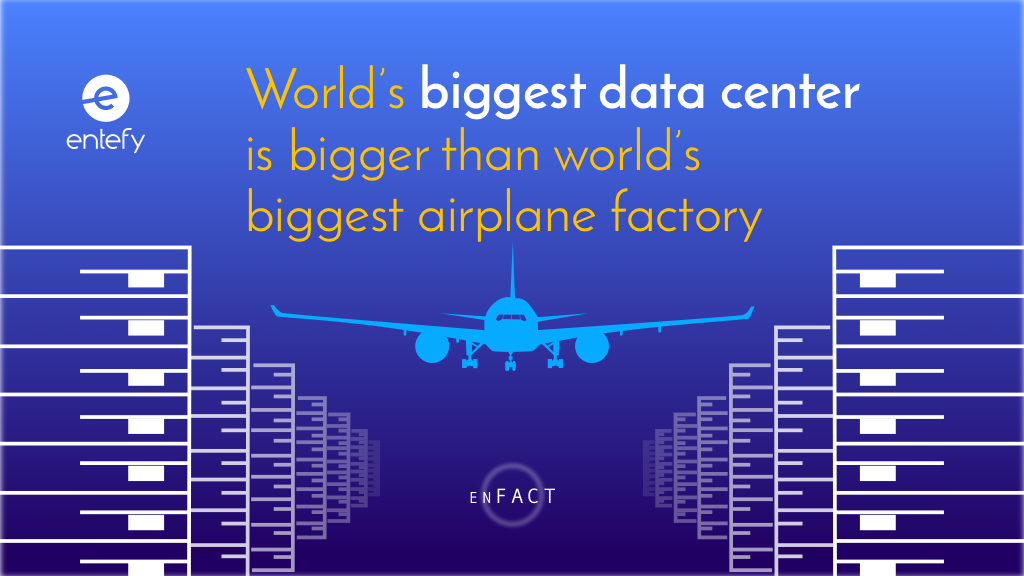
The world’s thirst for data is insatiable: mobile, video, Big Data, IoT, virtual reality. All of this data is housed on servers at data center facilities located all over the world. The biggest one on the planet is in China, the 6.3 million square feet Range International Information Hub. The world’s 10 largest data centers total 18.9 million square feet in size, the equivalent of more than 7,500 U.S. median-sized single family homes. Even more surprising: data centers account for “1.8% of total U.S. electricity consumption.”
There’s an interesting comparison to be made between data centers and airplanes. Boeing, one of the world’s largest manufacturer of commercial airplanes, has its largest production facility in Everett, Washington. That facility is 4.3 million square feet in size, and considered the world’s largest manufacturing building by volume. Which means that the largest commercial jets are manufactured in a factory with a smaller footprint than the largest data center processing tiny digital bits. That really underlines how central data (in all its forms) is to our lives today. Entefy’s enFacts are illuminating nuggets of information about the intersection of communications, artificial intelligence, security and cyber privacy, and the Internet of Things. Have an idea for an enFact? We would love to hear from you.
New patent strengthens the data security and search capabilities of Entefy’s core technology, deepening its ability to protect users’ privacy
PALO ALTO, March 16, 2017 — Entefy Inc. announced today that the company has been issued a new patent by the U.S. Patent and Trademark Office (USPTO). Patent No. 9,594,827 describes a “System and Method of Dynamic, Encrypted Searching.”
This newly issued patent represents encryption technology that offers “the increased security and privacy of client-side encryption to content owners, while still providing for highly relevant server-side search-based results via the use of content correlation, predictive analysis, and augmented semantic tag clouds for the indexing of encrypted data.”
In January 2017, Entefy announced the filing of 13 additional new patents, bringing its total filed patents to 31 in the areas of digital communication, artificial intelligence (AI), search, file sharing, security, and data privacy. Entefy’s innovation-first culture has attracted team members from around the world to work on developing the first-ever AI-powered universal communicator, a smart platform built on advanced computer vision and natural language processing technologies.
“Innovation is critical to Entefy in the pre-launch stage of our development. To overcome the many technical challenges our team is addressing requires the development of new technologies in AI, search, and data security. It was rewarding to learn the USPTO had issued this patent,” said Entefy CEO Alston Ghafourifar. “We are expecting additional issuances this year and beyond.”
Entefy’s universal communicator is designed to help people live and work better in today’s digital world. It simplifies everyday interactions between people, services, and smart things.
ABOUT ENTEFY
Entefy is building the first universal communicator—a smart platform that uses artificial intelligence to help you seamlessly interact with the people, services, and smart things in your life—all from a single application that runs beautifully on all your favorite devices. Our core technology combines digital communication with advanced computer vision and natural language processing to create a lightning fast and secure digital experience for people everywhere.
How much human language can a dog learn? Beyond the basics—sit, stay, come—dogs actually have a surprisingly large vocabulary. Which you might not have realized if you spend a lot of time trying to get your dog to obey just one of those words.
In our latest video enFact we look at communication between humans and man’s best friend. You’ll never guess what one high-achieving border collie has in common with the average 3-year-old child.
Read the original version of this enFact here. Entefy’s enFacts are illuminating nuggets of information about the intersection of communications, artificial intelligence, security and cyber privacy, and the Internet of Things. Have an idea for an enFact? We would love to hear from you.
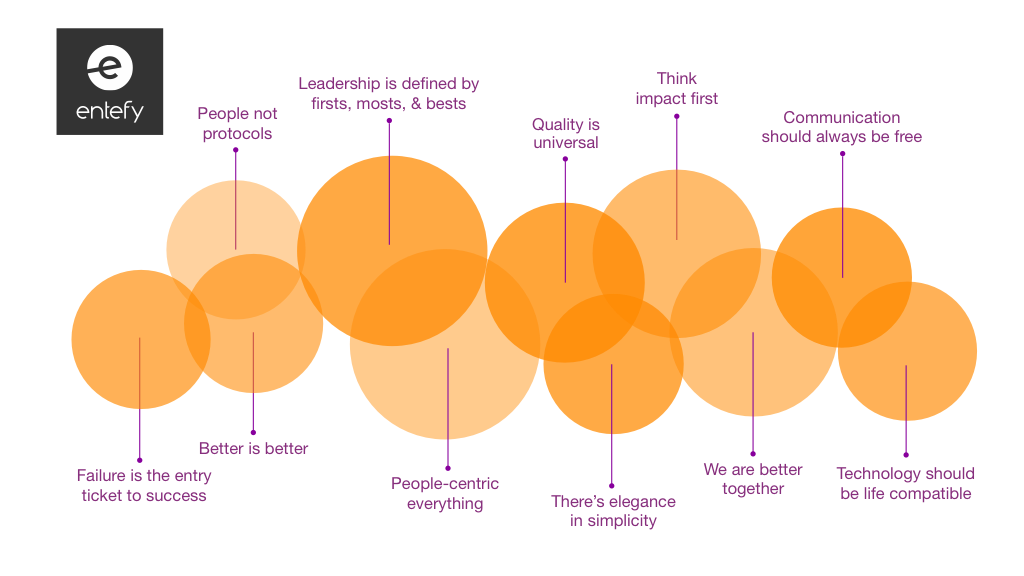
Often the value of advice is not the advice itself, but the insights you discover on your own when thinking about it. So we thought we’d share some of the “mantras” that inspire us in and out of the office. Not as advice, but simply as food for thought. Mantras are, after all, small bits of wisdom that can have outsized impact. And our mantras keep us centered in any circumstance.
Entefy is charting new terrain to reach the top of technology’s Mount Everest, the universal communicator for everyone and everything. Our mantras illuminate the path. Here’s an example: When we set short- and long-term goals, we think about how those goals sync with our belief in leadership and the importance of “firsts, mosts, & bests.”
Mantras serve another important purpose. They’re a compact way for us to pass along our beliefs to new team members. They keep every Entefyer seamlessly aligned, despite our different skill sets and different projects. We recognize that we’re better together as a high-performance family.
And with that, here are 11 Entefy mantras, in no particular order, that reflect who we are and the way we view the world.
1. Leadership is defined by firsts, mosts, & bests
2. Failure is the entry ticket to success
3. Think impact first
4. People not protocols
5. Better is better
6. Technology should be life compatible
7. Quality is universal
8. Communication should always be free
9. We are better together
10. People-centric everything
11. There’s elegance in simplicity
So there you have it. What are the words of wisdom that inspire you in your life and career?
The digital universe is the sum of all files, photos, videos, and other digitized information. We’re continually amazed by just how fast digital data is being created, and how people are using technology to manage all of the information.
We did our research, gathered surprising statistics, and created a presentation about the digital universe today and in the years ahead. These slides are useful for technologists, entrepreneurs, marketers, and other professionals interested in how technology is changing the way people communicate and interact in the modern world.
We previously looked at the ways artificial intelligence may disrupt the traditional classroom. From blended learning to AI tutors, algorithms are poised to reshape the way teachers engage with their students. But AI may do more than influence classroom experiences. It has the potential to replace classrooms entirely. No one can reliably predict the degree of impact AI may have in education, but one thing seems clear—parents should expect to deal with more complexity and greater responsibility in overseeing their children’s education.
Parents are responsible for nearly every aspect of their children’s development. Healthcare, cognition, socialization, behavioral modeling—parents do it all. The one area in which they exercise less control is in formal education. They make decisions about whether to send their children to private or public schools or to home school, oversee homework sessions, and volunteer for the PTA. But they leave the actual teaching to the teachers.
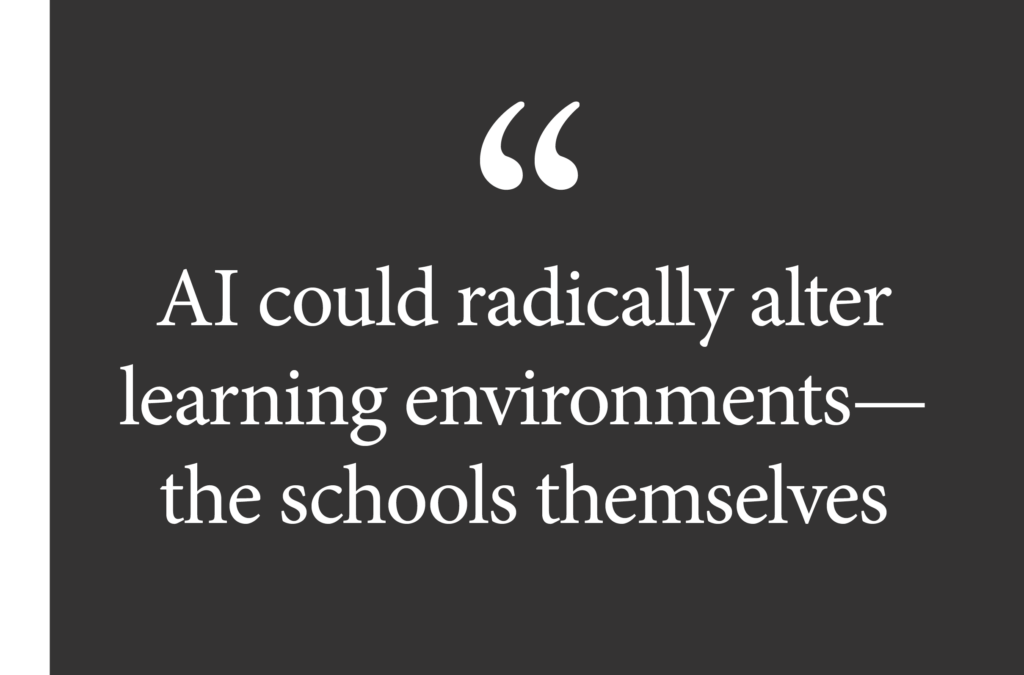
History shows that new technologies upend existing paradigms, usually in incremental ways. But artificial intelligence is unlike any technology we’ve encountered. AI could radically alter learning environments—the schools themselves. What will it mean for parents if their children can learn just as well, if not better, from the comfort of their homes instead of traditional classrooms?
Before we can answer that, we have to address something more fundamental: What is it that we expect of education? And, in particular, what is it that parents expect? Consider these three statements about education, which capture the range of expectations:
“Education does not mean teaching people to know what they do not know. It means teaching them to behave as they do not behave.” (John Ruskin)
“British parents are very ready to call for a system of education which offers equal opportunity to all children except their own.” (Lord Eccles)
“The value of an education…is not the learning of many facts but the training of the mind to think something that cannot be learned from textbooks.” (Albert Einstein)
Depending on how it is structured, education provides a child a craft, career, or trade; a foundation of knowledge; the development of culture; the capacity to learn; a hunger for knowledge and wisdom; or good behavior. That is a pretty long list of expectations. So long, in fact, that there is no school that can actually deliver on everything that might be expected of it.
Rather than try to define what education should be, let’s simply acknowledge the most common elements of people’s expectations. In general, we expect schools to achieve or facilitate: 1) Preparation of children for a productive life and career, 2) the transfer of an agreed-upon base of knowledge, 3) the development of a child’s understanding of their own culture, 4) socialization of a child around behavioral norms, and 5) creation of habits supportive of lifelong learning.
The mass customization of education
The American education system is built on standardization. Unless they attend Montessori or other philosophically-driven schools, most students learn from generalized lessons delivered in generalized classrooms. When they’re old enough, they begin taking standardized tests to determine how well they’ve kept up.
Of course, many students fall behind as they struggle to grasp concepts that are presented in ways they don’t understand. They may be ill-suited to the standardized school environment, or their cognitive development may take place at a different rate than that of their peers, both faster and slower.
Artificial intelligence offers an alternative for these children in the form of personalized learning systems that adjust lessons, reviews, and activities based on individual skill levels and strengths. The technology’s adaptive customization around individual capabilities also offers the opportunity for students to advance at the pace most appropriate for them.
Given evidence that AI-powered intelligent tutoring systems outperform traditional classrooms, AI could have a democratizing effect on education—not to mention reducing the need for large centralized physical schools. With the capacity to constantly adapt to an individual child’s capabilities and circumstances, AI learning systems allow what in manufacturing is called “mass customization.”
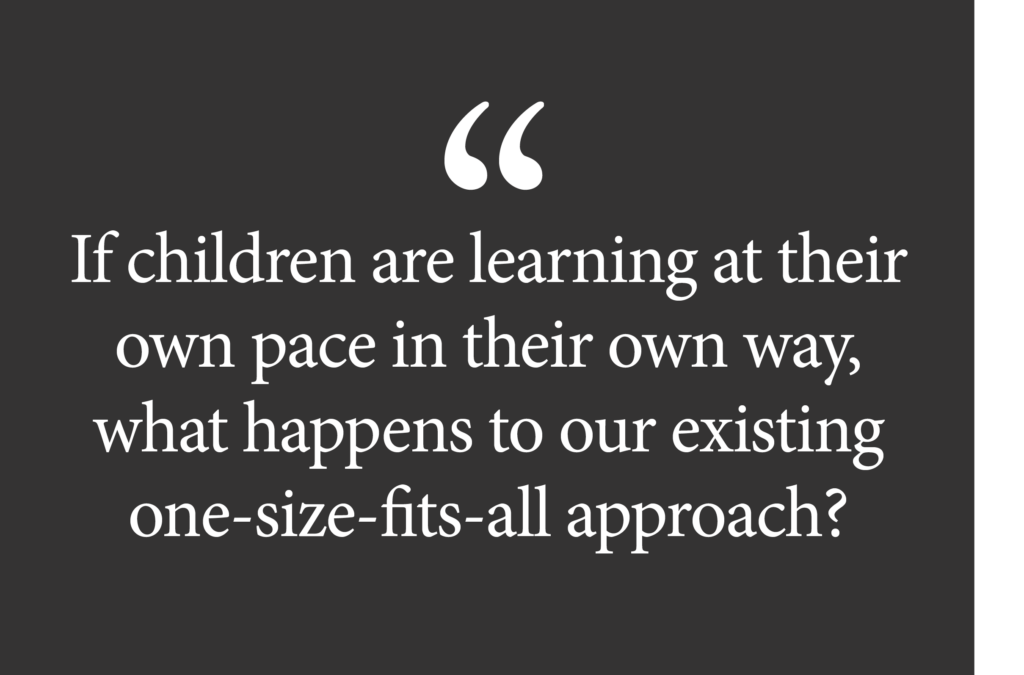
But if children are learning at their own pace in their own way, what happens to our existing one-size-fits-all approach where children are collected together in one large place and put through a standardized curriculum? No one knows the answer, yet.
But taken to its logical extreme, if there is less reason to send children to large, central, physical schools, parents may begin serving as the educational gatekeepers. They’ll also have to facilitate behavioral and social learning opportunities. And of course, they’ll have to grapple with questions of how to prepare their children for a rapidly changing workforce. AI is likely to give us choices, societally and as individuals, which we have not had before and for which we have not considered the full ramifications.
One possible future
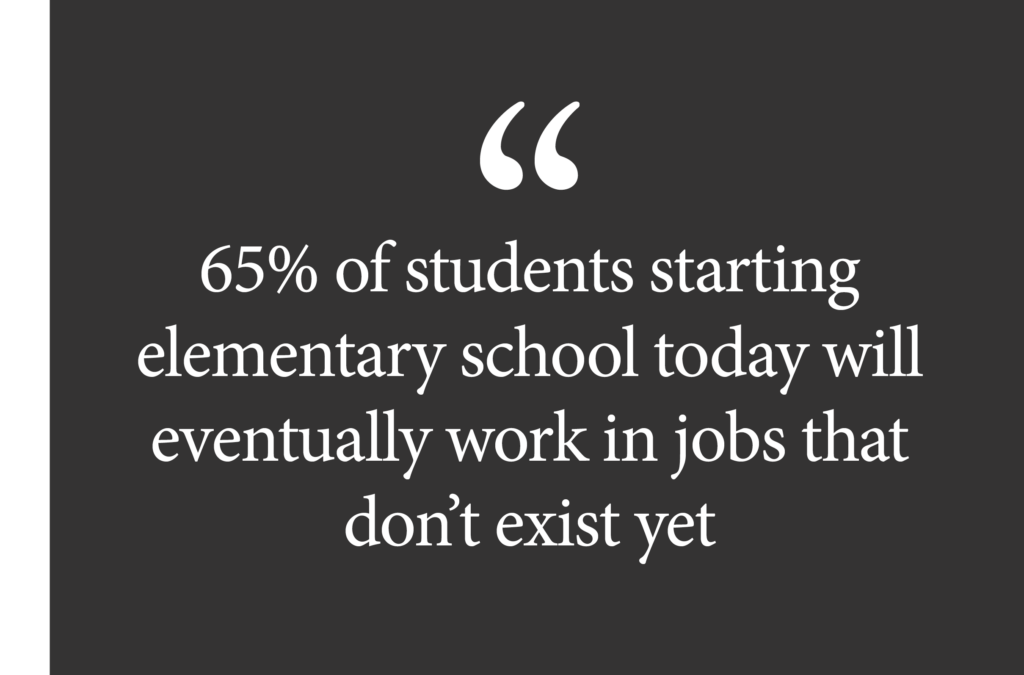
With AI in the mix, it seems likely that our educational choices will broaden; so, too, is the context of education likely to change quickly. A World Economic Forum report on the future of jobs predicts that 65% of students starting elementary school today will eventually work in jobs that don’t exist yet. If a core aim of education is to groom students for career success, how do we do that when we don’t know what careers will be relevant when they come of age?
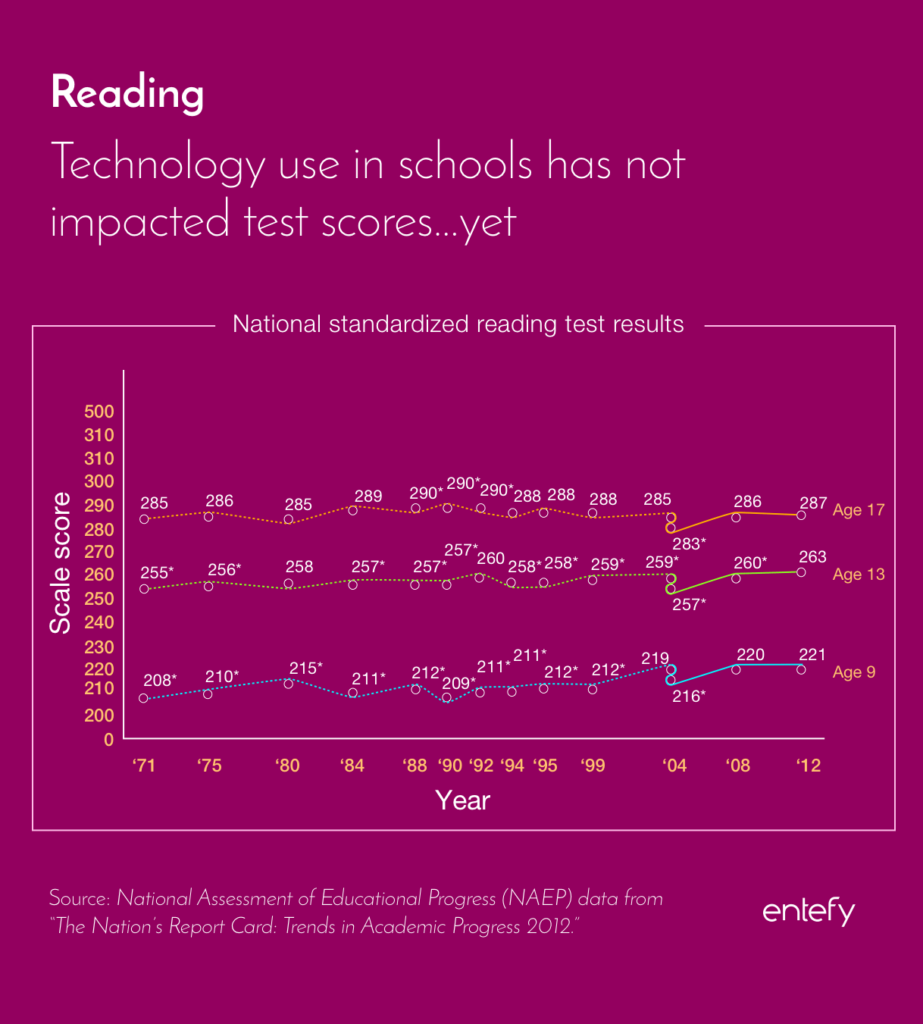
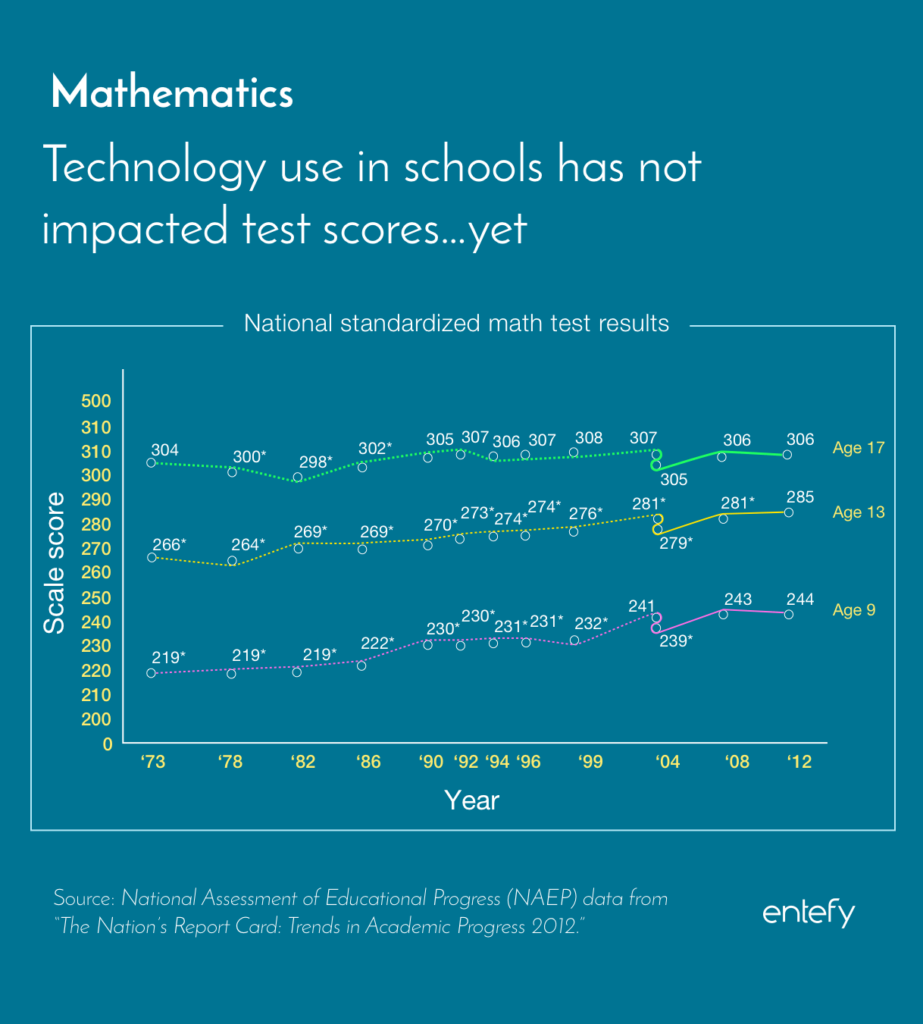
We don’t know how the impact of AI will play out. It is worth recalling the excitement and exuberance in the early and mid-1980s, when personal computers were first introduced into school systems. There was great anticipation that computers would have significant positive impacts on students’ educational outcomes. Though while computers in schools changed education practices and experiences, data shows that they did not make a meaningful difference in educational outcomes, at least in the aggregate. National scores on the National Assessment of Educational Progress tests for graduating seniors have barely budged in nearly fifty years.
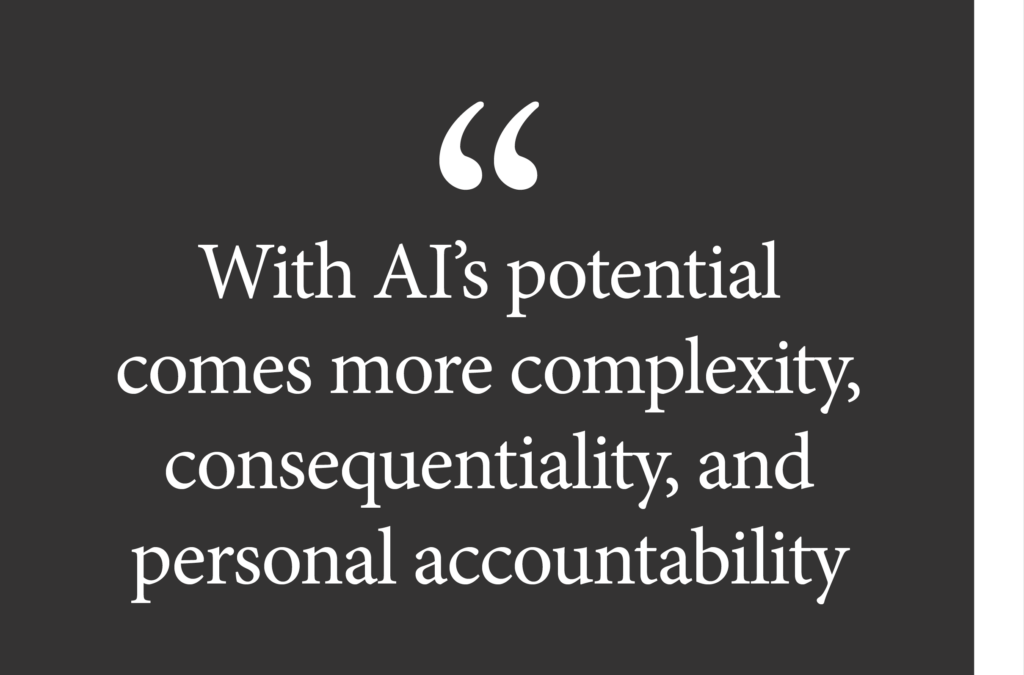
All of which is to say that it is premature to make firm forecasts of how AI might change educational outcomes. We can, however, think through the logical consequences of reasonable assumptions. AI-enabled education might give parents much more control over their child’s education than our current one-size-fits-all approach. But with AI’s potential comes more complexity, consequentiality, and personal accountability. Parents may find themselves facing entirely new and complicated decisions related to their children’s education.
If we indeed move to a system of education that optimizes individual learning experiences and outcomes, then we might expect better outcomes overall but also potentially greater variance in outcomes. Moving away from a factory-style, standardized educational model might also drive higher levels of knowledge acquisition. Right now, education is still strongly a community activity. What happens if the administrative focus changes from large regions to local neighborhoods—to self-organizing groups of parents with shared goals? Greater local control but also, perhaps, less normalization across larger groups.
Following through with this logic, here are 8 possible implications of AI’s adoption in education that parents and society at large may have to address:
1. AI could render large, centralized schoolhouses obsolete. If students are centralized, attending one-size-fits-all classes, and learning at a fixed pace, then big centralized facilities make sense. If students are moving at their own pace with an AI-enabled and customized curriculum, then the need for classrooms and lecturers is reduced, perhaps offset by teachers who function more in the fashion of a tutor or coach. Traditional schools might then be replaced by smaller, distributed structures and specialized learning centers.
2. Parents may assume greater responsibility in children’s education. Parents will likely serve multiple roles as coaches, curators, and guardians as their kids navigate new tools and platforms. Of course, such a shift would dramatically impact the 3.1 million public and 0.4 million private K-12 teachers, not to mention the 3.4 million administrators and support staff.
3. The cost of education may fall. With less expense associated with fewer large, centralized schools and less demand for skilled human teachers, the cost of education at the municipal level could fall materially. The decline in teacher, administrator, and facility costs would of course have to be set against the rise in costs to families if parents become more involved in their children’s education. These costs would be both monetary as well as the opportunity cost of increased time commitment.
4. Customized learning could accelerate natural inequalities. Not all children are created equal. An education system that focuses on standardization reduces the standard deviation between students. If AI tutoring systems can tailor their lessons to different children’s needs, some students will naturally progress faster than others.
5. Mass customization might improve children’s health. There has long been a concern that school children are not getting enough sleep, negatively impacting their physical health and cognitive development. If AI allows for mass customization and decentralization of education, then children’s schedules can be better matched to their sleep needs.
6. Socialization may become a concern if more children learn remotely. Australia’s School of the Air remote learning program could serve as a model for remote education that doesn’t sacrifice socialization. Students at the school learn via Internet lessons but meet classmates at camps and special events each year.
7. Customization and decentralization might lead to loss of normalization. Public schools create an environment that imposes common standards on all students. If schools become smaller, more local, and more customized, we may lose some of the common norms, behavioral, social, and cultural.
8. Parent-managed education would increase the complexity of the lives of parents. While the increase in effectiveness and value to children generated by AI might be substantial, society is not currently organized in a way that makes it easy for parents to play the role that AI might make possible. This would require its own significant shift in workplace standards.
AI-driven learning is a transformative solution with the power to change the way kids view the world and how they interact with the people around them. A child who learns via AI technologies could gain untold benefits and skills intellectually, socially, and emotionally. But this method is likely to demand increased parental oversight, including time-consuming direct supervision of kids’ AI learning activities. Parents may have to make tough decisions about their careers to oversee their children’s educations, or about where the family will live to access the best resources and support for this new type of learning.
AI has the potential to change the quality, delivery, and scalability of education. But it may also change forever the role parents play in their children’s education.
Here’s an imponderable for you. Which would you give up first: your refrigerator or your smartphone? In this short video enFact, we look at the surprising link between your largest kitchen appliance and your trusty mobile device.
Entefy’s enFacts are illuminating nuggets of information about the intersection of communications, artificial intelligence, security and cyber privacy, and the Internet of Things. Have an idea for an enFact? We would love to hear from you.
Request a Demo
Is your organization pursuing an AI-first transformation strategy? If so, start the conversation by submitting the form below.
Contact Us
Thank you for your interest in Entefy. You can contact us using the form below.
Download Data Sheets
See our Privacy Statement to learn more about how we use cookies on our website and how to change cookies settings if you do not want cookies on your computer. By using this site you consent to our use of cookies in accordance with our Privacy Statement.