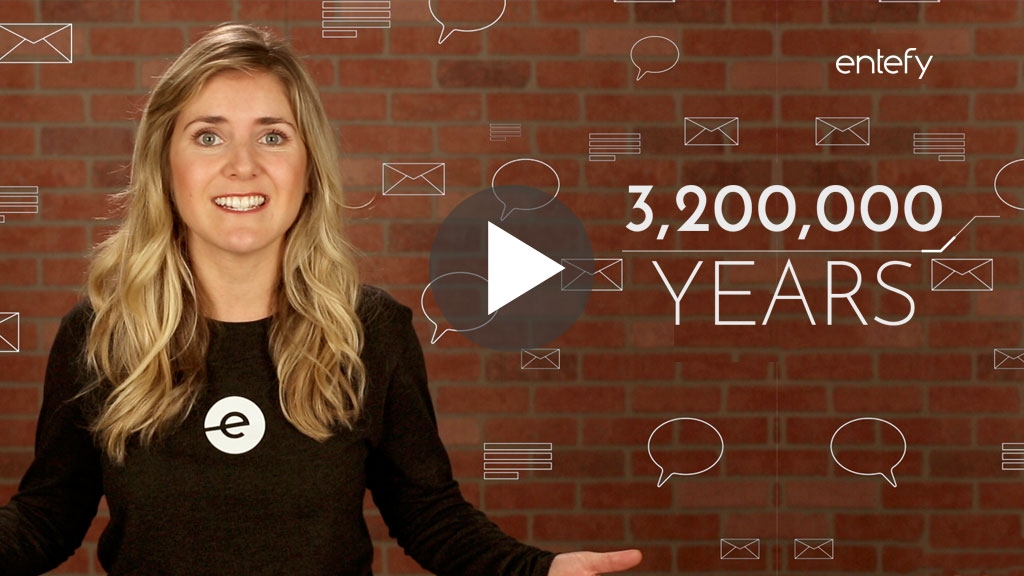
How many digital messages are sent in a year when you add up emails, texts, and IMs? It’s much more than you might think. This video enFact answers the question and looks at one way to put that number into perspective.
Read the original version of this enFact here. Entefy’s enFacts are illuminating nuggets of information about the intersection of communications, artificial intelligence, security and cyber privacy, and the Internet of Things. Have an idea for an enFact? We would love to hear from you.
Are you a solopreneur? One of the self-employed professionals that accounts for 10% of the U.S. workforce? At Entefy, we think of solopreneurs as nothing less than superheroes. And there are more than a few parallels. Solopreneurs—be they freelancers, consultants, or one-person entrepreneurs—are specialists that get called on when their superpowers are needed to solve the most challenging problems. And like most superheroes, you might spot them out on the streets looking just like an average Joe or Jane—until they get that call for help.
One of the biggest draws that attracts adventurous, results-oriented, career-driven individuals to the solopreneur ranks is the lifestyle that comes with being your own boss. More and more people are valuing professional flexibility, working for a purpose, and living in the now. And being self-employed offers exactly those things: control over your schedule, selectivity about who you work with and the projects you work on, and saying yes to events, workshops, and classes at the drop of a hat.
But as every solopreneur knows, for all of the lifestyle perks, there are still days where it can be hard to stay sane. Because the core challenge facing solopreneurs is time: how to manage it and where to find more of it. After all, it’s easy to over-schedule and over-promise when there’s no ceiling to the amount of work and obligation you could take on. Staying glued to digital devices, facing a stream of calendar invites, drowning in deliverables, and struggling with goal-setting are a few challenges worth mentioning. It can be hard to set boundaries, resist burnout, and maintain a clear path forward, but it doesn’t have to be.
Our team at Entefy includes former freelancers, consultants, and solopreneurs who have experienced the perks and pains of working for themselves. Here are some of the lessons they’ve shared about overcoming obstacles surrounding time, expertise, and building the right network.
1. Eliminate distractions and establish boundaries
Time. There’s two ways to spend it: doing things that propel you forward, or doing things that hold you back. Your productive streaks are jeopardized by notification popups on your phone, getting pulled into impromptu lunches or networking events, and chitchatting on the phone in the middle of the day. Device dependency and the challenges of saying “no” are two of the biggest sources of distraction.
Sound familiar? Then try a simple change of habit: Exit out of email and messaging apps, turn your phone on silent, and work distraction-free for an hour (or more) every single day. Expect your focus and productivity to skyrocket.
2. Know your body clock
Ever fall into the trap of planning to exercise or run an important errand during lunch, but then a last-minute call comes up? Solopreneurs often don’t know what the day is going to bring, and it’s important to be nimble and adaptable when unexpected things come your way. Since you can’t always plan what will happen in a day, one of the keys to solopreneur success is to know your circadian rhythm and schedule your day accordingly. Your body clock may be in your genes. Early birds should stack their most challenging work in the morning, while night owls should back-load their work day to increase effectiveness and productivity.
3. Identify the day’s most import task, then get it done first
One facet of the not-enough-time-in-the-day problem is prioritizing tasks. There’s one school of thought that involves identifying your Most Important Task (MIT). Given how many tasks solopreneurs have to juggle simultaneously, MITs are often the projects that get postponed because they are the hardest or most time-consuming items:
“Your MIT isn’t your easiest task, or the one you’ll enjoy the most. It’s not even the task that’s most pressing. Your MIT is your most important task—it’s the thing that will provide you (or those you work for) the most value…Think of your most important tasks as large stones that you need to fit into a jar. Those smaller tasks, which we can often knock out relatively quickly, are like small grains of sand. If you fill the jar up with sand first, the rocks will no longer fit. But if you place the rocks in the jar first, the sand easily falls into place—filling all the empty space between the rocks. Now you’ve accomplished everything, but you’ve given priority to the things that count most.”
4. Embrace your jack-of-all-trades nature to innovate
One question every solopreneur has been asked by a client goes something like, “We love your work. So can you also help with X?” Where X is another skillset or specialty distinct from the work you’re already doing. As a solopreneur, there is no shortage of new skills you could develop or topics you could learn about. After all, refining talents and honing expertise is critical to your success. But there’s a balancing act—you can’t spend all of your time learning new skills when you have your regular work to do.
Working independently requires many skillsets, which suits a jack-of-all-trades personality type. But instead of trying to learn and master new skill after new skill, innovate with what you already know. Emily Wapnick gave a TED Talk about “Multipotentialites,” people with many interests and creative pursuits. Her insight is that multipotentialites are naturally skilled at seeing patterns and overlaps between their distinct areas of interest, and are well-positioned to discover innovation in that overlap. Something she calls “idea synthesis,” combining two fields and creating something new at the intersection.
So rather than endlessly pursuing new skills and knowledge, consider devoting more time to leveraging the skills you already possess.
5. Don’t just network—build a tribe
Working for yourself requires doing administrative tasks, financial planning, writing contracts, managing day-to-day operations, and growing your business. That’s a lot of pieces to juggle on any given day, and you shouldn’t try to do it all. So let people help you. Pick a fantastic financial planner, a mentor who will help you find clarity on short- and long-term goals, people in your industry that you can bounce ideas off of to keep learning and stay inspired. And, equally important, spend time with those in your personal life who are your biggest cheerleaders. Because when your tribe is in place, you can create and do so much more.
There is endless advice on the type of people to surround yourself with for success, but consider this balanced approach: look for relentless workers, positive attitudes, people who ask questions, and dreamers.
Being an entrepreneur, freelancer, self-employed professional, or any other type of solopreneur is a career dream for many. And it should feel that way too. By implementing a few of these new habits, you might just find that being your own boss feels better than ever before.
UC Berkeley’s Newton distinguished innovator lecture series was born of the entrepreneurial vision of A. Richard Newton, Dean of UC Berkeley’s College of Engineering from 2000 to 2007. The College of Engineering invites innovators in a range of industries to share lessons from their entrepreneurial journeys.
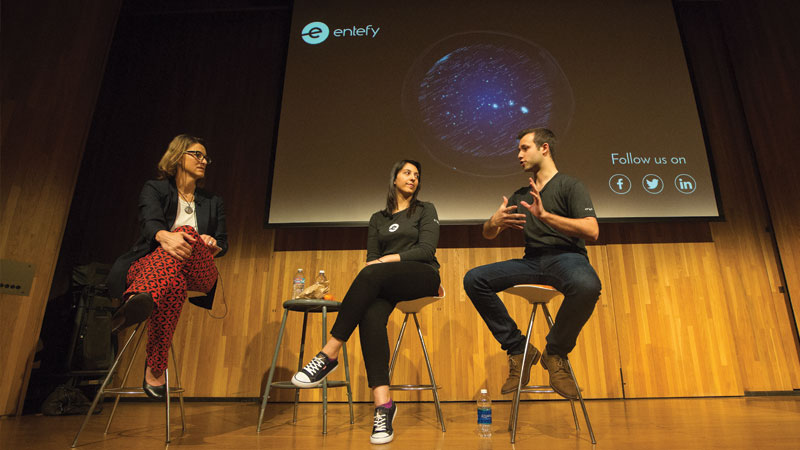
Entefy co-founders Alston and Brienne recently delivered a Newton Lecture they called “The next chapter: Authentic Intelligence” to a full house of engineering, sciences, and business students at Sibley Auditorium. The talk covered Entefy’s insights on AI and big data, and the need for advanced technologies to transform the worldwide data explosion into useful insights that directly benefit people.
After the presentation, Alston and Brienne sat down to answer moderator Vicky Howell’s questions on topics like graduating college at age 17, assembling a network of luminary advisors and investors, running a venture, and recruiting a world-class team. That discussion transitioned to an engaging Q&A with the students. We were excited to see so much interest, curiosity, and insight from the students and hope to hear again from them soon.
The presentation was broadcast on the Sutardja Center for Entrepreneurship & Technology’s Facebook page. The video can be found here.
Students also shared their perspectives on the event in a recap on the Sutardja Center’s website.
There is one small problem with digital advertisements: people hate seeing them everywhere. Like cigarette butts in parks, ads pollute digital environments by ruining your experience and distracting your focus. Every day that passes brings more ads in more places, a trend that shows no signs of changing.
But it could change if advertisers were to think more creatively about how to engage with their customers and consumers were to more actively exercise their power of choice. Both start with understanding why companies continue to invest heavily in digital advertising despite low success rates and high levels of consumer annoyance.
Because ads-everywhere-you-look isn’t inevitable. The Internet has evolved multiple channels for consumers to learn about products and services, and engage directly with companies. Brand-sponsored content is very effective at explaining how products work and how they can fit into your life. Online forums and communities provide outlets for consumers to ask questions from users of a particular product. Robust customer review systems prioritize the display of quality, relevant reviews (both positive and negative) by verified owners.
The problem with many of these ad alternatives is that they exist outside of the advertiser’s control; they are user-led and user-generated. The fact that many consumers prefer these alternatives is something many companies choose to ignore. Ads have been around forever, they’re safe, and anything that isn’t advertising seems risky. This is, quite simply, a lack of imagination. And consumers suffer for it.
The intrusive, distracting, annoying price of convenience
The public’s disdain for ads is true in TV, radio, print, and especially online, where one survey showed 64% of people find ads “annoying and intrusive.” Why TiVo? Because you can skip the TV ads. What is one of the keys to SiriusXM’s success? No radio ads. Why are newspapers and magazines being forced to reinvent themselves? People aren’t reading the ads so the advertisers are abandoning the format. And what about the web? AdBlock Plus, the top ad blocker software on desktops and mobile devices, has been downloaded more than 1 billion times.
Yet we’re told that ads are the “price of convenience.” When apps and services are offered for free, we accept that ads are how we pay for the software. There is a certain fairness to that—but only up to a point. Because free apps don’t merely show us an ad or two when we use them. Our activities inside the app, and even the things we do on our devices when we’re not in the app, are tracked, collected, bundled, and resold to third parties. The ads we see are one small part of a complex advertising ecosystem in which more than 2,500 different companies are battling to monetize our behavior. The price of “free” is far, far higher than the occasional banner ad.
Targeted ads aren’t that bad…oh, wait, yes they are
Despite this dismal effectiveness, U.S. advertisers are on track to spend more online than on television for the first time ever. The thinking is that digital user-tracking technologies have matured to the point where an advertiser can insert itself and its message practically anywhere, at any time. And target very narrow groups of potential customers.
On the surface, targeted advertising doesn’t sound like such a bad thing (“If I’m going to see a bunch of ads all the time, they might as well be relevant to me”). But here’s the problem with that: relevance is tied to the use of personal data. If you have ever noticed an ad on the margin of a web page advertising something very specific that could only be there because of an email you sent or a search you made, then you know this is at best an icky feeling (“I guess it’s all just algorithms and no one actually read that email”) and at worst an outrage (“When did I agree to let anyone read my private correspondence, algorithm or not!?”).
Advertisers compound the problem, and publishers love that
If there’s so much negative sentiment towards ads, why do advertisers bother? Because if they do enough advertising, that dismal sub-1% response rate can add up. Let’s say a company buys 100,000 ad placements in a month, and those ads generate $1 million in revenue. During the next period, however, consumers are less responsive and the same level of ad spending leads to just $500,000 in sales. Because there is no easy way to make consumers respond to its ads, the company decides to double its ad placements. They purchase 200,000 ad placements to bring sales back to $1 million. But six months later, sales are down by half again. What next? Double the ads. 400,000… 800,000… 1,600,000… 3,200,000… and soon, you get to a lot of ads. But just how many?
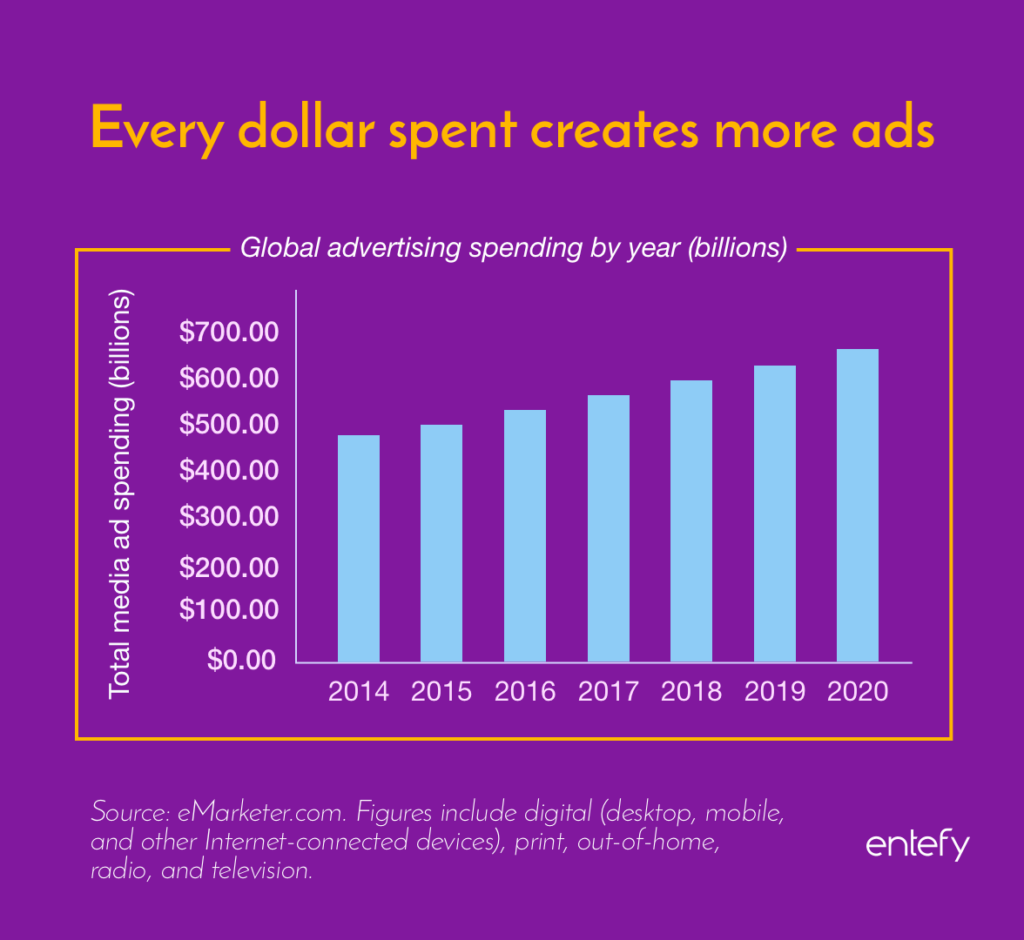
The precise answer to this question is difficult to ascertain, but what’s easier to measure is the dollars spent. Annually, global advertising spending has reached $600 billion, $235 billion of which is dedicated to digital and mobile advertising alone.
Advertisers buy more ads, people ignore the ads or adopt ad blockers, and in response advertisers serve up trillions of ads every year. If you’re someone that objects to all of this digital clutter, what’s to be done?
Empowered consumers can break the cycle
Quality is rarely free. If the price of “free”—data trackers, privacy violations, digital pollution—doesn’t sit well with you, then you need to get selective. There are two digital environments covered in ads where you have ad-free alternatives: content and apps.
On the content side, accept that subscriptions are how publishers keep the lights on. You can support the writers and publications that you value through subscriptions. Publishers have a responsibility for keeping those subscription prices affordable. Technologies like micropayments create consumer-friendly alternatives to the standard annual subscription.
On the software side, make the app explosion work for you. With approximately 4 million apps available in the app stores, there are usually several high-quality options for any given software category. Be sure to carefully read Terms of Service to verify that data tracking and monetization activities that you find objectionable are not employed by the developer. Be very discerning when using app services that track your behavior across multiple apps—these platforms are generally where the most egregious personal data collection and monetization take place.
Many software companies offer free versions of their apps for basic users, and paid versions for power users in which additional features are enabled. This so-called freemium business model links a software company’s financial success to the quality and usability of its product. It aligns their incentives with your own.
If advertisers and publishers could, every website, every newspaper, every TV channel, every radio station, and every surface in every public space would be covered with advertising. There are, after all, already ads on the floors of supermarkets, ads flown by drones, and ads inside urinals.
If we don’t become accustomed to paying for quality, the future is more personal data monetization and more ads. But there is a bright, shiny, clutter-free future in which our digital environments contain fewer and fewer ads. It takes informed consumers making informed decisions to get us there.
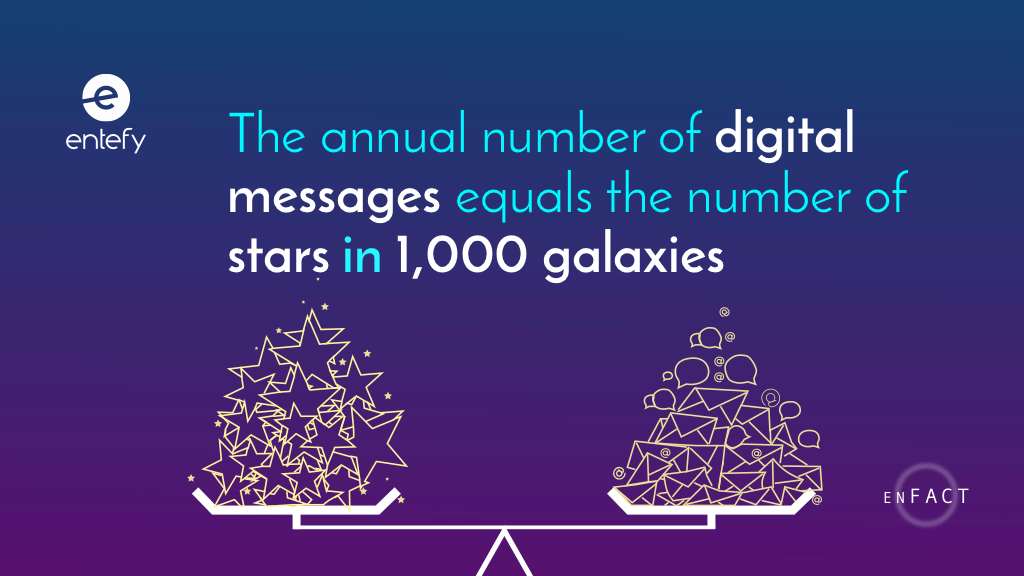
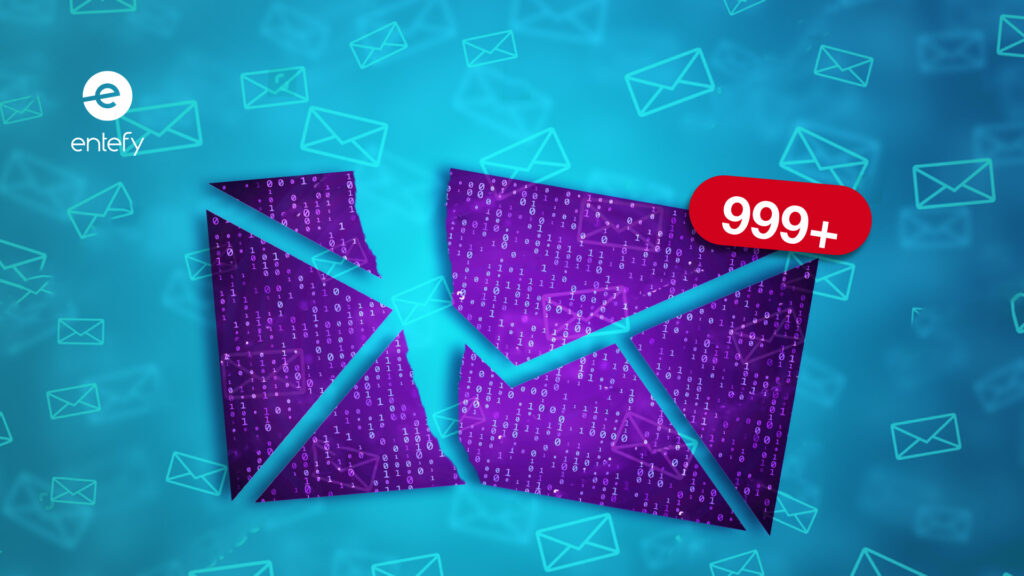
There’s an old brain teaser that asks: Are there more stars in the sky or grains of sand on all the beaches? With all the messages flying around daily, we thought we’d recast that question for the digital age: Are there more digital messages or stars in a galaxy?
Every year, more than 100 trillion messages are sent and received worldwide. That’s a huge number. So big that to make a comparison, we need to get galactic. Intergalactic, actually. Since a typical galaxy contains about 100 billion stars, 100 trillion messages equate to the number of stars in 1,000 galaxies.
Entefy’s enFacts are illuminating nuggets of information about the intersection of communications, artificial intelligence, security and cyber privacy, and the Internet of Things. Have an idea for an enFact? We would love to hear from you.
There is a long history of U.S. Presidents making use of new communication technologies to campaign, advocate, and connect. Here are a few Presidential firsts:
Abraham Lincoln was the first to make widespread use of the telegraph. He had to leave the White House and walk next door to the War Department to send a message.
William McKinley was the first President to be captured on film in 1896, in what today we would call a campaign ad.
Franklin Roosevelt was the first President to appear on television, in a broadcast from the 1939 World’s Fair.
Bill Clinton was the first President to launch a website in 1994. The site is archived by the National Archives. He was also the first President to send an email, though he later stated that he sent a total of two messages while in office.
Barack Obama was the first President to tweet, though not as @POTUS. During a 2010 visit to the headquarters of the Red Cross, a Red Cross staffer asked the President to press “Update” on a tweet they wrote about his visit.Entefy’s enFacts are illuminating nuggets of information about the intersection of communications, artificial intelligence, security and cyber privacy, and the Internet of Things. Have an idea for an enFact? We would love to hear from you.
In 1954, the psychologist Leon Festinger infiltrated a cult led by a woman who Festinger dubbed Marian Keech. Keech believed she received messages from an alien race telling her that on a certain date a flying saucer would appear to collect her and her supporters. At which point a catastrophic flood would decimate the remaining population of the earth.
Events didn’t exactly work out that way. But Festinger hadn’t joined the cult to test the validity of Keech’s claims. Instead, he wanted to observe how the cult would react to the discovery that their prophecy had failed. Would they admit the error and change their beliefs?
Festinger is now a mainstay in psychology textbooks due to his theories on cognitive dissonance, which describe a state of mind in which a person holds two or more conflicting thoughts, ideas, or opinions. Cognitive dissonance is by its nature an uncomfortable condition, one that the brain wants to quickly resolve by reinterpreting one or more of the conflicting thoughts. Which lets our brain return to a stable, coherent state.
But of course, reinterpreting facts or beliefs on the fly can be short-sighted. Take for instance the cult that Festinger studied—when the alien apocalypse didn’t materialize, most cult members chose to simply reinterpret what did happen (nothing) as a sign that the aliens had, in fact, saved humanity in response to the cult’s efforts and faithfulness. They opted to restore mental coherency at the expense of truth.
But don’t let the outlandishness of an alien cult fool you, the bias its members exhibited—interpreting the outside world in terms of pre-existing expectations—is something that we all do. In fact, bias can have beneficial aspects as a labor-saving shortcut that lightens the cognitive load on our brain. But bias is also responsible for limiting our understanding of things that are new or different. We’re not really immune from it at home or at work; it can infect how we discover and interpret information, and impact our behavior in workplace settings.
Fortunately, having a greater awareness of confirmation bias gives us tools to limit its shortcomings at work and in life. Let’s start by looking at how confirmation bias works for and against us, explore some of the ways it can surround us in ideological bubbles, and then discuss how we can burst our own personal bias bubbles.
Unbelievable
Beliefs we hold dear feel as though they are an inseparable part of us. But this can lead to problems when new information seems to contradict them, particularly when we’re not prepared to readjust. When we reinterpret an experience to conform with our prior beliefs, we are feeding confirmation bias—we place greater emphasis on information that supports our beliefs while discrediting or ignoring conflicting information.
A meta-analysis of 54 social psychiatry experiments concluded that people have stronger memories of events that conflict with their expectations, yet maintain stronger preferences towards things that support them. So much so that we’ll devote 36% more reading time to attitude-consistent material. When we do encounter opposing information, not only are we likely to try to interpret it in a corroborating way, we sometimes go so far as to use contradiction to strengthen already existing beliefs, something researchers call the ‘backfire effect.’
The confirmation bias does not only influence how we interpret new information, it also helps dictate what we go out looking for in the first place, and what we recall from our memory banks in response to certain questions and decisions.
Take for instance the question “Are you happy with your social life?” It is, on the face of it, basically the same as asking “Are you unhappy with your social life?” The state of someone’s happiness should not be swayed by the words used to ask about it. Yet this is often the case. So those asked if they’re happy will call forth memories of joy, while those asked if they’re unhappy will remember moments of sorrow.
The effects of this associative bias can appear out of nowhere, in the absence of conscious thought. If you’re about to purchase a particular model of new car, you’ll start noticing that car all over the place. Likewise, you might be considering starting a family and begin to see the world around you filled with children. Or go through a breakup and see everyone else traveling in pairs.
If we fail to realize that this is simply a byproduct of our brains seeking efficient means of directing our attention, we end up erroneously assuming that that car is really popular or that there are more kids in the area than there in fact are. This is a classic means of creating and maintaining stereotypes in social interactions, as we tend to see what we expect to see and neglect counter evidence.
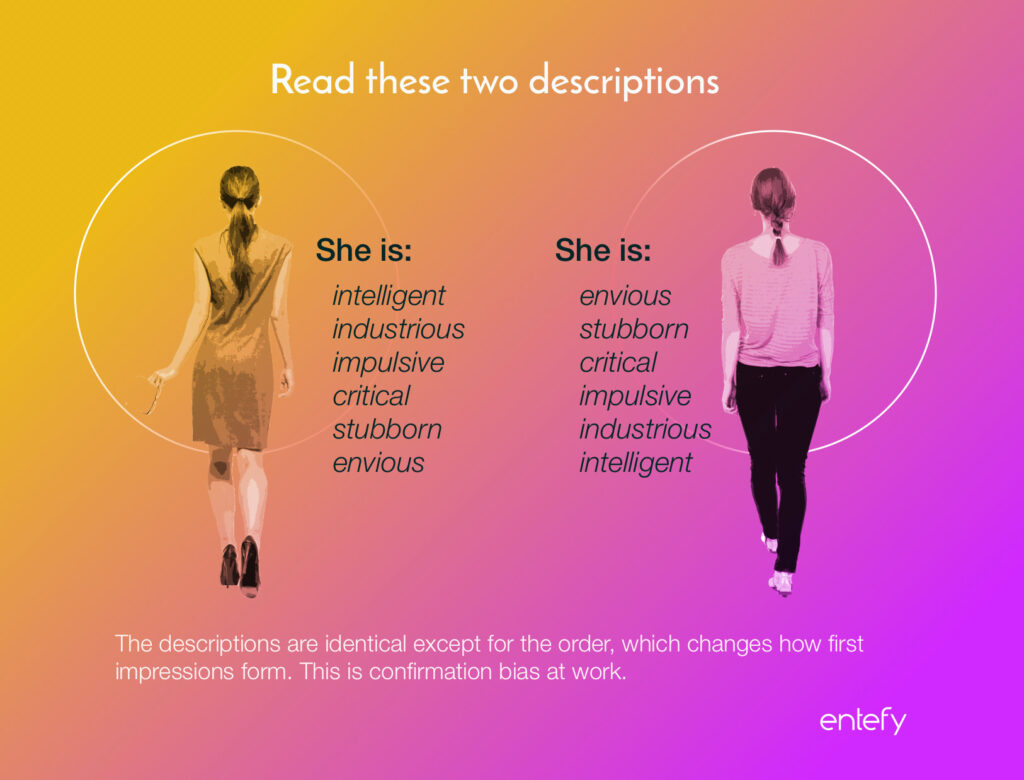
Moreover, research suggests that when we’re forming impressions of a person’s personality, we place greater importance on information learned earlier versus that which we learn later. When asked to form an opinion about someone who is “intelligent, industrious, impulsive, critical, stubborn, envious,” subjects rate the person as more positive than when the same words are presented in the reverse order. Like those pesky first impressions that linger, the information we learn about first becomes the baseline against which new evidence is compared—while we may adjust this baseline, each new piece of information ends up correcting it to a smaller degree. “Intelligent” makes for a better first impression than does “envious,” and while the subsequent adjectives provide some nuance, they don’t overwrite that initial judgement.
Bias is an unfortunate side effect of the brain’s need to reduce strain on its processing capabilities. By referencing past experiences and memories when finding and interpreting new information, we avoid having to start from scratch and can more effectively filter our environment for what’s relevant. But when we let bias run unchecked, we end up with some very unfortunate side effects. Especially when it comes to online news and information.
Information bubbles
Confirmation bias shows up in our news feeds and web searches because we tend to network with like-minded individuals and give more attention to belief-confirming information sources.
While search engines have not been shown to display a heavy bias in their results, the language we use in our searches can implicitly support an assumption or belief. If you believe in astrology and search for the Gemini horoscope, you’re going to find what you’re looking for without seeing (or paying much attention to) information that questions astrology itself. In a subtler sense, a simple comparison of a search for “how confirmation bias affects learning” and another for “does confirmation bias affect learning?” returns front page search results that are markedly different—some were the same, some weren’t.
When it comes to our social media feeds, the ability to personalize the people and brands we follow allows us to form networks that expose us to confirmation bias. Further complicating the issue are recommendation engines, which are designed to show us what the engines think we’ll like and nothing else, minimizing our exposure to information that might provide a well-rounded view or alternative perspective.
What happens if we’re only ever exposed to people and ideas that support our existing beliefs? Those beliefs are reinforced and strengthened by an affirmation feedback loop—each news item, blog post, and status update further demonstrates what we think we already know. And when opposing ideas do manage to sneak in, people tend to quickly label those ideas “exceptions that prove the rule” given that it’s much easier to reinterpret a fact than change a fundamental belief.
Of course, how can one be expected to traverse complex informational landscapes free from this bias? The brain can only process so much information, after all. It takes time and effort to process and internalize new ideas and concepts. Plus, the Internet is filled with fake news to such an extent that it is seldom possible to check the reliability of every source we encounter. And so despite even good intentions, our bubbles grow.
Bursting the bubble
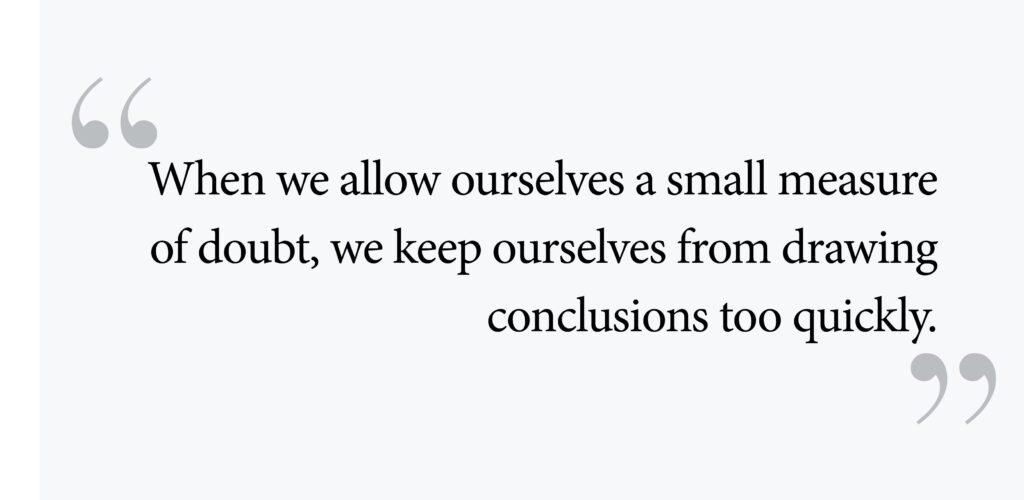
Perhaps the most important and, thankfully, simplest way to battle confirmation bias is to acknowledge that there are many sides to every story. While we may hold a strong opinion, it is but one perspective, of which there may be many more, each with its valid points and arguments. When we allow ourselves a small measure of doubt, we keep ourselves from drawing conclusions too quickly.
A more time-consuming defense against confirmation bias is to act as though you’ll need to explain yourself to someone. Researchers have found that people were more likely to critically examine information and to learn more about ideas if they believed they would need to explain them to another person who was well-informed, interested in the truth, and whose views they were not already aware of. Call it accounting for the effects of accountability.To go even further, get in the habit of playing devil’s advocate—that is, take the opposite view and try to argue from there. It is not always easy to see things from the other side, but then, if you cannot take an opposing perspective seriously, chances are you don’t really understand your own views, and are missing important elements required for a full understanding of the topic.
Getting to the bottom of an issue is an endeavor that requires time and effort, coupled with robust reasoning skills, and as such it is not possible for each of us to get to the bottom of every important topic. But this does not mean we are doomed to suffer at the hands of our biases. If we can simply admit to ourselves that we are missing important elements of the story—that our view is incomplete—we will be more likely to open ourselves to conflicting ideas, and less likely to cling to inconsistent viewpoints.
When it comes to the beliefs we hold dear, we may benefit when we take the time not only to find support for our views, but to discover the contradictions and counterarguments. Time to put ourselves in the other person’s shoes. Time to imagine the outsider’s perspective. Time to resolve cognitive dissonances. And time to purposefully burst our own bubbles of bias.
Here’s the thing with job listings: they can’t tell you everything. Even detailed job descriptions paint a two-dimensional picture, at best. But when you’re considering going to work for a company you have three-dimensional questions. What’s it really like to work there? What’s a typical day like? What sort of support will you get from the team?
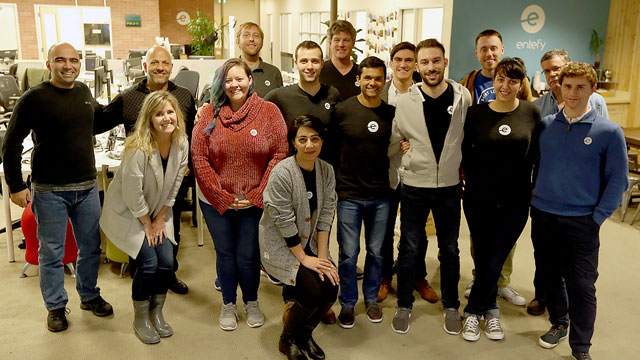
To give you answers to questions like these, we went straight to the source: the Entefyers themselves. Today, we’re adding four short videos to our Careers page. The videos feature interviews with some of the Entefyers who work on different teams and in different roles. Check them all out to get an in-depth look at life at Entefy.
Entefy is like an extended family, and many of us joined Entefy through referrals. So if you know someone who might be interested in tackling one of the biggest challenges in tech, please share a link or send them our way.
There are 6,909 ways to say “I love you” around the world, a sentiment that gets shared via an estimated 1 billion Valentine’s Day cards sent worldwide each year. In the U.S., romantics spend around $98 on spouses and significant others. Which in some cases are our pets, who receive on average $26 worth of gifts.
Red roses are by far the most popular flower gift, surpassing pink roses and mixed bouquets as the second and third most popular flowers. But be careful before you select roses for your special someone! According to the Farmer’s Almanac, the color of a rose carries meaning. Red roses represent love and desire, yellow is friendship, pink is happiness.
If you’re on the receiving end of a bouquet of made up of yellow and coral roses, take note: coral represents “sympathy” and yellow “friendship.” Which might not be the language of love you were hoping for.
Entefy’s enFacts are illuminating nuggets of information about the intersection of communications, artificial intelligence, security and cyber privacy, and the Internet of Things. Have an idea for an enFact? We would love to hear from you.
A friend of Entefy conducted a weeklong experiment in curbing digital distraction. Here’s what she learned.
Recently I went through a period when I just wasn’t feeling myself. I didn’t have my usual energy. Ditto my creativity. So I started reasoning through why that was. Perhaps I wasn’t getting enough sleep? No, that wasn’t it. What was I doing at night? Well, I was on social. I was reading news feeds. I was messaging. I was… all over the place, digitally speaking. And I was all over the place pretty much every evening before bed. In fact, I was getting into bed with my smartphone and tapping away until I fell asleep. Could this have something to do with it? I vowed to find out.
But first, some back story. My smartphone is the first and last part of my day, every day. I check headlines and social before getting out of bed in the morning. I bring my phone on nature walks to track my steps and take photos of my dog along the way. Basically, my phone is attached to my hip all day and then is the last thing I look at before falling asleep. And I am definitely among the 71% of people who sleep with their smartphones within reach.
The truth is, I like to be connected. So I make myself available to everyone and every app. I have grown accustomed to being available and responsive to messages pretty much 24/7. Until it dawned on me. For someone who loves “me” time for clarity, planning, and meditation, I was giving away precious time and attention… to my phone.
Which brings us back to the experiment. What would happen if I simplified my nighttime digital habits? The experiment was simple: for one week I kept my phone on silent and put it away at least an hour before bed. Here’s what happened…
Seven days, seven lessons
1. I took action on goals that had been on the backburner. I’ve long wanted to take new exercise classes, schedule more events with friends, get a better handle on my personal finances, and meditate more. But here’s how it would normally go: “I want to take a yoga class tomorrow.” So I’d check three schedules. But then thinking about yoga would get me thinking about my yoga instructor friend in L.A. and so I’d text her. Which would make me curious how much a ticket to L.A. might cost right now. But what’s my budget for a trip like that? I’d check my bank. And before I knew it, 30 minutes had passed, I hadn’t signed up for a class, and besides now it was too late to wake up early for yoga anyways.
The first thing I noticed about not having a device nearby to deter me was that I had the time and mental clarity to add goal setting to my daily routine. The big change was that instead of passively searching for ideas or solutions generated by other people, I got clear on what I wanted and created a personal action plan. Taking the time to do so each evening led to my days feeling far more productive and complete.
2.I finally started that book on my nightstand. Without digital distractions, I finally started the book that had been gathering dust on my nightstand. Which isn’t an incidental detail. Every night I looked at that book and thought, “Tonight’s the night.” But instead of reading, what I’d find myself doing was scrolling through my Instagram feed.
Two things happened once I started reading the book. First, even though I had picked it up purely for pleasure, I found information as I was reading that was relevant to my work. Or would read passages that had nothing to do with work, but still find myself creating new ideas for work in the background. And what was cool was how clearly I was able to recall the information the next day. Nighttime reading delivered a great deal of daytime clarity.
The second effect was that reading a physical book at night was therapeutic in itself. I was deeply engrossed in the book, with no outside distractions to impede my focus. No thoughts of the 30 things I needed to do tomorrow. No quick check-ins. And even better, I slept great reading a paper book every night. I awoke very restful and energized.
3.One night, my device wasn’t on silent. I heard my phone buzz and I snapped out of my zone. The feeling was a little like walking out of a silent room into a noisy party. It turns out that recovering from the cost of interruptions can take a few minutes, even half an hour, and I experienced this right away. My clear mind wanted to go straight back into the notification rabbit-hole. What was interesting was that after just a few nights without notifications, this one buzz actually created a feeling of anxiety—who could that be!?
4. I was mindful and grateful of the moment. Digital-free evenings gave me time that I used to appreciate the fragrance of my candle, my dog cuddled next to me, even the weather outside. This made me feel calm and relaxed, which reminded me of all the benefits of mindfulness. Home in bed is safe place where you stop worrying about things outside of your control—that is, when you’re not being constantly reminded about them. The mind can wander, that’s heathy, but it isn’t prompted to wander as when the notifications are rolling in. There is a time and place for everything—most 11pm emails aren’t something you can act on until the morning anyways.
5. I came up with better ideas and didn’t forget them in the morning. Sometimes I would come up with ideas right before bed, but I didn’t have a lot of success with actually capturing them by writing them down. Because when I was multitasking on my phone, the idea would appear then disappear the moment something on the screen caught my eye.
With my journal in hand and phone put away, I found inspiration within myself and took time to write ideas by hand. When I read them in the morning, they stayed with me all day. Whether or not Archimedes actually coined the phrase “Eureka” in the bath, my experience supports the core idea of the story: relaxation creates focus that prepares the mind for discovery and invention.
6. I didn’t miss my apps, but I did miss my people. There are a few people I like making time to talk to before bed. I also want to be reachable if a team member or someone I know needs something really important. The one part I missed about not having my phone near before bed was not being able to connect more deeply with people. One of the best parts about technology is being able to maintain connections from a distance. I didn’t want a million social media notifications but I did want to be connected to loved ones.
7.I slept like a baby. There is research that the blue light emitted from devices “negatively affects health and sleep patterns.” Putting my phone away sent my mind a signal that I was shutting down for the day. It’s amazing how fast I fell asleep during my digital hiatus.
So did I change any habits?
I learned a lot about this phenomenon of information overload just by unplugging for a little while every day. Now, my phone is still with me the majority of the day, but my relationship with it has changed. I’ve pretty much turned off all app notifications permanently. Instead, I mindfully open an app only when I decide I want to, not when it calls out to be checked. I haven’t lost any of my availability to my colleagues, family, and friends; I’m reachable when I’m needed. And, overall I’m more efficient with my time throughout the day. Creativity and energy are off the charts.
As with many things that we grow accustomed to, we don’t realize exactly what our behavior is like until we break the habit, even temporarily. Notifications affected my focus, clarity, even creativity, until I took it upon myself to take control of my digital life. My experiment was one amazing vacation, and I didn’t post a single pic of it.
Undistractedly,
Entefyer Meghan
Request a Demo
Is your organization pursuing an AI-first transformation strategy? If so, start the conversation by submitting the form below.
Contact Us
Thank you for your interest in Entefy. You can contact us using the form below.
Download Data Sheets
See our Privacy Statement to learn more about how we use cookies on our website and how to change cookies settings if you do not want cookies on your computer. By using this site you consent to our use of cookies in accordance with our Privacy Statement.