New patent strengthens the data security and search capabilities of Entefy’s core technology, deepening its ability to protect users’ privacy
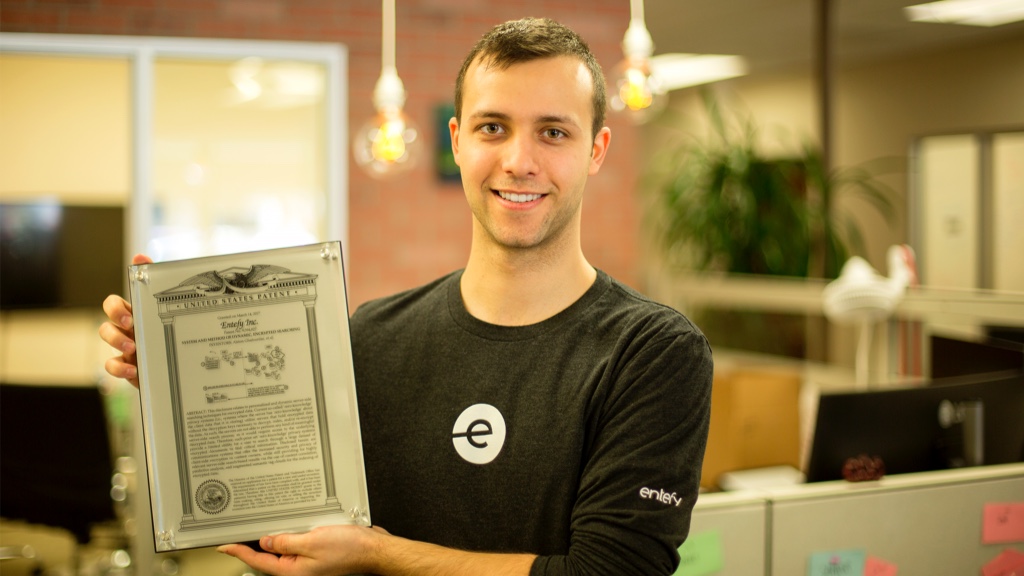
PALO ALTO, March 16, 2017 — Entefy Inc. announced today that the company has been issued a new patent by the U.S. Patent and Trademark Office (USPTO). Patent No. 9,594,827 describes a “System and Method of Dynamic, Encrypted Searching.”
This newly issued patent represents encryption technology that offers “the increased security and privacy of client-side encryption to content owners, while still providing for highly relevant server-side search-based results via the use of content correlation, predictive analysis, and augmented semantic tag clouds for the indexing of encrypted data.”
In January 2017, Entefy announced the filing of 13 additional new patents, bringing its total filed patents to 31 in the areas of digital communication, artificial intelligence (AI), search, file sharing, security, and data privacy. Entefy’s innovation-first culture has attracted team members from around the world to work on developing the first-ever AI-powered universal communicator, a smart platform built on advanced computer vision and natural language processing technologies.
“Innovation is critical to Entefy in the pre-launch stage of our development. To overcome the many technical challenges our team is addressing requires the development of new technologies in AI, search, and data security. It was rewarding to learn the USPTO had issued this patent,” said Entefy CEO Alston Ghafourifar. “We are expecting additional issuances this year and beyond.”
Entefy’s universal communicator is designed to help people live and work better in today’s digital world. It simplifies everyday interactions between people, services, and smart things.
ABOUT ENTEFY
Entefy is building the first universal communicator—a smart platform that uses artificial intelligence to help you seamlessly interact with the people, services, and smart things in your life—all from a single application that runs beautifully on all your favorite devices. Our core technology combines digital communication with advanced computer vision and natural language processing to create a lightning fast and secure digital experience for people everywhere.
How much human language can a dog learn? Beyond the basics—sit, stay, come—dogs actually have a surprisingly large vocabulary. Which you might not have realized if you spend a lot of time trying to get your dog to obey just one of those words.
In our latest video enFact we look at communication between humans and man’s best friend. You’ll never guess what one high-achieving border collie has in common with the average 3-year-old child.
Read the original version of this enFact here. Entefy’s enFacts are illuminating nuggets of information about the intersection of communications, artificial intelligence, security and cyber privacy, and the Internet of Things. Have an idea for an enFact? We would love to hear from you.
Often the value of advice is not the advice itself, but the insights you discover on your own when thinking about it. So we thought we’d share some of the “mantras” that inspire us in and out of the office. Not as advice, but simply as food for thought. Mantras are, after all, small bits of wisdom that can have outsized impact. And our mantras keep us centered in any circumstance.
Entefy is charting new terrain to reach the top of technology’s Mount Everest, the universal communicator for everyone and everything. Our mantras illuminate the path. Here’s an example: When we set short- and long-term goals, we think about how those goals sync with our belief in leadership and the importance of “firsts, mosts, & bests.”
Mantras serve another important purpose. They’re a compact way for us to pass along our beliefs to new team members. They keep every Entefyer seamlessly aligned, despite our different skill sets and different projects. We recognize that we’re better together as a high-performance family.
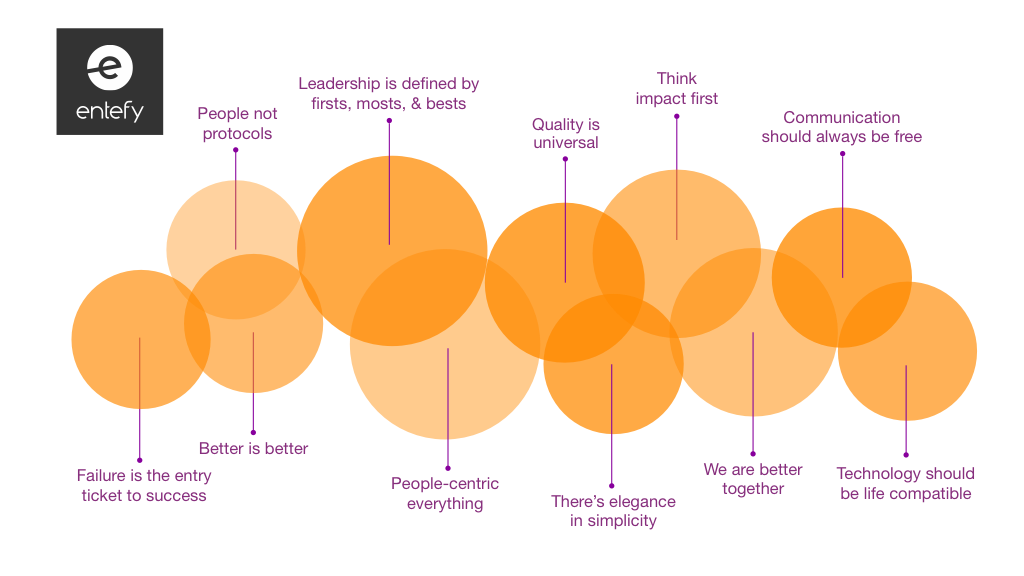
And with that, here are 11 Entefy mantras, in no particular order, that reflect who we are and the way we view the world.
1. Leadership is defined by firsts, mosts, & bests
2. Failure is the entry ticket to success
3. Think impact first
4. People not protocols
5. Better is better
6. Technology should be life compatible
7. Quality is universal
8. Communication should always be free
9. We are better together
10. People-centric everything
11. There’s elegance in simplicity
So there you have it. What are the words of wisdom that inspire you in your life and career?
The digital universe is the sum of all files, photos, videos, and other digitized information. We’re continually amazed by just how fast digital data is being created, and how people are using technology to manage all of the information.
We did our research, gathered surprising statistics, and created a presentation about the digital universe today and in the years ahead. These slides are useful for technologists, entrepreneurs, marketers, and other professionals interested in how technology is changing the way people communicate and interact in the modern world.
We previously looked at the ways artificial intelligence may disrupt the traditional classroom. From blended learning to AI tutors, algorithms are poised to reshape the way teachers engage with their students. But AI may do more than influence classroom experiences. It has the potential to replace classrooms entirely. No one can reliably predict the degree of impact AI may have in education, but one thing seems clear—parents should expect to deal with more complexity and greater responsibility in overseeing their children’s education.
Parents are responsible for nearly every aspect of their children’s development. Healthcare, cognition, socialization, behavioral modeling—parents do it all. The one area in which they exercise less control is in formal education. They make decisions about whether to send their children to private or public schools or to home school, oversee homework sessions, and volunteer for the PTA. But they leave the actual teaching to the teachers.
History shows that new technologies upend existing paradigms, usually in incremental ways. But artificial intelligence is unlike any technology we’ve encountered. AI could radically alter learning environments—the schools themselves. What will it mean for parents if their children can learn just as well, if not better, from the comfort of their homes instead of traditional classrooms?
Before we can answer that, we have to address something more fundamental: What is it that we expect of education? And, in particular, what is it that parents expect? Consider these three statements about education, which capture the range of expectations:
“Education does not mean teaching people to know what they do not know. It means teaching them to behave as they do not behave.” (John Ruskin)
“British parents are very ready to call for a system of education which offers equal opportunity to all children except their own.” (Lord Eccles)
“The value of an education…is not the learning of many facts but the training of the mind to think something that cannot be learned from textbooks.” (Albert Einstein)
Depending on how it is structured, education provides a child a craft, career, or trade; a foundation of knowledge; the development of culture; the capacity to learn; a hunger for knowledge and wisdom; or good behavior. That is a pretty long list of expectations. So long, in fact, that there is no school that can actually deliver on everything that might be expected of it.
Rather than try to define what education should be, let’s simply acknowledge the most common elements of people’s expectations. In general, we expect schools to achieve or facilitate: 1) Preparation of children for a productive life and career, 2) the transfer of an agreed-upon base of knowledge, 3) the development of a child’s understanding of their own culture, 4) socialization of a child around behavioral norms, and 5) creation of habits supportive of lifelong learning.
The mass customization of education
The American education system is built on standardization. Unless they attend Montessori or other philosophically-driven schools, most students learn from generalized lessons delivered in generalized classrooms. When they’re old enough, they begin taking standardized tests to determine how well they’ve kept up.
Of course, many students fall behind as they struggle to grasp concepts that are presented in ways they don’t understand. They may be ill-suited to the standardized school environment, or their cognitive development may take place at a different rate than that of their peers, both faster and slower.
Artificial intelligence offers an alternative for these children in the form of personalized learning systems that adjust lessons, reviews, and activities based on individual skill levels and strengths. The technology’s adaptive customization around individual capabilities also offers the opportunity for students to advance at the pace most appropriate for them.
Given evidence that AI-powered intelligent tutoring systems outperform traditional classrooms, AI could have a democratizing effect on education—not to mention reducing the need for large centralized physical schools. With the capacity to constantly adapt to an individual child’s capabilities and circumstances, AI learning systems allow what in manufacturing is called “mass customization.”
But if children are learning at their own pace in their own way, what happens to our existing one-size-fits-all approach where children are collected together in one large place and put through a standardized curriculum? No one knows the answer, yet.
But taken to its logical extreme, if there is less reason to send children to large, central, physical schools, parents may begin serving as the educational gatekeepers. They’ll also have to facilitate behavioral and social learning opportunities. And of course, they’ll have to grapple with questions of how to prepare their children for a rapidly changing workforce. AI is likely to give us choices, societally and as individuals, which we have not had before and for which we have not considered the full ramifications.
One possible future
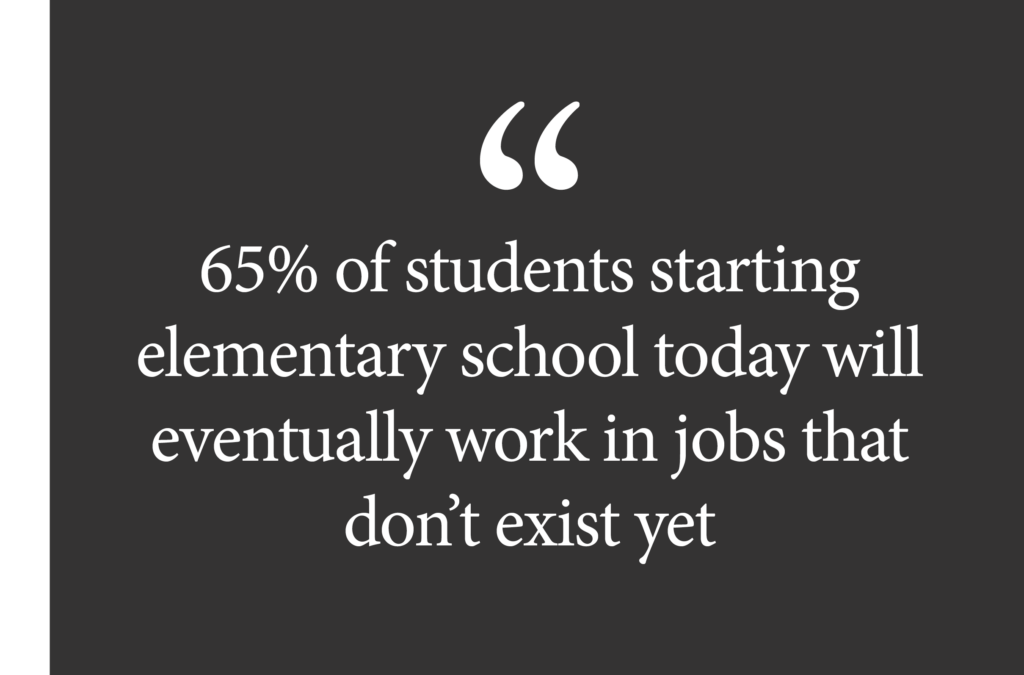
With AI in the mix, it seems likely that our educational choices will broaden; so, too, is the context of education likely to change quickly. A World Economic Forum report on the future of jobs predicts that 65% of students starting elementary school today will eventually work in jobs that don’t exist yet. If a core aim of education is to groom students for career success, how do we do that when we don’t know what careers will be relevant when they come of age?
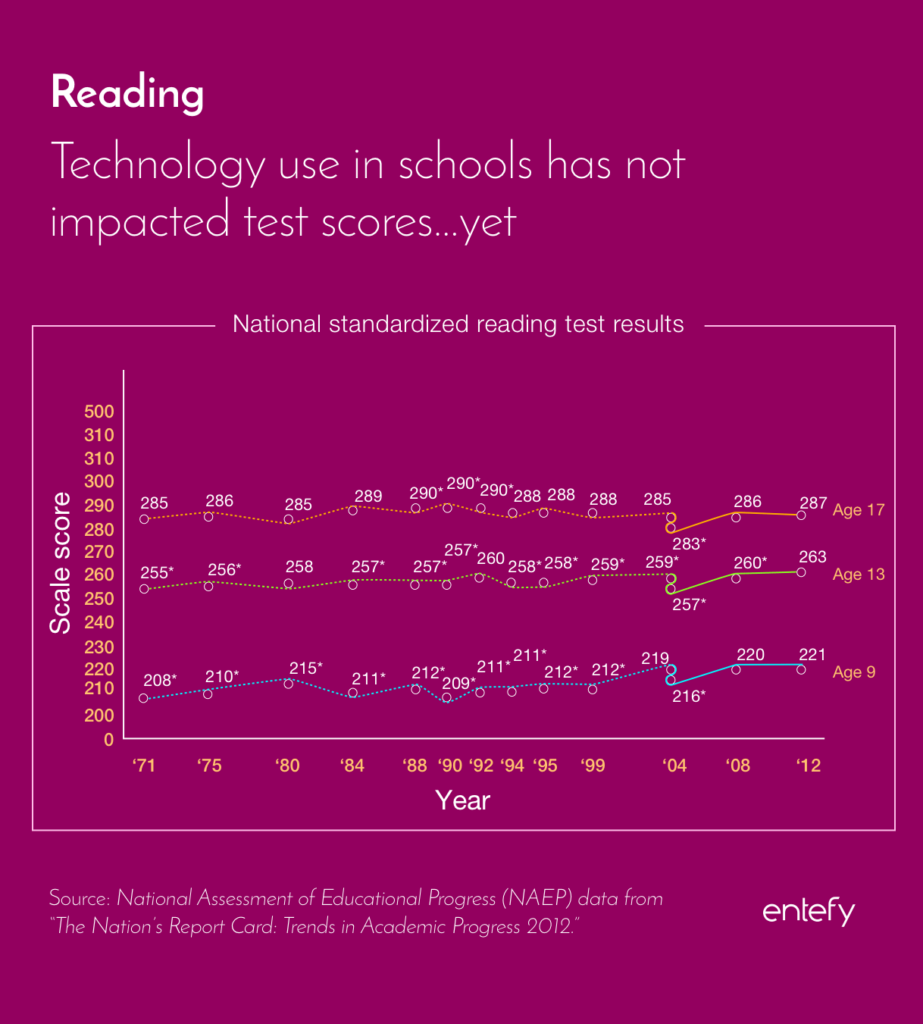
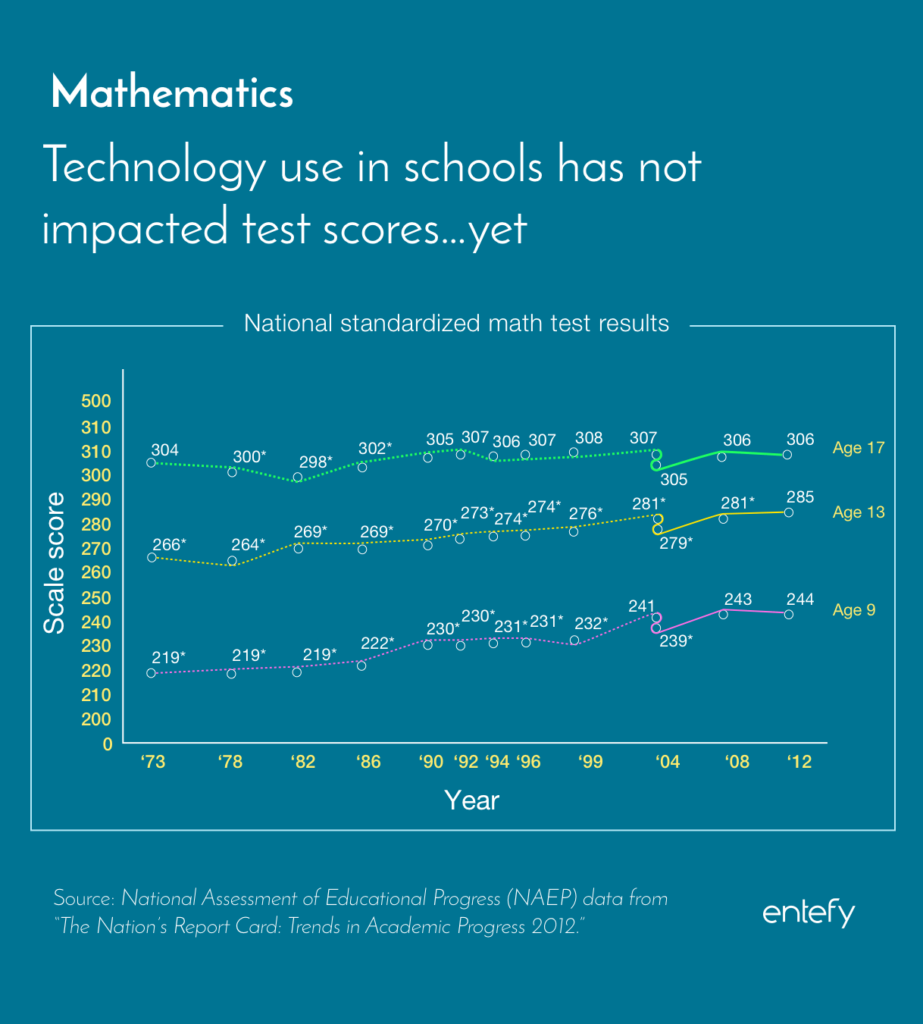
We don’t know how the impact of AI will play out. It is worth recalling the excitement and exuberance in the early and mid-1980s, when personal computers were first introduced into school systems. There was great anticipation that computers would have significant positive impacts on students’ educational outcomes. Though while computers in schools changed education practices and experiences, data shows that they did not make a meaningful difference in educational outcomes, at least in the aggregate. National scores on the National Assessment of Educational Progress tests for graduating seniors have barely budged in nearly fifty years.
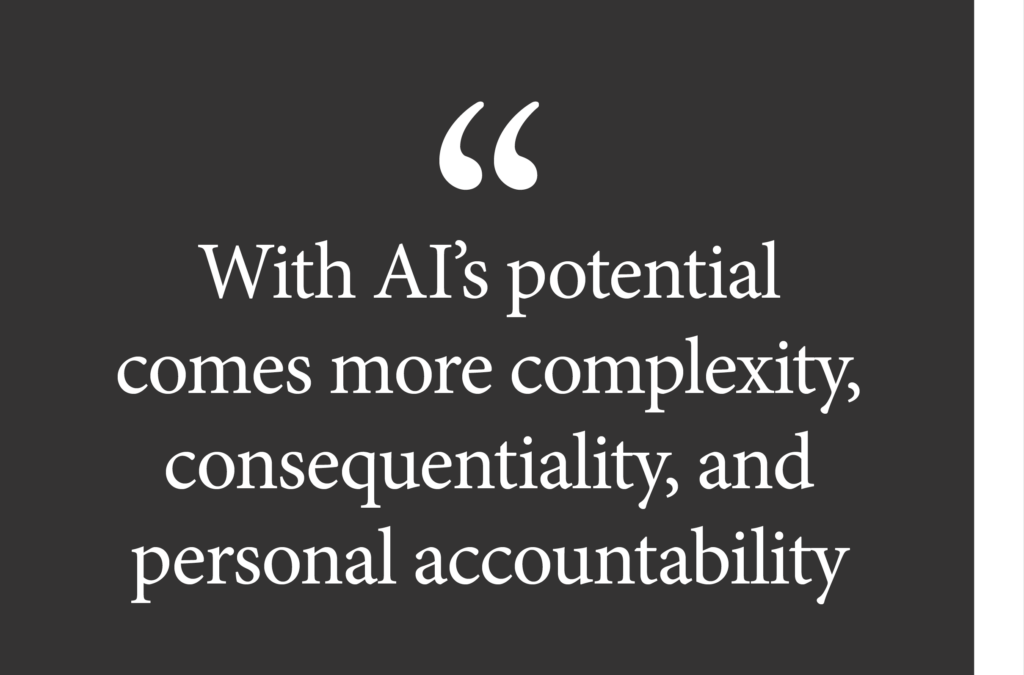
All of which is to say that it is premature to make firm forecasts of how AI might change educational outcomes. We can, however, think through the logical consequences of reasonable assumptions. AI-enabled education might give parents much more control over their child’s education than our current one-size-fits-all approach. But with AI’s potential comes more complexity, consequentiality, and personal accountability. Parents may find themselves facing entirely new and complicated decisions related to their children’s education.
If we indeed move to a system of education that optimizes individual learning experiences and outcomes, then we might expect better outcomes overall but also potentially greater variance in outcomes. Moving away from a factory-style, standardized educational model might also drive higher levels of knowledge acquisition. Right now, education is still strongly a community activity. What happens if the administrative focus changes from large regions to local neighborhoods—to self-organizing groups of parents with shared goals? Greater local control but also, perhaps, less normalization across larger groups.
Following through with this logic, here are 8 possible implications of AI’s adoption in education that parents and society at large may have to address:
1. AI could render large, centralized schoolhouses obsolete. If students are centralized, attending one-size-fits-all classes, and learning at a fixed pace, then big centralized facilities make sense. If students are moving at their own pace with an AI-enabled and customized curriculum, then the need for classrooms and lecturers is reduced, perhaps offset by teachers who function more in the fashion of a tutor or coach. Traditional schools might then be replaced by smaller, distributed structures and specialized learning centers.
2. Parents may assume greater responsibility in children’s education. Parents will likely serve multiple roles as coaches, curators, and guardians as their kids navigate new tools and platforms. Of course, such a shift would dramatically impact the 3.1 million public and 0.4 million private K-12 teachers, not to mention the 3.4 million administrators and support staff.
3. The cost of education may fall. With less expense associated with fewer large, centralized schools and less demand for skilled human teachers, the cost of education at the municipal level could fall materially. The decline in teacher, administrator, and facility costs would of course have to be set against the rise in costs to families if parents become more involved in their children’s education. These costs would be both monetary as well as the opportunity cost of increased time commitment.
4. Customized learning could accelerate natural inequalities. Not all children are created equal. An education system that focuses on standardization reduces the standard deviation between students. If AI tutoring systems can tailor their lessons to different children’s needs, some students will naturally progress faster than others.
5. Mass customization might improve children’s health. There has long been a concern that school children are not getting enough sleep, negatively impacting their physical health and cognitive development. If AI allows for mass customization and decentralization of education, then children’s schedules can be better matched to their sleep needs.
6. Socialization may become a concern if more children learn remotely. Australia’s School of the Air remote learning program could serve as a model for remote education that doesn’t sacrifice socialization. Students at the school learn via Internet lessons but meet classmates at camps and special events each year.
7. Customization and decentralization might lead to loss of normalization. Public schools create an environment that imposes common standards on all students. If schools become smaller, more local, and more customized, we may lose some of the common norms, behavioral, social, and cultural.
8. Parent-managed education would increase the complexity of the lives of parents. While the increase in effectiveness and value to children generated by AI might be substantial, society is not currently organized in a way that makes it easy for parents to play the role that AI might make possible. This would require its own significant shift in workplace standards.
AI-driven learning is a transformative solution with the power to change the way kids view the world and how they interact with the people around them. A child who learns via AI technologies could gain untold benefits and skills intellectually, socially, and emotionally. But this method is likely to demand increased parental oversight, including time-consuming direct supervision of kids’ AI learning activities. Parents may have to make tough decisions about their careers to oversee their children’s educations, or about where the family will live to access the best resources and support for this new type of learning.
AI has the potential to change the quality, delivery, and scalability of education. But it may also change forever the role parents play in their children’s education.
Here’s an imponderable for you. Which would you give up first: your refrigerator or your smartphone? In this short video enFact, we look at the surprising link between your largest kitchen appliance and your trusty mobile device.
Entefy’s enFacts are illuminating nuggets of information about the intersection of communications, artificial intelligence, security and cyber privacy, and the Internet of Things. Have an idea for an enFact? We would love to hear from you.
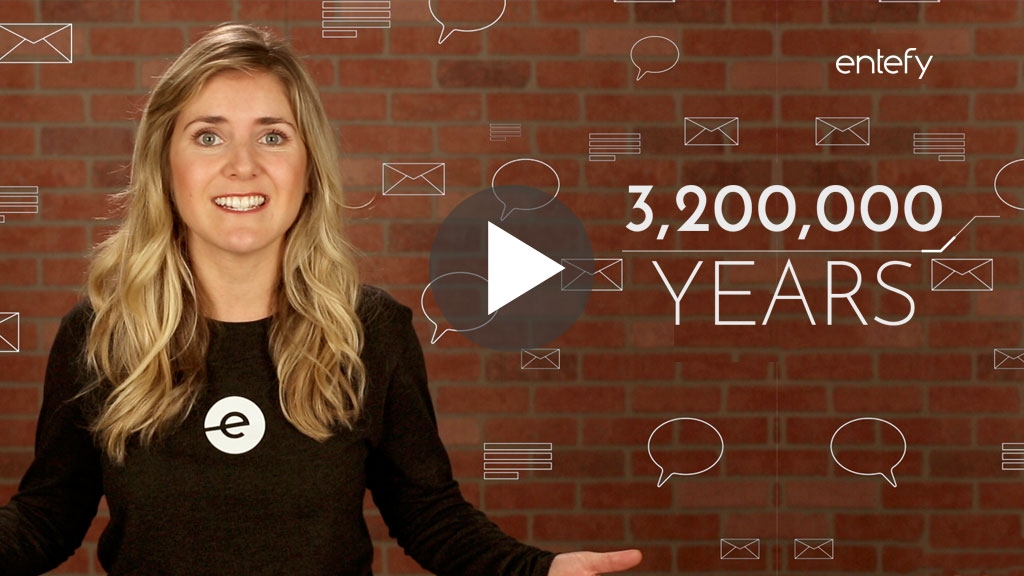
How many digital messages are sent in a year when you add up emails, texts, and IMs? It’s much more than you might think. This video enFact answers the question and looks at one way to put that number into perspective.
Read the original version of this enFact here. Entefy’s enFacts are illuminating nuggets of information about the intersection of communications, artificial intelligence, security and cyber privacy, and the Internet of Things. Have an idea for an enFact? We would love to hear from you.
Are you a solopreneur? One of the self-employed professionals that accounts for 10% of the U.S. workforce? At Entefy, we think of solopreneurs as nothing less than superheroes. And there are more than a few parallels. Solopreneurs—be they freelancers, consultants, or one-person entrepreneurs—are specialists that get called on when their superpowers are needed to solve the most challenging problems. And like most superheroes, you might spot them out on the streets looking just like an average Joe or Jane—until they get that call for help.
One of the biggest draws that attracts adventurous, results-oriented, career-driven individuals to the solopreneur ranks is the lifestyle that comes with being your own boss. More and more people are valuing professional flexibility, working for a purpose, and living in the now. And being self-employed offers exactly those things: control over your schedule, selectivity about who you work with and the projects you work on, and saying yes to events, workshops, and classes at the drop of a hat.
But as every solopreneur knows, for all of the lifestyle perks, there are still days where it can be hard to stay sane. Because the core challenge facing solopreneurs is time: how to manage it and where to find more of it. After all, it’s easy to over-schedule and over-promise when there’s no ceiling to the amount of work and obligation you could take on. Staying glued to digital devices, facing a stream of calendar invites, drowning in deliverables, and struggling with goal-setting are a few challenges worth mentioning. It can be hard to set boundaries, resist burnout, and maintain a clear path forward, but it doesn’t have to be.
Our team at Entefy includes former freelancers, consultants, and solopreneurs who have experienced the perks and pains of working for themselves. Here are some of the lessons they’ve shared about overcoming obstacles surrounding time, expertise, and building the right network.
1. Eliminate distractions and establish boundaries
Time. There’s two ways to spend it: doing things that propel you forward, or doing things that hold you back. Your productive streaks are jeopardized by notification popups on your phone, getting pulled into impromptu lunches or networking events, and chitchatting on the phone in the middle of the day. Device dependency and the challenges of saying “no” are two of the biggest sources of distraction.
Sound familiar? Then try a simple change of habit: Exit out of email and messaging apps, turn your phone on silent, and work distraction-free for an hour (or more) every single day. Expect your focus and productivity to skyrocket.
2. Know your body clock
Ever fall into the trap of planning to exercise or run an important errand during lunch, but then a last-minute call comes up? Solopreneurs often don’t know what the day is going to bring, and it’s important to be nimble and adaptable when unexpected things come your way. Since you can’t always plan what will happen in a day, one of the keys to solopreneur success is to know your circadian rhythm and schedule your day accordingly. Your body clock may be in your genes. Early birds should stack their most challenging work in the morning, while night owls should back-load their work day to increase effectiveness and productivity.
3. Identify the day’s most import task, then get it done first
One facet of the not-enough-time-in-the-day problem is prioritizing tasks. There’s one school of thought that involves identifying your Most Important Task (MIT). Given how many tasks solopreneurs have to juggle simultaneously, MITs are often the projects that get postponed because they are the hardest or most time-consuming items:
“Your MIT isn’t your easiest task, or the one you’ll enjoy the most. It’s not even the task that’s most pressing. Your MIT is your most important task—it’s the thing that will provide you (or those you work for) the most value…Think of your most important tasks as large stones that you need to fit into a jar. Those smaller tasks, which we can often knock out relatively quickly, are like small grains of sand. If you fill the jar up with sand first, the rocks will no longer fit. But if you place the rocks in the jar first, the sand easily falls into place—filling all the empty space between the rocks. Now you’ve accomplished everything, but you’ve given priority to the things that count most.”
4. Embrace your jack-of-all-trades nature to innovate
One question every solopreneur has been asked by a client goes something like, “We love your work. So can you also help with X?” Where X is another skillset or specialty distinct from the work you’re already doing. As a solopreneur, there is no shortage of new skills you could develop or topics you could learn about. After all, refining talents and honing expertise is critical to your success. But there’s a balancing act—you can’t spend all of your time learning new skills when you have your regular work to do.
Working independently requires many skillsets, which suits a jack-of-all-trades personality type. But instead of trying to learn and master new skill after new skill, innovate with what you already know. Emily Wapnick gave a TED Talk about “Multipotentialites,” people with many interests and creative pursuits. Her insight is that multipotentialites are naturally skilled at seeing patterns and overlaps between their distinct areas of interest, and are well-positioned to discover innovation in that overlap. Something she calls “idea synthesis,” combining two fields and creating something new at the intersection.
So rather than endlessly pursuing new skills and knowledge, consider devoting more time to leveraging the skills you already possess.
5. Don’t just network—build a tribe
Working for yourself requires doing administrative tasks, financial planning, writing contracts, managing day-to-day operations, and growing your business. That’s a lot of pieces to juggle on any given day, and you shouldn’t try to do it all. So let people help you. Pick a fantastic financial planner, a mentor who will help you find clarity on short- and long-term goals, people in your industry that you can bounce ideas off of to keep learning and stay inspired. And, equally important, spend time with those in your personal life who are your biggest cheerleaders. Because when your tribe is in place, you can create and do so much more.
There is endless advice on the type of people to surround yourself with for success, but consider this balanced approach: look for relentless workers, positive attitudes, people who ask questions, and dreamers.
Being an entrepreneur, freelancer, self-employed professional, or any other type of solopreneur is a career dream for many. And it should feel that way too. By implementing a few of these new habits, you might just find that being your own boss feels better than ever before.
UC Berkeley’s Newton distinguished innovator lecture series was born of the entrepreneurial vision of A. Richard Newton, Dean of UC Berkeley’s College of Engineering from 2000 to 2007. The College of Engineering invites innovators in a range of industries to share lessons from their entrepreneurial journeys.
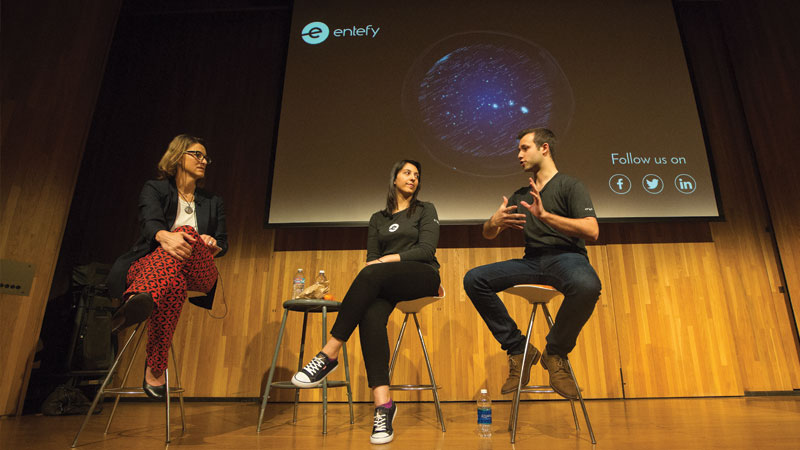
Entefy co-founders Alston and Brienne recently delivered a Newton Lecture they called “The next chapter: Authentic Intelligence” to a full house of engineering, sciences, and business students at Sibley Auditorium. The talk covered Entefy’s insights on AI and big data, and the need for advanced technologies to transform the worldwide data explosion into useful insights that directly benefit people.
After the presentation, Alston and Brienne sat down to answer moderator Vicky Howell’s questions on topics like graduating college at age 17, assembling a network of luminary advisors and investors, running a venture, and recruiting a world-class team. That discussion transitioned to an engaging Q&A with the students. We were excited to see so much interest, curiosity, and insight from the students and hope to hear again from them soon.
The presentation was broadcast on the Sutardja Center for Entrepreneurship & Technology’s Facebook page. The video can be found here.
Students also shared their perspectives on the event in a recap on the Sutardja Center’s website.
There is one small problem with digital advertisements: people hate seeing them everywhere. Like cigarette butts in parks, ads pollute digital environments by ruining your experience and distracting your focus. Every day that passes brings more ads in more places, a trend that shows no signs of changing.
But it could change if advertisers were to think more creatively about how to engage with their customers and consumers were to more actively exercise their power of choice. Both start with understanding why companies continue to invest heavily in digital advertising despite low success rates and high levels of consumer annoyance.
Because ads-everywhere-you-look isn’t inevitable. The Internet has evolved multiple channels for consumers to learn about products and services, and engage directly with companies. Brand-sponsored content is very effective at explaining how products work and how they can fit into your life. Online forums and communities provide outlets for consumers to ask questions from users of a particular product. Robust customer review systems prioritize the display of quality, relevant reviews (both positive and negative) by verified owners.
The problem with many of these ad alternatives is that they exist outside of the advertiser’s control; they are user-led and user-generated. The fact that many consumers prefer these alternatives is something many companies choose to ignore. Ads have been around forever, they’re safe, and anything that isn’t advertising seems risky. This is, quite simply, a lack of imagination. And consumers suffer for it.
The intrusive, distracting, annoying price of convenience
The public’s disdain for ads is true in TV, radio, print, and especially online, where one survey showed 64% of people find ads “annoying and intrusive.” Why TiVo? Because you can skip the TV ads. What is one of the keys to SiriusXM’s success? No radio ads. Why are newspapers and magazines being forced to reinvent themselves? People aren’t reading the ads so the advertisers are abandoning the format. And what about the web? AdBlock Plus, the top ad blocker software on desktops and mobile devices, has been downloaded more than 1 billion times.
Yet we’re told that ads are the “price of convenience.” When apps and services are offered for free, we accept that ads are how we pay for the software. There is a certain fairness to that—but only up to a point. Because free apps don’t merely show us an ad or two when we use them. Our activities inside the app, and even the things we do on our devices when we’re not in the app, are tracked, collected, bundled, and resold to third parties. The ads we see are one small part of a complex advertising ecosystem in which more than 2,500 different companies are battling to monetize our behavior. The price of “free” is far, far higher than the occasional banner ad.
Targeted ads aren’t that bad…oh, wait, yes they are
Despite this dismal effectiveness, U.S. advertisers are on track to spend more online than on television for the first time ever. The thinking is that digital user-tracking technologies have matured to the point where an advertiser can insert itself and its message practically anywhere, at any time. And target very narrow groups of potential customers.
On the surface, targeted advertising doesn’t sound like such a bad thing (“If I’m going to see a bunch of ads all the time, they might as well be relevant to me”). But here’s the problem with that: relevance is tied to the use of personal data. If you have ever noticed an ad on the margin of a web page advertising something very specific that could only be there because of an email you sent or a search you made, then you know this is at best an icky feeling (“I guess it’s all just algorithms and no one actually read that email”) and at worst an outrage (“When did I agree to let anyone read my private correspondence, algorithm or not!?”).
Advertisers compound the problem, and publishers love that
If there’s so much negative sentiment towards ads, why do advertisers bother? Because if they do enough advertising, that dismal sub-1% response rate can add up. Let’s say a company buys 100,000 ad placements in a month, and those ads generate $1 million in revenue. During the next period, however, consumers are less responsive and the same level of ad spending leads to just $500,000 in sales. Because there is no easy way to make consumers respond to its ads, the company decides to double its ad placements. They purchase 200,000 ad placements to bring sales back to $1 million. But six months later, sales are down by half again. What next? Double the ads. 400,000… 800,000… 1,600,000… 3,200,000… and soon, you get to a lot of ads. But just how many?
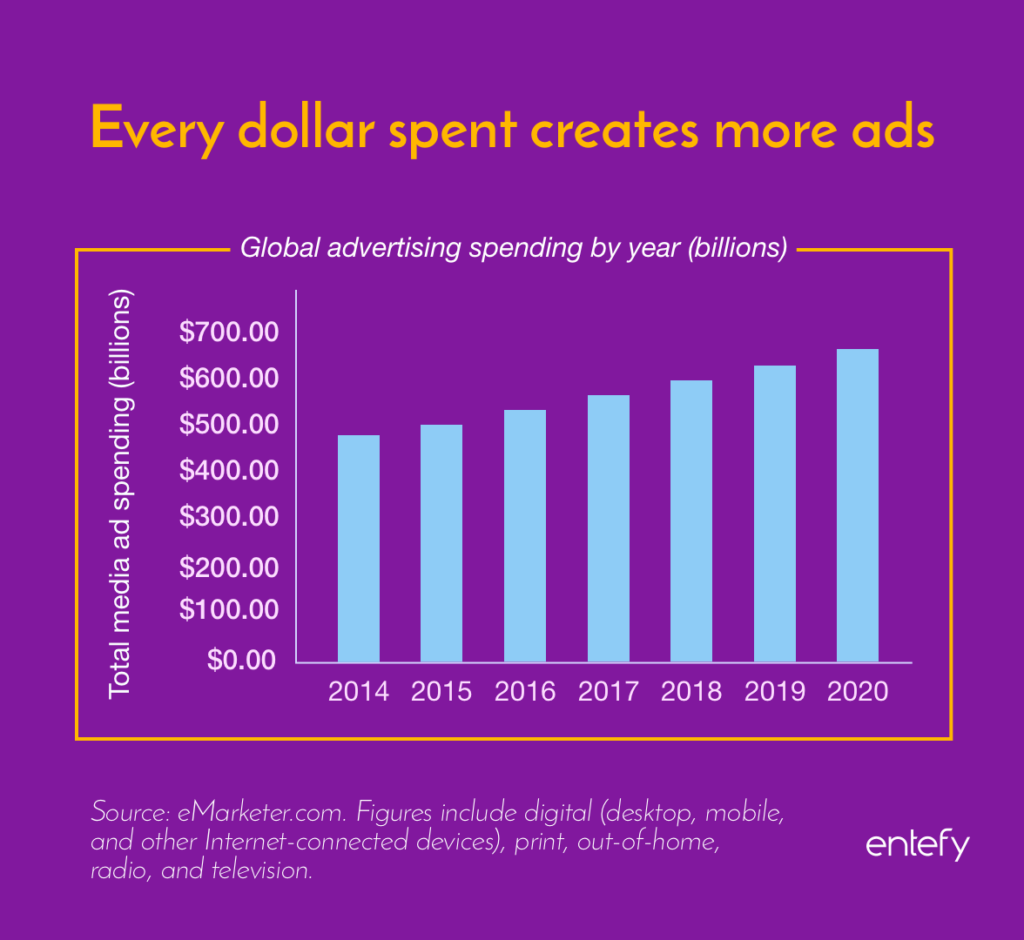
The precise answer to this question is difficult to ascertain, but what’s easier to measure is the dollars spent. Annually, global advertising spending has reached $600 billion, $235 billion of which is dedicated to digital and mobile advertising alone.
Advertisers buy more ads, people ignore the ads or adopt ad blockers, and in response advertisers serve up trillions of ads every year. If you’re someone that objects to all of this digital clutter, what’s to be done?
Empowered consumers can break the cycle
Quality is rarely free. If the price of “free”—data trackers, privacy violations, digital pollution—doesn’t sit well with you, then you need to get selective. There are two digital environments covered in ads where you have ad-free alternatives: content and apps.
On the content side, accept that subscriptions are how publishers keep the lights on. You can support the writers and publications that you value through subscriptions. Publishers have a responsibility for keeping those subscription prices affordable. Technologies like micropayments create consumer-friendly alternatives to the standard annual subscription.
On the software side, make the app explosion work for you. With approximately 4 million apps available in the app stores, there are usually several high-quality options for any given software category. Be sure to carefully read Terms of Service to verify that data tracking and monetization activities that you find objectionable are not employed by the developer. Be very discerning when using app services that track your behavior across multiple apps—these platforms are generally where the most egregious personal data collection and monetization take place.
Many software companies offer free versions of their apps for basic users, and paid versions for power users in which additional features are enabled. This so-called freemium business model links a software company’s financial success to the quality and usability of its product. It aligns their incentives with your own.
If advertisers and publishers could, every website, every newspaper, every TV channel, every radio station, and every surface in every public space would be covered with advertising. There are, after all, already ads on the floors of supermarkets, ads flown by drones, and ads inside urinals.
If we don’t become accustomed to paying for quality, the future is more personal data monetization and more ads. But there is a bright, shiny, clutter-free future in which our digital environments contain fewer and fewer ads. It takes informed consumers making informed decisions to get us there.
Request a Demo
Is your organization pursuing an AI-first transformation strategy? If so, start the conversation by submitting the form below.
Contact Us
Thank you for your interest in Entefy. You can contact us using the form below.
Download Data Sheets
See our Privacy Statement to learn more about how we use cookies on our website and how to change cookies settings if you do not want cookies on your computer. By using this site you consent to our use of cookies in accordance with our Privacy Statement.