Data privacy

Seven new assaults on data privacy [SLIDES]

Digital trackers can be unnerving when every day seems to bring headlines of some data security hack or another company accused of misusing customer data. All of which means that protecting your personal data is an ongoing effort—and that effort starts with awareness. With that in mind, these slides highlight 7 recent developments that you may have missed about privacy and security in popular apps and services.You can read an in-depth look at these data trackers in Entefy’s article, Seven new assaults on data privacy.

Broken email icon

If “check email” is on your to-do list, tear up that list

With the possible exception of social media, email is the ultimate time-suck. What once seemed like a marvel of the modern age has become a constant irritant, one our society seems to have accepted as a given. 

Go out for after-work drinks or coffee, and you’re almost guaranteed to hear someone grumble about how stressed they are. In the same breath, they’ll also tell you they “just need to reply to a work email really quick.” That same person will skim their messages while “unwinding” at home later that night, shooting off responses while they catch up with their roommates or spouse, and again before they go to sleep. If this sounds familiar, you may be that person. But you’re not alone. 

The email epidemic is pervasive. One study found that 78% of people interviewed checked email continuously throughout the day, and 66% turned to their inboxes first thing in the morning. In Entefy’s research, professionals are sending and receiving 110 emails per day, plus another 114 instant messages and texts for good measure. Yet only a fraction of the emails most people receive are truly urgent. Think about your own inbox. What’s the ratio of important messages to promotions, newsletters you never read, and messages you send directly to the trash? Probably not a very favorable one. 

Why we can’t quit email 

Most people will spend 47,000 hours checking email throughout their careers, which is a lot of time to waste in your inbox instead of actually producing a valuable body of work. We all know email is a time-waster, yet we persist in checking it constantly. But why? 

Irritating as it is, email is addictive. We know that most messages are likely to be irrelevant or uninteresting, but once in a while, we receive a gem in the form of a note from an old friend or a great new professional opportunity sent to us out of the blue. Knowing that there’s potential for new messages to be exciting, our brains get stuck in a “random rewards” pattern. There’s no rhyme or reason to when we’ll receive those exciting emails, so we become wired to check all the time. 

This neurological drive is exacerbated by our always-on culture. We often feel that we need to respond to every message at all times, whether they’re from friends, relatives, or bosses and co-workers. No one wants to seem like a slacker, and we think we’re more productive (at least, we seem more productive) if we respond to emails 24/7. 

In fact, the opposite is true. For one thing, how often we check email directly influences how stressed we are. Research shows that decreasing the frequency with which we check email can be as beneficial as deep breathing and peaceful visualization strategies for lowering stress levels. When we’re not opening our inboxes every five minutes, we focus on a single task without allowing interruptions to break our concentration – a far less stressful scenario than trying to do two things at once. 

Earlier this year, Entefy explored the cognitive costs of multitasking, which was once the gold standard of professional performance. Recent evidence suggests, however, that multitasking makes us less productive and less capable of high-value work. Every time we switch tasks or become distracted, it takes at least 23 minutes to regain our focus. Multiply that by the number of times you check email while writing a report or preparing a presentation, and you’ll understand why it feels so difficult to get anything done throughout the day. 

Not only do you lose time when you multitask, you also deplete your brain’s resources. Our brains cannot actually carry out three tasks at once. To write a report, carry on a chat conversation with a co-worker, and check email, the brain’s executive system must rapidly switch focus between the three, often doing this many times throughout the entire workday. We only add to the load when we continue to check email while also scrolling through our social media feeds and texting with friends during lunch. It’s no wonder we feel exhausted by the end of the day. Humans simply aren’t wired to multitask, which is why the email addiction is such a dangerous trap. 

A saner approach to email  

Despite its drawbacks, email is here to stay – at least for now. While professional chat and project management services are useful for taking workplace collaboration outside the inbox and into a more real-time forum, email is still the preferred mode of communication among teammates, clients, and probably all of your friends and family as well. That’s not necessarily a bad thing. Email isn’t evil. It’s a useful tool that most of us mismanage. 

Here’s how to reclaim email’s efficacy and thousands of hours of your time: 

Stop chasing inbox zero 

In the days before smartphones and the 24-hour news cycle, achieving inbox zero was a useful productivity tip. Clearing your messages each day meant you could shut down for the evening without feeling like there were loose ends that needed tying off, and you avoided the crushing sense of doom as you let your unread emails pile up. But Jocelyn K. Glei, author of “Unsubscribe: How to Kill Email Anxiety, Avoid Distractions, and Get Real Work Done,” suggests that inbox zero is no longer realistic, nor is it a worthwhile pursuit. 

Striving toward inbox zero is seductive because our brains crave the dopamine hit that comes with completing a task. Answering email is seductive because it’s easy to do and easy to repeat. We feel like we’re accomplishing something, and that surge of dopamine inspires us to go for that reward again the next day.  

But if you’re like most people, you receive emails at all hours, often from people you barely know or have never met. Does it really make sense to spend your time sifting through and replying to these messages when you could be brainstorming new ideas with your team, wrapping up work early so you can get in a few extra hours with your kids, or simply enjoying a few minutes of peace outside your inbox? Even if you’re ruthless with the delete button and spend as few seconds as possible on non-urgent messages, you’re still investing a significant amount of time in low-value tasks. Instead, answer the important emails, shut it down, and get back to the truly important work. 

Don’t check email first thing in the morning 

You may have heard this advice already, particularly if you’ve ever sought tips for improving your productivity and time-management habits. But it bears repeating, because checking your email as soon as you wake up can derail the rest of your day. 

Saying “no” can be hard, but remember that emails from other people represent their priorities, not yours. This goes for both professional and personal emails. A colleague requesting that you help out with a project or your mom asking you to help her research new laptops may be sincere and valid requests. You may even be glad to help out when you have time. However, as soon as you see them, they become your concerns, too, and you might spend your whole commute mentally rearranging your day to accommodate those requests instead of rehearsing the presentation you’re about to give. Our concentration reserves are finite, so guard yours carefully. Start the day clear on your priorities and attend to those first before taking care of other people’s needs. 

Flooding your brain with information before you’re fully awake also creates unnecessary stress. Instead of allowing your mind to come online naturally, you go from zero to 100 in about two seconds. Now you’re worried about your boss’s request to see you as soon as you get in or about the concerning news story someone sent you in the middle of the night. 

But here’s the thing: your boss will find you whether or not you respond to her email. Any news that’s truly important or relevant will make its way into your consciousness eventually. And knowing about these concerns as soon as you wake up doesn’t give you any more control over them. You’re better off starting your morning with meditation, exercise, or a mindful breakfast with your family. Then you’ll be prepared to meet any crisis or concern with a calm, centered, and refreshed mind. 

Don’t let your inbox be the last thing you see at night 

Contrary to what our always-on culture suggests, human beings need down time. Just because you’re checking email from your couch instead of your desk doesn’t make it any less stressful, especially when you do it while you’re supposed to be relaxing. Multitasking taxes our brains even when we’re doing fun things, like watching TV or playing games. We need time to unwind, particularly if we want to get a good night’s sleep. And sleep should be a priority, considering that it impacts our mood, ability to heal, and overall resilience to a wide range of serious health conditions. 

No matter how tired you are, looking at a screen right before bed makes it very hard to follow your body’s natural sleep cues. The blue light emitted from your smartphone or laptop screen signals to your brain that it’s time to wake up, not conk out for the next eight hours. Blue light suppresses production of melatonin, the chemical that helps us sleep and regulates our circadian rhythms. That’s why even if you do get a full eight hours sleep, you may wake up feeling less than rested. 

If you can’t cut the email cord entirely after leaving the office, stop checking at least an hour before you go to bed. You may event want to leave the phone in another room to help you avoid the impulse to give it one last glance before you get some shut-eye. Checking email before bed once again makes us hostage to other people’s priorities, and you can lose hours of rest because you chose to respond to messages instead of letting them wait until the morning. Even if you read your emails but don’t respond, there’s a good chance you’ll lie awake thinking about what you’ll write back tomorrow. 

Set and communicate email boundaries 

Curbing the email-checking habit is easier said than done. That’s why it helps to set specific times when you’ll check email each day. You might check once in the morning and once in the afternoon, just once before you leave work, or more or less frequently depending on the nature of your job. Some people can check in once a week while others need to be more responsive to their teams. Whichever camp you fall into, email boundaries will help you be more productive.  

Assess your typical workday and decide how often you plan to check email. Once in the morning and once in the afternoon provides a nice balance between staying in the loop and giving yourself plenty of time to focus on more pressing priorities. But you can decide what will work for you. 

Then commit to it. If you need help sticking to the plan, write your email schedule on a post-it note or print it out and hang it near your desk. The visual reminder will help keep you on the straight and narrow, at least in the beginning. After a few weeks, you’ll have broken the cycle of continual checking and will likely find that you’re much more focused and productive. So much so that you won’t want to waste time on email anymore. 

Let other people know what to expect from you in terms of responsiveness. You can set up an auto-responder for the first few weeks of the new regimen to make sure everyone you interact with gets the message. Or you can include a simple note in your email signature stating when you check email and leaving a phone number people can call if they need to reach you urgently. They will very rarely use it, and most will wait for your written reply. 

If you’ve always been an instant-responder, it may take time for people to get used to your new way of doing business. But when they see your mood and productivity soar, they’ll be happy to accommodate your boundaries.  

Embrace in-person conversations 

Everyone has been on an email thread that never seems to end. It starts out reasonably enough, but the back-and-forth over details ends up eating up hours of your day. Sometimes writing out replies is the way to go, since you have time to collect your thoughts and avoid sending overly emotional responses. But oftentimes, email conversations go on far longer than a short, face-to-face chat would. 

As soon as a thread seems to spiral out of hand or you find yourself spending an hour on a conversation that could take place in five minutes, close your email app. Walk over to the other person’s desk and ask if they want to grab a conference room to hash out the details or work through any miscommunication. 

If an in-person chat isn’t feasible, pick up the phone. You’ll be amazed at how much faster problems get solved when people aren’t composing opuses in their inboxes or reading into everyone’s tone before deciding how to reply. 

Email is a double-edged sword, and we need to wield it more carefully. At its best, email helps us connect with professional and personal contacts, work efficiently, and stay on top of what’s happening in the world. At its worst, it drains our energy reserves, kills our productivity, and prevents us from achieving our goals. Fortunately, we can choose to use email for our own good. 

Broken glass

The Equifax breach exposed dangerous levels of apathy

Your stomach knots as you notice the shimmering glass on the concrete beside your car. With a sinking feeling that gets worse with each step, you know what you’ll find. You were only in the store for a few minutes—how could this happen!? And sure enough as you step up to the car, you confirm what you already knew: shattered glass on the passenger-side seat where just moments before your backpack had been. And inside it your laptop, wallet, and smartphone. Gone are thousands of dollars’ worth of electronics…and signed-in access to your email, bank accounts, credit cards, medical records, and who knows what else. 

You immediately run into the store to call the police.

As more and more of our lives are stored on smartphones and laptops, the prospect of being without them can be frightening. They represent convenience, privacy, security, organization, even offloaded memories. All weightlessly and effortlessly digitized and available on demand. Their loss can be stressful, traumatic to the point of “smartphone separation anxiety.” 

So it’s interesting to contrast our collective reaction to the Equifax data breach, in which at least 145 million Americans had their names, Social Security numbers, birth dates, addresses, and, in some cases, driver’s license numbers stolen en masse. That data is no doubt making its way around the dark web, being sold in whole and in parts, today, tomorrow, and forever. After all, data has no expiration date.

The Equifax breach was in the headlines for weeks, covered in-depth by practically every major media outlet. You couldn’t have missed the news. As the scope of the theft became known, there was extensive coverage of what to do and how to check your credit accounts for signs of identity theft. Yet in a post-breach survey of 1,000 Americans, only 22% had initiated a credit freeze on their accounts, one of the key steps recommended by experts. If 145 million of us had our smartphones stolen, would 78% of us decide to stick our heads in the sand?

Comparing these two thefts reveals something really important about where we’re at with privacy and data security today. People just don’t value digital data in the same way we do physical access to our information. But we should. In fact, there’s reason to believe we should be even more concerned about our online information being stolen. According to the Bureau of Justice Statistics, 7% of Americans above the age of 16 were identity theft victims in 2014. There were 1,091 reported data breaches in the U.S. in 2016, and experts predict that this number will jump by 37% to 1,500 by the end of 2017. The odds that you or someone you know has or will be victimized are high. One expert grimly assessed the situation by saying, “It’s a safe assumption that everyone’s Social Security number has been compromised and their identity data has been stolen. While it may not be explicitly true, we have to operate under that assumption now.” 

The identity theft threat 

Identity theft impacts many areas of our lives. Hackers and analog fraudsters use stolen data to steal federal tax refunds, open credit lines and bank accounts, steal money from existing bank accounts, and even use their victims’ insurance policies to receive medical treatment. Even more alarmingly, there seem to be new ways for cybercriminals to steal personal data all the time. High-profile cases like Equifax occur due to database hacks, but phishing and text scams, malware, and “evil twin” Wi-Fi attacks (in which hackers set up malicious connections that mirror legitimate hotspots) are also used to steal information. If you unwittingly log into your bank account through a corrupt connection, you’ve just handed hackers the keys to your financial life. 

Digital hacks are becoming increasingly sophisticated and increasingly worrisome. A series of recent cyberattacks on hospitals and medical organizations highlights the growing problem. In one case, an 85-year-old woman received benefits documentation for a nose job she had never had – someone stole her information to receive the cosmetic surgery under her insurance plan. A Los Angeles hospital shelled out $17,000 in Bitcoin to hackers who were holding its electronic medical records ransom. Such hacks are extremely dangerous because they provide criminals with key pieces of data needed to successfully pull off an identity theft scam. Once you have someone’s name, birthday, and Social Security number, it’s not terribly difficult to begin opening accounts in their name. 

Americans aren’t unaware of cybersecurity risks. The Pew Research Center found that 64% of people surveyed in the U.S. had personally experienced a significant data breach. Roughly 50% expressed a lack of confidence in the federal government’s and major social media sites’ abilities to keep their data secure. With those kinds of numbers, you’d think we’d be more nervous about digital theft than physical break-ins. 

But it seems that the opposite is true. The same Pew study indicated that despite people’s awareness of cyber threats, most practice rather poor digital hygiene. Only 12% used a password management system, which is a best practice cybersecurity experts often recommend. Many simply memorize their passwords or write them down with pen and paper, and they often used the same passwords for multiple accounts – all of which experts advise against. Pew also found that many people are lax in their smartphone security, leaving their phones unlocked or failing to install system updates that contain important security patches. 

Rethinking cybersecurity 

So, what gives? We know that cyberattacks pose substantial threats to our data, yet we consistently fail to protect our digital security in the same way we protect our physical property. One reason for this might be the “free” nature of online content. We’ve become so accustomed to consuming digital content for low or no cost that perhaps we undervalue what’s online. Whether or not we’re conscious of it, we make the calculation that our online information is more disposable, or at least less valuable, than hard copies of our data. 

While that mentality might have made sense 20 years ago, it doesn’t work today. More and more, we share and save important data online, from photos and videos to deeply private data about ourselves. Not being able to hold that data in our hands doesn’t make it less valuable than the property we keep in our homes. As more of our financial, medical, and other personal records are digitized, we should be just as concerned – if not more so – about our online data as we are about information in “real life.”  

Identity theft

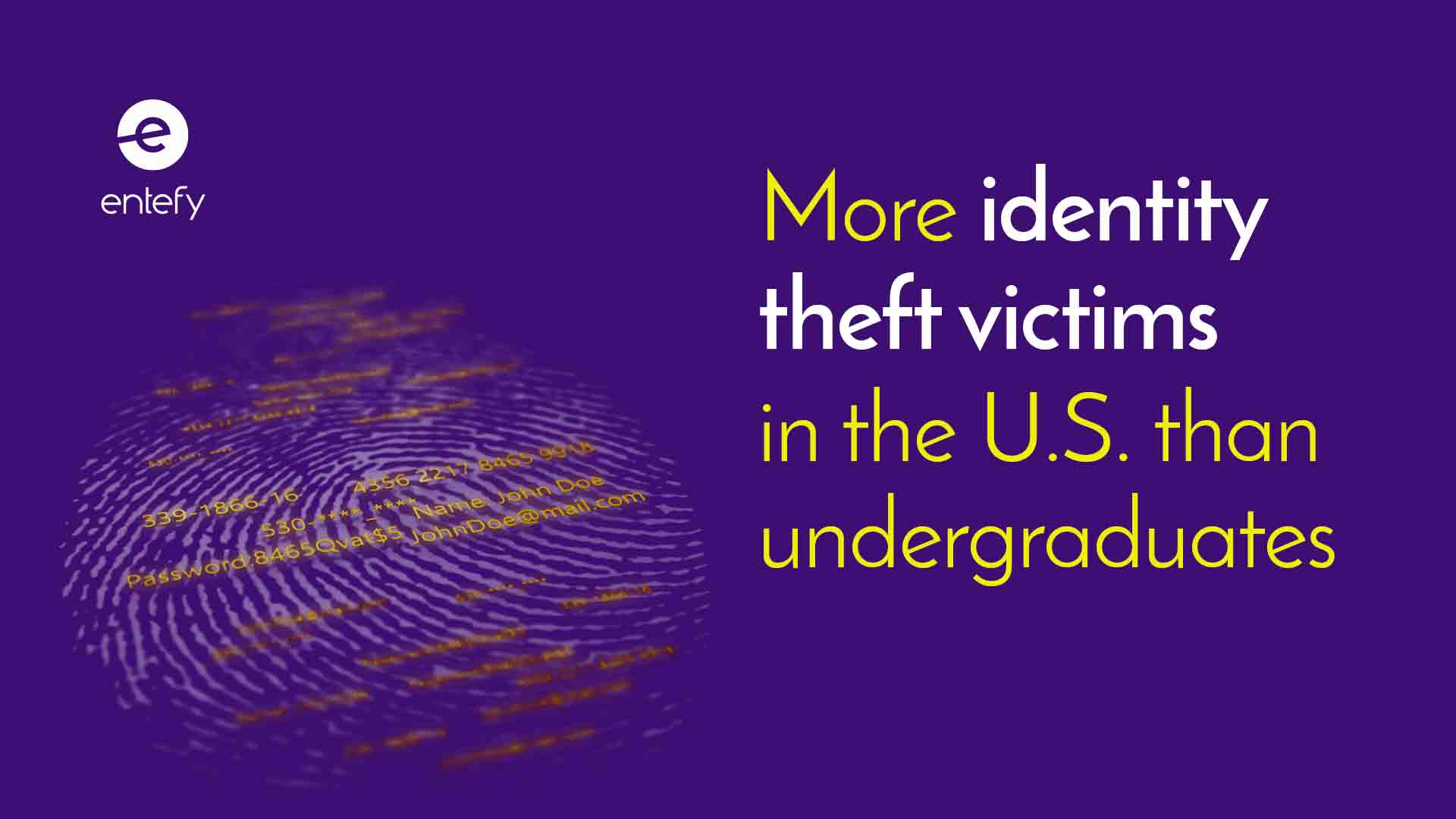
More identity theft victims in the U.S. than undergraduates

There is a war being fought online between people, corporations, governments, and other organizations defending against every “black hat” hacker determined to steal data, profit from ransomware, or any other nefarious act. You could say that victims of identity theft are a casualty of this war, paying a steep financial price when fraudsters use stolen credentials like Social Security numbers and credit card accounts to create false identities. 

If you haven’t been the victim of identity theft, or known someone who was, you’re fortunate because the problem has become widespread and all-too-common. In 2014, the latest year for which there’s data, 17.6 million U.S. residents above the age of 16 reported being identity theft victims. That’s 7% of the population aged 16 or older, according to the Bureau of Justice Statistics’ data. 64% of those victims experienced direct financial loss that averaged $7,761 each.

To get a sense of just how big a number that is, consider this. In 2015, there were 17 million undergraduate students enrolled at a university in the U.S., a number that’s actually 600,000 smaller than the total number of identity theft victims. That’s a grim reminder of the importance of cybersecurity in the modern digital world.

Entefy’s enFacts are illuminating nuggets of information about the intersection of communications, artificial intelligence, security and cyber privacy, and the Internet of Things. Have an idea for an enFact? We would love to hear from you. 

Fist

Social media: the promise to unite, the power to divide

Wael Ghonim helped spark a revolution that toppled Egyptian President Hosni Mubarak. This was 2011, so unlike, say, Che Guevara, Ghonim had access to social media to help organize people and protests. “Social media was crucial for this campaign,” he said. “It helped a decentralized movement arise. It made people realize that they were not alone. And it made it impossible for the regime to stop it.” 

Connecting people is the stated goal of social media, or at least it was. Access to everyone you know or have ever met, right there a tap or two away. Yet over time, the promise of social media has fallen short of its once high-minded standards. Even Ghonim, six years after the Egyptian revolution, concludes: “The Arab Spring revealed social media’s greatest potential, but it also exposed its greatest shortcomings. The same tool that united us to topple dictators eventually tore us apart.” 

Social media platforms today don’t represent unification but division. Instead of bringing all of us together, it brought some of us together. Social platforms are more likely to consist of clusters of like-minded people with largely similar viewpoints and beliefs. The platforms direct our attention away from the people (and viewpoints) in the other clusters, by design exposing us to fewer of their updates and shares. What’s emerging is awareness that social media is leading us to become overconfident in our knowledge, to discredit divergent perspectives, and to make irrational decisions. We’re a long way from social media’s golden promise not too many years ago. 

The data defining social media echo chambers

In the modern economy data is power. With every online interaction, a user provides a small piece of information about their preferences and ideologies. While a single interaction may not reveal a great deal, thousands of them reveal quite a lot. The more a company learns about us, the better they become at predicting how we’ll respond to different types of information. 

Social networks want engagement and interaction. Clicks, likes, comments, and shares ensure people have their attention on the information at hand. When we don’t respond positively to some information, our psychological profile is updated, there’s a change somewhere in the algorithm, and we are shown less of that type of content in the future. When we respond positively, that type of content is reinforced. 

2016 study confirmed that these “echo chambers” exist on Facebook, and are made possible through confirmation bias and algorithm updates. “Confirmation bias helps to account for users’ decisions about whether to spread content, thus creating informational cascades within identifiable communities. At the same time, aggregation of favored information within those communities reinforces selective exposure and group polarization.”

The more we rely on social media to get our information, the more our biases will be reinforced. “This attention economy, vying for clicks, eyeballs, pushes people into very confirmatory outlets,” says Alex Krasodomski-Jones, a researcher at the Centre for the Analysis of Social Media, and who led a study that found these same political echo chambers are present on Twitter.

What happens is our social networks turn into a stream of information catered to each individual. The term “news feed” is apt, as more people use social media as a news source, the information they’re exposed to is continually customized for their tastes. It’s a self-reinforcing cycle that whisks us away from bipartisanship and into echo chambers, where everyone shares our opinion and supports our beliefs. 

Social media drives overconfidence in what we know

There is another behavioral impact caused by echo chambers: overconfidence in what we know and what we believe. When someone relies almost entirely on social for news and information, they naturally miss out on the perspectives and opinions of people occupying different ideological domains. A well-rounded understanding does not come from one-sided information.  

One study of how the Internet inflates our understanding of what we know suggests that accessing information online can cause us to become overconfident in our knowledge of it. The researchers asked participants a series of questions with some of them able to look up the answers online, followed by a second set of questions. Those that could look up information overestimated their ability to answer the following questions, even when they were unrelated, and even when their prior searches came up empty.

“We saw that people were more confident that they knew the answers—had the information in their heads—if they had access to search. It’s more like thinking you know how to fix a car if you have access to a mechanic,” says lead author Matthew Fisher in an interview with HBR. “Searching the internet is almost effortless, and it’s almost always accessible. You never face your ignorance when it’s there. Because we’re so deeply plugged into it, we misattribute the connection to knowledge to actually having the knowledge ourselves. It becomes an appendage.”

This builds upon other research into the “Google Effect” showing that when people look up answers online they tend to remember only where they found it, not what the information was. Other research into gut instincts indicates that our evaluation of truth can come from purely intuitive reactions, which value familiarity and ease of comprehension over any rigorous analysis. While these studies focus on the Internet rather than social media itself, it is on these social networks that we consume a lot of our information.

Putting all of these insights together tells us a lot about why we’re seeing the limits—and strains—of social media use. When we become sheltered and uninformed, we grow biased and overconfident in our knowledge thanks to being surrounded by confirmatory information; we either remain ignorant of opposing ideas or they appear to come from a discredited minority. Even the knowledge that validates our ideas often stays online rather than being incorporated into our memory. When it comes time to have any meaningful debate or discussion, we feel assured that we’re right even when we’re unable to support our argument.

We’re right, they’re wrong

People have always drifted towards other people who think and behave similarly. “Homophily, where we hang out with people like us, is an ancient human trait, resulting from our basic psychology. That applies to segmentation of media as well,” says Tom Stafford, a cognitive scientist at Sheffield University. Opposites, in this sense, do not attract. Social networks, while opening up a new world of communication and sharing, have inadvertently given people the opportunity to form insulated communities, and to reinforce an already problematic confirmation bias.  

Throughout most of our history we have formed small coordinated groups that depended on people sharing the same values and beliefs. Whether such cohesion can exist in groups numbered in the billions remains to be seen. What we can be sure of is that more content is going to be published every day, and a big challenge is going to be trying to get the good, truthful, objective information to spread across this network and into the attention of as many people as possible. 

Social media aided Wael Ghonim in making the Arab Spring possible by giving him a platform to organize people around an idea. Since then, people have grouped around many ideas, some of which are beneficial, others based on nonsense and erroneous assumptions. “Five years ago, I said, ‘if you want to liberate society, all you need is the Internet,’” recalled Ghonim. “Today I believe if we want to liberate society, we first need to liberate the Internet.”

Cybersecurity

10 cybersecurity and privacy threats that will make you miss Nigerian prince and lottery email scams

Phishing refers to any attempt to obtain a person’s sensitive private data—usernames, passwords, bank account numbers—or plain old cash, usually using a misleading email or other communication. If you’ve ever received an email from a down-on-his-luck Nigerian prince looking for some help, you’ve been targeted in a phishing scam. Believe it or not, people around the world lose $12 billion annually to phishing.

The New Zealand-based Internet safety nonprofit Netsafe has a novel tool for fighting back against phishing, called Re:scam, an AI-powered chatbot that responds to phishing emails. Not once, but again and again, as long as the scammer continues sending emails. Anyone can use Re:scam by sending a phishing email to a dedicated Netsafe email address. You can see the chatbot in action in this article.

Though Re:scam offers some humor, there’s nothing funny about the $12 billion annual loss due phishing scams. Phishing is digital activity we all need to be aware of, on the same list as malware and the unannounced collection or misuse of our sensitive private data. To help keep you informed about what’s going on in personal data security, we’ve assembled 10 examples of hacking and data collection threats to your digital security:

  1. Take a closer look at Facebook’s “People You May Know.” Facebook may know way more about you than you ever imagined, or intended. Case in point: a one-time sperm donor received a Facebook recommendation that he should connect with the child born of his donation—despite having no Facebook connection to the child’s parents. “Behind the Facebook profile you’ve built for yourself is another one, a shadow profile, built from the inboxes and smartphones of other Facebook users. Contact information you’ve never given the network gets associated with your account, making it easier for Facebook to more completely map your social connections.” 
  2. Entefy has previously examined privacy problems with so-called “Internet of Toys” products. Despite consumer concerns about invasive data collectors masquerading as toys, Mattel attempted to launch an Amazon Echo-style device intended for use by children. Briefly, because they quickly announced it was canceling plans to bring to market a smart device called Aristotle. Aristotle was “aimed at children from infancy to adolescence and was set to hit stores in 2018. The voice-activated Wi-Fi device with a companion camera was billed as a ‘first-of-its kind connected kids room platform’ that was designed to ‘comfort, entertain, teach, and assist during each development state — evolving with a child as their needs change.’” After a consumer safety petition gathered 15,000 signatures, two Congressmen sent a letter to Mattel in which they wrote: “This new product has the potential to raise serious privacy concerns as Mattel can build an in-depth profile of children and their family. It appears that never before has a device had the capability to so intimately look into the life of a child.”
  3. Google Home Mini given to a journalist ahead of the product’s launch suffered from hardware defects that caused the unit to make thousands of recordings without being purposefully activated. Or in his words, “spying on me 24/7.” Google resolved the situation by disabling the malfunctioning features. Nevertheless, the defect reinforces just how potentially problematic an Internet-connected home device can be if hacked or otherwise misused to secretly collect data about you and your family.
  4. File this under “potentially worrisome.” Apple’s iOS 11, the operating system that powers iPhones and iPads, has a new feature that provides machine learning functionality that third-party apps can make use of. Called Core ML, it lets developers make use of Apple’s artificial intelligence capabilities so third-party (non-Apple) apps can crunch user data to provide personalization services. Which isn’t itself a problem. But questions instantly emerged about privacy and security: “It’s hard to tell during App Store screening [Apple’s approval of a new app] whether a Core ML model can accidentally or willingly leak or steal sensitive data.”
  5. There’s a potentially serious privacy loophole in iOS that could allow any app with permission to access the iPhone’s camera to secretly take photos and videos without you knowing. Some apps might request camera access when starting up to obtain a profile picture of you, or to handle media you want to send to friends. If users grant an app permission to access their device’s camera, that app can now do much more than take a photo of you. What’s worse, there’s no indication of the app’s activity, so you’re none the wiser.
  6. Here’s a reminder of just how important software updates and vigilant security practices are these days. One malware research organization looked into the ransomware economy and found that there was a 2,502% increase in the sale of ransomware on the dark web from 2016 to 2017—in just one year. Entefy has covered how blockchain technology can improve cybersecurity, but it may be years before the potential for that increase in cybersecurity is fully realized. Until then, be careful out there.
  7. Security software provider Symantec shared some startling findings about malware on the Google Play app store: “We have encountered a new and highly prevalent type of Android malware posing as apps on Google Play and later adding compromised devices into a botnet. So far we have identified at least eight such apps, with an install base ranging from 600,000 to 2.6 million devices. This malware appears primarily targeting users in the United States, but also has a presence in Russia, Ukraine, Brazil, and Germany.” The company notified Google Play of these malicious apps and Google has confirmed removing these apps from the store.
  8. In an announcement straight out of a spy movie, security researchers at an Israeli university showed that security cameras infected with malware can receive secret signals and leak sensitive information. According to the researchers, “Security cameras are unique in that they have ‘one leg’ inside the organization, connected to the internal networks for security purposes, and ‘the other leg’ outside the organization, aimed specifically at a nearby public space, providing very convenient optical access from various directions and angles.” Hackers can potentially use this covert communication channel to install malware and steal data from any computing device connected to the same network as the camera.
  9. Not even pacemakers are safe from hackers. The FDA issued an emergency firmware patch intended to protect people who have a pacemaker from hackers. The FDA stated, “As medical devices become increasingly interconnected via the Internet, hospital networks, other medical devices, and smartphones, there is an increased risk of exploitation of cybersecurity vulnerabilities, some of which could affect how a medical device operates.” The software patch took just 3 minutes to update and did not require surgical removal and replacement of the vulnerable devices.
  10. Another category of security threat plagues the servers that power infrastructure like the electrical grid and banking networks. One such backdoor was found in software used by banks and energy companies. Called ShadowPad, the malicious code allowed hackers to secretly collect data as it passed through infected servers. This particular vulnerability was discovered by a security research firm after 17 days. The potential for a future backdoor malware to go undetected raises the specter of an energy grid shutdown like happened in the Ukraine

Entefy regularly covers data trackers and cybersecurity threats, most recently in a presentation highlighting threats to your sensitive private data.

Blockchain

Demystifying blockchain and Bitcoin

With news outlets breathlessly reporting every time the price of Bitcoin reaches new highs, all the hype around it might suggest that Bitcoin is the biggest thing since cruise control.  

Meanwhile blockchain, the infrastructure technology that makes Bitcoin, Etherium, and other cryptocurrencies possible, garners far less attention in the general media. Scratch just below the surface, though, and you’ll quickly find that new uses of blockchain are emerging daily. And those novel uses of this novel technology may be big or bigger than Bitcoin in the not too distant future.

Let’s start with a non-technical analogy that gives you some context for blockchain and Bitcoin. It goes like this: Blockchain is to paper as Bitcoin is to cash. That is to say, just like paper, blockchain is a foundational technology upon which other capabilities can be built. Bitcoin and other cryptocurrencies are the first examples of a new class of digital currencies that are built using blockchain. But already in development are other blockchain-powered applications like replacing Social Security numbers with a more secure digital alternative, creating securely encrypted yet easily portable medical records, and tracking and auditing government disbursements like tax refunds. 

How can a single technology support all those very different uses? Let’s take a look at how blockchain works. Then dive into how it’s being used.

Blockchain is a distributed, encrypted, auditable record of transactions

A good starting point for understanding blockchain technology is to picture an accounting ledger book, filled with line after line of transaction records. Pretty straightforward. But this ledger book has some interesting properties. First, there are copies of it all over the place, so that no one person controls access to the ledger. Next, anyone who wants to can inspect its contents at any time. Finally, adding a new line item to the ledger only happens after everyone agrees that the record is correct and accurate. There are security aspects as well, but we’ll get to that in a moment.

That’s the blockchain concept in a nutshell. Putting all of those items together gives us a working definition: Blockchain is a digital ledger that is distributed (no central owner of the records), encrypted (highly secure), and auditable (records can be inspected and verified). Let’s look at each of those elements in turn.

Blockchain is a type of distributed ledger technology, an electronic record of information where multiple copies of the ledger exist simultaneously and are always in sync. The information contained on the ledger can be anything, from transaction records to contracts between businesses to medical records. That’s an important point: Bitcoin uses blockchain, not Bitcoin is blockchain.

A blockchain system is digitally distributed across a number of computers in real-time. Being decentralized means that a copy of the entire blockchain record is available to all users via a peer-to-peer network. A peer-to-peer network simply means that computers hosting blockchain ledgers connect directly with each other, and not with one “hub” computer. There’s a key business implication here, which can be explained by looking at the financial services industry. Blockchain’s decentralized and peer-to-peer structure does an end run around service provider intermediaries like banks or brokerage firms. Using blockchain, buyers and sellers of a financial instrument like shares of a stock can transact directly without needing to use (and pay for) a brokerage firm. Big picture, pretty much any business based on collecting fees in exchange for connecting two parties in a transaction faces significant risk of disruption from a blockchain-powered alternative.

That last idea is a key part of why blockchain is considered a disruptive technology. The world’s largest banks are intermediaries that enable pretty much every possible financial transaction: loans, mortgages, capital equipment purchases, IPOs. In exchange for providing the infrastructure that makes these transactions possible, the banks collect fees. Highly profitable fees. So not surprisingly, financial services companies are moving quickly to implement blockchain.

The security aspects of blockchain technology are equally important, but far more technical. Without diving into detail, what’s important is that with blockchain, transparency and security go hand-in-hand. Each block in the blockchain is individually encrypted using a private and public key encryption framework. This creates security at the block level. 

Blockchains are auditable, meaning that anyone can inspect its records. This in turn creates another layer of security in which the blockchain becomes more secure with more participation. This is because more people monitoring the blockchain makes it nearly impossible to alter blockchain data in any unauthorized way. More eyeballs on the data, fewer chances of mistakes or opportunity to do anything nefarious with the records.

That’s the blockchain in a nutshell. Now let’s look at how it is used to enable cryptocurrencies.

Blockchain enables cryptocurrencies like Bitcoin and Etherium

The term cryptocurrency means secure digital money. To date, Bitcoin has attracted the lion’s share of attention, with Etherium a close second. But as of November 2017, there are 1,172 and counting cryptocurrencies each with its own blockchain infrastructure. 

Understanding the blockchain is actually the hardest part of understanding cryptocurrencies like Bitcoin. Because once you’ve grasped how a blockchain works, the only other thing you need to know about Bitcoin is that it’s a currency (and digital payment system) with records contained in its own blockchain ledgers.

Bitcoin has another concept that shines further light on the blockchain: Bitcoin mining. The world’s supply of gold increases as more of the substance is dug out of the Earth and introduced to the market. Bitcoins are also mined, but the mining process looks very different. Here’s how it works. Each Bitcoin block contains a unique, complex mathematical problem that is unsolved. Solving that math problem yields a reward in the form of Bitcoin (or a fraction of a Bitcoin). The people who attempt to solve these equations are miners; the process of solving them is called mining.

But like the millions who chased dreams of free gold laying around in streambeds during the Gold Rush, there’s a catch. Well, two catches. The first is that solving these mathematical problems requires the use of computing power. Lots and lots of computing power. In fact, so much computing power that dedicated computers called Application Specific Integrated Circuits have been designed to enable mining. And not only are these computers expensive, the electricity required to run them is considerable, which adds a steep cost to Bitcoin mining. The electricity being used in Etherium mining, for instance, is equivalent to the entire electrical usage of the country of Cyprus.

The other element that makes Bitcoin mining a risky proposition is built into the original design for Bitcoin. In a bid to prevent Bitcoin inflation (a rapid increase in supply), only 21 million Bitcoins can ever come into existence. Every 4 years, the number of Bitcoins available as rewards is reduced, making Bitcoin mining more difficult as time passes. In 2009, it took Bitcoin miners just a few days to mine 200 coins; in 2014, it took the equivalent of 98 years to mine just one. It is estimated that the 21 million Bitcoin threshold won’t be reached until 2040.

Blockchain beyond Bitcoin

Blockchains are being built by governments and companies around the world, using the advantages of the technology to enable new uses. Here’s a sampling of blockchain at work in a variety of industries:

To address concerns about safety and property damage, sharing economy companies could employ blockchain to provide secure, authenticated user reviews and histories. 

As more homeowners who use solar power find themselves net generators of electricity, a blockchain-powered electricity network could allow homeowners to sell power directly to other users, without paying fees to an incumbent provider.

Businesses can use blockchain for self-executing, self-enforcing smart contracts, for instance between a company that exports fruit and its shipping partner.

As a foundational technology, blockchain provides the raw material for innovation at startups and established companies alike. How will your industry make use of blockchain?

Shopping

$30 billion shopping spree in 3 days

November plays host to three of the world’s biggest online sales days. In China, there is Single’s Day on November 11 (11/11). Then in the U.S., Black Friday and Cyber Monday take place just as the Thanksgiving leftovers are getting cold, on the Friday after Thanksgiving and the next Monday, respectively. Many billions of dollars are spent by many millions of consumers chasing online deals. 

Let’s start with Singles Day, the Chinese retail holiday called the “anti-Valentine’s Day.” Online retailer Alibaba reported Single’s Day sales of an eye-melting $25.3 billion, 39% higher than the previous year. No doubt helped by Nicole Kidman and Pharrell Williams, who were enlisted to entertain shoppers. At the peak of the e-commerce frenzy, Alibaba processed 256,000 sales transactions per second, with 90% of sales conducted on mobile devices. 

In the U.S., Black Friday is traditionally driven by physical retailers, while the newer Cyber Monday is dominated by online retailers like Amazon. In 2016, $3.39 billion in Cyber Monday online sales eclipsed Black Friday’s $3.34 billion in online sales. Which puts into perspective the magnitude of Single’s Day: Black Friday and Cyber Monday online sales together are just a small portion of one Single’s Day.

Entefy’s enFacts are illuminating nuggets of information about the intersection of communications, artificial intelligence, security and cyber privacy, and the Internet of Things. Have an idea for an enFact? We would love to hear from you. 

Entefyer

Cutting-edge technology meets cutting-edge health science

Recently, Entefyers were treated to a health and wellness seminar called Health 360 presented by our advisor and investor Dr. Farzan Rajput. Known fondly to our team as Dr. Fuzz, Dr. Rajput is a cardiologist and the founder of Southcoast Cardiology in Southern California. He is also one of the masterminds behind Health 360.

The seminar begins with two key insights. First, most diet plans use a one-size-fits all methodology leaving many people dissatisfied with the results. Second, health and nutrition go far beyond balancing calories in and calories out or basic measuring of body mass index (BMI); the most recent nutritional science tells us that metabolism is a far more important factor. In fact, each of us have dietary and exercise needs that are as unique as a fingerprint. 

Through that lens, optimal health depends on factors like how the body processes macronutrients (carbohydrates, fats, and proteins), produces insulin, and activates different muscle groups during exercise. 

The seminar concluded with an informative Q&A focused on tips for making better diet and exercise decisions. As Dr. Fuzz pointed out, working at a fast-paced company like Entefy means getting creative about fitting health and wellness into our lives. Health 360 helps promote wellness in ways that sustain momentum and productivity far into the future. 

Entefy is committed to promoting the health and wellness of its team members, including hosting a previous Health 360 seminar in May.

Innovation

Big innovation takes courage

Innovation. A cornerstone concept in Silicon Valley, but a term that has worn a little thin from overuse. These days the word is trotted out to describe just about any new idea. Recall that the $700 Internet-enabled juicer Juicero was hailed as “the latest Silicon Valley innovation” before failing spectacularly after news broke that anyone could hand-squeeze the company’s proprietary juice pouches without needing the juicer. 

Innovation’s reputation has declined to where economists and tech insiders question whether the age of innovation has passed. As early as 2011, entrepreneur Max Levchin said that U.S. innovation was “somewhere between dire straits and dead.” His PayPal co-founder Peter Thiel agreed, asserting that “If you look outside the computer and the Internet, there has been 40 years of stagnation.” 

Well, yes and no. Every day it seems there’s some new app or service designed to make our lives easier or save us a few minutes here or there. There’s innovation in there somewhere. But aren’t most new startups examples of incremental improvement, and not fundamentally disruptive innovation? 

Despite the flurry of new tech products that have come to market in the past 10 years, innovation’s economic impact has flagged considerably. The Wall Street Journal noted that:

“Economies grow by equipping an expanding workforce with more capital such as equipment, software and buildings, then combining capital and labor more creatively. This last element, called ‘total factor productivity,’ captures the contribution of innovation. Its growth peaked in the 1950s at 3.4% a year as prior breakthroughs such as electricity, aviation and antibiotics reached their maximum impact. It has steadily slowed since and averaged a pathetic 0.5% for the current decade.

Outside of personal technology, improvements in everyday life have been incremental, not revolutionary. Houses, appliances and cars look much like they did a generation ago. Airplanes fly no faster than in the 1960s. None of the 20 most-prescribed drugs in the U.S. came to market in the past decade.”

Economists view this innovation slump as the reason that the standard of living in the U.S. is the same as it was in 2000. Even though there are more jobs than ever in science and engineering and even though patent approvals are at an all-time high, productivity growth is trending downward. Some experts say that the low-hanging fruit in tech innovation has already been captured, and all that’s left to pursue are complex, risky fields that are subject to strict regulation and public scrutiny.  

So, the question becomes, can you still innovate when every idea has been done to death?

Shifting the innovation conversation 

Let’s define what we mean by the term “innovation.” At Entefy, we evaluate innovative concepts according to three criteria:

  • Ideas that are novel for their time
  • Ideas with clear benefits
  • Ideas that are developed and implemented effectively 

In other words, innovative ideas are original, beneficial, ahead of their time, and launched successfully. We also prioritize the concept of courageous innovation, which often involves taking the more difficult path toward finding and developing truly transformative ideas. Ideas that require overcoming major obstacles: financial and technological risks, political headwinds, and the power of incumbents. The market doesn’t demand more incremental lifestyle improvements – after all, how many social sharing apps does one world need? The world’s most interesting and urgent problems require complex-challenging-difficult-to-bring-to-life solutions.

Seen through that light, it’s clear that innovation isn’t dead. The bar is simply much higher than it used to be. And the good news is that there’s reason for optimism. Advances in artificial intelligence, which encompasses a range of groundbreaking technologies, and blockchain are just two examples of foundational technologies that companies can use to create true innovation. Both artificial intelligence and blockchain are notoriously complex, but they offer great opportunities to create new solutions in a variety of industries.  

Finding new paths to true innovation 

Companies that want to innovate have literally limitless opportunities to do so. But they must be bold and resilient enough to tackle real problems. Fifteen years ago, social media platforms were revolutionary. They provided us with new ways to keep in touch with family members, friends, and classmates, not to mention gather real-time news, and amplify the voices of oppressed communities around the world. 

But today unless you have figured out how to build a social network that defies the trend toward ageist design, combats fake news, improves fact-checking, and resists bots and fake accounts, the chances are your idea isn’t all that innovative. Same goes for online delivery services and e-commerce platforms. The innovative ideas of today, and the coming decades, will solve more critical problems, and they’ll do it in groundbreaking ways. 

If you want to innovate for the long term within your company, start with business intelligence. Instead of tweaking existing products or chasing competitors’ latest updates, build something entirely new. By tracking your audience’s digital shopping and behavioral patterns, you’ll get a sense of what their pain points and frustrations are. That’s where you’ll find opportunities to deliver substantial value. 

But as we discussed above, we’re long past the need for better vacation rental apps. Yesterday’s innovators are today’s dominant platforms. Copying or iterating on what they’ve done does not add up to innovation. Instead of playing catch-up to past disruptors, use your business intelligence data to innovate for your audience’s needs several years out. If you can identify the products and services they’ll need in the coming years, you give yourself some lead time to invest in genuinely innovative ideas. 

Sometimes bigger companies find themselves in an innovative rut. As they grow larger, they’re beholden to a greater number of stakeholders, and they become risk-averse. One way to shake up your team’s thinking under these circumstances is to give them constraints. Even if your business is flush with cash, limit their budgets or the types of ideas you’ll accept. Set clear parameters for what counts as an innovative concept, and see what they come up with. 

You might also consider partnering with a company outside your field. Even if your existing product lines don’t have much in common, you can provide a fresh take on one another’s offerings. With shared values and a commitment to finding truly groundbreaking ideas, you’ll likely be able to create a product that sets a new standard in both your respective fields. Better yet, the collaboration could help both brands make inroads into new markets. 

Finally, tap your internal networks for ideas. Intrapreneurship programs could yield innovative ideas from unexpected places. Your product development team might be burned out, but an IT employee or marketing associate could be sitting on the next big thing. By instituting an intrapreneurship policy, you encourage people from across the company to think about your clients’ or customers’ biggest problems. 

Most important, you create a culture in which they feel free to voice those ideas instead of staying silent until they one day strike out on their own. Small businesses are hard to launch and even harder to sustain. With your resources and your employees’ insights, you both stand a better chance of bringing innovative concepts to market. 

At Entefy, we believe that innovation is alive and well. The appetite for truly new, beneficial uses of technology has never been stronger. But we also believe that innovating requires inventors to roll up their sleeves and do the hard work of building and launching complex systems. Those that rise to meet the challenge really will change the world.