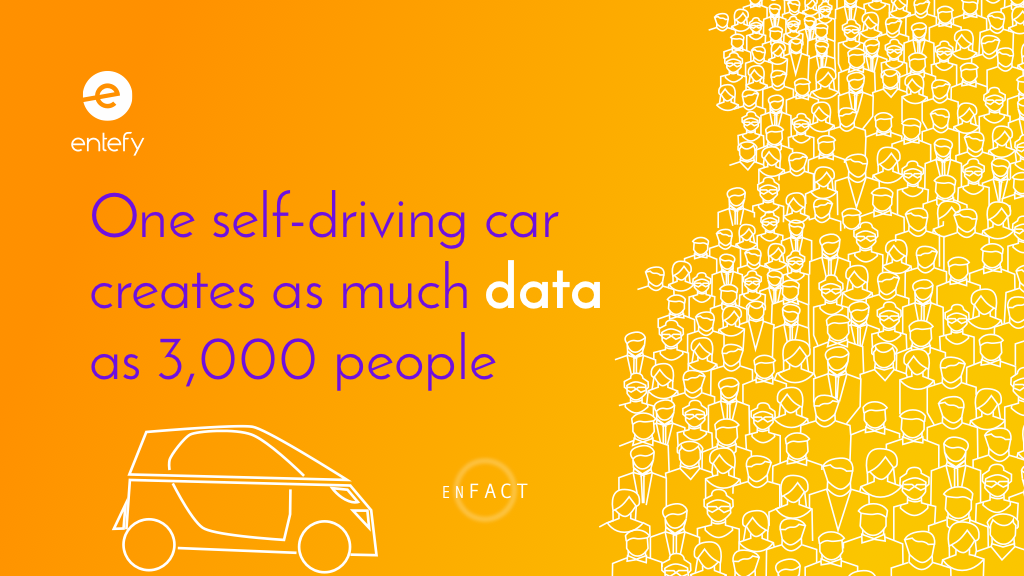
Data collection by self-driving cars is a growing market. Why do car companies collect data? Some data provides insight into how the car is running. The rest reveals what people are doing and where they’re going, information that’s sought after by retailers, marketers, governmental organizations, and more. McKinsey forecasts that this type of data collection could become a $450 to $750 billion market by 2030.
As things stand today—whether you’re browsing online, walking past a store front, even driving a car—it’s hard to get around the fact that everything we do generates data, and that data finds its way into growing resale markets.
Entefy’s enFacts are illuminating nuggets of information about the intersection of communications, artificial intelligence, security and cyber privacy, and the Internet of Things. Have an idea for an enFact? We would love to hear from you.
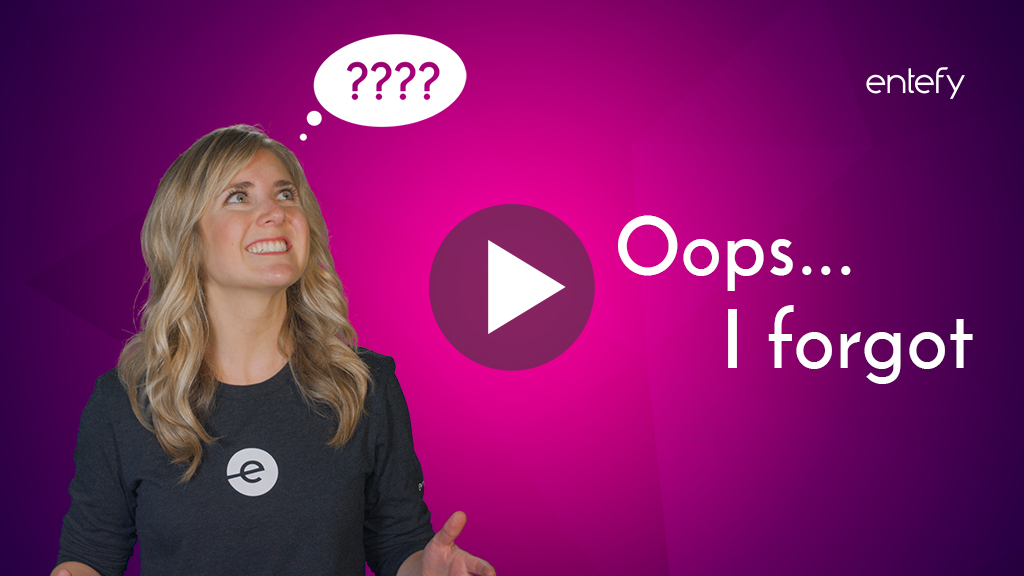
You memorize and memorize and memorize some more, trying to get something new to stick. And then whoops! You forget most of it a short time later. Sound familiar? Don’t worry, you’re not the only one. Because research confirms that there’s a universal rate of forgetting. A 19th century psychologist was able to map the rate of decline in memory retention after learning new information.
This video enFact explains how the Ebbinghaus forgetting curve works. If you’ve ever gotten frustrated not being able to fully remember a book, movie, or test notes…rest easy. It’s just the way our brains work.
Entefy’s enFacts are illuminating nuggets of information about the intersection of communications, artificial intelligence, security and cyber privacy, and the Internet of Things. Have an idea for an enFact? We would love to hear from you.
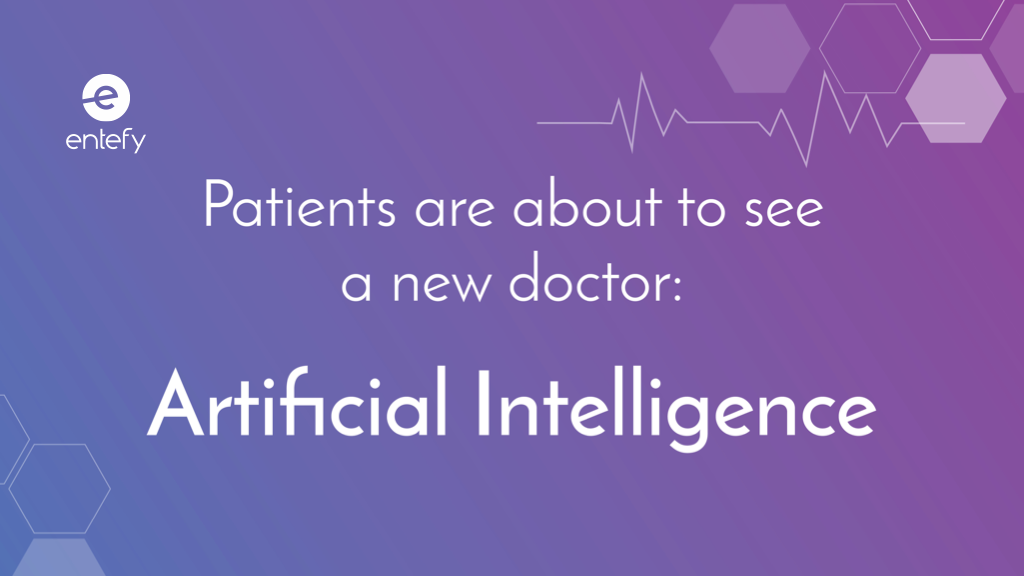
The health care industry has already seen advanced artificial intelligent systems make an impact in areas like medical diagnosis and patient care. But the long-term big-picture importance of AI in medicine may be something else entirely: a potential fix for the intractable problem of too few doctors and nurses worldwide. And as part of that, a solution to health care’s public enemy number one—paperwork.
Entefy curated a presentation based on our article “Patients are about to see a new doctor: artificial intelligence.” These slides provide a snapshot of how AI is at use in medical care today, the advances and limits of current AI systems, and AI’s potential in patient care. The presentation contains useful data and analysis for anyone interested in the intersection of AI and medical care.
People love a good David and Goliath story. Thanks to artificial intelligence, we may once again see many iterations of this narrative play out in the business space.
For a long time now, big corporations have held most of the cards. Their capital, brand recognition, large staffs, and access to data have dwarfed the resources and capabilities of small businesses. So much so that in 2015, the Global Fortune 500 represented $27.6 trillion in revenues and employed 67 million people. This is a stunning concentration of power in a relatively small number of corporations.
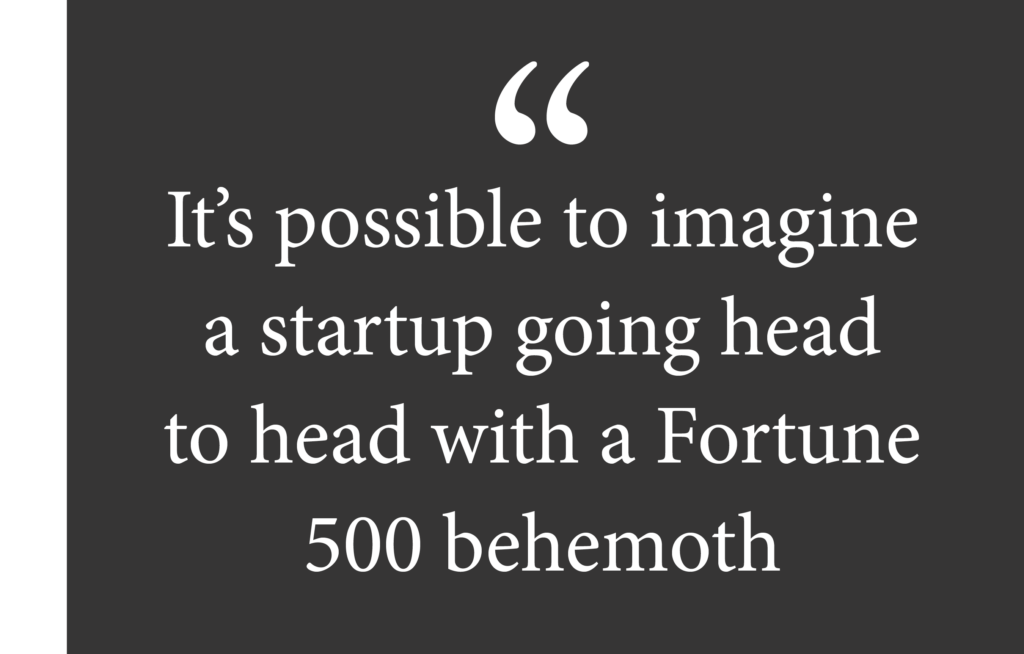
But AI is changing competitive dynamics and leveling the playing field in several ways. AI systems are becoming more advanced even as the cost to develop or access these systems is declining. We’re approaching a time when AI technologies will facilitate smarter, faster business processes at lower costs, allowing for some serious disruptions of existing markets by newcomers. It’s becoming possible to imagine a five-person startup going head to head with a Fortune 500 behemoth. Here’s how it might work.
Is history about to repeat itself?
One of the most dramatic David and Goliath business stories of our time is that of Microsoft outmaneuvering IBM in the 1980s. At its peak market capitalization in 1985, IBM was larger than Apple is today, accounting for 6.4% of the market value of the S&P 500 (compared to Apple around 4% today). With scale, personnel, capital, and clout, IBM seemed untouchable.
IBM was a pioneer in computing, but it was blinded by its own success. The company focused on mainframes and developed big, clunky computers as it always had. It invested heavily in large-scale enterprise computing even as advances in technology allowed for the advent of the personal computer market.
That’s when Microsoft seized its chance. The story of Microsoft’s development and release of MS-DOS while working on an operating system for IBM is the stuff of Silicon Valley legend. Microsoft knew that personal computing was a market with huge potential. As a smaller, more agile company, it was better-positioned than IBM to capitalize on it. By focusing on graphical user interfaces (GUIs) that could be used in personal computing, Microsoft catered to an entirely new market for home computers and found a way to outcompete its industry-dominating client.
Today’s big tech corporations should heed IBM’s disruption as AI becomes an increasingly significant component of their business operations. Many of the largest brands in the world are using AI to address their internal needs, building improved advertising systems, bolstering product recommendation algorithms, and collecting data for business intelligence (BI) systems. AI’s primary purpose in those cases is to serve the companies’ needs, not cater to their customers.
Focusing on internal needs and legacy systems—IBM’s strategic mistake—leaves the door open to the same technologies being applied to new products and customer experiences by disruptive competitors. Small businesses don’t need to spend heavily on operational improvements. They can direct their AI investments into consumer-facing products, targeting market segments that are overlooked or underserved by major corporations.
Take one San-Francisco-based startup using AI to disrupt the lingerie industry. Knowing that most women find bra shopping a grueling experience, the company created an app that enables women to find the perfect fit from the comfort of their own homes. The app uses AI to analyze photos submitted by the women to determine their sizes, a much more comfortable experience than being sized in-store while other customers may be milling around nearby. The application of AI to a novel business offering neutralizes the advantages of large networks of stores and existing brands.
In another example of disruption through AI, travel companies have begun using behavioral data and predictive analytics to customize brand experiences based on individuals’ preferences and patterns. Using this technology allows them to compete with major travel brands through unique, personalized offerings. That’s a powerful differentiator, considering that consumers crave personalization but delivering it can be a challenge.
No personnel, no problem
One traditional advantage of entrenched enterprises is large teams of highly specialized workers. These companies can attract top-tier talent and have the resources to hire employees for whatever critical tasks arise. Small businesses, meanwhile, get by with team members who are often jacks-of-all-trades by necessity.
But AI is neutralizing the large staff advantage, laying bare its associated limitations, like more bureaucracy and slower execution times. A smaller organization doesn’t suffer from those limitations because its teams can be flat and agile. Now add AI to the mix. AI-based services are capable of handling administrative tasks such as scheduling, invoicing, data entry, and even legal work. Right out of the gate, startup founders can outsource essential but low-level tasks to automated systems that operate faster and cheaper than human employees. Automating IT functions alone reduces expenses by 14% to 28%, so companies that launch using automated services quickly establish a financial advantage over larger, legacy burdened competitors.
For higher-level tasks, many AI software systems now include intuitive dashboards that anyone on the team can access and utilize productively. Centralized data hubs allow colleagues to draw from the same pool of information and track how their efforts impact the rest of the company.
Next generation customer-relationship management (CRM) systems, for instance, could be a game-changer for small businesses. CRMs help companies track important information about their customers—what they’ve purchased in the past, when they’ve interacted with the organization’s website, what they’re saying about the brand on social media. But CRM systems are generally cost-prohibitive for new businesses. They also only work if salespeople input customer data, and that’s a tedious, time-consuming task akin to analog paperwork.
That’s why some companies use AI assistants to integrate data from sales reps’ smartphones and work-related apps. Rather than spend hours inputting or scrolling through customer data, they’d have all the information they need at their fingertips. Without having to focus on low-level tasks like data entry, sales representatives can focus on building long-term customer relationships that lead to increased earnings for their companies.
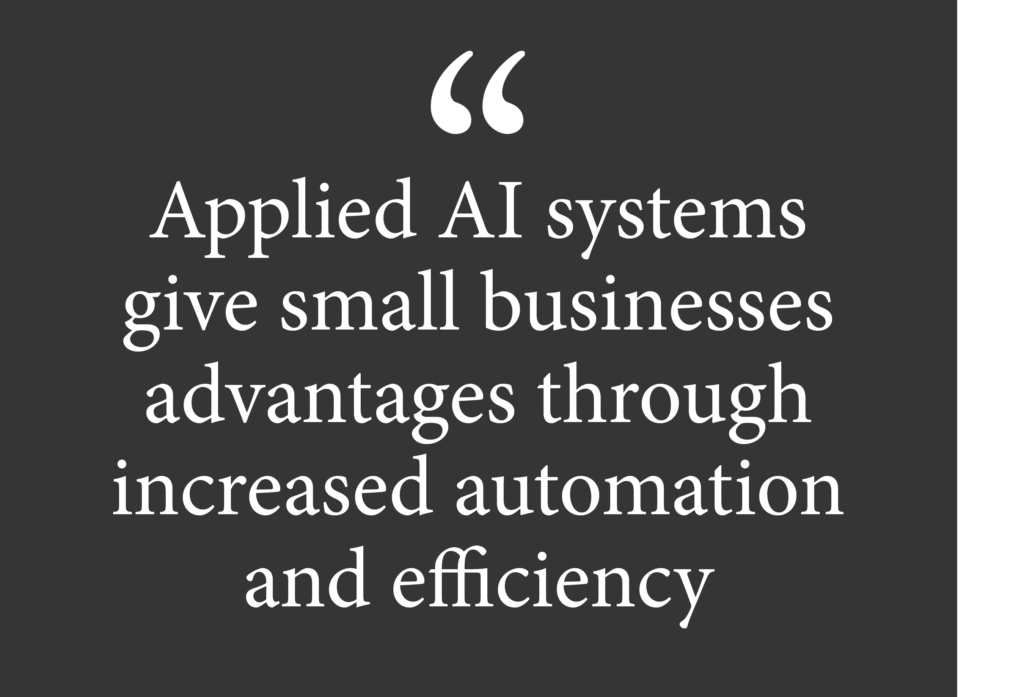
Real-time campaign analytics systems enable small, nimble organizations to pivot quickly based on performance. That ability is a critical competitive edge in today’s rapidly evolving consumer markets. Some tech experts believe that the current generation of applied AI systems, such as predictive analytics, will give small businesses advantages through increased automation and efficiency.
Cloud services and automated marketing programs also reduce costs and personnel needs considerably. The barrier to launching and growing a company successfully has lowered significantly, and the rise of adaptive small companies is closing the gap between the little guys and the titans of industry.
An example of this is in fintech, where startups are taking on major investment companies. They’re using dashboards and roboadvisers to offer smarter, more user-friendly ways for consumers to track, manage, and plan their investments. They expect AI to disrupt financial advisory services, and they’re building that anticipation into their services. Such foresight makes them uniquely suited to meet shifting consumer demands even when legacy organizations may struggle to keep up.
Attacking the large company data advantage
One area in which Fortune 500s may still hold an advantage is in their vast stores of customer and market data. That information can be used to make predictions and inform product development, and newer, smaller companies simply don’t have the same data pool from which to draw.
However, massive amounts of open source intelligence (publicly available data) on consumers is generated every day. People’s online behaviors, social media activity, and even geolocation check-ins contribute to a growing data pool that small businesses can tap.
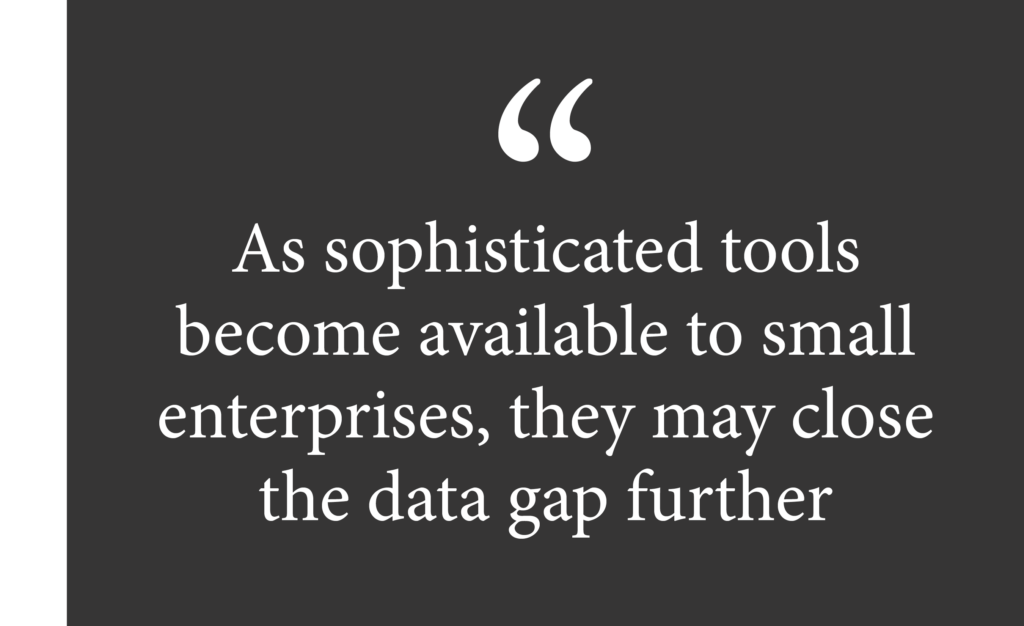
As increasingly sophisticated data tools become available to small enterprises, they may be able to close the data gap further. Business intelligence software was once so costly and complex, only major companies could afford to buy it and hire IT personnel who could make sense of it. Today, smaller businesses are taking advantage of the growing range of lower-cost BI solutions that essentially work out of the box. There’s no need to hire a team specifically to work with the software; it’s intuitive enough that anyone can draw insights from it.
New BI platforms offer data visualization, customer relationship management programs, and other critical BI services. One micro-lending company uses a modern BI program to conduct performance analyses of its beneficiaries. It can now identify under-performers in a fraction of the time it took when relying on spreadsheets. This is just one way BI is enabling businesses of all sizes to make faster, smarter decisions.
Focus on customers and their needs
Increasingly tech-savvy consumers demand seamless, automated user experiences, and a new generation of innovators will rush to meet the demand. AI is enabling these companies to compete based on the quality of their products and move quickly into new markets free of any legacy technology burden—basically, to apply the early Microsoft vs. IBM formula to today’s business environment. With the increasing automation and analytical benefits of AI systems, these companies can use the technology to assist with report writing, improve job listings, data crunching, and a range of other functions. Fewer people can do more with less.
As AI becomes more ubiquitous, small businesses will find further opportunities to go up against major players. The balance of power looks likely to shift from the biggest companies with the greatest resources to those that can quickly create innovative services that satisfy real needs for consumers.
We know that smartphone use is changing our behavior. But there is evidence that our handy digital companions are also changing our bodies.
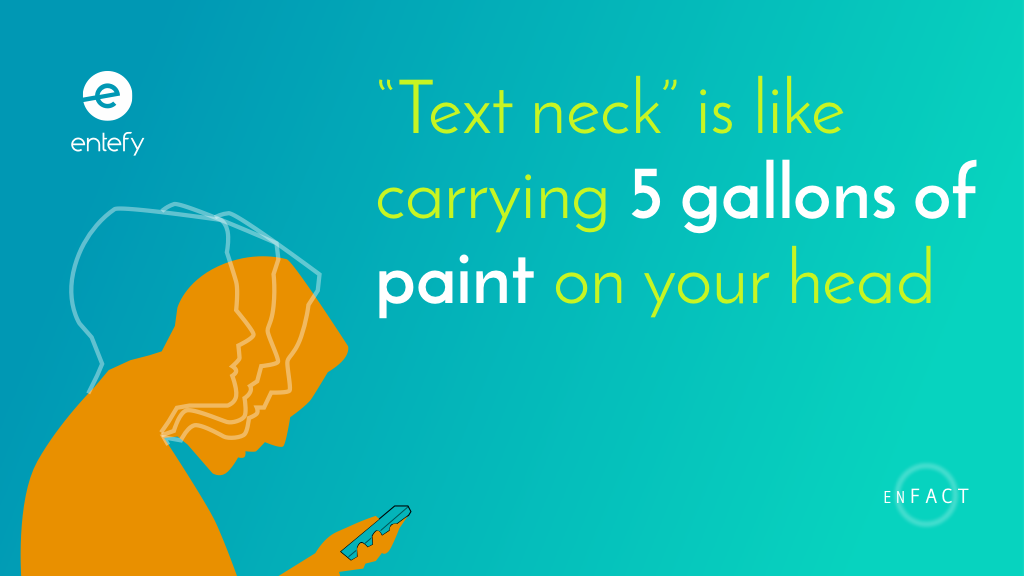
The healthiest posture is when you stand with your ears aligned with your shoulders and your shoulder blades retracted. But that’s not what we do when we, say, walk and text. We tilt our whole head forward to focus on the screen. Call it “text neck.”
According to one study into stresses of the cervical spine, this posture creates undue pressure on your spine. And the more you bend your neck, the worse it is for your spine. So much so that a relatively modest 15-degree tilt of the head creates the equivalent of 27 pounds of pressure on your spine. That weight increases the more you tilt: 40 pounds at 30 degrees, 49 pounds at 45 degrees, and a shocking 60 pounds at 60 degrees. Which is like carrying an 8-year-old child on your head. Or a punching bag. Or 5 gallons of paint.
Incidentally, it is estimated that people spend on average 4.7 hours daily on their smartphones. This represents the potential for more than 1,700 hours a year spent stressing out your spine. Entefy’s enFacts are illuminating nuggets of information about the intersection of communications, artificial intelligence, security and cyber privacy, and the Internet of Things. Have an idea for an enFact? We would love to hear from you.
Entefy sends green wishes to everyone celebrating Earth Day this weekend. Since the first Earth Day in 1970, the event has grown to include 1 billion people in 195 countries.
Environmental problems can seem so big compared to the scale of our day-to-day lives. Climate change. Biodiversity. Pollution. But it’s all a matter of perspective. Because when a lot of people act in concert, change can happen at the global scale. That is, after all, how Earth Day came about.
So in that spirit, here are some specific actions you can take today to contribute to a healthier, greener Earth.
Waste is accumulating in the oceans. The World Economic Forum estimates that, pound for pound, there will be more plastic waste in the oceans than fish by 2050. Even more concerning, there’s no practical solution on the horizon. But we can reduce the rate this pollution accumulates with new behaviors. Stop purchasing single-use plastic drink containers. Refuse throwaway plasticware at restaurants. And, of course, recycle. Read about 7 ways to reduce ocean plastic pollution here.
Global temperatures are rising. The politics of climate change are controversial and wrapped in partisanship. But we can all agree that using less energy leads to slower depletion of natural resources. There are a lot of easy-to-do actions that will reduce your energy use. Use compact fluorescent lightbulbs. Car pool and use public transit. Lower your thermostat in winter. See this excellent list of 10 actions you can take today.
Biodiversity is at risk. Life on Earth is defined by intricate connections between species. So reports that human activity has touched off a global extinction event are deeply troubling. With such a massive, global problem, what’s to be done? Again the logic holds that small changes in behavior can have outsized impact. Start with understanding how deforestation impacts habitats. And make biodiversity-friendly decisions when traveling and dining out.
It’s easy to get caught up in numbers when talking about the environment. But there’s only one number that really matters: 1. Because there’s only 1 Earth, we all need to treat her kindly. And we only get 1 shot at preserving a healthy, green environment for life in all its wondrous forms.
Entefy’s enFacts are illuminating nuggets of information about the intersection of communications, artificial intelligence, security and cyber privacy, and the Internet of Things. Have an idea for an enFact? We would love to hear from you.
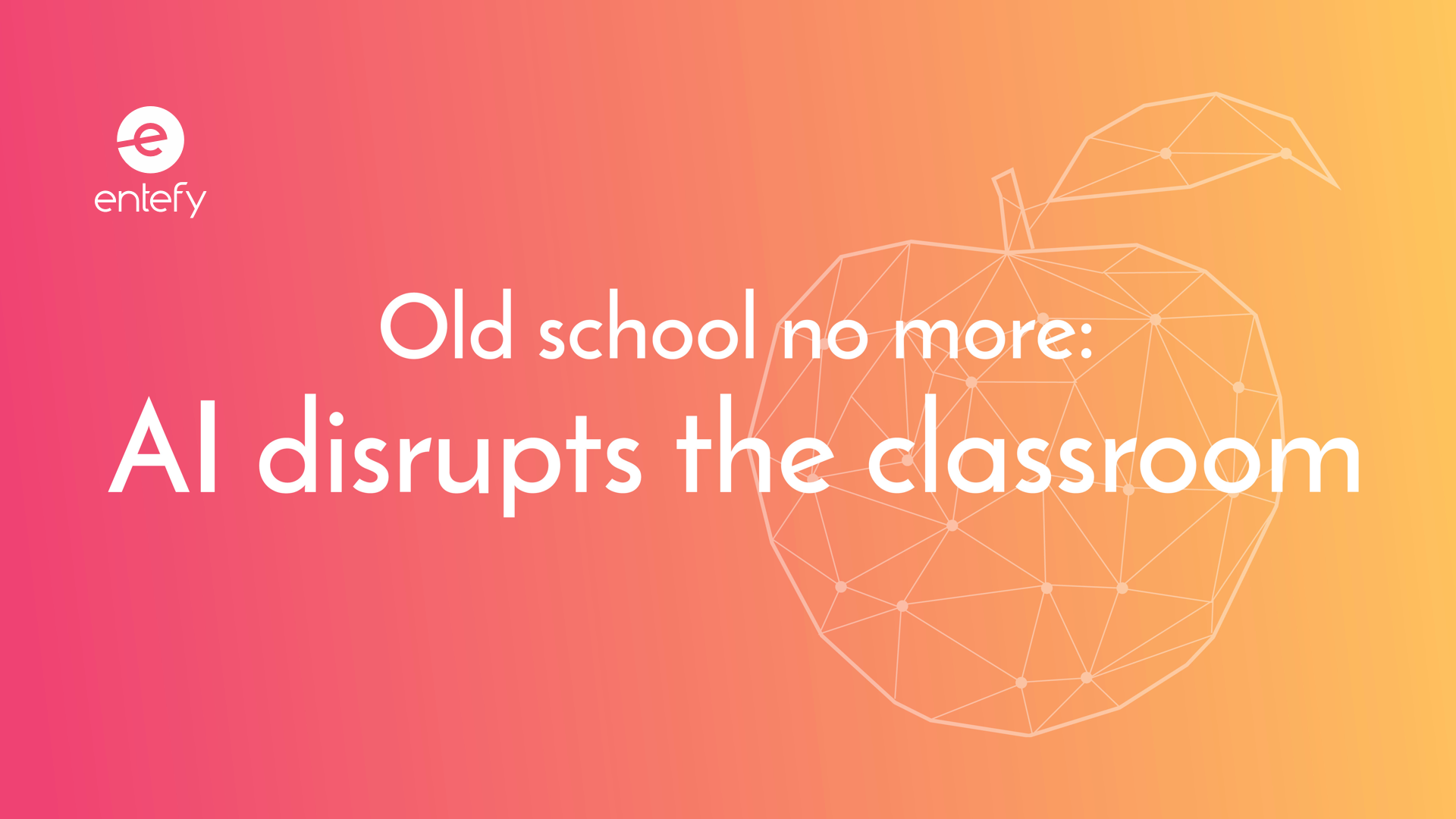
Over the years, multiple digital technologies have been heralded as the next big thing in education—personal computers, apps, and, now, artificial intelligence. Will AI be different? It has the potential to reshape classrooms and transform education in the years ahead. While the first generation of “AI Ed” will likely be limited to systems that supplement teaching, it’s possible to imagine an AI-powered teacher replacement. And if we can imagine it, history shows that we’ll eventually create it. What do these developments mean for parents, students, and teachers? Entefy curated a presentation based on our article about the impact of artificial intelligence in the classroom. These slides provide a look at education today, the promise and limits of current AI Ed offerings, and the possibilities of tomorrow’s AI-powered education. The presentation contains useful data for anyone interested in AI and education.
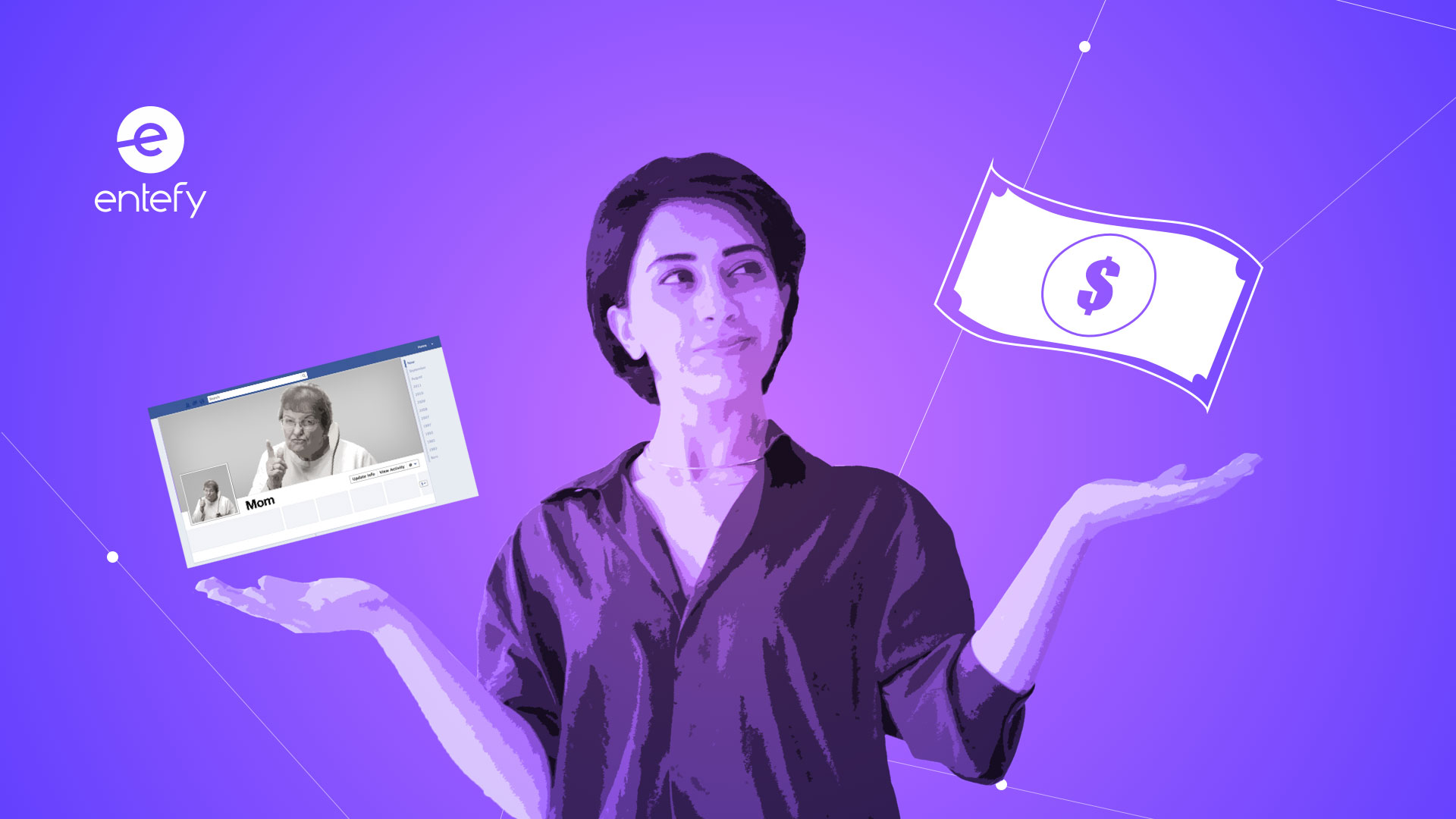
Artificial intelligence is powered by algorithms and the effectiveness of those algorithms is in large part determined by the data they work with. So developments in the use of AI in consumer lending are of interest because lenders, particularly alternative finance platforms, have begun using the social media data of loan applicants to determine their creditworthiness.
This trend carries the potential to create new consumer-friendly financial products but it also raises substantial concerns about privacy and bias. Issues that we’ll delve into here. We’ll start with a look at the ways our use of social media is changing, and then look at what those changes mean for social’s use in determining whether or not an applicant receives a loan.
The way we use social media has evolved
Human beings are having a collective social media identity crisis. What began as a means of sharing our lives with friends and family has evolved into something more calculated and less, well, social. From a pastime to an obligation.
In their early days, social media platforms offered people new ways to connect with their loved ones. We started carving time out of our day to check friends’ status updates or photos of a family member’s trip overseas. Social media gave people new options for connection and inspired closeness with people who were geographically far apart.
But social media has evolved into something far more complicated. Our social shares began impacting our career prospects. Evidence emerged that online interactions were fraying real-life relationships. Cyberbullying became a real concern. Many people responded to these developments by carefully curating their social media presences. We learned to be more mindful of what our online activities revealed about ourselves, and weighed each post, comment, and opinion against how it would impact us offline. We became aware of a simple truth: the data we create will outlive us all.
More recently, we’ve started asking more sophisticated questions about social media use. Do we pay a price for constant connectivity? Not just in career opportunities but in interpersonal relationships as well. Is the experience of round-the-clock notifications detracting from the quality of our lives? Are we sacrificing precious time with friends, family, and romantic partners for diminishing returns on social media?
Now with rapid advancements in artificial intelligence we have a new generation of considerations. Friends and employers aren’t the only ones evaluating our social activity. Ahead lies an era where the articles we post, photos we share, and even who we friend could impact our financial lives.
Here’s how social media-powered lending would work
Proponents of the use of social media data in lending say that the use of social data will help, not harm, potential borrowers. Including people with poor or minimal credit histories. Let’s say you want to take out an auto loan but have a weak credit score and little collateral. Your application is rejected based on a traditional risk assessment, but then the lender offers you the chance for a ‘second look.’ If you allow them to analyze your social media profiles, they’ll use that information to do a deeper evaluation that may result in an approval.
This review might include verifying your location and educational background via social data, along with an analysis of your online connections. If you’re connected to people in high-paying jobs, for instance, an alternative underwriting system might determine that you’re on an upward financial trajectory and are therefore likely to repay your loans.
In situations where social media use is voluntary and expands access to credit and other financial products, these new approaches have the potential to be groundbreaking.
Borrowers face entirely new questions about personal privacy
The challenge right now is that you don’t know how your social activity factors into the determination of your creditworthiness. This dynamic could lead to changes in who we let into our social networks and influence who we friend or accept as a connection. Will you decline requests from family members based on your perception of their financial circumstances? “Sorry, Grandma, I love you but I can’t accept your friend request. Your lack of upward mobility might ruin my chances of getting a loan.”
Continuing this logic, if we start evaluating friend requests against financial consequences, we reach a point where these platforms are no longer social. Rather than serving as welcoming environments for sharing news, posting milestones, and exchanging ideas, our social spaces may simply become extensions of our professional lives–carefully curated and impersonal by necessity. Call it the LinkedIn-ification of all social media.
Then there’s the issue of how much control we have over how our data is used. If social media companies themselves partner with lenders to assess creditworthiness via online profiles, we will be forced to make decisions about how we use social platforms and whether the potential financial benefit is worth a sacrifice in privacy and freedom of choice.
We’ve focused on social media here, but there are other online behaviors being evaluated in similar ways. Some lenders look at people’s typing patterns, device use, and online behaviors to evaluate whether they’re worthy of a loan. Even the time of day when a borrower requests financing could impact whether they’re approved. A small business owner who applies for a loan at “4 a.m. could be a signal of desperation” and therefore a higher risk than someone who applies during standard operating hours.
The only thing that doesn’t change is change
The use of social media activity in lending illustrates interesting yet problematic ways in which our online and offline lives are merging. This convergence is exciting and offers the prospect for new consumer-friendly financial products and an overall boost in convenience. The potential is there for these new products to prove beneficial in ways we can’t yet imagine.
But as in all areas where new digital technologies intersect with our lives, we must be mindful of how these shifts impact our privacy along the way.
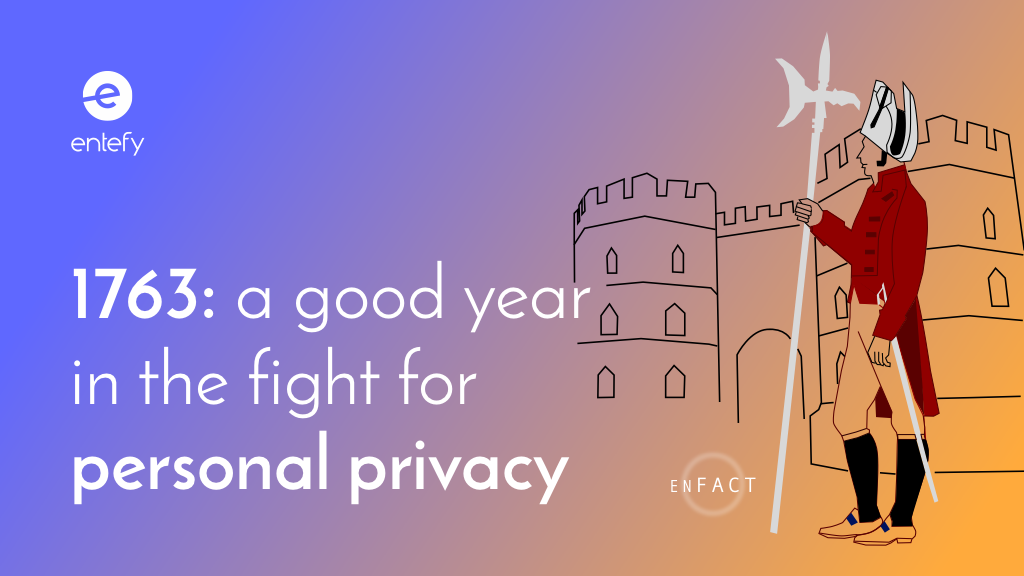
“The poorest man may in his cottage bid defiance to all the forces of the crown. It may be frail; its roof may shake; the wind may blow through it; the storm may enter; the rain may enter; but the King of England cannot enter – all his force dares not cross the threshold of the ruined tenement!”
The shorthand for this principle is the maxim “each man’s home is his castle,” which has become a foundational idea supporting freedom of thought and expression. These words would later inspire the structure of the Fourth Amendment to the U.S. Constitution and the due process clause of the Fifth.
A person’s right to privacy is more important than ever, and people deserve to have the companies that handle their personal identifiable information protect and safeguard their data.Entefy’s enFacts are illuminating nuggets of information about the intersection of communications, artificial intelligence, security and cyber privacy, and the Internet of Things. Have an idea for an enFact? We would love to hear from you.
This true story about a bird is pretty out of the ordinary. A carrier pigeon by the name of Cher Ami was awarded one of France’s highest military honors, the Croix de Guerre.
Cher Ami relayed a message for American troops caught behind enemy lines in a battle that took place during World War I. The brave bird was able to deliver a life-saving note that was shorter than a tweet. Because of his efforts, 194 soldiers were saved. Cher Ami is nothing short of a war hero. No matter how hard it might be for most people to properly pronounce “Croix de Guerre.”
Entefy’s enFacts are illuminating nuggets of information about the intersection of communications, artificial intelligence, security and cyber privacy, and the Internet of Things. Have an idea for an enFact? We would love to hear from you.
Request a Demo
Is your organization pursuing an AI-first transformation strategy? If so, start the conversation by submitting the form below.
Contact Us
Thank you for your interest in Entefy. You can contact us using the form below.
Download Data Sheets
See our Privacy Statement to learn more about how we use cookies on our website and how to change cookies settings if you do not want cookies on your computer. By using this site you consent to our use of cookies in accordance with our Privacy Statement.