Over the years, multiple digital technologies have been heralded as the next big thing in education—personal computers, apps, and, now, artificial intelligence. Will AI be different? It has the potential to reshape classrooms and transform education in the years ahead. While the first generation of “AI Ed” will likely be limited to systems that supplement teaching, it’s possible to imagine an AI-powered teacher replacement. And if we can imagine it, history shows that we’ll eventually create it. What do these developments mean for parents, students, and teachers? Entefy curated a presentation based on our article about the impact of artificial intelligence in the classroom. These slides provide a look at education today, the promise and limits of current AI Ed offerings, and the possibilities of tomorrow’s AI-powered education. The presentation contains useful data for anyone interested in AI and education.
Artificial intelligence is powered by algorithms and the effectiveness of those algorithms is in large part determined by the data they work with. So developments in the use of AI in consumer lending are of interest because lenders, particularly alternative finance platforms, have begun using the social media data of loan applicants to determine their creditworthiness.
This trend carries the potential to create new consumer-friendly financial products but it also raises substantial concerns about privacy and bias. Issues that we’ll delve into here. We’ll start with a look at the ways our use of social media is changing, and then look at what those changes mean for social’s use in determining whether or not an applicant receives a loan.
The way we use social media has evolved
Human beings are having a collective social media identity crisis. What began as a means of sharing our lives with friends and family has evolved into something more calculated and less, well, social. From a pastime to an obligation.
In their early days, social media platforms offered people new ways to connect with their loved ones. We started carving time out of our day to check friends’ status updates or photos of a family member’s trip overseas. Social media gave people new options for connection and inspired closeness with people who were geographically far apart.
But social media has evolved into something far more complicated. Our social shares began impacting our career prospects. Evidence emerged that online interactions were fraying real-life relationships. Cyberbullying became a real concern. Many people responded to these developments by carefully curating their social media presences. We learned to be more mindful of what our online activities revealed about ourselves, and weighed each post, comment, and opinion against how it would impact us offline. We became aware of a simple truth: the data we create will outlive us all.
More recently, we’ve started asking more sophisticated questions about social media use. Do we pay a price for constant connectivity? Not just in career opportunities but in interpersonal relationships as well. Is the experience of round-the-clock notifications detracting from the quality of our lives? Are we sacrificing precious time with friends, family, and romantic partners for diminishing returns on social media?
Now with rapid advancements in artificial intelligence we have a new generation of considerations. Friends and employers aren’t the only ones evaluating our social activity. Ahead lies an era where the articles we post, photos we share, and even who we friend could impact our financial lives.
Here’s how social media-powered lending would work
Proponents of the use of social media data in lending say that the use of social data will help, not harm, potential borrowers. Including people with poor or minimal credit histories. Let’s say you want to take out an auto loan but have a weak credit score and little collateral. Your application is rejected based on a traditional risk assessment, but then the lender offers you the chance for a ‘second look.’ If you allow them to analyze your social media profiles, they’ll use that information to do a deeper evaluation that may result in an approval.
This review might include verifying your location and educational background via social data, along with an analysis of your online connections. If you’re connected to people in high-paying jobs, for instance, an alternative underwriting system might determine that you’re on an upward financial trajectory and are therefore likely to repay your loans.
In situations where social media use is voluntary and expands access to credit and other financial products, these new approaches have the potential to be groundbreaking.
Borrowers face entirely new questions about personal privacy
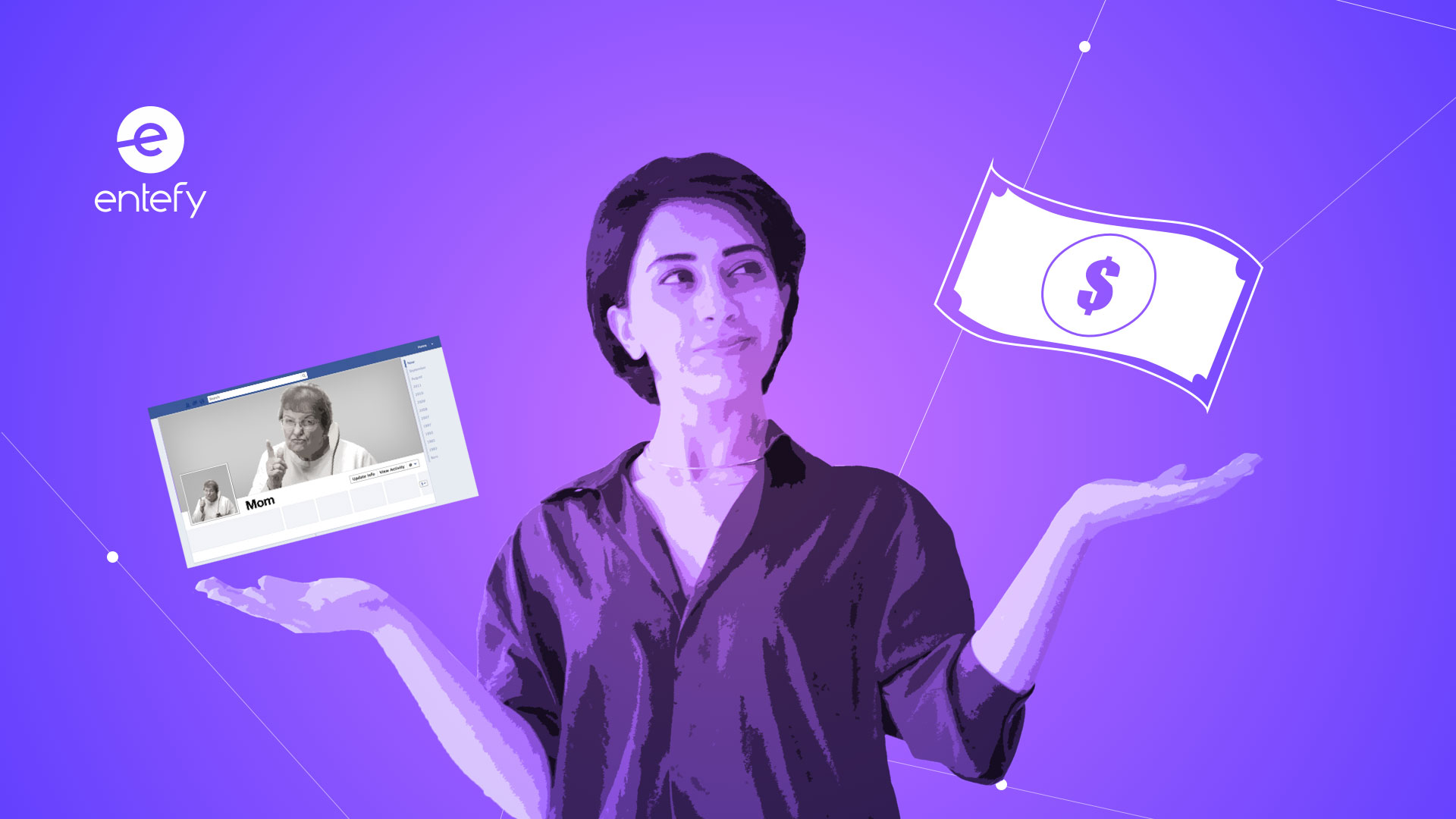
The challenge right now is that you don’t know how your social activity factors into the determination of your creditworthiness. This dynamic could lead to changes in who we let into our social networks and influence who we friend or accept as a connection. Will you decline requests from family members based on your perception of their financial circumstances? “Sorry, Grandma, I love you but I can’t accept your friend request. Your lack of upward mobility might ruin my chances of getting a loan.”
Continuing this logic, if we start evaluating friend requests against financial consequences, we reach a point where these platforms are no longer social. Rather than serving as welcoming environments for sharing news, posting milestones, and exchanging ideas, our social spaces may simply become extensions of our professional lives–carefully curated and impersonal by necessity. Call it the LinkedIn-ification of all social media.
Then there’s the issue of how much control we have over how our data is used. If social media companies themselves partner with lenders to assess creditworthiness via online profiles, we will be forced to make decisions about how we use social platforms and whether the potential financial benefit is worth a sacrifice in privacy and freedom of choice.
We’ve focused on social media here, but there are other online behaviors being evaluated in similar ways. Some lenders look at people’s typing patterns, device use, and online behaviors to evaluate whether they’re worthy of a loan. Even the time of day when a borrower requests financing could impact whether they’re approved. A small business owner who applies for a loan at “4 a.m. could be a signal of desperation” and therefore a higher risk than someone who applies during standard operating hours.
The only thing that doesn’t change is change
The use of social media activity in lending illustrates interesting yet problematic ways in which our online and offline lives are merging. This convergence is exciting and offers the prospect for new consumer-friendly financial products and an overall boost in convenience. The potential is there for these new products to prove beneficial in ways we can’t yet imagine.
But as in all areas where new digital technologies intersect with our lives, we must be mindful of how these shifts impact our privacy along the way.
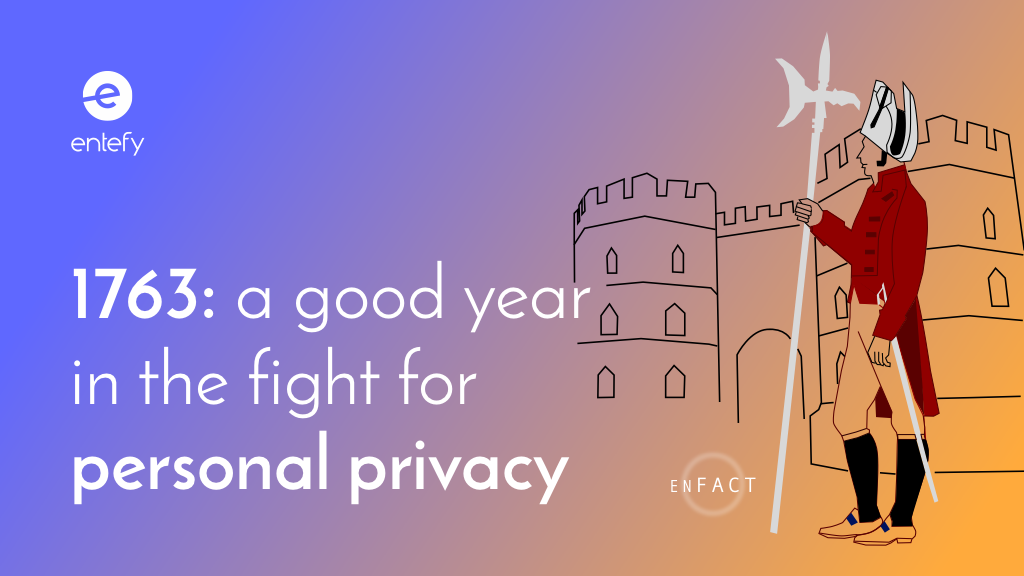
“The poorest man may in his cottage bid defiance to all the forces of the crown. It may be frail; its roof may shake; the wind may blow through it; the storm may enter; the rain may enter; but the King of England cannot enter – all his force dares not cross the threshold of the ruined tenement!”
The shorthand for this principle is the maxim “each man’s home is his castle,” which has become a foundational idea supporting freedom of thought and expression. These words would later inspire the structure of the Fourth Amendment to the U.S. Constitution and the due process clause of the Fifth.
A person’s right to privacy is more important than ever, and people deserve to have the companies that handle their personal identifiable information protect and safeguard their data.Entefy’s enFacts are illuminating nuggets of information about the intersection of communications, artificial intelligence, security and cyber privacy, and the Internet of Things. Have an idea for an enFact? We would love to hear from you.
This true story about a bird is pretty out of the ordinary. A carrier pigeon by the name of Cher Ami was awarded one of France’s highest military honors, the Croix de Guerre.
Cher Ami relayed a message for American troops caught behind enemy lines in a battle that took place during World War I. The brave bird was able to deliver a life-saving note that was shorter than a tweet. Because of his efforts, 194 soldiers were saved. Cher Ami is nothing short of a war hero. No matter how hard it might be for most people to properly pronounce “Croix de Guerre.”
Entefy’s enFacts are illuminating nuggets of information about the intersection of communications, artificial intelligence, security and cyber privacy, and the Internet of Things. Have an idea for an enFact? We would love to hear from you.
The Russian novelist Leo Tolstoy wrote in the novel Anna Karenina, “All happy families are alike; each unhappy family is unhappy in its own way.” It’s an idea that comes to mind when analyzing the significant and rapid impact that artificial intelligence is having at companies and within industries. Because while the specifics of these changes are unique to the dynamics of the individual industry, AI’s impact is happening everywhere all at once. The question of whether an industry is a happy or unhappy family depends on your perspective.
“Artificial intelligence” utilizes a cluster of technologies like machine learning, neural networks, computer vision, and natural language processing. What each area has in common with the others is the core building blocks of AI itself, algorithms that power systems with the capability to learn.
The programs most of us are most familiar with—email applications, spreadsheets, word processors, and so on—are engineered to link every input (for instance, a click on the interface in a specific location) to an output (like creating a new blank document). Each possible input is laboriously documented in a line of code and all of these lines of code together define everything a user can do with the program. By way of illustration, the Microsoft Office suite of applications has ballooned to more than 40 million lines of code.
Artificial intelligence works differently. AI systems are powered by algorithms engineered to find a solution to a problem without the programmer specifying all the steps to follow to solve the problem. So, for example, an algorithm can be pointed at the problem of how best to navigate through city streets without requiring specific lines of code that describe how to handle every possible path through those streets.
But much of the excitement about AI emerges from its ability to get better at solving problems over time. To learn. Unlike a traditional computer program, which only improves with more or better lines of code, a well-crafted AI algorithm can learn over time to get better at solving problems. So in an area like business intelligence (BI), an AI-powered BI system can provide insights about a company’s operations out of the box and then get better and better at delivering those insights as it analyzes the company’s performance data over time.
We’ve written quite a lot about how AI algorithms are transforming industries large and small. Here are some highlights of our findings:
Insurance. What’s distinctive about the insurance industry’s adoption of AI is how these companies intend to collect their data. Insurers are turning to sensors to collect data directly from individuals, including technologies like in-home monitors and wearables. And whenever data collection intersects with a real person, privacy questions emerge. See AI and insurance: How much privacy would you trade for a cheaper policy?
Education. Since the advent of the personal computer, digital technologies have long been heralded as the next big thing in education. But artificial intelligence is unlike any digital technology the education system has encountered. What will it mean for parents if their children can learn just as well, if not better, from the comfort of their homes instead of traditional classrooms? See Artificial intelligence may transform education, but are parents ready? and Old school no more: AI disrupts the classroom.
Professional sports. Proponents of automated officiating in professional sports say that AI could reduce corruption and improve the accuracy of referees’ decisions. And it seems likely that the technology will play an increasingly prominent role in athletics. But the transition won’t occur overnight. See What would the Super Bowl look like with AI referees and other smart technologies?
Health care. The World Health Organization has estimated that there is a global shortfall of approximately 4.3 million doctors and nurses, with poorer countries disproportionally impacted. Around the globe, researchers are studying how AI might become a new tool in the caregiver tool kit, from diagnosis to personalized medical advice to insights into genetics. See Patients are about to see a new doctor: artificial intelligence.
Law. While AI judges aren’t likely to be sitting on benches anytime soon, the adoption of artificial intelligence solutions in the legal system is happening and happening rapidly. AI’s impact on the practice of law looks like it will begin inside firms. Where it goes from there and how much it will impact people involved in lawsuits remains to be seen. See Will AI-powered robot lawyers still use cheesy billboard ads?
Online dating.That time- and labor-intensive process we call “dating” is characterized by a notoriously high failure rate. Developments in the use of AI in online dating systems raise the question of whether machines are better matchmakers than we are. We look at some of the ways advanced artificial intelligence is being developed to take automated matchmaking to a new, hands-off level. See Game, set, match. Is there room for AI in the game of love?
Be sure to follow us on your favorite social platform to stay in the loop on emerging developments in artificial intelligence, communication, data privacy, and cyber security.
There are many ways a parent can teach and mentor a child. One of the most common takes place at home, with a parent reading to a child or helping them solve a particularly difficult math problem. But teaching moments can take place at work, too. An idea that Entefy supports by providing team members the flexibility to bring their children to work.
Around here, we believe in the sort of work-life fulfillment that grows out of a healthy integration of work and everything else. For parents—especially families with two working professional parents—this sort of integration can be a challenging tight-rope walk. Balancing the many responsibilities of work with the many obligations of family life. So to support our team members and their families, we encourage Entefyers to bring their children to work when doing so can help out at home—think teacher work days and summer vacations. The company has found that by supporting our team members this way, everyone wins: team members get extra support and the company benefits from happier, less stressed, more productive employees.
We thought we’d share the story of Entefyer Daryoush and his daughter Donya. Daryoush is Entefy’s UI/UX developer and one of the company’s earliest hires. He has been bringing his 11-year-old daughter Donya to the office from time to time since he started working here four years ago. During her recent Spring Break, Donya spent two days as an honorary Entefyer, helping around the office when she wasn’t working on her school assignments. Inspired by watching Daryoush and Donya interact, we asked them both about their experiences being together in the office.
Daryoush explained how bringing Donya to the office during a school break has many benefits:
“As a father, I always feel the stress of not having enough quality time to spend with my daughter. Being able to bring Donya to work has not only created this precious time, it has also lowered my overall stress. If I wasn’t able to bring Donya to work, I would only see her in the mornings and on some evenings before she goes to bed. Weekends get so busy, too, that there’s not always enough one-on-one time. By spending time with Donya in the office, I’m more attuned to how she’s feeling throughout the day. This has helped me understand her better and be a better parent.”
There is another important benefit to families. Joining a parent at the office exposes the child to real-world work environments. Daryoush explained:
“There are so many things kids learn when they go to work with their parents. It’s real-world experience that they won’t learn in school. It gets their minds thinking about what they might want to do in the future. When Donya is at Entefy, my role is to lead by example and help her see that work can be both fun and meaningful.”
This can have unexpected benefits:
“She gets inspired by everyone being productive around her and I get really excited when I see Donya getting involved around the office. The other day, she asked to learn how to paint in Photoshop, and I had the opportunity to teach her. When it was time to leave for the night, she didn’t want to go home! She enjoys being a part of the team and that makes me really happy.”
Luckily since Donya was in the office, we got the chance to ask her about her own experience:
“When I have a day off, I ask to come to Entefy because I get to spend more time with my dad. I love to learn about what he is doing and I like helping him with his work. One time we made a picture of a face out of a bunch of triangles. It was really fun!
I watch him at work and always think about how cool design is. My dad does a lot of things and I especially love photography. I want to be a photographer! I’m now more excited to grow up and have a job. I don’t feel work is boring when you have a lot of people who are cheerful all the time.”
Happy team members, happy kids, and…happy companies? Yes, indeed. There is convincing evidence that mingling work and family delivers tangible benefits to companies. In fact, happy employees experience a 12% boost to their productivity by getting more done without any measurable loss in quality. As we see with Daryoush and Donya, that’s been our experience too.
In the words of one technology analyst, the legal profession hasn’t really changed since the time of Charles Dickens. And like the never-ending Jarndyce and Jarndyce lawsuit in Dickens’ Bleak House, today’s courtrooms are overburdened and justice often frustratingly slow. Advances in artificial intelligence are changing these long-entrenched realities, and changing them fast. But just what does this mean for lawyers, judges, and the many individuals involved in court cases and other legal proceedings each year?
The jury trial is just one aspect of the U.S. judicial system (the courts) and the legal industry in general (the firms). And while AI judges aren’t likely to be sitting on benches anytime soon, the adoption of artificial intelligence solutions in the legal system is happening rapidly. AI’s impact to the practice of law looks like it will begin inside firms. Where it goes from there and how much it will impact people involved in lawsuits remains to be seen.
Teaching lawyers new tricks
It’s worth noting just how large the U.S. legal services market is. Data from Thomson Reuters, which consolidates law firm revenue and corporate spending on internal legal departments, pegged the market at $437 billion. Nearly half a trillion dollars are spent annually on everything from contracts to intellectual property to litigation.
At risk is the revenue model common to many large law firms. These firms assign recent law school graduates to extremely labor-intensive projects like reviewing documents related to litigation. These lawyers review and analyze massive volumes of documents to identify, for example, particular emails that are relevant to a claim in a case. The law firm, which bills its clients on a per-lawyer, per-hour basis, leverages that work into a highly profitable revenue stream.
So when headlines like “Artificial intelligence disrupting the business of law” appear, a lot of people take notice. “One question lurking in all this is whether someone can come in and do to law what Amazon did to bookselling,” mused technology consultant Richard Susskind.
One global law firm, Allen & Overy, launched an AI-powered system to automatically draft contracts used by investment managers and traders in derivative markets. The firm estimates that its system, called MarginMatrix, can dramatically outpace a human lawyer: “Where one document would normally take three lawyer hours to complete manually, MarginMatrix can deliver this in three minutes. Using the system, the time taken to manually handle the 10,000 contracts on average that any major bank holds can be reduced from over 15 years in lawyer hours to just 12 weeks.”
The ultimate impact of AI in the legal industry may be quite positive. And it’s a story we see in other industries as well. By automating labor-intensive, low-value tasks, artificial intelligence systems free up lawyers and other legal professionals to concentrate on complex, high-value projects. But when between 13% to 23% of the average lawyer’s time could be automated, the financial impact to the industry is an open question.
The case for AI in the courtroom
The Sixth Amendment to the U.S. Constitution guarantees “the right to a speedy and public trial, by an impartial jury.” It cannot, however, guarantee a perfectly fair trial, an effective jury, or an infallible judge.
Humans make mistakes, and the courtroom is no exception: Juries make the wrong decision approximately 1 in 8 times. Put in human terms, that means more than 12 out of 100 defendants are wrongly convicted or acquitted. It’s not the sort of error rate we would accept in say, manufacturer defects. If 12 out of 100 new cars broke down a mile from the lot, consumers would be outraged and companies would lose money.
This error rate becomes even more difficult to accept when we turn to death penalty convictions. Here, data suggests that 1 in every 25 people sentenced to death in the United States are innocent of the crime they were found guilty of committing.
In broad terms, a trial involves the evaluation of a set of facts, the comparison of those facts to a set of rules, and a decision on whether a violation has occurred. Which sounds like a system that an intelligent machine could manage. A properly designed artificial intelligence system could in theory speed up trials and increase consistency in court decisions, which in turn could lead to improved accuracy and fairness.
This is not entirely speculative. The legal AI system called ROSS is an artificially intelligent attorney hired by one of the largest law firms in the U.S. In the UK, researchers are working on an AI that can replace the need for a judge by examining evidence and deciding right and wrong to predict the outcome of trials. “The AI ‘judge’ has reached the same verdicts as judges at the European court of human rights in almost four in five cases.”
Another AI system, a chatbot called DoNotPay, provides legal advice on issues like parking tickets, reimbursement for travel delays, and housing evictions. The system not only provides legal advice, but is able to generate documents that assist users in their legal disputes. While its interface and capabilities are limited, it is nonetheless a working example of machine-automated lawyering.
A solution to gridlocked courts
A defendant’s right to a speedy trial by a jury of his or her peers is a cornerstone of American jurisprudence. Yet courts are clogged with pending cases and humans are fallible, often swayed by emotion. Artificial intelligence agents could conceivably provide accuracy and impartially, but the jury is still out on whether they can become capable of moral and ethical reasoning.
Taken as a whole, the impact of artificial intelligence on the legal system appears likely to be pervasive. From the individual involved in a legal dispute, to the attorneys and judges handling the suit, and on up to the world’s largest global law firms, AI is poised to play a major role in improving the efficiency and effectiveness of the legal system.
And that efficiency impact may be the key to the country’s overburdened courts. In 2015, there were an estimated 30,000 Federal civil suits that had been pending for three or more years; and that was the fifth year out of ten for which that was true. Overall, an estimated 330,000 civil suits were pending that same year, up 20% from 2004. Lengthy trials and an overall shortage of judges form a bottleneck that delays legal resolutions and compromises the right to a speedy trial. AI stands ready as the tool to alleviate the gridlock of justice.
Entefy was excited to host 30 future entrepreneurs from Howest, University College of West Flanders in Belgium. These computer science, business, and sports students visited Entefy during their tour of Silicon Valley technology companies. In between site visits, the group explored Golden Gate Park, Yosemite National Park, and hit the beach at Santa Cruz.
Entefyers welcomed the visitors with warm conversation before everyone settled in for the discussion. Entefy’s Co-Founder Brienne talked about establishing the company and its early development. Alston, Entefy’s CEO and Co-Founder, spoke next, taking the students on a tour of Entefy’s approach to user data, machine learning, natural language processing, and context awareness and how it’s differentiated in the market.
Following a lengthy Q&A, Entefyers and guests mingled and posed for a group photo. We wish these rising stars safe travels on their return to Belgium.
Visits like these are another way we support the mission of STEM education and digital technology innovation.
From 2013 to 2020, the digital universe—the sum of all the websites, videos, documents, photos, messages, and data of all sorts—will grow by a factor of 10x.
What does this explosion of bits and bytes look like in physical terms? In this video enFact, we cover the amazing growth in the world’s data and express its mind-boggling size in a real-world terms.
Entefy’s enFacts are illuminating nuggets of information about the intersection of communications, artificial intelligence, security and cyber privacy, and the Internet of Things. Have an idea for an enFact? We would love to hear from you.
Is there room for the humble pen and paper in the digital world? After all, imagine how much knowledge would be lost if humans hadn’t invented writing. From clay tablets to quill and ink to QWERTY, the externalization of information—recording what’s in our heads via writing—and the ability to reproduce it en masse have been essential to humanity’s technological, scientific, and cultural advancement.
So as the sun sets on the era of longhand, it’s worth asking whether we are leaving anything important behind. And in fact recent research suggests that the answer is a resounding “yes.” For all of its advantages in speed and efficiency, typing on a keyboard is disadvantaged in one critically important area: comprehension. The answer to the question “keyboard or notebook?” comes down to how deeply you want to learn the information recorded. In this era of lifelong learning, where knowledge acquisition plays an active part in our lives long after we’ve ceased being students, the reasons behind longhand’s everlasting importance are highly relevant. Don’t recycle that notebook just yet.
A little way-way-back story
Long before hunting and pecking, the philosopher Socrates expressed doubts about the value of handwriting (as in, putting pen to paper to memorialize thoughts and ideas). In conversations with Phaedrus, Socrates claimed that writing cannot possibly express thoughts with the same clarity as speaking can, and should therefore not be relied upon. He says to Phaedrus, “he who has knowledge of the just and the good and beautiful…will not, when in earnest, write them in ink, sowing them through a pen with words, which cannot defend themselves by argument and cannot teach the truth effectually.” In other words, to really own a concept you need conversation to state the idea, argue in its favor, and respond to criticism. The written word lacks that dynamism, and so in his view shouldn’t be relied upon. But Socrates’ query is not so much about longhand versus speech, as it is about whether writing primes your mind to acquire and utilize information. Which is certainly a relevant consideration in our digital world.
So now consider that handwriting has long been in decline. Does that mean humanity is doomed to lose the entirety of our accumulated knowledge? No, of course not. Handwriting is simply being replaced by its digital cousins, keyboards and touch screens. While typing on a laptop keyboard or tapping a thumb over a screen are how we prefer to record information today, good old-fashioned handwriting holds advantages over its digital counterparts. What might we be giving up when we abandon pen and paper? To answer that, we’ll start in the classroom.
The clickety clack of distraction
Look inside a university classroom today and you’ll see about 2 out of 3 students taking notes using laptops. One study of the effects of laptop use in the classroom found that 64% of students used their laptop during at least one class. Another analysis of laptop use in higher education found that 72% students surveyed felt that laptops were “helpful or very helpful” in supporting classroom learning. If the problem you’re trying to solve is taking more notes faster, laptops are the ideal solution.
The laptop is a tool, and with any tool, how well you use it determines what you can produce with it. One study on the effects of laptop multi-tasking found laptop-using students spent 42% of their time in class doing things unrelated to the class. Frequent multi-tasking using apps unrelated to the class had a statistically significant negative impact on academic performance. 90% of students in another study of law student laptop use during class engaged in unrelated activities for at least 5 minutes, with 62% of them strongly distracted.
Even putting distraction aside, the challenge with notetaking by keyboard is that it reduces the need to think about the information you’re recording, which impacts learning and comprehension.
Writing sticks around
Research into the advantages of longhand versus computerized notetaking found that written note-takers remembered more and had a better understanding of concepts. The researchers hypothesized that, thanks to the slower nature of writing, these students were forced to perform real-time prioritization and summarization of the material they were recording. In comparison, students who type process information in a shallow way, without deeper thought regarding what it means or what’s most important.
There is also research into “digital amnesia” suggesting that when we find and store facts and notes digitally, the lasting imprint on our memory is where to find that information, not what the information is. This effect has a positive side in that we can concern ourselves less with the details and concentrate more on the larger concepts the facts pertain to. Which would be great if we never had to, say, argue in favor of something or convince someone of an idea. Both activities require a working knowledge of the supporting facts as well as the core concepts. Yet the trend towards externalizing knowledge is clear: digital devices are fast becoming our chosen gatekeepers to facts.
The slow word movement
Is there a way to reap the benefits of both worlds? The speed of digital notetaking and the memory boost of longhand? Surely we want to remember more of the information we consume, to store more of the facts we need to support our theories and ideas. Yet we also likely want to rely upon our devices not only as a means to back up what we know but to efficiently organize the wealth of information we end up collecting.
Typing is a fast method for recording information and one that requires less mental effort, which certainly makes it appropriate in circumstances when time is in short supply and a comprehensive account is needed. However, writing would seem the better option if we want to start our relationship with any new information on the right foot. While writing may be slower, its very slowness is what forces you to focus on what’s most important and to summarize what you want to remember into its most basic form. It is the exquisite slowness of longhand that etches knowledge—and understanding—into your memory most effectively.
Request a Demo
Is your organization pursuing an AI-first transformation strategy? If so, start the conversation by submitting the form below.
Contact Us
Thank you for your interest in Entefy. You can contact us using the form below.
Download Data Sheets
See our Privacy Statement to learn more about how we use cookies on our website and how to change cookies settings if you do not want cookies on your computer. By using this site you consent to our use of cookies in accordance with our Privacy Statement.