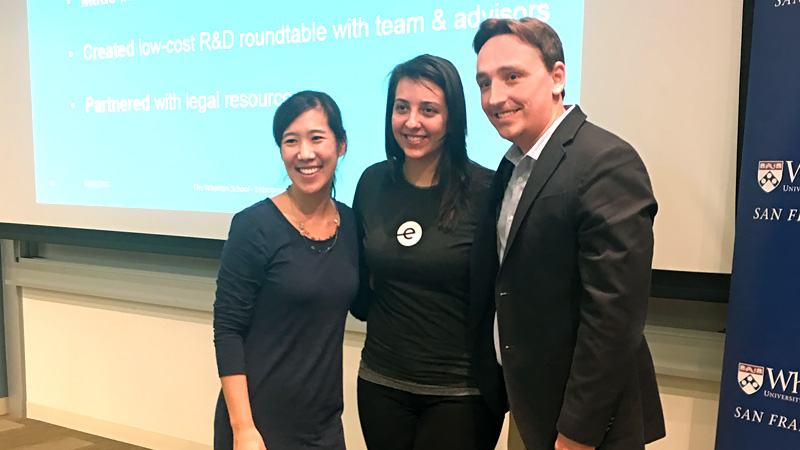
As a growing company, Entefy seeks opportunities to share insights with other entrepreneurs. Last week, co-founder Brienne joined Daniel Peterson, Intellectual Property attorney at Blank Rome LLP and friend of Entefy, to give a talk to Wharton MBA students at their San Francisco campus. The duo presented their thoughts on how the ownership of IP assets plays into entrepreneurship and the startup journey.
It was a beautiful evening for a visit to Wharton’s campus overlooking the Embarcadero and Bay Bridge. Brienne and Daniel were warmly welcomed by Professor Laura Huang and students before jumping into their presentation. Daniel provided an overview of intellectual property and Brienne discussed Entefy’s filed and issued patents, trademarks, and copyrights. The students asked questions based on their personal experiences and, as the event drew to a close, they met one-on-one with Brienne and Daniel.
Entefy promotes courageous innovation and entrepreneurship around the world. We welcome the opportunity to share our team’s experiences and discoveries with more groups like Wharton’s MBA students who are passionate about business and technology.
Take a wild guess at the number of YouTube videos watched every day. The number is astounding—we’re talking billions and billions. And there’s a reason for it.
Each day, 10 to 20 billion YouTube videos are consumed and the average adult watches 76 minutes of digital video. By 2019, video is expected to account for 80% of all consumer Internet traffic. Video is not only here to stay, but for many people it accounts for the majority of their online activity.
This video enFact explores reasons why everyone is watching so much video these days. The answer lies in how our brains process different inputs like video and text.
Entefy’s enFacts are illuminating nuggets of information about the intersection of communications, artificial intelligence, security and cyber privacy, and the Internet of Things. Have an idea for an enFact? We would love to hear from you.
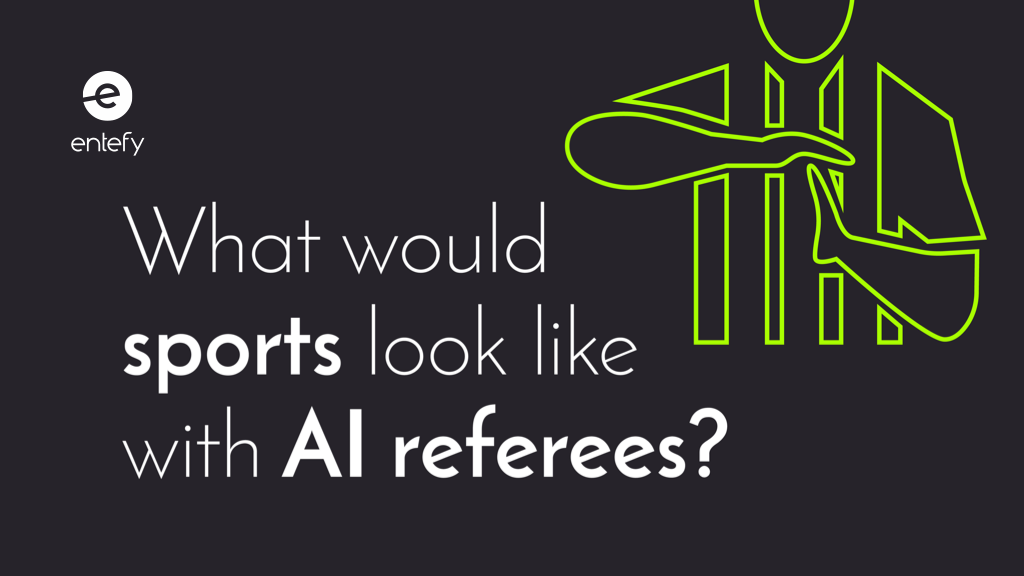
Does the idea of watching sporting events with AI referees sound futuristic? It certainly might. But when you take a look around the world of professional sports—football, soccer, fencing, basketball—advanced technologies are already having an impact on the roles of referees, coaches, players, and fans.
In fact, “precursor” technologies that provide the sensory input data for yet-to-be-invented AI algorithms are already in use. In some sports, athletes’ uniforms feature wearable devices and refs are using smart technologies to call plays. Technology looks likely to have a serious impact on how games are played and watched.
This presentation highlights key points from our article about how AI and other smart technologies might impact the future of professional sports. These slides provide an overview of the systems in use today, the rapid implementation of new smart technologies, and what fully automated refereeing might look like.
Entefy’s latest patent unlocks new possibilities in managing digital conversations across apps and services
PALO ALTO, May 10, 2017 – Entefy Inc. announced today that the company was recently issued a new patent by the U.S. Patent and Trademark Office (USPTO). Patent No. 9,639,600 describes a “System and method of personalized message threading for a multi-format, multi-protocol communication system.”
Entefy’s new patent advances the state-of-the-art in digital communication by allowing intelligent threading of conversations across multiple protocols and channels of communication. This innovation helps the Entefy platform make smarter connections about the meaning and context of messages, regardless of where those messages came from or how they were first transmitted.
“With so many apps and services, it can be difficult to keep track of your conversations. This Entefy innovation helps make sense of the conversations we have with other people even when they’re spread out over time and across different apps or services,” said Entefy CEO Alston Ghafourifar.
Today’s announcement is the latest patent announcement from Entefy in 2017. In March, the company announced the issuance of a new patent covering encrypted search. That patent strengthened the data security and search capabilities of Entefy’s core technology, deepening the company’s capabilities in protecting user privacy and data. In January, Entefy announced the filing of a group of 13 new patents in artificial intelligence (AI), security, and cyber privacy.
Entefy’s universal communicator simplifies everyday interactions between people, services, and smart things to help you live and work better in today’s digital world.
ABOUT ENTEFY
Entefy is building the first universal communicator—a smart platform that uses artificial intelligence to help you seamlessly interact with the people, services, and smart things in your life—all from a single application that runs beautifully on all your favorite devices. Our core technology combines digital communication with advanced computer vision and natural language processing to create a lightning fast and secure digital experience for people everywhere.
As automation and artificial intelligence advance rapidly, there is naturally a lot of discussion about how these technologies will impact work. It’s surprising how important multitasking is to this discussion. Why? Because the jobs least likely to be automated will be those that demand focused high-level thinking. In fact, the World Economic Forum’s “Future of Jobs” report predicts that active learning, critical thinking, creativity, and mathematical reasoning “will be a growing part of the core skills requirements for many industries.”
“Knowledge workers dedicate too much time to shallow work — tasks that almost anyone, with a minimum of training, could accomplish (e-mail replies, logistical planning, tinkering with social media, and so on). This work is attractive because it’s easy, which makes us feel productive, and it’s rich in personal interaction, which we enjoy (there’s something oddly compelling in responding to a question; even if the topic is unimportant). But this type of work is ultimately empty.”
Empty maybe, but certainly common. After all, for a long time now multitasking has represented the gold standard of productivity. Tapping away at an email while leading a conference call while updating a spreadsheet is the sort of behavior that many people admire and emulate. And technology gives us plenty of tools to make it easy to do so.
Then science came along and ruined all the multitasking fun. It’s now widely understood that “efficient multitasking” is an oxymoron, in large part because of a concept known as switching costs. Switching costs refer to the time it takes the brain to transition from focusing on one task to a second, generally measured at about a few tenths of a second per switch. Not significant by itself, but those seconds add up when we repeatedly switch from task to task. Do it enough, and research shows that switching quickly between projects can reduce productivity by up to 40 percent.
Unfortunately, multitasking has become ingrained in our daily habits, and most people struggle to operate any other way. We’ve become so accustomed to using multiple screens, browsing in multiple tabs, and swiping through multiple apps that many of us have forgotten what it is like to focus on one task at a time.
But if preparing ourselves for how to work best in the jobs of the future is what’s at stake, it’s worth the effort to shift away from multitasking toward…well, let’s call it unitasking.
The headwinds to unitasking
Unitasking simply means focusing on one task at a time. Ideally, paired with concentration unbroken by distractions such as emails, phone calls, text messages, or push notifications. These days, however, sustained focused can be elusive. When you’re in the habit of always being “on,” the idea of turning “off” can provoke what one researcher calls FOMO, the fear of missing out.
To make matters worse, multitasking on our phones, laptops, desktops, and tablets delivers the illusion that we’re getting a lot done. Then add the fact that practically everyone around us at work is doing the same thing. The pressure to be always available and always busy creates a “trap” that we often deliberately fall into, despite the fact that multitasking “is not a necessary or inevitable condition of life; it’s something we’ve chosen, if only by our acquiescence to it.”
Dr. Christine Grant, an occupational psychologist at the Centre for Research in Psychology, Behaviour and Achievement at Coventry University cautions people about these patterns, saying “The negative impacts of this ‘always on’ culture are that your mind is never resting, you’re not giving your body time to recover, so you’re always stressed. And the more tired and stressed we get, the more mistakes we make. Physical and mental health can suffer.” After all, our brains aren’t designed to handle several tasks at a time.
And that’s an important point. When we think we’re doing three things at once—getting the oil changed, making social plans via text, and catching up on a podcast, for instance—the brain’s ‘executive system’ in the frontal lobe is actually just shifting our attention rapidly between these activities. One MIT neuroscience professor described it as, “You’re not paying attention to one or two things simultaneously, but switching between them very rapidly.” Aside from a handful of multitask masters, most people can’t do several things simultaneously. The more tasks we attempt, the more poorly we perform all of them. And the more time we waste.
Estimates for the time it takes to fully regain your focus after getting distracted range from 23 minutes and 15 seconds to 30 minutes. We can lose hours if we’re switching gears several times a day.
Breaking the multitasking habit
Curbing the impulse to multitask during work is challenging. Fortunately, there are ways to strengthen our unitasking muscles. Scheduling uninterruptible time for priority tasks is a good start. Whether you’re writing a report, preparing a presentation, or learning to code, you need stretches of undisturbed time to make any real progress. You may choose to do this in the mornings before heading into the office or during the least hectic periods of your workday. The key is to eliminate distractions and let colleagues know not to disturb you unless there’s an emergency.
“To remain valuable in our economy, therefore, you must master the art of quickly learning complicated things. If you don’t cultivate this ability, you’re likely to fall behind as technology advances,” Cal Newport wrote. Seek opportunities to stretch your abilities and practice making connections between complex concepts.
Perhaps the most effective step we can take toward a unitasking mindset is being conscious of the choices we make and how we spend our time. Rather than succumb to the constant impulse to check notifications or log onto email, we can be mindful of whether these actions facilitate the deep learning and dedicated thinking that will help us advance.
As author and focused work proponent Srinivas Rao wrote in an essay about the competitive advantages of deep work, “Nobody ever changed the world by checking email. Significant creative accomplishments require focus, consistency, good habits, and deep work.” The future of work may well be unitasking, and it could usher in an era of more deliberate, conscientious use of technology to enable focus, not shatter it.
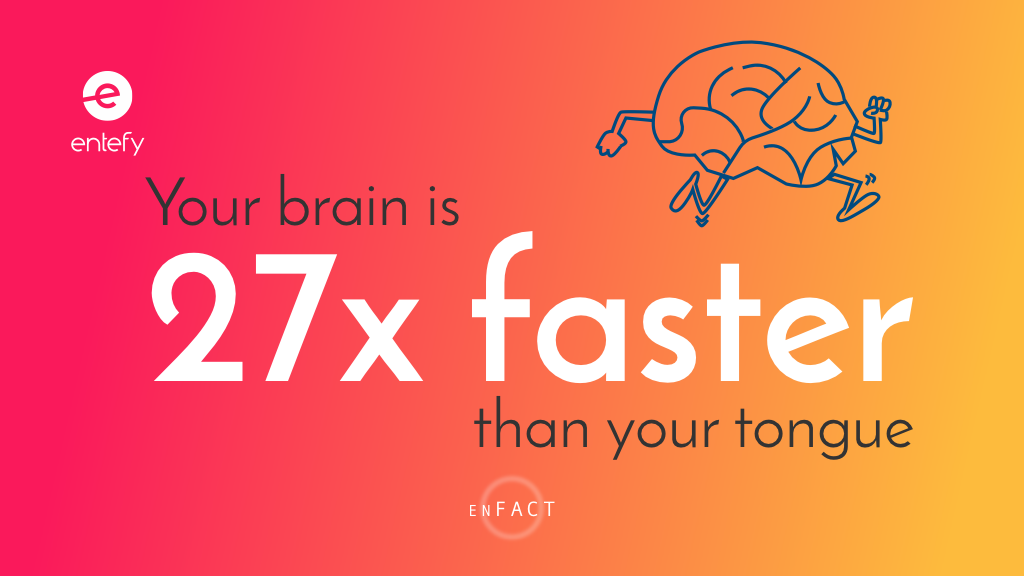
That is at a snail’s pace compared to another form of speech that we all engage in: inner speech. Inner speech is the scientific term for ‘talking to yourself in your head,’ the voice of your conscious thinking. Psychologists have measured the rate at which humans produce this speech at 4,000 words per minute. Or nearly 27x the speed of speaking aloud. To put just how fast that is in context, the Gettysburg Address at the speed of inner speech will loop about 15 times in the span of a minute.
This really puts some new meaning to just how fast we’re thinking when we’re “thinking on our feet.”
Entefy’s enFacts are illuminating nuggets of information about the intersection of communications, artificial intelligence, security and cyber privacy, and the Internet of Things. Have an idea for an enFact? We would love to hear from you.
Data indicates that about 55% of Americans are invested in the stock market through direct ownership of shares, stock mutual fund holdings, or retirement accounts. That figure jumps to 88% for households with income greater than $75,000. Many investors trust someone else to handle their investments, like a stock broker or financial advisor. What’s interesting is how quickly that “someone” increasingly refers to an artificial intelligence system.
Already, some 1,360 hedge funds rely on computer models to trade stocks and other investments. These funds represent $197 billion dollars of investor money being directed by lines of computer code. Most of these funds represent traditional “quant” (quantitative) funds that use computer models to predict share price movements and determine trades.
But an increasing number of hedge funds are entirely directed by AI-powered trading engines. These funds are at the vanguard of the use of AI in financial markets. And like many markets where AI is transforming business as usual, its use in investment markets represents innovative new investment products while simultaneously raising new questions.
The growth in AI-directed investing could have radical consequences. Especially in a scenario where a single investor or investment fund using proprietary AI is able to secure an unfair advantage over other market actors. Call it the stock market singularity. And the groundwork has already been laid.
Financial neural networks resurrected
The investment world began looking at artificial intelligence in the 1990’s. The focus then was on artificial neural networks (ANN), computer algorithms modeled after the connections that power the human brain. ANN can be thought of as a predecessor to today’s machine learning systems, computers that self-modify by learning from massive data sets. Neural networks were expected by some to transform trading in the 1990s, but the revolution never came. Their legacy, programmatic trading, lives on.
Programmatic trading is computer-controlled investing using algorithms to perform the roles of traditional investment professionals, like spotting opportunities, managing risk, and making lightning-fast trading decisions. This approach shifts a lot of decision-making onto computers, but the technology by itself hasn’t given one market actor an unfair gain over the others.
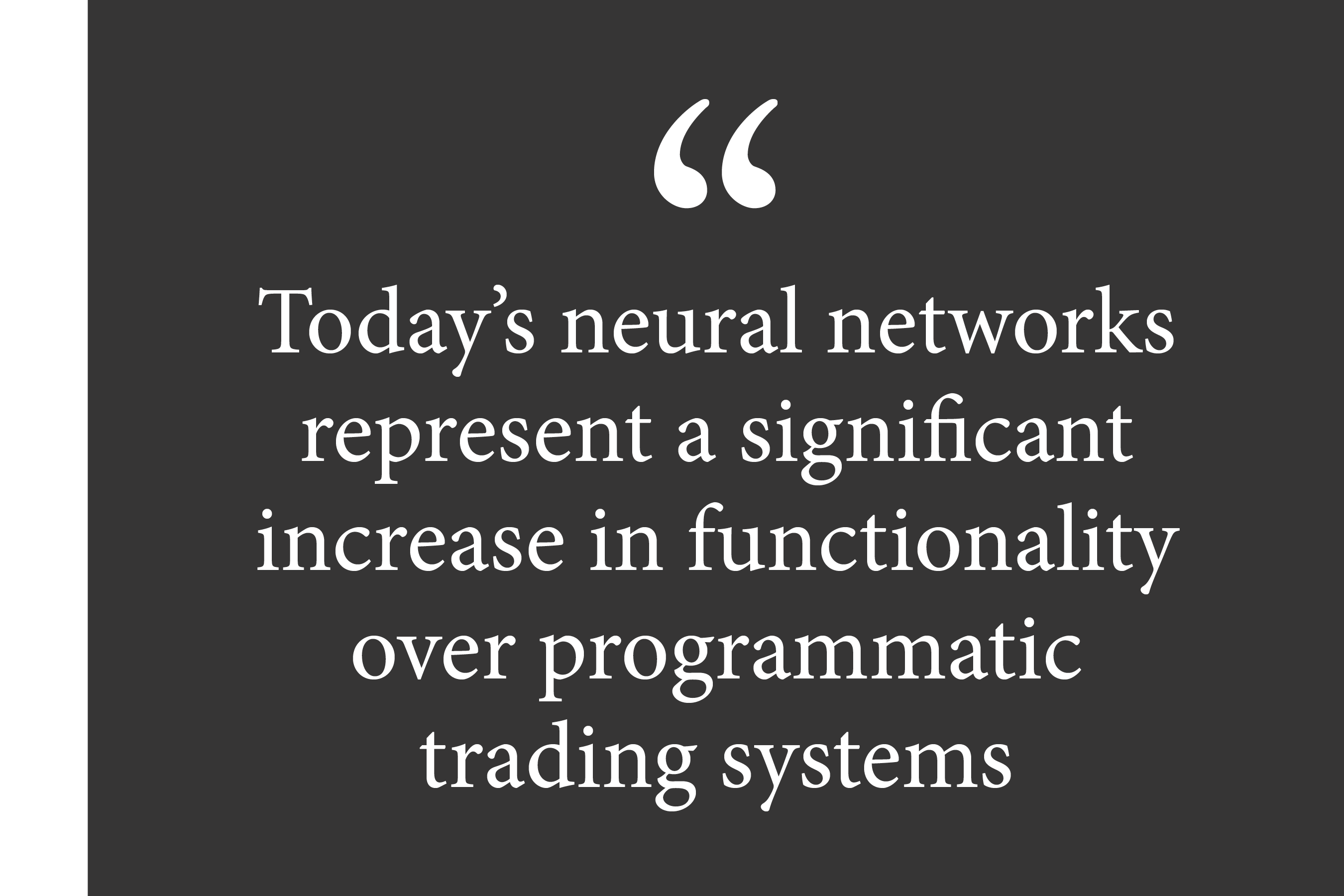
Today’s neural networks represent a significant increase in functionality over programmatic trading systems. The technology is already becoming mainstream – neural networks are used in voice-activated assistants and self-driving cars. Investment funds want to leverage these increasingly sophisticated systems to achieve faster, smarter trades and better yields.
To see why automated AI trading systems might generate a lot of unprecedented challenges, we need to walk through a few ideas.
On the path to an AI super-investor
Ever wonder why insider trading is illegal? It’s illegal because a single person with information not readily available to other investors has an unfair advantage. This is, in turn, significant because share prices should, in theory, reflect all of the information available about a company. Having knowledge that other participants don’t have creates the opportunity to trade (buy or sell) shares in anticipation of the price change that happens when that information becomes widely known. Knowing in advance that, for example, a company’s quarterly sales will be unusually strong allows that person to buy shares at a price lower than they will trade when that information becomes public. Insider trading and other rules that restrict investment activities of investors with special access to information are one way to enforce fairness among market participants.
Getting back to automated AI systems, we next need to get theoretical. It’s possible to imagine an AI system that’s a perfect predictor of a single financial variable like, say, interest rates. Another system might develop infallible inflation predictions. A third might get really good at predicting earnings growth in a particular industry. And so on.
If these individual systems are possible, it’s within reason to imagine a single system made up of several of these specialist systems. And though it’s far outside the limits of today’s technology, it’s at least plausible that that single system could make use of countless specialist systems that are near-perfect predictors of all of the key factors that move markets. That single system would, by this logic, be virtually perfect at predicting price changes in any—or all—tradeable assets.
Now picture this AI system in the hands of a single investor.
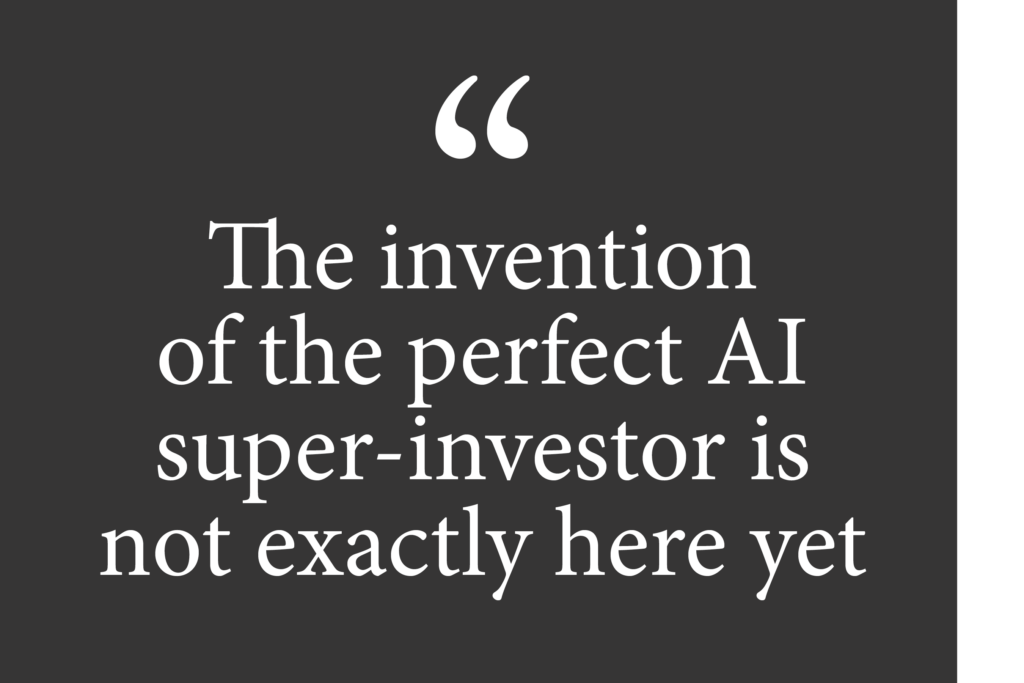
The invention of the perfect AI super-investor is not exactly here yet. But this is the sort of consideration that rapid advances in artificial intelligence require. Because if there’s a chance such a perfect system could come into existence—for the benefit of one individual or group at the detriment of everyone else—it’s worth having a conversation about what to do about it. Luckily, the financial singularity conversation has already started.
Hedging bets on AI
There are in general two responses to the financial singularity question. The first is that it’s not actually possible. The second that it wouldn’t actually be that bad.
Representing the first group is Babak Hodjat, the founder of one AI trading fund, who is eager to see trading in the hands of AI. “It’s well documented we humans make mistakes,” he told Bloomberg. “For me, it’s scarier to be relying on those human-based intuitions and justifications than relying on purely what the data and statistics are telling you.”
Others dismiss the idea that one company will achieve such advances without competitors close on their heels. “If someone finds a trick that works, not only will other funds latch on to it but other investors will pour money into [it]. It’s really hard to envision a situation where it doesn’t just get arbitraged away,” author Ben Carlson told Wired.
There is also the idea that a financial singularity would be beneficial. By this logic, a market that operates purely on logic could reach perfect efficiency, where all assets are priced correctly with no need for human intervention. Computers would set prices based on optimized projections that include future profits, tech advancements, and demographic shifts, according to Robert J. Schiller, a Yale economics professor.
Schiller is skeptical that a financial singularity lies ahead. He argues that it would have to occur in a world where markets run according to rationality alone. But humans are irrational, and a successful AI would have to account for our unpredictable natures.
A future worth pondering
At present, trading algorithms can fake one another out to gain advantages, which the BBC notes is illegal but difficult to prove. They can also predict a slower program’s next moves and then trade accordingly. With firms competing aggressively to get faster trading times, a slower program could create massive functionality gaps. As algorithms become more intelligent and more powerful, the financial industry will require ever-smarter safeguards against exploitation and risk.
Then there are the potential glitches. In August 2012, a trading program at one fund “ran amok,” creating losses of $10 million a minute. It took nearly an hour for the human team to identify and solve the problem, and the firm lost $440 million in the process. Two years earlier, an algorithmic trade caused a ‘flash crash,’ in which U.S. share and future indices dropped 10 percent within minutes.
Some say those incidents are telling preludes to disaster. A rogue algorithm at one of the country’s major banks, or a cascading failure in which multiple big banks are derailed by faulty programs, could lead to a catastrophic crash.
Whether the financial singularity will happen – and whether its impact would be positive or negative – remain to be seen. But we should all be paying attention, because as we witnessed in 2008 with the financial crisis, what happens in the market affects us all.
Social media feeds can be a great way to pass the time discovering new information from sources we trust and admire. But repeatedly revisiting those feeds is also perfectly suited to overindulgence because the impulse to “check in” runs on the same mental machinery that drives overindulge in exercise or sweets or coffee.
Then there’s the attention factor. Research suggests that low levels of focus can negatively impact memory formation. There are ways to improve memory retention, starting with understanding how memories are formed. So what does it take to remember?
Entefy curated a presentation based on our article about the brain’s complex relationship with social media. These slides provide a research-driven perspective on how the human brain adapts (and doesn’t) to the unique characteristics of social media technology.
Privacy matters. A quick thought experiment about online and offline privacy shows us why. Let’s say you own a grocery store. And at that store, you have a security camera positioned to record everyone who walks through your door. Customers entering the store understand that the camera is going to record their images and activities while they’re in the store. If a particular customer thinks about this agreement at all, it’s most likely to find it a reasonable exchange of privacy.
With a digital service like a social media app, this privacy exchange is markedly different. Because when an individual installs and uses an app, they are required to agree to what amounts to digital surveillance. The app provider gets to know everything about what users do inside the app; and in many cases actions they take outside of the app. Each user “agreed” to this surveillance via the app maker’s Terms and Conditions and Privacy Policy when they signed up for the service, but often did so by default rather than expressly affirming consent. And since all of the surveillance happens invisibly, the consumer is able to conveniently ignore the data collection and everything that happens to the data after it’s collected.
Now back to the grocery store. For the store to match the same level of surveillance as the social media app we described, its security camera would need to capture not just faces, but names, addresses, birthdays, heights, weights, dietary habits, brand preferences, favorite meals, frequency of cooking at home, conversations about food with friends, and so on. And if simply walking into the store touched off that level of surveillance, a lot of us would be hesitant to walk into the store. Yet billions of people around the world make daily use of digital products that do just that.
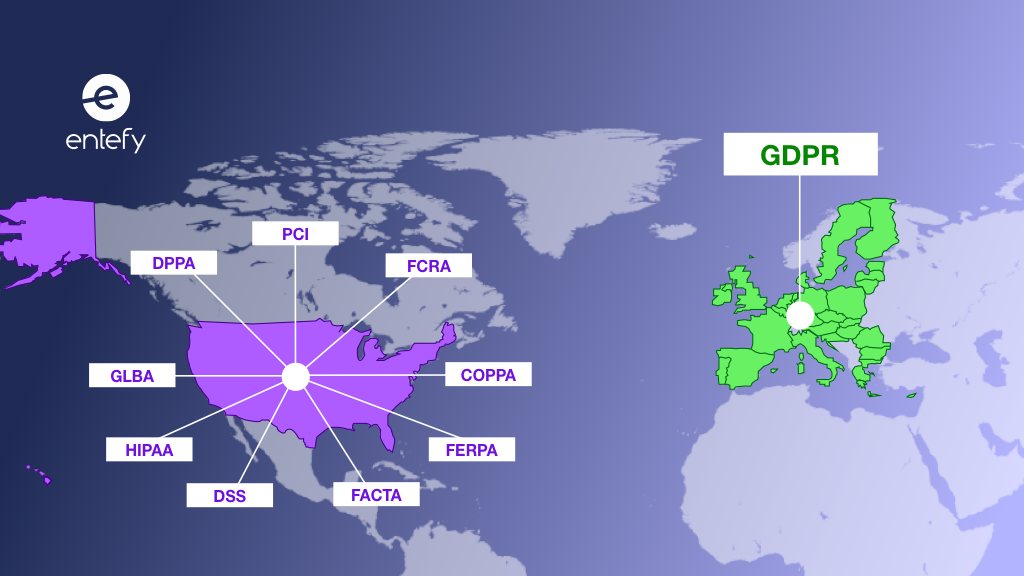
At the dawn of the digital age the U.S. established an early lead in enumerating principles and passing laws designed to protect individual data privacy. Those principles would inspire other countries, and the EU in particular, to enact increasingly pro-consumer privacy laws, culminating in the EU’s expansive 2016 General Data Protection Regulation (GDPR). GDPR is a unified privacy standard applicable to any company or group collecting and handling personal data about EU citizens.
All is not lost for U.S. privacy policy. Steps could be taken to improve privacy protection and put the U.S. back on the path to leadership in privacy law. But first, the history.
Privacy law at the birth of computing
The U.S. is often criticized by her European counterparts for not having implemented robust and universal data privacy laws.
Yet most people don’t realize that the privacy laws
operating in many countries today are built on foundational principles that emerged from the Fair Information Privacy Practices (FIPPs) framework developed in the U.S. in the 1970’s.
FIPPs defined core digital privacy principles like:
• Notice. A consumer must be told that data has been collected and how it might be used.
• Choice. Defining how data can be used, including the right to opt-in or opt-out.
• Access. A consumer’s right to see data about themselves and verify or contest its accuracy.
FIPPs emerged in the 1973 U.S. Advisory Committee Report on Automated Data Systems. The report was prepared by the Secretary of Health, Education, and Welfare in response to the first major computer systems containing what today we would call personally identifiable data. The Forward to the report begins with a surprisingly prescient pronouncement: “Computers linked together through high-speed telecommunications networks are destined to become the principal medium for making, storing, and using records about people.”
The report goes on to propose fundamental principles for designing and regulating computer systems that record, store, and protect data about one or more aspects of the life of a specific person. This was a major milestone for digital privacy. The language in the report remains highly relevant today:
“An individual’s personal privacy is directly affected by the kind of disclosure and use made of identifiable information about him in a record. A record containing information about an individual in identifiable form must, therefore, be governed by procedures that afford the individual a right to participate in deciding what the content of the record will be, and what disclosure and use will be made of the identifiable information in it. Any recording, disclosure, and use of identifiable personal information not governed by such procedures must be proscribed as an unfair information practice unless such recording, disclosure or use is specifically authorized by law.”
In plain language, this passage translates into something like: “If I say you can make a record about me, you agree that I’ll know exactly what is recorded and how it will be used; and I’ll have the right to correct or delete it if it’s wrong. Any behavior outside of these limits is illegal.” This was FIPPs in a nutshell.
In the 1980’s, FIPPs went international. The Organization for Economic Co-operation and Development (OECD) embedded FIPPs in its privacy guidelines. The OECD is an intergovernmental economic organization with 35 member countries, including most of the world’s largest economies. The OECD published data privacy guidelines to which its members agreed to voluntarily adhere. Again, the language of this agreement seems fresh and relevant today. The OECD guidelines recognized:
“That, although national laws and policies may differ, Member countries have a common interest in protecting privacy and individual liberties, and in reconciling fundamental but competing values such as privacy and the free flow of information.”
It was already clear that a natural tension existed between an individual’s right to privacy and a corporation’s desire to profit from that individual giving up some of that privacy.
Back in Europe, FIPPs was at the heart of the Council of Europe’s “Convention 108” treaty in 1981. The Council of Europe is the continent’s leading human rights organization. Its membership is larger than the more exclusive EU, and its primary purpose is promoting human rights. Emphasis on “rights.” Because here we see FIPPs graduate from what had been principles in the U.S. to what became a right in Europe. Again, the language is relevant today:
“This Convention is the first binding international instrument which protects the individual against abuses which may accompany the collection and processing of personal data and which seeks to regulate at the same time the transfrontier flow of personal data. In addition to providing guarantees in relation to the collection and processing of personal data, it outlaws the processing of ‘sensitive’ data on a person’s race, politics, health, religion, sexual life, criminal record, etc., in the absence of proper legal safeguards. The Convention also enshrines the individual’s right to know that information is stored on him or her and, if necessary, to have it corrected.”
On the path to the right to privacy
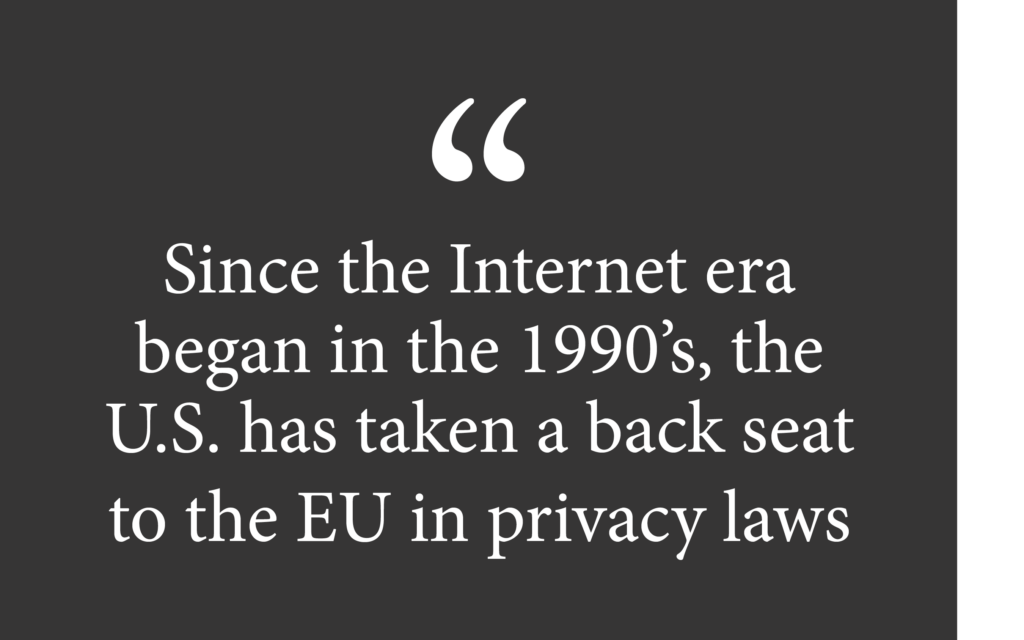
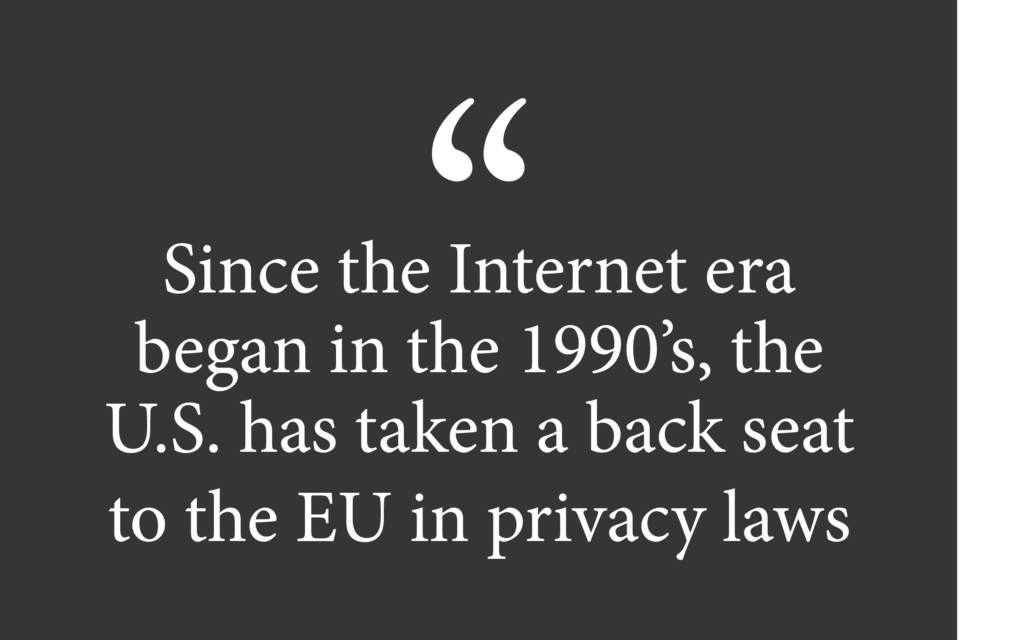
Since the Internet era began in the 1990’s, the U.S. has taken a back seat to the EU in the continuing development of privacy laws.
By the mid-1990’s, the EU sought to address inconsistent enforcement of the Convention 108 treaty by passing the EU Data Protection Directive in 1995. This was a major step toward achieving EU-wide uniformity in every sector of society. Here we see clearly that privacy is firmly enshrined as a right. Article 1 of the law defined the importance of individual privacy succinctly: “Member States shall protect the fundamental rights and freedoms of natural persons, and in particular their right to privacy with respect to the processing of personal data.”
To understand just how differently privacy was treated in the EU and the U.S. at this time, we need only ask what was happening in the U.S. in 1995. Rather than attempt a comprehensive privacy approach, the U.S. was creating narrow, sector-specific privacy laws covering, for example, our health records, our children, our driving records, and our financial records. We recognized that certain parts of our lives deserved special privacy protection mandated by the government but we stopped short of applying the same principles to other parts of our lives. And, importantly, we left the rest of our privately identifiable information as fair game. But why?
It’s an important question, and one the EU answered with the General Data Protection Regulation, the granddaddy of consumer-friendly privacy laws. The European Commission approved GDPR in April 2016 and it is expected to be enacted by May 2018. GDPR is Europe’s attempt to harmonize data protection regulations and even attempts to extend EU privacy principles to any company doing business with EU citizens.
FIPPs, and the U.S.’ lead in digital privacy law, is today a footnote to a footnote.
What the U.S. can do to protect its citizens
Today, more than 100 data protection laws exist worldwide. And all of those laws have a common set of core principles which consist of: notice to consumers; transparency towards individuals regarding how their information will be used; choice for the individual, furnishing them the opportunity to give consent or to object to how their data is being used; access to their data, for example, to correct the information should it be out of date; and security of their data.
The problem isn’t that the U.S. lacks any privacy regulation. In fact, there are laws like the Fair Credit Reporting Act of 1970 (FCRA), the Driver’s Privacy Protection Act of 1994 (DPPA), the Health Insurance Portability and Accountability Act of 1996 (HIPAA), and the Children’s Online Privacy Protection Act of 1998 (COPPA). And, in addition, most states have enacted some form of privacy legislation. The problem is that U.S. laws only provide some protection for some of our personal identifiable information, not comprehensive protection for all of our data.
But there are two significant omissions in privacy protection in the U.S. today: universal protection for the core privacy principles once enshrined in FIPPs; and the fundamental recognition to a right to privacy. To regain its leadership in privacy rights, the U.S. could:
1. Expand privacy as a right for all personal identifiable information, not just for some.
2. Ensure that before any data collection, consumers are clearly and simply informed of exactly what personal data will be collected prior to opting in.
3. Prohibit data collectors from selling personal data collected without express permission of the consumer.
In today’s global business environment, GDPR’s relevance to companies doing business in Europe means that practically every U.S. multinational will be required to abide by that law. Formal adoption of a universal, comprehensive, consumer-friendly privacy law could benefit American consumers and businesses alike. There is still much history to be written.
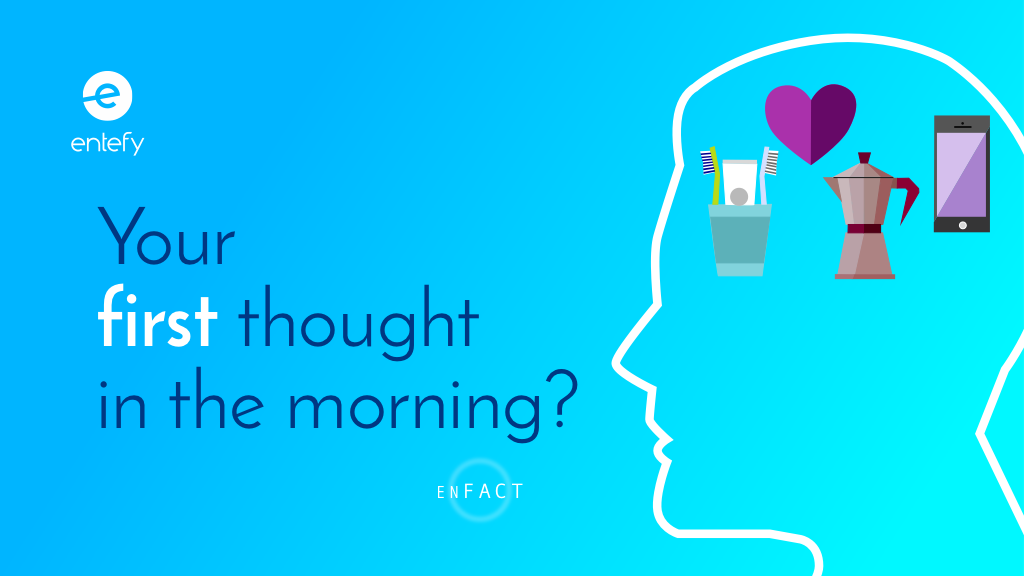
What’s the first thing you think of in the morning? According to one survey about trends in consumer mobility, 35% of us think about our smartphones, 17% of coffee, 13% of a toothbrush, 10% of a significant other, 6% of a remote control, and 4% of a bathrobe. There were interesting findings in a different mobile consumer survey: 50% of us check our mobile devices in the middle of the night, and more than 1 in 3 check devices right before bed. Which is easy to do because 71% of us are sleeping with—or next to—their mobile phones.
With a lot of data like this, the findings are neither “good” nor “bad.” That’s too simple. Instead, they give us fascinating insights into how rapidly our trusty mobile devices have become central to how we interact with the world around us. At Entefy, we like the positive sides of these changes—the countless opportunities for person-to-person connection that exist today. It’s not all perfect, but it’s certainly inspiring. Entefy’s enFacts are illuminating nuggets of information about the intersection of communications, artificial intelligence, security and cyber privacy, and the Internet of Things. Have an idea for an enFact? We would love to hear from you.
Request a Demo
Is your organization pursuing an AI-first transformation strategy? If so, start the conversation by submitting the form below.
Contact Us
Thank you for your interest in Entefy. You can contact us using the form below.
Download Data Sheets
See our Privacy Statement to learn more about how we use cookies on our website and how to change cookies settings if you do not want cookies on your computer. By using this site you consent to our use of cookies in accordance with our Privacy Statement.