Car

Self-driving cars and Hollywood movies: The surprising connection

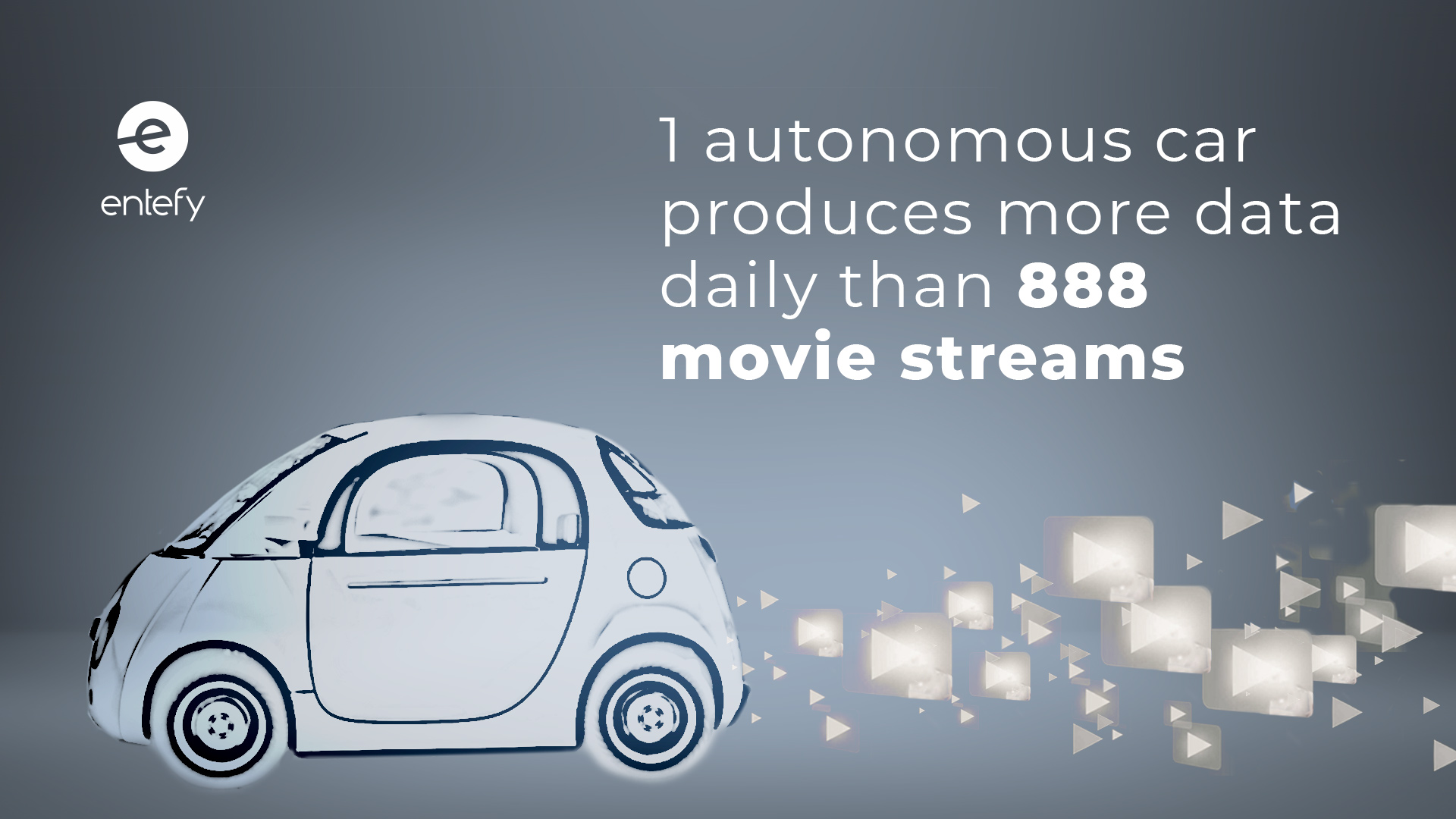
Self-driving cars, those autonomous computers-on-wheels coming soon to a highway near you, are endlessly fascinating. They make use of many of today’s cutting-edge emerging technologies all in one package, everything from real-time AI-powered computer vision to complex clusters of Internet of Things (IoT) sensors. Given their complexity, it may not be surprising to learn that a single autonomous car will create 4TB (that’s 4,000 gigabytes) of data per day as it collects sensor data, records route optimizations, and so on. But just how much data is that exactly?

We can visualize just how big 4TB is by using video streaming. An HD stream of a typical 90-minute movie uses 4.5GB of data. So 4TB represents the data it takes to stream 888 movies—and there were only 726 movies released by Hollywood last year.

So the next time you want to conceptualize the data needs of the self-driving car revolution, picture every self-driving car generating more data than a year’s worth of Hollywood movie releases every day.

Entefy’s enFacts are illuminating nuggets of information about the intersection of communications, artificial intelligence, security and cyber privacy, and the Internet of Things. Have an idea for an enFact? We would love to hear from you.

Cybersecurity

Cybersecurity and data privacy: 8 recent developments

Global cyberattacks like the WannaCry ransomware outbreak grab headlines. And rightly so. Yet one of the biggest cybersecurity threats out there isn’t software, it’s people. In one cybersecurity study, 60% of corporate cyberattacks were carried out by insiders, and 25% of those by “inadvertent actors” like employees who accidentally reveal passwords or other security credentials. While the lion’s share of cyber threats continue to be hackers, a lot of progress could be made if well-intentioned people made fewer security errors.

This thinking is behind a movement to introduce cybersecurity education into schools. The goal would be to educate children early about the need to protect personal data and generally stay safe online. As a secondary goal, this type of education might contribute over the long term to increasing the number of cybersecurity professionals, an area where there is an estimated shortfall of 2 million workers.

As part of Entefy’s commitment to increasing awareness of the many forms that cyber threats can take, we’re sharing another roundup of 8 recent developments in cybersecurity and data privacy.

  1. Researchers have demonstrated a vulnerability in the dating app Tinder. By just entering a user’s phone number the researchers could gain control of an entire account. The attack works by exploiting vulnerabilities on both Tinder and Facebook’s Account Kit System, which Tinder uses to manage logins. Both Facebook and Tinder have since patched the vulnerability.
  2. The Mi-Cam baby monitor has numerous vulnerabilities that allow hackers access to anything the camera sees or hears. Via the Mi-Cam’s Android application, hackers can bypass the password login by setting up a proxy server to intercept and modify HTTP requests between a phone and the Mi-Cam. Hackers can also exploit vulnerabilities with the application programming interfaces (APIs), allowing them access to information on how to connect to the Mi-Cam cloud network. “Information retrieved by this feature is sufficient to view and interact with all connected video baby monitors for the supplied [user ID]”, said Johannes Greil, head of the SEC Consult Vulnerability Lab. The Mi-Cam has approximately 50,000 users.
  3. According to data from the Princeton Web Transparency & Accountability Project, 76% of websites contain hidden Google trackers, 24% have hidden Facebook trackers, and 12% contain Twitter trackers. Google, Facebook, and Twitter create large data profiles for all tracked individuals that can include interests, purchases, searches, and browsing and location history.  These data profiles are then made available to advertisers and fed into their proprietary AI algorithms. These algorithms in turn create filters of what they think an individual is most likely to click on, creating an echo chamber effect that can distort one’s perception of reality.
  4. Even state-of-the-art neural networks can be hacked. Two researchers at the University of California, Berkeley have managed to “trick” a neural network into transcribing almost any type of audio into whatever they want. “With powerful iterative optimization-based attacks applied completely end-to-end, we are able to turn any audio waveform into any target transcription with 100 percent success by only adding a slight distortion. We can cause audio to transcribe up to 50 characters per second (the theoretical maximum), cause music to transcribe as arbitrary speech, and hide speech from being transcribed.”, the researchers report.
  5. The data collected by one fitness tracking company was found to inadvertently reveal sensitive information about the location and staffing of military bases and spy outposts around the world. Users of the app record and upload their exercise routines, which the company then shares on global heat maps showing trillions of individual data points. However, military analysts noticed that the heat maps for places like Afghanistan, Djibouti, and Syria revealed the position of U.S. military personnel in those regions. If you knew what to look for, “U.S. bases are clearly identifiable and mappable”, said Nathan Ruser, an analyst with the Institute for United Conflict Analysts.
  6. hack on ATMs known as “jackpotting” is making the rounds. The exploit involves hackers using off-the-shelf tools to force ATMs to spit out cash, affecting drive-thru ATMs and standalone ATMs located at pharmacies and big box retailers. Hackers gain physical access to the ATMs by replacing its hard drive or using an industrial endoscope to reset the device by pressing an internal button. Diebold Nixdorf and NCR Corp, two of the largest ATM makers, issued a warning about the hack, writing that “This should be treated by all ATM deployers as a call to action to take appropriate steps to protect their ATMs against these forms of attack.”
  7. A global cybersecurity report shows that a new class of malware has taken the dubious honor of the most prevalent global cyber threat: Coinhive. Coinhive is a form of cryptojacking malware, software that embeds itself secretly on computers and other devices then uses the device’s processing power to mine cryptocurrency. In an unfortunate case of market dynamics, hackers are apparently finding better ROI with cryptojacking than ransomware, malware that takes over computers until a ransom is paid. Ransomware is ineffective in many cases because victims won’t or can’t pay the ransom, or they simply don’t understand how to pay ransoms that must be paid in…cryptocurrencies. In contrast, cryptojacking miners save on energy costs and receive the mining rewards of Bitcoin or other cryptocurrencies. “The problem is that cryptojacking is simply everywhere—on websites, servers, PCs, and mobile”, explains Lotem Finkelstein, a threat intelligence analyst. 
  8. Flaws in the WhatsApp messaging app allow hackers to infiltrate group chat, according to research from a German team of cryptographers. Infiltrators are able to insert new users into private group chats without permission of administrators by controlling WhatsApp servers. Paul Rösler, co-author of the paper, said “The confidentiality of the group is broken as soon as the uninvited member can obtain all the new messages and read them.” Because having control of WhatsApp servers is required for the hack, likely only very sophisticated hackers, WhatsApp staff, or governments who legally pressure WhatsApp to give them access could pursue this hack. The researchers found that even if an infiltration occurred, messages sent prior to the attack would still remain encrypted.

Be sure to read our previous article on cybersecurity and data privacy threats and solutions.

Laptop

More ISP competition is the key to restoring net neutrality

For supporters of a free and fair Internet protected by net neutrality rules, December 14, 2017 was a dark day. On that day, the FCC voted to repeal net neutrality rules, changing the regulatory classification of Internet Service Providers (ISPs) in a way that gives them significantly more power over how they provide—and potentially restrict—Internet service.

As is so often the case in the news these days, the media coverage for and against the topic oversimplified many of the issues and omitted mention of others. So we thought we would revisit the still very much unresolved net neutrality debate by digging a little deeper into the dynamics of the ISP industry.

First, some critically important context. The top 4 broadband ISPs control 75% of the residential Internet market. For fast Internet (100+ Mbps), 88% of the country has 1 provider or no provider at all. Since the largest ISPs are also content providers (for example, Comcast controls NBCUniversal, AT&T is trying to acquire TimeWarner, and Verizon bought Yahoo!), their financial incentives to treat competing content equitably is complicated at best.

What follows is a deeper look at some of the key issues surrounding net neutrality.

ISPs have already tried to block access to popular apps and services

In a world without net neutrality, ISPs have the power to block Internet traffic to and from specific apps, websites, and services. And they’ve used that power before. In 2012, AT&T prevented some of its customers from using FaceTime unless users upgraded their data plans to a more expensive tier. The company eventually backed off the change during a period when net neutrality protection was in effect.

Then there was the 2014 tug-of-war between Comcast and Netflix over transmission speeds. Netflix isn’t just any Internet service. It can represent as much as 30-40% of total Internet traffic at peak times of the day. It’s estimated that by 2019, video streaming services in general will account for 80% or more of consumer Internet traffic. So when an ISP purposefully manipulates the quality of streaming video, a lot of people are affected.

Netflix found out the hard way. Beginning in December, 2013, Netflix’s customer service lines started ringing with user complaints about slow-loading videos. Within a few months, these complaints had quadrupled. Turns out the users having the problems were Comcast customers. Netflix ended up entering into a direct-connection deal with Comcast that improved transmission speeds, eventually signing similar deals with the other major ISPs. Fortunately for Netflix customers, the company had the resources to be successful in these negotiations. But what would have happened to these consumers if Netflix was still a startup?

In a world without net neutrality protection, ISPs are free to manipulate Internet data streams however they see fit.

The feared “fast lanes” come in different varieties

One concept that comes up a lot in the net neutrality debate is the idea of “fast lanes,” loosely defined as ISPs charging for preferential transmission speeds or access. In the run-up to the FCC vote in December, this was one of the major talking points for net neutrality supporters. When you scratch below the surface, however, things get complicated because there already are fast lanes—and many of us benefit from them every time we watch a Netflix or YouTube video. 

Here’s how it works. Large content providers like Netflix, Google, and Facebook place dedicated servers inside ISP data centers around the country. Called content delivery systems or peering connections, these servers speed up the delivery of popular content by placing copies of the content closer to users.

Importantly, the cost of these types of fast lanes are paid by the content producers whose bottom lines benefit from high-quality streams. Which makes sense given that Netflix shoulders the expense of providing high-quality service and then benefits when happy subscribers continue as subscribers or new users sign up.

Here’s where it gets murky. Do we want ISPs charging additional fees to users for preferential access to websites and services? That seems like unfair double dipping. Linking access to higher fees forces you to make a false choice between degraded service or a bigger bill.

At the end of the day, however, the real culprit here is the lack of choice in ISP providers.

Maintaining a fair Internet may require big bold ideas

More competition would help neutralize some of the worst fears of an Internet without net neutrality. But it’s not so simple. The cost to build rival Internet infrastructure is enormous. Look no further than Google’s failed attempt with its Fiber project, whose goal was to provide fast Internet in underserved markets. The cost of digging up streets and sidewalks to connect homes is prohibitive even to a tech giant.

The idea of local loop unbundling might offer a solution that brings in more competition. The term “local loop” refers to the segment of the Internet infrastructure that connects individual homes and businesses to an ISP’s transmission backbone. Local loop unbundling, then, refers to the idea of requiring ISPs to license their last mile connections to competitors.

This idea has precedent. The Telecommunications Act of 1996 required the former AT&T “Baby Bells” to allow competitors to access its copper telephone lines, which increased competition in the DSL market. More recently, there are multiple markets in Europe and Asia that also work on a local loop unbundling model. Analysis suggests that consumers in these markets pay less for faster service. Time will tell whether the idea catches on in the U.S.

Another solution to increased competition comes from space

Local loop unbundling isn’t the only competitive force at work in the ISP market. There’s also lot of investment happening in satellite-based Internet.

The space company SpaceX received a recommendation of approval from the FCC Chairman for it to provide fast Internet service using a network of satellites. The declining costs of orbital launches, related to more commercial space companies like SpaceX and Blue Origin, as well as rapidly advancing space programs in countries like India, are applying good old fashion supply and demand mechanics to push down the cost of launching satellites into orbit. The FCC has given similar support for space-based Internet providers like OneWeb, SpaceNorway, and Telesat.

At the end of the day, competition looks like a silver bullet that could stave off most of the worst-case fears about the end of net neutrality. For supporters of a fair and open Internet, however, the best-case outcome remains the reinstatement of net neutrality rules, either through new laws passed by Congress or favorable high court rulings.

If you’re still on the fence, be sure to check out Entefy’s look at powerful arguments in favor of net neutrality.

12 Ways

12 Ways digital devices are affecting the brain [SLIDES]

Technological advances have certainly changed our lives. But perhaps none more than the handy smartphone in your pocket. What’s emerging is awareness in science that these innovations aren’t just changing our lives, they’re changing our brains.

These days, that old adage “everything in moderation” is particularly good advice. What’s important to keep in mind is that much of the research in these slides focuses on what happens when people overuse their favorite devices.

The original research in this presentation comes from the Entefy article, Brain-damaged millennials and social narcissists? 12 Ways digital devices are affecting the brain.

Question mark

Why “why” matters, especially at work

“Know your why” has become something of an entrepreneurship mantra. It’s a weighty and worthwhile concept, and not just for startup CEOs. “Why” in the hands of a strong leader—or as a core element of company culture—is a powerful motivator. 

You can see the “why” of why by looking at the development of a company. At the startup stage when headcount is low, team members wear multiple hats and are a part of, or at least aware of, big-picture discussions. They see firsthand how their daily duties impact the organization’s growth, and being part of that movement is its own psychological reward.

As businesses grow larger, they tend to add organizational layers and hierarchies. Specialized departments emerge, offices spread across multiple floors of a building, or across campuses. Where before there was literal closeness and easy communication, now there are departments and teams that often have little interaction. These siloes hinder collaboration and information-sharing, and can leave employees feeling separated or unaware of the bigger picture.

It’s at this stage that “why” can have a powerful effect. When teams are grinding away implementing a new data security system or pulling overtime to launch a marketing campaign, you want them to know the reasons they’re doing those things. How will that security system impact the rest of the company? Why does this particular campaign matter in a broader sense? Put simply: Why should they care about what they’re doing?

Sure, financial incentives matter, especially if you want to ensure that your workers enjoy a high quality of life. But money isn’t everything, especially to younger professionals. In one study, 94% of Millennials said they want to serve a cause, and research shows that employees in general would take a 32% pay reduction for the chance at more meaningful work. Value is clearly more than a paycheck.

Why define your why?

Pursuing a worthy goal is vital to living a meaningful, satisfying life. Considering that people spend the majority of their adult lives in their careers, how they perceive their work affects their well-being. When people are aimless and unhappy, their mental and physical health suffers, causing them to disengage. Absenteeism costs American companies more than $225 billion a year, so keeping people motivated and fulfilled is just good business.

Motivation has also been shown to correlate with happiness, a key factor in productivity. Happy workers are 12% more productive than their glum counterparts, and you can boost the good feelings by reminding your team often of how they’re helping the company and your customers. Helping other people generates feelings of happiness, so educate your employees about the impact your products and services have.

The more internal-facing someone’s position is, the more difficult it may be for them to see their impact day-to-day. Let them know that the boost in sales profits this quarter allowed you to increase your corporate social responsibility budget and that they played a role in that. Tell your strategists how the new business plan they prepared for a client directly enhanced that company’s donations to a low-income community. Whatever your business’s ultimate goal, make sure employees know how they help you reach it. If they can keep the end goals mind, they’ll stay motivated to deliver great work and drive results.

Everyday motivation

You don’t need to begin each morning with rousing speeches about how your company is changing the world. Though integrating your mission into internal communications is a good way to keep it top of mind. Sometimes you just need to help people see just a bit broader than what’s in front of them.

Let’s say you’ve put together a cross-functional team to work on a high-priority project. You know everyone in the group is talented and goal-oriented, but they don’t know each other very well. Lack of familiarity can breed apprehension and cause people to withdraw into their own areas of expertise.

Laying out the project goals and how they correspond to the company’s success can change that dynamic. A shared purpose unifies employees and fosters trust. It also mitigates frustration and negativity when the project hits a snag or the team suffers a setback. The last thing you want is people bonding over their complaints and griping around the water cooler. Gossip and negativity have corrosive effects on morale, and they lead to fractured teams, anxious employees, and a decline in productivity.

Employees who feel motivated every day are not only happy but loyal as well. Businesses that intend to grow and prosper depend on worker longevity. You don’t want people turning over after a year or two, only to have to recruit and retrain someone else who might do the same. Companies are built by people invested in bringing their missions to life.

Connecting workers with the greater “why” inspires them to dig in and help the team however they can. A Gallup report indicated that 71% of Millennials know what their organization stands for and what makes it different from its competitors,” and say they plan to be with their company for at least one year.

Motivate to engage

When people know why they’re doing something, they engage more deeply with their work. Even the most mundane task holds energy and purpose if you understand that you’re part of a greater whole. Engagement also inspires people to go the extra mile. They see how one initiative yielded success, and they crave that rush of pride and accomplishment again. Maybe next time, they brush up on their skills, volunteer to work extra hours, or enroll in a course to bring even more to the table on the next project.

No job is without its frustrations or its off days. Everyone feels disconnected from time to time, but that’s why it’s all the more important to define your business’s “why” and each employees’ role with it. Because when people know why their contributions are important, they can look past the hiccups and take pride in the knowledge that they’re part of something meaningful. 

Blockchain

Blockchain reaction: 5 examples of blockchain beyond Bitcoin

There’s more to blockchain than Bitcoin, as we discussed in our article covering blockchain innovations that have nothing to do with cryptocurrencies. If you’re just getting up to speed on blockchain technology, start with our overview of how blockchain works and what makes it distinctive. We use a discussion of a low-tech paper ledger book as a starting place to examine what makes blockchain unique:

A good starting point for understanding blockchain technology is to picture an accounting ledger book, filled with line after line of transaction records. Pretty straightforward. But this ledger book has some interesting properties. First, there are copies of it all over the place, so that no one person controls access to the ledger. Next, anyone who wants to can inspect its contents at any time. Finally, adding a new line item to the ledger only happens after everyone agrees that the record is correct and accurate.

Blockchain’s potential can be seen in its anticipated impact on practically every industry, market, or business process. In financial services, to take one example, the transparency and distributed structure aspects of the technology can be used to create markets with no central authorities or transaction costs. Picture a peer-to-peer stock exchange that directly connects buyers and sellers and you’ll understand why regulators like the U.S. SEC are paying close attention to blockchain startups.

Let’s dive into 5 happening-right-now examples of blockchain disruption:

1.     Increasing financial inclusion in third-world countries

According to World Bank data, 2 billion adults around the world don’t have bank accounts. The so-called “unbanked” are at a severe financial disadvantage. Without a bank account, they struggle to secure and build credit, build savings, and access formal financial products, trapping them in a cycle of poverty. Those who support their families as foreign domestic workers often face high transaction fees when sending remittances back home, further straining their economic resources.

However, blockchain is helping to alleviate the burden of poverty and establish digital identities for the unbanked. Blockchain-powered remittance services offer significantly lower transaction costs and faster speeds, allowing workers to send more money to their families. As more and more companies accept bill payments via mobile apps, low-income users will be able to establish financial records and verify their identities via blockchain, creating a foundation from which they can access banking services and begin building true financial security.

2.     Reducing real estate costs

Blockchain-powered smart contracts could speed up the home buying process and reduce buyers’ expenses along the way. A trusted, transparent ownership record would help prospective buyers verify the legitimacy of property listings, and smart contracts could reduce the potential for errors and fraud. Because contracts executed on the blockchain must be authenticated across the network, buyers, sellers, and lenders can rest assured that every party’s financials and ownership records are above-board.

Blockchain-based smart contracts also make rent-to-own arrangements feasible, enabling renters to incrementally purchase equity in their homes while current owners continue to enjoy regular income from the property. The smart nature of smart contracts means that as renters gain ownership, the terms of their rental agreements will adjust accordingly, eliminating logistical headaches for everyone involved.

3.     Increasing safety in the sharing economy

Goldman Sachs estimates that blockchain solutions could drive $3 to $9 billion in increased revenue in peer-to-peer lodging alone, to say nothing of other aspects of the sharing economy. A report from the company notes that although services such as Airbnb provide interesting and more personal alternatives to hotels and traditional lodging services, some consumers resist the trend because they’re not sure they can trust the person whose home they’re renting.

Smart contracts could help both hosts and renters protect their assets, while blockchain systems can pull personal identification data to verify both parties’ backgrounds. By pulling in information such as consumer reviews and trustworthiness scores, these platforms can provide people with up-to-date information that assuages their fears and drives higher adoption of peer-to-peer services.

4.     Enabling smarter energy grids

The need for clean, sustainable energy sources has never been clearer. Neither has the need for a better way to manage energy data and usage. Currently, clean energy production is tracked via tradable certificates that are generated around the globe, but the management of these certificates is unwieldy, to say the least. Without a better method for tracking renewable production, investment in clean energy will lag far behind what it needs to be.

But blockchain could automate and streamline energy certificate management, along with other critical energy processes. By allowing smart meters to communicate directly with the blockchain, records can be generated automatically, reducing the opportunities for errors and data corruption along the way. Blockchain systems would also facilitate faster payments for energy producers and could theoretically allow for a peer-to-peer energy trading system that would drive more dynamic and efficient energy grids.

5.     Improving financial investments   

The investment management company Vanguard Group recently announced that it is using blockchain to deliver faster, timelier market index information to investors. The blockchain system automatically integrates new data and pushes it to investors and decisionmakers, which enables them to make faster, smarter calls with less chance for making mistakes. Vanguard also expects that the technology will allow it to create better financial advising programs, making blockchain even more relevant to individuals who rely on advisers to make critical money decisions.

For a more in-depth look at another blockchain disruption, check out Entefy’s article on how AI and blockchain are joining forces to boost cybersecurity defenses. 

Digital security

8 Digital security threats in everyday life [SLIDES]

8 Digital security threats in everyday life from Entefy

Threats to personal data privacy and cyber security are all too common. And sometimes they’re even hiding in plain sight. After all, every time you download an app or use a new device that is connected to the Internet, you may be exposing yourself to new privacy and security risks. As these slides illustrate, it’s no longer so crazy to ask, “Is that Roomba watching me?”

The original research in this presentation comes from the Entefy article, Hiding in plain sight: 8 Digital security threats in everyday life.

Doubt

The power of doubt in making smart decisions

We often make decisions under a considerable amount of uncertainty—even if we fail to recognize it. We might say we know something for sure when we only have a strong hunch. We also accept that people will often be more confident of themselves and their beliefs than is perhaps warranted—in large part because the evidence shows that self-deceived individuals are really good at deceiving others

In this era of artificial intelligence, we have to ask similar questions. Do we want to design overconfidence into intelligent machines? Or is it better to create humble systems that are aware of their limitations? While the thought of your self-driving car piping up to point out that it’s not really sure how to handle the icy conditions is unsettling, a car that reacts incorrectly in a dangerous situation wouldn’t be much better. Uncertainty inspires caution, overconfidence is more likely to get you into trouble.

These are not abstract questions. Artificial intelligence developers are already exploring the value of designing doubt into their systems. The approach could make AI less error prone: “You might even say they are getting smarter, in part, by learning what they don’t know.”

When we consider the important and consequential areas of life where AI is being deployed, the value of a little bit of doubt becomes clear. We don’t want automated systems making important decisions without making use of all relevant data. Take the scenario in which your car is 95% sure the blue color it detects up ahead is the sky, but there’s a 5% chance it’s a wall. You want that system to make use of that uncertainty and take the cautious approach.

When it comes to living our lives, we don’t often quantify circumstances in such a precise way. Especially when there is so much value placed on confidence, or at least the outward expression of confidence. It’s worth spending a little time exploring the role doubt plays in our lives and careers. Think of it as the counterweight not to confidence, but overconfidence. Especially overconfidence that emerges from faulty logic or limited and biased information.

The limits to decisionmaking

There’s a paradox around confidence that was made clear in a 1999 study that appeared in the Journal of Personality and Social Psychology. The researchers, psychologists David Dunning and Justin Kruger, gave subjects tests covering humor, grammar, and logic, then asked participants to score how confident they were in their own performance. The lowest-performing test takers were also the most confident in their performance. And not just by a little: the group scored around 12% but estimated their performance more than 5 times higher, at 62%. The paradox was clear: those who knew little didn’t know enough to know they knew little. This illusion of confidence has since been dubbed the Dunning-Kruger effect.

One of the more memorable examples of Dunning-Kruger overconfidence comes from McArthur Wheeler. After learning that lemon juice could be used to make invisible ink, he decided that it could also make him invisible if he smeared it over his face. He did so, then proceeded to attempt to rob a bank while covered in lemon juice. He was not successful.  

When the economist Herbert A. Simon defined bounded rationality, he began by observing that we are each limited in our personal inventory of information, time, and cognitive capability. Since we cannot expect to make perfect decisions, we must satisfice, the combination of “satisfy” and “suffice.” To satisfice is to make do with what knowledge and time we have, while still making firm decisions without excessively splitting hairs.

Simon wrote that, ‘Whereas economic man maximises, selects the best alternative from among all those available to him, his cousin, administrative man, satisfices, looks for a course of action that is satisfactory or “good enough.’”

Think about how difficult it is to be the economic man in Simon’s description. Deciding which box of cereal to buy becomes an endlessly complex activity of comparing prices and quality and amount from among a growing number of options. What’s more, we haven’t had the chance to taste all the different varieties, and our knowledge of their chemistry and molecular composition is incomplete.

It’s the same everyday predicament we’re in when deciding which movie to see or what to cook for dinner. Bringing us back to the value of doubt: acknowledging and accepting a little uncertainty can speed up our decisions. It can be comforting to accept, “that will do” when the alternative is endlessly anguishing over deeper and deeper levels of detail.

What can we be sure of?

Like anything, doubt taken to the extreme leads to questions like whether we’re living in a computer simulation or really any science-denying, anti-rational school of thought.

But we needn’t go to that extent for doubt to have value. We just need to acknowledge that our understanding of the world is often based on imperfect assumptions, and that it is in our best interest to use that realization to moderate our confidence. To know that it’s impossible to be 100% certain, without letting that stop us from making decisions.

Recognizing that most of our decisions are made under some uncertainty—whether we are aware of it or not—is important for aligning our expectations with reality. This is the power of doubt.

Patent

Entefy patent allows for encrypted group messaging simultaneously across multiple protocols

Entefy patent opens new doors to secure communication across groups using different protocols at the same time

PALO ALTO, Calif. March 7, 2018 — Entefy Inc. has been issued another patent by the U.S. Patent and Trademark Office (USPTO). Patent No. 9,843,543 describes an “Apparatus and method for multi-format and multi-protocol group messaging.” 

“In a world with so many different apps and services for group communication, I’m excited about Entefy’s latest invention that, for the first time, allows groups of users to securely communicate with each other without being bound to a specific app, protocol, or service,” said Entefy’s CEO, Alston Ghafourifar.

Today’s announcement follows the recent news that Entefy filed 15 new patents in the areas of search, AI, blockchain, communication, data privacy, and IoT, bringing its portfolio of filed and issued patents to 46. In February, the company announced the issuance of a patent for people-centric messaging. Also see the issuance of an Entefy patent for encrypted search and another patent covering context awareness in messages.

Entefy’s mission is to savepeople time so they can live and work better in today’s digital world. 

ABOUT ENTEFY

Entefy is building the first universal communicator—a smart platform that uses artificial intelligence to help you seamlessly interact with the people, services, and smart things in your life—all from a single application that runs beautifully on all your favorite devices. Our patented technology combines digital communication with advanced computer vision and natural language processing to create a lightning fast and secure digital experience for people everywhere. 

Brain

Rewire your brain to never forget a name again

We all know the pain of being at a social event and spotting an acquaintance whose name escapes you as they make their way over to say hello. You wrack your brain trying to remember where you met, who introduced you, or any identifying detail that might offer a clue as to how you should greet them. Yet you can’t for the life of you remember their name.

It’s hardly the end of the world, and as we’ll see, we’re all prone it. In informal settings, you might endure a mildly awkward conversation before you both laugh it off. But if that memory lapse happens in a professional setting, the repercussions can be far more consequential. Either way, once you understand how the brain remembers names, you can adopt a few straightforward practices to help ensure you’re never speechless after “Nice to see you…”

Why we never forget a face   

Considering how socially valuable name recognition can be, it seems maladaptive to be so forgetful. Yet from an evolutionary perspective, it makes perfect sense. Biologically, humans are wired to remember faces because that’s how we identify members of our tribes. It’s more advantageous to recognize an ally’s face than to focus on details as trivial as his or her name.

Even in the modern world, our brains don’t rank people’s names as high as, say, household objects. Knowing the words for chairs, tables, food, and forms of transportation is universally useful. Names, on the other hand, are ultimately arbitrary, and they tell us little about the person with whom we’re speaking. Sure, it’s socially helpful to know what they like to be called. But our minds prioritize information such as distinguishing facial features, where they work, and even the conversations we have with them beyond their names.

You would think that being able to recall someone’s political views or their love of tennis would jog your memory when you run into them again. But often it doesn’t, because your brain links those details to your memories of the person—not their name. The human brain works by association, so remembering one detail of an interaction usually brings others to the surface as well. Names bear no connection to the other circumstances surrounding the memory, so that information can remain out of reach.

We can also blame our forgetfulness on the perils of modern life. Long-term stress, an affliction shared by Americans of all ages and backgrounds, may cause memory-eroding inflammation in the brain. Anxiety also contributes to memory problems, causing forgetfulness as well as side effects such as difficulty concentrating and poor sleep quality, which further impair people’s memories.  

Hacking the name game

Ok, so that’s why most of us are so bad with names. Now here’s what can be done about it. There are ways to boost your recall skills. It starts with relaxing. Because the habits that work here are of little help if you’re in a constant state of stress and anxiety. Daily meditation, journaling, rest, and even behavioral therapy can reduce anxiety and help you think – and remember – more clearly.

Once you’ve done that, here are some steps to try:

  1. Make associations. Remember how we said human brains are associative? You’ll have an easier time recalling people’s names if you consciously connect certain details to their names. For instance, someone might casually mention her interest in wind surfing or obsession with 80s action movies. Linking those facts to the person’s name gives you an association on which to draw the next time you encounter them. You’ll even get bonus points for remembering their obscure preferences.
  2. Be present. We’re all guilty of nodding our way through a conversation while we’re mentally checking to do lists or planning what we’re going to cook for dinner. The more distracted your mind, the less chance it has of remembering someone’s name. We are up against biology, after all. Instead, focus on the people with whom you’re speaking. Repeat their names after they introduce themselves and again when you say goodbye. Not only does this show that you’re paying attention, it also cements their name in your mind. Leave your phone in your pocket while chatting as well. Listen to what the other person is saying and ask questions you genuinely want the answers to. When you’re engaged and present, your brain is better able to process and save the details of the interaction. 
  3. Create mnemonics. When all else has failed, create mnemonic devices to get the associative gears turning. A mnemonic device turns a person’s name into an acronym, with each letter representing a word or phrase linked to that person. So, a guy named Pat might Play old-school video games on an Atari every Tuesday night. Make the acronym as unique and specific as possible, because that makes it easier to recall the name quickly.

Forgetting people’s names is as common as it is embarrassing. Using these tips to improve your name recall skills will impress people and show that you’re genuinely interested in them. And that’s the beginning of a potentially long and mutually satisfying relationship.