

Cowboy

10 Signs data privacy is the new Wild West

Digital privacy in the U.S. is in a Wild West phase. There are few laws, less enforcement, and a lot of uncertainty and chaos. Practically everything we do online creates a data trail that we have little or no access to or control over.

Take these two straightforward questions: What information does your favorite app or Internet service collect about you? And what do they do with it? Most of us couldn’t answer that, but that’s by design. The United States lacks an overarching privacy protection law, like the European Union’s GDPR—the big new law that might finally shake up digital privacy. So technology companies don’t have much reason to share exactly what data about you they collect, store, and, in some cases, sell to third parties. 

Below is Entefy’s latest roundup covering the gamut of cyber privacy matters to help keep you informed: 

1. The Lumen Privacy Monitor will tell you which apps are collecting your data. 7 in 10 smartphone apps share your data with third-party services. To help users become aware of which apps are collecting data from them, researchers developed an app that lets users “see their information collected in real time and the identity of the entities receiving the information.”

2. Get your Facebook data back. Do you ever wonder how Facebook gains so much insight about its users? The free browser extension Data Selfie sheds light on Facebook’s machine learning algorithms and “tracks all the digital breadcrumbs you would leave behind when using Facebook (hint: it’s a lot of breadcrumbs) and creates your personality profile.”

3. It’s possible to hack a phone through sound waves. Accelerometers measure rest and acceleration in smart devices and are commonly found in smartphones, fitness trackers, and automobiles. Although helpful for navigation and orientation, there’s been a recent discovery that accelerometers are susceptible to vulnerabilities. “Researchers describe how they added fake steps to a Fitbit fitness monitor and played a ‘malicious’ music file from the speaker of a smartphone to control the phone’s accelerometer. That allowed them to interfere with software that relies on the smartphone, like an app used to pilot a radio-controlled toy car.”

4. ESPN collected first-party data on about 106 million of its users. ESPN collects information such as a person’s favorite teams, leagues, and players, as well as displays strategic advertisements based on these preferences. If a Warriors fan visits the website after a win, advertisements for special merchandise will appear when that person checks the website. For the ESPN visitors that do not volunteer their preferences, the network can figure out sport preferences by tracking their behavior online.

5. Smart TVs are known to track personal data, and Vizio got caught. Earlier this year, Vizio paid $2.2 million to settle charges for monitoring viewing habits of more than 11 million TVs without consent. “The main problem was that Vizio TVs had tracking features turned on by default, instead of an opt-in setting like many other manufacturers use…but the situation is now a relatively good one for Vizio TV owners: the company is specifically prohibited from tracking your viewing habits without explicit permission.”

6. Google can track when someone clicks an ad and buys something from a physical store. If you see an online advertisement for a product, then go to a store and buy it with a credit card, Google can track your behavior and report the data to marketers so that they can see how effective their advertisements are. “How does Google know if you bought something at Subway or Aldo? It works with the credit and debit card companies to match up in-store purchases with your online identity. The company has partnerships with companies that account for 70% of credit and debit card purchases in the U.S.”

7. There are “microdots” on printed documents that encode the serial number for the original printer. Research that printers might be spying on us has been around for a while. A recently leaked document has brought it to the forefront of the news again. After a quick analysis of documents related to a National Security Agency leak case, experts “seemed to reveal the exact date and time that the pages in question were printed: 06:20 on 9 May, 2017 – at least, this is likely to be the time on the printer’s internal clock at that moment. The dots also encode a serial number for the printer.”

8. Not all virtual private networks (VPNs) are created equal. VPNs create an encrypted connection between your browser and another private server, and protect users from things like malware. But it can be hard to tell how secure every VPN is and what it’s doing with your data. To optimize security on your VPN, “avoid free services, and…look into setting up your own. Otherwise, make sure a paid VPN has a privacy policy you’re okay with…And on a larger scale, remember that the best solution is still policies that would tackle the problem at the source: ISPs’ ability to sell your data.”

9. Twitter’s new privacy policy with invasive defaults doesn’t “sound good.” Twitter has updated its privacy policy in order to provide users with a more personalized experience, which includes very specific tailored ads. Twitter “will now record and store non-EU users’ off-Twitter web browsing history for up to 30 days, up from 10 days in the previous policy.” This policy is on an opt-out basis. You can “click ‘Review settings’ to opt out of Twitter’s new mechanisms for user tracking.” Wondering why EU users are exempt from this privacy policy? Read on.

10. Amazon Echo Look is collecting a full picture of you and your home. The cloud-connected camera wants to give consumers feedback on their outfits by using advice from fashion experts and machine learning algorithms. “The lookbook is a digital collection of ‘what you wore and when.’” But what’s important here is that “you’re potentially giving the tech giant a lot more data than just the type of chinos you sport. The pictures can reveal socioeconomic status, whether you’re married, religious affiliation (hello cross above your bed), and potentially a lot more.”

Digital privacy in the U.S. is going through growing pains, and we hope these resources help you stay informed. After all, protecting yourself starts with awareness. For additional information be sure to check out our firstsecondthird, and fourth articles related to this topic.
Big data

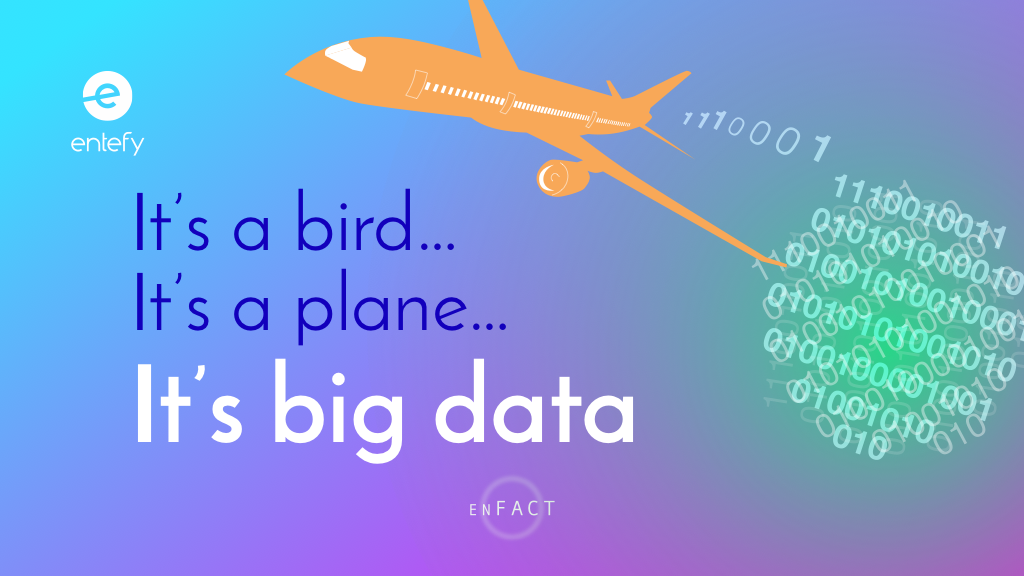
Here’s a high-flying stat about big data

There’s a lot of data flying around these days. Literally. Commercial jets are continuously generating data while they’re in the air: log files, GPS info, data recorders, audio files, the list goes on. In fact, a single 787 Dreamliner produces 500 gigabytes of data every time it flies. That’s the same amount of data it would take to stream music or video on a device for over 31 days. 

This tells us a lot about the extent of today’s global data explosion. With 553 Dreamliners delivered to airlines to date, all those 500 gigabyte flights add up to 276.5 terabytes of data on days the whole fleet takes to the air. 

All this data creation is a reason artificial intelligence is transforming industries around the world. One of the strengths of AI is its ability to identify patterns and meaning in piles of data. Which becomes critically important as big data gets bigger by the day.Entefy’s enFacts are illuminating nuggets of information about the intersection of communications, artificial intelligence, security and cyber privacy, and the Internet of Things. Have an idea for an enFact? We would love to hear from you.

Brain-damaged people

Brain-damaged millennials and social narcissists? 12 ways digital devices are affecting the brain

The wheel. The printing press. The telegraph. These technological advances certainly changed things for humans. And today smartphones are no exception. Science is beginning to show that they’re not just changing things, they’re changing us. Some of these changes are unexpected and certainly worth knowing about.

Entefy recently shared a roundup of research into the ways new technology is impacting our physical health. Now there is evidence accumulating that digital devices have a strong effect on our behavior and mental health as well. 

In the digital era, that old piece of wisdom “everything in moderation” seems particularly valid. Look at it as finding your own personal Goldilocks formula for screen time.

Here are 12 ways digital device use can impact our brains, behavior, and mental health:

1. Technology heightens our desire for instant gratification

If you click on a video and it’s slow to play, how long are you willing to wait? One study into how video quality impacts viewers provides an answer that’s pretty telling. The study included 6.7 million unique viewers who watched 23 million videos for 216 million minutes. The finding was that viewers start clicking elsewhere after just 2 seconds, and every additional second of delay added another 5.8% to the abandonment rate. These findings are specific to online video behavior, but certainly point to a lot of people expecting instant (digital) gratification.

2. Social media can fuel narcissism 

A group of 292 individuals (75% were college students) participated in a study into potential links between Facebook use and high scores on the narcissistic personality inventory (NPI) survey. It found that Facebook users with high NPI scores tended to have more friends on Facebook, tag themselves more often, and update their profile photos and newsfeeds more. “For the average narcissist, Facebook ‘offers a gateway for hundreds of shallow relationships and emotionally detached communication,’” said Christopher Carpenter, the study’s author. “In general, the ‘dark side’ of Facebook requires more research in order to better understand Facebook’s socially beneficial and harmful aspects.”

3. Social media impacts the mental health of young people

The images we see on social media are carefully curated and not always the best reflections of the everyday world. Compare your next home cooked meal to the food porn on Instagram and you’ll know the feeling.

This “unreality” can have a big impact on younger users. The #StatusofMind study in the UK surveyed 1,500 participants aged 14 to 24 about their social media use. It found that social media platforms did in fact negatively impact health in areas like anxiety, depression, and body image. Further, 7 in 10 participants reported experiencing cyberbullying. 

But other findings were more positive: Social media can improve access to information about other people’s experiences with health issues, and social media users report more emotional support from their contacts.

4. Trouble when your smartphone is something you “can’t live without”

One idea about smartphones seems to be taking hold: Smartphones are the new cigarettes. Like smoking in, say, the 1950’s, smartphones are a habit that few people really question. But unlike cigarettes, the verdict is still out on exactly how much smartphone usage leads to negative health effects. 

One consideration is whether constant connectedness makes it easier to dedicate time and attention to things that don’t really matter. One psychiatrist observed that many people in her practice have “disconnected from what really matters, from what makes us feel nourished and grounded as human beings.” 

5. Technology appears to be warping millennials’ brains

There are 83.1 million people aged 18 to 34 in the U.S. spending an average of 18 hours per day using digital media. If that seems high, the study counts 1 hour multitasking on social media and streaming video as 2 total hours of media use. Being constantly “on,” digitally speaking, may be changing how the brain develops. Preliminary findings of research into brain development among millennials suggest that their brains are developing differently because of their almost constant interaction with digital apps and devices. These differences can be seen in brain regions linked to communication skills and the core of a person’s personality.

6. Digital overload impairs our natural ability to filter stimuli 

Our brains simply weren’t designed to handle the flood of information that constantly bombards us online. The brain works best when it can efficiently filter the noise from the signal, and a big way to help it do that is to limit how much informational stimulus we’re exposed to. 

7. Social media and online news can inhibit memory formation

There is another noteworthy aspect of brain behavior related to social media use: memory formation. Research suggests that low levels of focus (as is typical while browsing social feeds and online news sites) can inhibit memory formation. You may have experienced this when you tried and failed to recall something that you saw on your feeds earlier in the day. The takeaway is that if you want to remember something, be prepared to give it sustained attention, and then revisit it again and again to make it stick.

8. Smartphone use can cause headaches and nerve damage

First, a quick anatomy lesson. The occipital nerves run out from the spine into the back of the neck and continue running to the top of the head. Problems with the occipital nerves include tension headaches and back pain. There is evidence that prolonged smartphone use can stress the occipital nerves, eventually leading to a condition called occipital neuralgia. Occipital neuralgia is characterized by chronic pain and headaches, especially those localized to the side of the head and scalp. 

9. Talk about stress

The American Psychological Association polled 3,500 adults about their smartphone use in an online questionnaire. The survey found that “people who are always looking at their digital devices—called ‘constant checkers’—reported higher levels of stress compared to people who spend less time interacting with their gadgets.” The report used a scoring metric to quantify stress levels: “On a 10-point scale, where 1 is ‘little or no stress’ and 10 is ‘a great deal of stress,’ the average reported overall stress level of constant checkers is 5.3. For non-constant checkers, the average reported stress level is 4.4.” Suggesting that too much smartphone checking leads to a 20% boost in stress levels.

10. Screen time before bed impacts sleep worse than a double espresso

University researchers conducted a sleep study that compared the impact to the circadian clock from bedtime caffeine consumption and digital device screen time. The results suggested that, “consumption of a caffeine dose equivalent to that in a double espresso 3 hours before habitual bedtime induced a ~40-min phase delay of the circadian melatonin rhythm in humans. This magnitude of delay was nearly half of the magnitude of…exposure to 3 hours of evening bright light” from a digital device. We’ve previously covered better sleep from a notification vacation.

11. Digital connectedness can lead to real world isolation

A Massachusetts Institute of Technology researcher conducted a metaanalysis (a study of multiple studies) of psychiatric research into social media use and isolation. She found that, “people who choose to devote large portions of their time to connecting online are more isolated than ever in their non-virtual lives, leading to emotional disconnection, mental fatigue, and anxiety.”

12. Mobile device use associated with an increased risk of brain cancer

The tin hat crowd may be onto something. A study into the potential link between brain tumors and mobile phone use found that there is indeed an increased risk associated with prolonged mobile and cordless phone use. The World Health Organization is more cautious, calling the electromagnetic fields produced by mobile devices “possibly carcinogenic.” 

What’s important to keep in mind is that much of the research focuses on what happens when people over-use devices. So, like with many things in life, the answer to “What can I do about it?” is to practice moderation. Understand what the science tells us can happen, and modify your own habits accordingly.

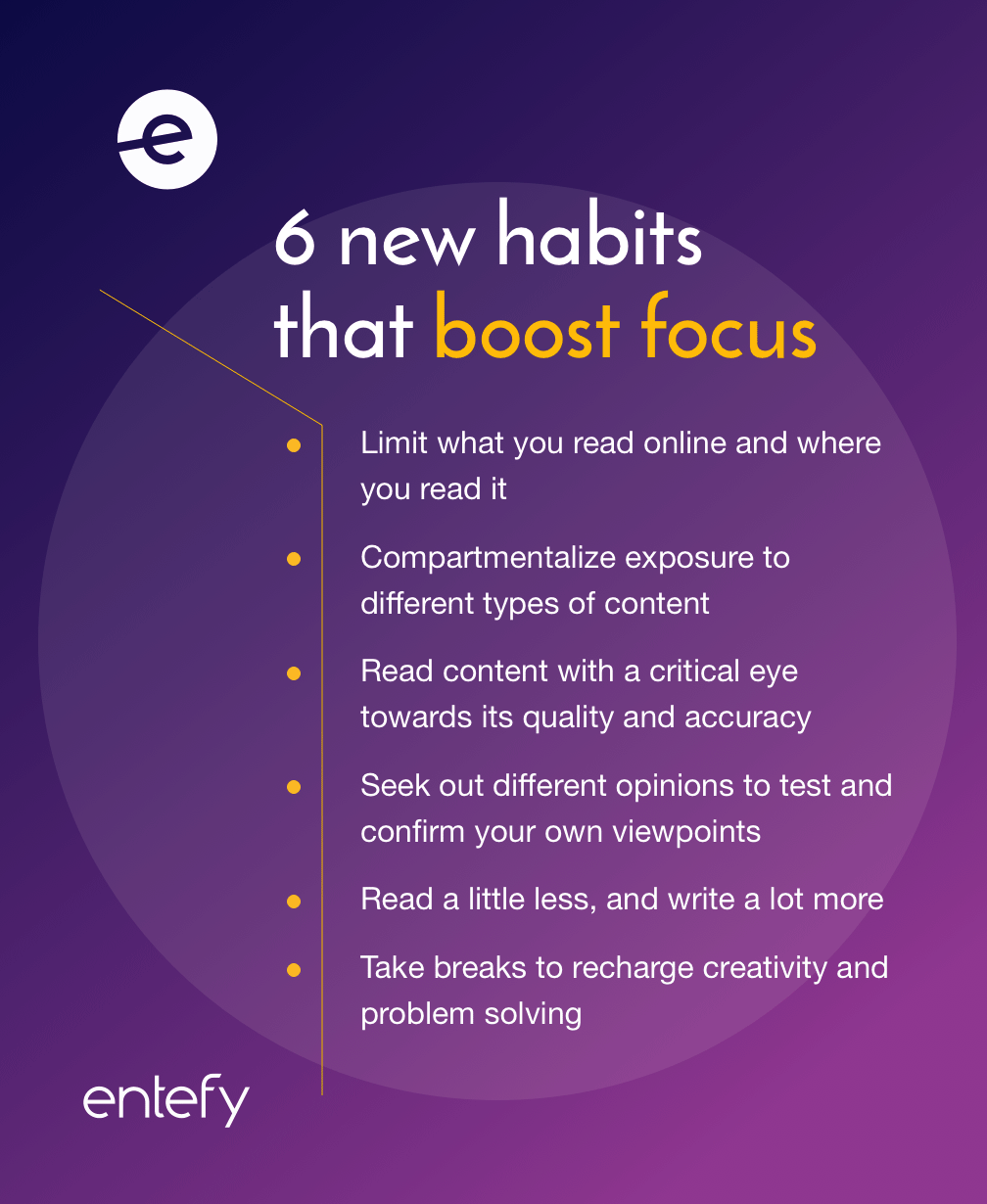
Here are 6 ways to boost your focus and retain more of what you read:

Information overload

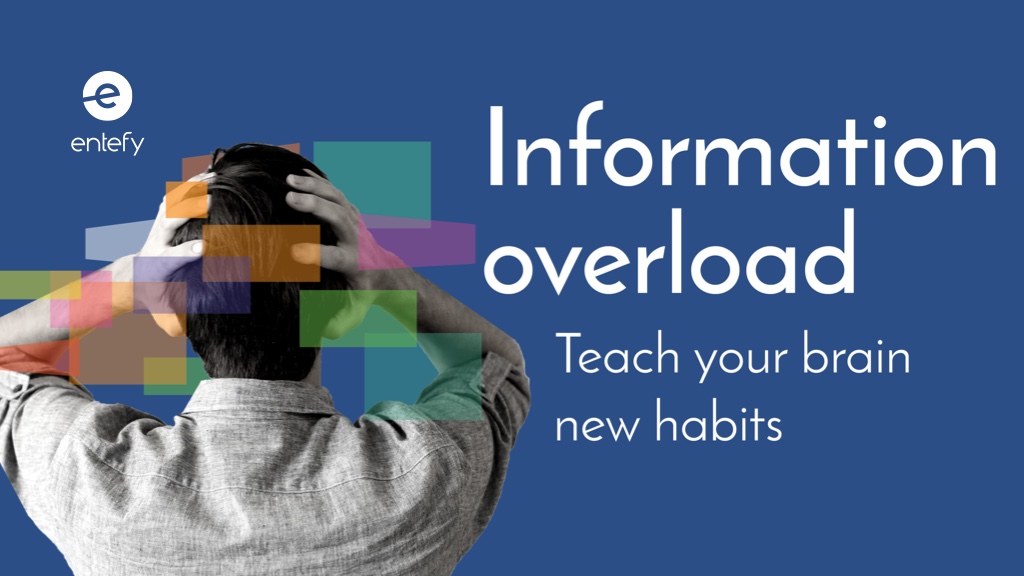
Information overload, fake news, and invisible gorillas. Teach your brain new habits. [SLIDES]

When it comes to getting our information off the Internet, we’re all a little like children—we have limited attention and we’re not always sure where to direct it. The challenge is that it can be difficult to limit how much information we consume when there’s always something new calling out for a click. The thing is: attention is a finite resource. Knowing how to spend it wisely can be a challenge. 

This presentation highlights key concepts from our article about how information overload affects us, and how we can identify accountable sources and focus better. These slides examine how the brain handles information as well as strategies for optimizing the time we spend directing our focus. 

Download full PDF version here.

Man looking at a computer screen

Can AI fix fake news?

In 2014, the term “fake news” hadn’t yet become part of the American lexicon and the 2016 U.S. presidential race was only beginning to make headlines. But in California, a man named Jestin Coler was hard at work creating one of the most divisive media trends in modern history. 

Dubbed the godfather of the fake news industry, Coler’s efforts began with publishing fabricated stories—including an article about Colorado food stamp recipients using welfare benefits to buy marijuana—that garnered enough traffic to generate tens of thousands of dollars a month in ad revenue. The idea quickly caught on. Competing sites sprang up around the world as other publishers raced to create fake news masterpieces of outrageous, conspiratorial, and highly partisan news ahead of the election. 

Since then, the fake news phenomenon has created the means for people (including public leaders) to dismiss reports of their wrongdoings and infuse otherwise legitimate political debates with falsehoods. Even amateur web users can doctor images and videos to create evidence of events that never happened. 

There’s no easy answer to the problem. But artificial intelligence can help. 

Fighting fake

Sixty-two percent of Americans look to social media for information on what’s happening in the world. How we engage with the articles and videos we find on these platforms influences which stories and posts we’ll see in the future. If we like, comment on, or share more conservative news items than we do liberal ones, for instance, social algorithms will show us similar content the next time we sign on. Our online contacts also factor into this equation. Having a disproportionate number of liberal-leaning friends or followers skews our feeds as well. 

Blatantly false news isn’t the only thing that should concern us. Headlines and stories that frame accurate information in misleading ways also distort our perceptions. As Kim LaCaria, content manager for Snopes, told Quartz, ‘There’s information and then there’s how it’s presented, and those two aren’t always the same.’ 

Colombia Journalism Review has advised journalists to look at creation dates and source materials to verify videos, along with clues from content creators’ online backgrounds. Video analysis programs and other verification tools also help. Nearly 60 percent of people repost articles without reading past the headline; so the odds of readers vetting every article seem slim. Even if we all had sufficient time and inclination to become digital detectives, the sheer amount of online content means that making a dent is unfeasible. Millions of online interactions occur each minute, and no human can keep up with them all. An artificial intelligence system, on the other hand, might be able to help stem the fake news tide. 

Using AI to solve the fake news problem

An AI system trained to analyze text, videos, images, and audio could work around the clock at rates that far exceed even the most efficient human. Computer science researchers at one university are developing a machine-learning approach to fake news detection. The program will analyze the content of an article and then score it based on how likely it is to be fake news. It can also generate a breakdown of why the score was assigned so readers can understand why the AI system flagged something as fake news. 

“Artificial intelligence (AI) can have all the same information as people, but it can address the volume of news and decipher validity without getting tired,” said Stephen Woerner, a student working on the project. “People tend to get political or emotional, but AI does not. It just addresses the problem it’s trained to combat.” 

Ironically, the more fake news that’s produced, the better an AI vetting system may become. Machine learning platforms self-improve based on data inputs, so a glut of false articles and videos can enable them to hone their fake news detection abilities. 

Other AI systems being developed to identify fake news use natural language processing (NLP) to conduct a complex series of analyses on news items. NLP systems process and organize even unstructured information, pulling insights from vast data sets—an ability that would clearly be useful in scanning and categorizing large volumes of articles created on the web. Algorithms written specifically to identify fake news might compare the ways in which different sites cover certain news events and how a lesser-known site’s coverage stacks up against mainstream outlets, as well as dissect elements such as context and location. 

Some developers are working to create programs that parse the contents of articles from different websites and compare their coverage of events against one another to look for potentially misleading items. Again, the more fake news the system takes in and analyzes, the more adept it becomes at identifying suspicious claims and publication details. 

A man-machine alliance

Even if AI helps curb the fake news problem, humans still bear responsibility for creating and sharing fake news. Platforms, including social media, enable users to flag posts as fake news. They use algorithms to identify fake content and keep it from spreading. However, the output are as accurate as people’s input. If enough users flag authentic content as fake, then quality publishers are at risk of being wrongly labeled. 

Darren Campo, an adjunct professor at New York University’s Stern School of Businesses, told Fox News that humans can also manipulate AI systems by using careful language in fake news production. “Fake news protects itself by embedding a ‘fact’ in terms than can be defended,” Campo said. While AI systems may be effective at identifying that a fact is incorrect, it may not be as effective at identifying the context around that fact. 

Developers would also need to account for limitations in their programs. For instance, a vetting algorithm might draw on existing content to verify a story’s accuracy. But when a reputable outlet publishes breaking news, it may do so without much context, which may in turn impact the AI system’s determination. Proper human input can help safeguard against this and avoid further exacerbating the fake news problem. 

We’ll also need to overcome our own biases. Reading articles that feed into our confirmation bias can make us feel good, but we’ll have to exercise skepticism about what we read if we’re to defend truth and factual reporting in our society. AI will likely play a critical role in combating fake news, but progress in this area depends on us, as people, becoming more conscientious about what we share and how we engage with one another online.   

Brain image

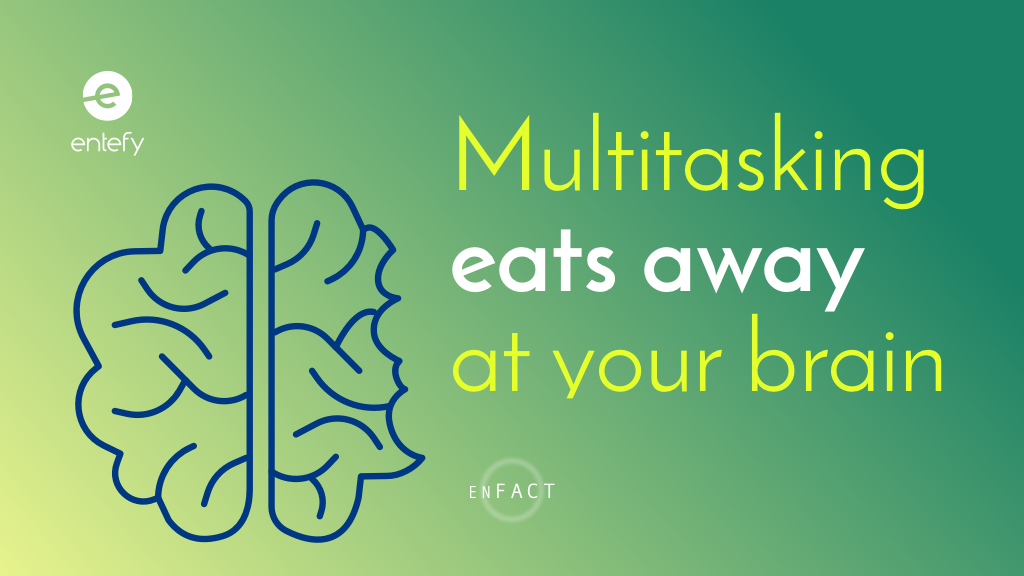
Multitasking: bad for productivity and your brain

In this era of information oversaturation, notification overload, and app-for-everything overkill, many people have turned to multitasking as one strategy for keeping their heads above the digital waters. Research shows that switching quickly between projects can reduce productivity by up to 40 percent. 

The extra hours you seem to be creating by multitasking come with serious trade-offs compared to focused unitasking. When we’re bombarded with simultaneous streams of electronic information, we lose focus which then negatively impacts our ability to recall the information. And research has found signs that media multitaskers have less grey matter density in the brain region responsible for cognitive and emotional control. 

The science is still preliminary, but are we going to look back on this era one day and shake our heads over how we ignored signs that constant multitasking eats away at our brains?
Entefy’s enFacts are illuminating nuggets of information about the intersection of communications, artificial intelligence, security and cyber privacy, and the Internet of Things. Have an idea for an enFact? We would love to hear from you.

A worm’s-eye view of the world [VIDEO]

How often do you find yourself thinking about roundworms and their connection to the Internet of Things—the world of smart devices often just called IoT? IoT devices are things like Internet-enabled appliances and fitness trackers.

What do these devices have to do with worms? Strength in numbers. Individual IoT devices might not have a lot of capacity on their own, but when you link a bunch of them together, they can have a big impact. 

In this video enFact we examine the surprising links between the humble roundworm and cutting-edge IoT devices. 

Read the original version of this enFact here.

Entefy’s enFacts are illuminating nuggets of information about the intersection of communications, artificial intelligence, security and cyber privacy, and the Internet of Things. Have an idea for an enFact? We would love to hear from you. 

Open office space

Flat and open: 2 lessons about modern workplaces

Have you ever sat comfortably in a quiet place and looked out at the hustle and bustle of a city street? Libraries are often like this, and a home office can provide the same sense of separation from the busyness of the outside world. These spaces are perfect for open, deep thinking and productive work. But if you had to design one from scratch, how would you go about it? As a growing company, this is a challenge Entefy has had to tackle.

“Better is better” is a core mantra that inspires our work, not only in engineering the product, but in engineering our workspace and how we collaborate in it every day. This continual quest for better has given us some insights into how to create a workplace that simultaneously supports inspired productivity and focused problem solving. We thought we’d share a couple of lessons we’ve learned about modern workplaces: 

Lesson 1: An open office takes more than just removing walls

Believe it or not, open floorplan offices have been controversial for decades. The case against the open office centers around the productivity loss from noise and other distractions. 

Entefy’s decision to choose an open floor plan was driven by data that demonstrates the strengths of openness. One study of more than 2,000 employees in an open office found that productive people create a “spillover effect” that boosts the productivity of their neighbors. This effect can be quite strong:

“…Neighbors have a significant impact on an employee’s performance, and it can be either positive or negative. In terms of magnitude, we found that approximately 10% of a worker’s performance spills over to her neighbors. Replacing an average performer with one who is twice as productive results in his or her neighboring workers increasing their own productivity by about 10%, on average.” 

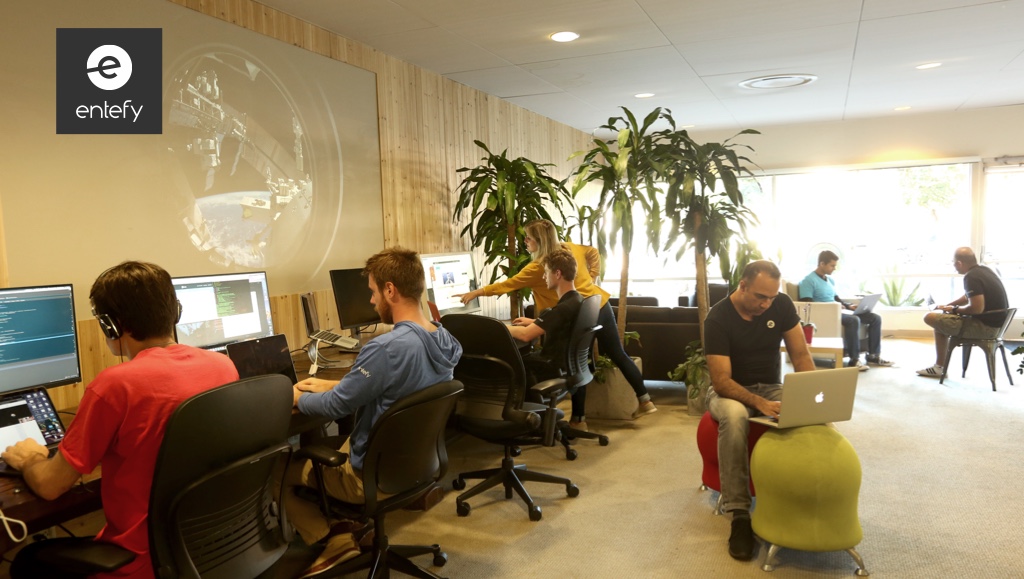
Our experience with an open office echoes this data. Team members sit (and stand) nearest to teammates from their assigned Force (one of Entefy’s 4 operating groups) but not too far away from team members who work in other Forces. This approach gives us the benefits of the creativity and problem solving boost created by close proximity. To address the occasional noise and distraction inherent to open workspaces, our team uses headphones or private conference rooms (with whiteboards of course) for when additional “space” is needed to support focused, deep work.

To us, an open office isn’t just about the floorplan. It’s a mind space. Walls create barriers to collaboration and companionship. Being open to ideas from others is a requisite for rewarding collaboration. And openness to a diversity of ideas is what leads to great innovation. 

Lesson 2: A flat organization takes more than just removing hierarchy

Another factor that boosts the team’s effectiveness is flat-ness. Entefy is organized as a flat organization, meaning we minimize the ranks of managers by granting team members broad autonomy and authority to pursue their best work. But don’t confuse “flat” with lack of structure, oversight, or accountability. What we’ve found is that for small, driven teams, flat leads to better and faster decision making, lower costs, and improved organizational agility overall. 

In a traditional hierarchical organization, a cadre of managers and executives possess most of the organization’s decision-making authority. Downsides of this structure can include inefficient information flow, slower decision making, analysis paralysis, increased organizational bureaucracy, and escalating operational costs. The managers on top are often far removed from the details of any given decision: 

“In most companies the hierarchy is neither natural nor dynamic. Leaders don’t emerge from below; they are appointed from above. Maddeningly, key jobs often go to the most politically astute rather than the most competent. Further, because power is vested in positions, it doesn’t automatically flow from those who are less capable to those who are more so.”

What we’ve found is that if you have the right individual contributors in the right positions, they will be better positioned to make faster informed decisions. With a flat organization, removing layers of oversight and empowering employees to develop their best ideas gives the entire organization a boost in productivity. 

“Solace and inspiration”

Recently, a visitor to Entefy’s office in Palo Alto gave us an unexpected compliment about our work environment. She said that “Entefy feels like a place of solace and inspiration,” adding that the environment was both electric and peaceful. 

When all the elements click—the open space encourages collaboration and creativity, while the flat organizational structure boosts motivation and productivity—even a first-time visitor can sense the electricity in the air.

Infographic

Prioritize new tasks with two simple questions

Triage is something that we usually associate with a hospital emergency room, the term for all the decisions required to prioritize the treatment of patients based on the severity of their needs. 

But that sort of prioritization process can be very relevant to your work day—call it “time management triage.” You can’t always predict who is going to walk through the door next or what they might ask of you, much less what might hit your inbox the next time it dings. But, just like a well-run emergency room, you need to have a strategy for how to handle any eventuality. 

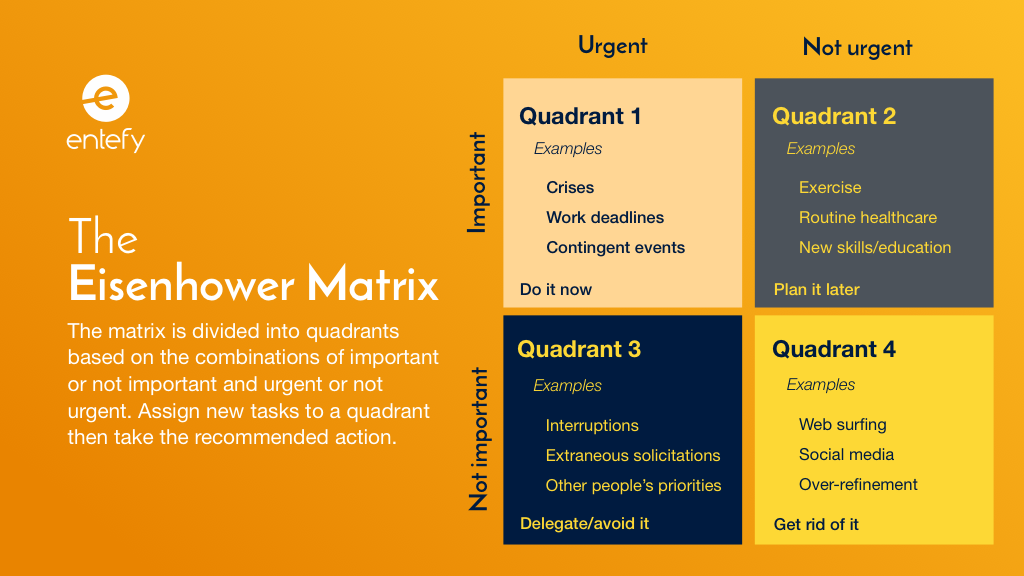
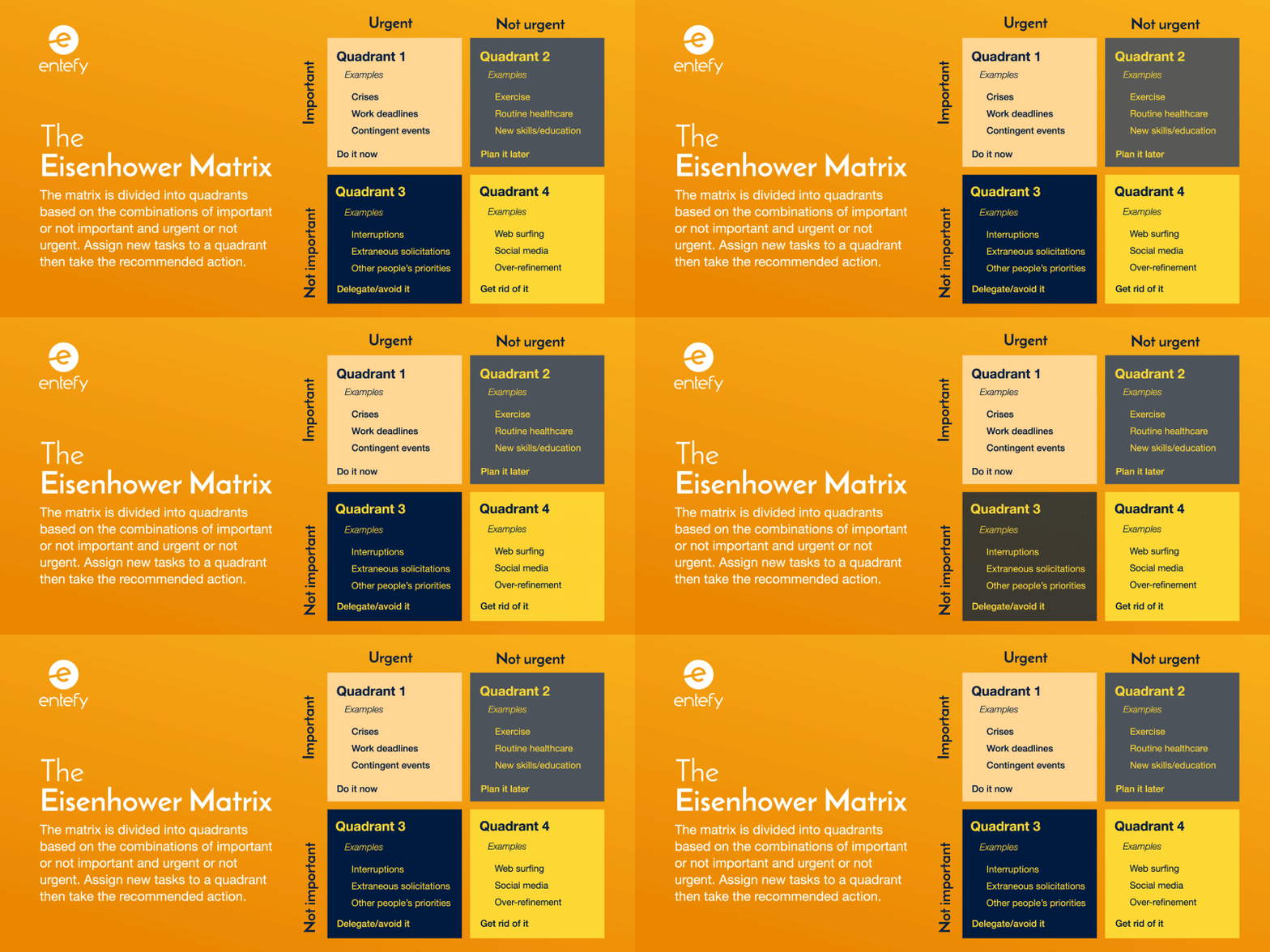
As we presented in The Eisenhower Matrix: 4 rules for getting more done faster, the Eisenhower Matrix is a simple-to-use tool that helps you quickly prioritize tasks and requests as they come your way. The core insight to the Matrix is that your productive time is best spent on tasks that directly support your personal and professional goals. It works by asking two questions of every new task or request: Is it important to my goals? And is it urgent to me?

With those answers in mind, locate the appropriate Matrix quadrant and take the recommended action. The important and urgent tasks that qualify for Quadrant 1 need to get done quickly; unimportant and not-urgent tasks appropriate for Quadrant 4 should be avoided or politely declined. 

The Eisenhower Matrix is not intended for highly complex decisions. Rather, think of it as a first step in prioritizing new projects as they arise during a meeting or when you’re reading an email. Getting into this habit can speed up prioritization and improve your decision making. 

The gentle art of learning to say “no” when you’re overbooked is a whole other discussion…