U.S. Patent Number: 12,699,741 Patent Title: Location-aware query transformation using weighted temporal models to derive user and region context Issue Date: August 4, 2026 Inventors: Ghafourifar, et al. Assignee: Entefy Inc.
Patent Abstract
A system and method for transforming location-based data queries into temporal domain by leveraging a location-to-time knowledge conversion graph. In some systems which contain diverse sets of data objects, only certain objects may contain explicit location data, while others may not. Therefore, queriability of this diverse data by location properties would likely yield incomplete results. In some embodiments, this method allows for the transformation and augmentation of a given data query containing location-based filtering properties into a time-region-based lookup, wherein a given location has been assigned to a time region in the given data graph and all data events within that time region may be augmented with location metadata automatically in the knowledge graph. Over time, a system utilizing these embodiments can offer comprehensive location-based data services and insights with a diverse set of data objects that exists and not all objects contain explicit location information.
USPTO Technical Field
This disclosure relates generally to converting a location-based query to a time-based query.
Background
Many data items are generated with location information embedded as metadata. For example, an image file may include global positioning system (GPS) data indicating where the image file was created. Location data associated with data items may be used for a variety of purposes. For example, an individual may query a system that tracks data items to determine which data items the individual generated while on a trip to Europe. However, some data items may not be associated with location data. Such data items may not be considered by systems and applications that operate on such data based on location, therein reducing the scope or efficacy of location-based queries with regard to retrieval of diverse data in a given system.
Entefy is an enterprise AI software company. Entefy’s patented, multisensory AI technology delivers on the promise of the intelligent enterprise, at unprecedented speed and scale.
Entefy products and services help organizations transform their legacy systems and business processes—everything from knowledge management to workflows, supply chain logistics, cybersecurity, data privacy, customer engagement, quality assurance, forecasting, and more. Entefy’s customers vary in size from SMEs to large global public companies across multiple industries including financial services, healthcare, retail, and manufacturing.
To leap ahead and future proof your business with Entefy’s breakthrough AI technologies, visit www.entefy.com or contact us at contact@entefy.com.
Abstract: In today’s rapidly evolving labor market, many organizations face mounting difficulties in efficiently and effectively identifying top job candidates when faced with potentially thousands of applications for each open role. The growing use of job-posting platforms, professional social networks, AI-assisted resume tools, and bot-generated applications is creating a significant transparency and data-processing burden for recruiting teams. Traditional applicant tracking systems (ATSs) and rule-based screening tools, though efficient for structured data, often fail to deliver high quality decision support, scalability, and more advanced levels of contextual understanding for job application analysis. As hiring processes become increasingly digital, new challenges emerge around data privacy, human and algorithmic bias, opportunity misalignment between candidates and roles, and a widening trust gap caused by opaque automated hiring practices. This study explores these limitations and proposes solutions to each, leveraging the strengths of traditional tools and artificial intelligence (AI), combining each solution into a hybrid agentic platform that integrates a variety of machine learning (ML) techniques and models, including large language models (LLMs), as well as privacy preserving methodologies. This multifaceted platform enhances evaluation of job candidates, reduces systemic bias, and strengthens transparency in early stages of candidate selection while improving efficiency, trustworthiness, and compliance with ethical and data-protection standards in large-scale recruitment.
Traditional Approaches to Processing Job Applications
Early-stage job application processing typically follows a structured, yet largely manual workflow centered on human judgment and basic automation. The process begins with the creation of a job requisition and the public posting of a role, followed by the submission of resumes and cover letters through online portals or ATSs. These systems organize and store applications but rely on predefined keyword filters or basic rule-based logic to identify candidates who appear to meet minimum qualifications. Human reviewers then conduct initial screenings, verifying certain attributes such as education, experience, or certifications, and removing candidates who do not meet baseline requirements. While ATS tools and resume parsers improve efficiency by helping manage high application volumes, they often depend on rigid pattern matching or rule-based criteria that may overlook qualified applicants who use nonstandard formats or language (Fuller et al., 2021). Due to the absence of standardization in resume review and scoring, evaluations are often inconsistent and subject to bias (Cohen et al., 2019). Additionally, the use of proxies such as degree or job title may mask true candidate potential, particularly for individuals from nontraditional backgrounds. Such traditional systems are limited in their ability to capture contextual nuance, adaptability, and fairness in candidate assessment. The cumulative effect is a process that is time-consuming, inconsistent, and prone to inefficiency, especially in competitive or high-volume hiring environments.
Challenges in Common Applicant Selection Processes
High Application Volume
The surge in job applications, fueled by “quick apply” features, the proliferation of online job posting sites, increased availability of remote work opportunities globally, and candidates casting wider nets in response to economic uncertainty, have left human resources (HR) departments contending with vastly larger resume inflows for open roles (Forbes, 2025). The high application volume introduces several challenges, including:
Screening inefficiency. A large share of incoming applications fails to meet basic role requirements yet still consume HR department resources. This diverts valuable time and attention away from evaluating qualified candidates and reduces overall hiring efficiency, creating significant bottlenecks in the early stages of recruitment (Maree et al., 2020).
Quality risk. Rapid and superficial screening using traditional rule-based automation and processing increases the risk of overlooking qualified candidates, especially if resumes do not match rigid keyword patterns or formats. Recruiters may advance the most obvious or easy-to-assess candidates, rather than those with greater long-term potential, undermining strategic talent acquisition (Dutta & Vedak, 2023).
Delays and attrition. Excessive application volume can lead to delayed responses (or no responses), generic messaging, and minimal feedback that can serve to frustrate candidates, leading to unnecessary drop-offs or losses to competitors. This poor candidate experience can damage employer reputation, reduce applicant engagement, and discourage future applications, especially among high-quality candidates who expect timely, respectful treatment (Priyadarsini & S.S, 2025).
Resource strain. Quantitative increases to inbound applications often translate to overwhelmed HR teams with higher risks of burnout or inconsistency in hiring. This pressure compromises the depth and fairness of application evaluation, particularly for non-traditional candidates (Fisher et al., 2021).
Collectively, these pressures diminish both the efficiency (time to hire, throughput) and effectiveness (quality of hires, fairness, candidate experience) in high volume recruitment.
Applicant Privacy
ATSs, resume parsers, and AI-enabled assessment systems routinely collect, store, and process extensive personally identifiable information (PII) and other sensitive data. While these tools help recruitment scale, they introduce substantial privacy risks if not managed with care. The primary risks in collecting PII are data breaches resulting from weak security practices. For example, in 2025 a vulnerability in McDonald’s AI hiring chatbot “Olivia,” developed by Paradox.ai, exposed millions of applicant chat records through weak administrator credentials. The leaked information included names, emails, phone numbers, and more (Wired, 2025). Legal and regulatory frameworks add further considerations. Under General Data Protection Regulation (GDPR) in the EU, certain data categories (such as health or race) are classified as “sensitive” and face stricter processing requirements (GDPR, 2016). Automated decision-making also requires transparency, consent, and rights to explanation. In the U.S., some state laws (e.g., Illinois’ biometric privacy laws) require explicit consent for collecting biometric data or using video interviews with facial recognition (American Privacy Rights Act of 2024, 2024). HR tools that process such data without clearly obtaining and managing consent risk violating privacy laws (NIST, 2023). Data retention and pseudonymization practices are often weak in ATS and other hiring tools. Many tools retain PII excessively or do not properly restrict identifying data in analytical systems. For example, a case study of an ATS used by Rangreen showed that both successful and unsuccessful candidates’ data (identifiers, demographics, and recruiting data) were stored, with pseudonymization and anonymization applied only under certain conditions and delays (ICO, 2025). Weak retention practices increase the risk of misuse, unauthorized access, or eventual data exposure.
Cognitive Bias of Recruiters
While both human reviewers and traditional ATSs remain essential to modern recruitment, each introduces significant risks of bias that challenge fairness and objectivity in hiring. Human evaluators are susceptible to conscious and unconscious biases shaped by social norms and prior experiences, often giving undue weight to factors such as race, gender, university prestige, or even hobbies and names. These subtle cognitive shortcuts can result in unequal treatment, where candidates who mirror existing organizational or cultural norms are favored over equally or more qualified candidates from underrepresented backgrounds. Traditional ATSs, designed to automate and streamline this process, are not immune to similar problems. Rule-based filters can unintentionally encode historical inequities, while systems trained on imbalanced or non-representative data perpetuate discriminatory patterns already embedded in past hiring decisions. Research has shown that linguistic and feature based models frequently reflect societal stereotypes, with word embeddings and keyword matching disadvantaging applicants from certain national or ethnic origins (Li et al., 2023). Likewise, studies of resume evaluation demonstrate that human decision makers systematically favor familiar or prestigious profiles, reinforcing structural inequities in access to opportunity (Moore et al., 2023). Beyond ethical concerns, such biases carry tangible risks, such as eroding candidate trust, damaging organizational reputation, and exposing companies to potential legal liability. Addressing these biases requires transparent, accountable systems and deliberate oversight to ensure that efficiency does not come at the expense of equity.
Opportunity Misalignment
In many organizations, candidate screening is tightly bound to role specific criteria. Rigid job requirements, narrow educational credentials, or fixed skill lists. This specificity often creates opportunity misalignment, where candidates who would be well suited for roles, teams, or levels other than those to which they applied are rejected. Given the high volume of applicants, most teams are unable to redirect candidates to more suitable roles within their organization. Traditional hiring tools often consider only keyword matches between a candidate’s resume and the applied job description.A candidate’s broader skill set, transferable skills, or potential adaptability across roles are not considered. Many organizations also retain “required qualifications” emphasizing formal education (e.g., degree, years of experience) rather than actual skills or potential. This limits the pool of applicants who can be considered for roles outside of their experience, even when they have relevant skills or could quickly learn. The consequences of opportunity misalignment are significant. Highly qualified individuals may never be considered for roles where they could add value, leading to frustration, wasted effort, and lost morale. For organizations, misalignment reduces talent utilization, limits diversity of thought, and undercuts recruitment ROI. Over time it can also contribute to higher turnover or gaps in filling roles. Research using data from the Organization for Economic Co-operation and Development (OECD) and the Program for the International Assessment of Adult Competencies (PIAAC) suggest economic costs to opportunity misalignment. It highlights that when workers are overqualified or underqualified, productivity suffers and overall economic output declines (Rathelot, 2023).
Model Interpretability and Trust Gap
Many modern ATSs operate opaquely, even to those who deploy them. Internal logic, feature weighting, ranking criteria, and thresholds are often hidden, either by design (e.g., proprietary models) or due to model complexity (e.g., deep learning or ensembles) that hinders interpretability. While these tools may offer efficiency and consistency in screening, their “black box” nature can generate a significant trust gap among candidates, HR practitioners, regulators, and the public (Ajunwa, 2020). A core driver of the trust gap is the lack of transparency around how decisions are made. Candidates often have no way of knowing why their application was rejected or advanced, whether due to keyword matching, inferred traits, or historical data patterns. This opacity breeds suspicion, reduces candidates’ confidence in fairness, and can damage employer reputation. According to the U.S. Department of Justice and Equal Employment Opportunity Commission (2024), many AI-powered hiring systems disadvantage candidates for unclear or undisclosed reasons, such as penalizing proxies for protected characteristics (e.g., race, age, disability) or failing to disclose algorithmic use.
Limitations with Existing Automation Tools
Automated hiring tools such as ATSs, keyword filters, and basic Natural Language Processing (NLP) are now widespread in recruitment. These tools streamline resume screening, reduce manual workload, and allow HR teams to manage applications at scale. However, despite accelerating the hiring process, these tools suffer from shortcomings that undermine both fairness and utility. Outlined below are the downsides to relying on traditional hiring tools:
Limited accuracy on unstructured inputs. Traditional keyword-based parsers perform well only when resumes conform to expected templates or formats. Their high precision comes at the cost of recall, meaning that valuable candidates can be missed if their resumes use unconventional structure or wording. This rigidity becomes a serious drawback in real-world recruitment pipelines, where applicants often use visually distinct or creative designs to stand out (Zielinski, 2022; Maree et al., 2020).
Rigid and brittle parsing logic. Classical rule-driven systems rely on hard coded patterns or regular expressions that must be updated whenever document structure changes. Even minor variations, such as substituting “Work Background” for “Professional Experience,” can break parsing logic. This lack of adaptability makes traditional tools fragile and limits their usefulness in global or fast evolving industries where resume conventions vary widely (Chiticariu et al., 2013).
Poor support for complex file formats. Traditional parsers generally handle plain text or simple PDFs, but struggle with layouts containing tables, columns, charts, or scanned documents. As resumes increasingly incorporate infographics, visual timelines, and portfolio samples, legacy systems fail to extract relevant data accurately from such unstructured data. This narrow format compatibility restricts the diversity of candidates who can be fairly assessed (Gemelli et al., 2024).
No contextual understanding. Rule-based systems treat words as isolated tokens and cannot interpret context, such as distinguishing a graduation date from an employment period when both appear near similar keywords. The result is misclassification of fields, timeline errors, and ultimately reduced trust in automated screening outcomes.
Low scalability and adaptability. Extending traditional parsers to new markets or job types requires manual creation and testing of additional rules. As organizations expand across regions with different languages or resume conventions, maintaining consistency and accuracy becomes prohibitively labor intensive. This manual overhead limits scalability and delays deployment.
Short-term cost efficiency, long-term inefficiency. While traditional systems may appear more cost effective to deploy initially, their cumulative maintenance costs rise steeply as resume diversity increases. Continuous rule updates, version control, and regression testing inflate total cost of ownership, making the approach economically unsustainable for large or multinational enterprises (Chiticariu et al., 2013).
Hybrid Agentic AI Talent Platform
Recruiting challenges (an overabundance of applications, data privacy vulnerabilities, cognitive bias, opportunity misalignment, mistrust in opaque hiring strategies, and limitations with traditional ATSs) can be resolved by taking advantage of the flexibility and contextual awareness of agentic AI. By leveraging the individual strengths of AI agents and ML into an integrated, cohesive system, an efficient pipeline for swift and fair hiring decisions can be built that resolves the issues outlined above. The platform is built upon the following:
Resume Parsing. Accurately interpreting diverse formats, preserves structure, and adapts to new layouts, outperforming rigid rule-based systems.
Deeper Analytical Evaluation. Understanding context and meaning in resumes to enable more accurate, inclusive, and efficient identification of qualified candidates.
Automated PII Protection and Detection. Automatically safeguarding sensitive candidate data at scale while reducing bias and ensuring regulatory compliance.
Fused ML-Driven Quantitative Scoring Method. Selecting candidates via reliable, interpretable, and resource-efficient candidate scoring for structured resume data, in support of fair and auditable hiring decisions in high-volume and regulated environments.
Systematic Role Matching. Systematically analyzing candidate and job data, uncovering complex qualification-job relationships, and adapting to trends in order to improve fit, fairness, and recruitment efficiency.
Uniform Evaluation Process. Promoting fairness and trust by standardizing evaluation criteria, removing demographic bias, and ensuring consistent assessment across all candidates.
Chat Interface for Viewing and Filtering. Providing recruiters with an intuitive, conversational interface to filter and interact with candidate data, streamlining access, enhancing transparency, and supporting decision-making without replacing human judgment.
Analysis Report Generation. Synthesizing unstructured data, highlighting relevant skills and nuanced qualities, and reducing recruiter cognitive load for more strategic decision-making.
Customized Candidate Engagement. Enhancing engagement, satisfaction, and organizational reputation while reducing recruiter workload.
Scalability. Enabling organizations to efficiently and consistently process large application volumes.
The following details each of the above features in a hybrid agentic AI talent platform:
Resume Parsing
AI significantly advances resume parsing by replacing brittle, rule-based methods with flexible, context-aware, multimodal models capable of interpreting diverse document formats, including text, tables, and PDFs. Unlike traditional regex systems that break with nonstandard headings or layouts, modern architectures such as LayoutLM jointly encode textual, spatial, and visual cues, enabling them to recognize equivalent fields and maintain structural context. For instance, these systems can recognize “Education” whether it is placed in a column or in an embedded table (Xu et al., 2020). Recent extensions using multi-granularity fusion further enhance extraction accuracy by capturing hierarchical relationships from token to table cell levels (Jiang et al., 2024). This approach yields concrete benefits, improving recall on irregular or OCR-processed resumes, contextual disambiguation of entities such as dates or roles, and reliable preservation of tabular data. Moreover, because these models learn from data rather than fixed rules, they can evolve through active learning and incremental labeling to accommodate new formats, offering a robust, adaptive alternative to the rigid maintenance demands of regex-based parsers.
Deeper Analytical Evaluation
AI systems employ semantic analysis and contextual understanding to evaluate resumes, which can overcome the limitations found in simple keyword matching and traditional ATSs (Abhishek, 2025; Bevara et al., 2025). By capturing the meaning behind words and phrases, recognizing synonyms, related terms, and industry-specific jargon, LLM-based AI can outperform traditional NLP tools when applied to understanding tasks (Ajjam & Al-Raweshidy, 2025). This deeper analytical capability enables more accurate assessment of candidate qualifications, ensuring relevant experience is not overlooked due to language differences (Lo et al., 2025). Integrating advanced AI capable of deeper analytical evaluation into the resume screening process addresses the limitations of traditional keyword and NLP-based ATSs. By understanding context and meaning in resumes, today’s LLM-based AI systems offer a more accurate, inclusive, and efficient method for identifying qualified candidates, leading to better hiring outcomes.
Table 1. A comparison between traditional and advanced AI tools in ATSs.
Traditional Tools
Advanced AI Tools
Accuracy
Works well if resumes strictly follow expected formats; high precision on structured input.
Handles unstructured, varied, or noisy resumes; higher recall and context sensitivity across formats.
Flexibility
Rigid: breaks when headings, fonts, or layouts change (e.g., “Professional Experience” vs. “Work Background”).
Flexible: models learn semantic equivalences (e.g., “Education” vs. “Academic Background”).
Formats Supported
Mostly text or simple PDFs; struggles with tables, graphics, or scanned images.
Multimodal: processes text, tables, and scanned PDFs; robust with OCR + layout-aware models (e.g., LayoutLM).
Context Awareness
Cannot disambiguate similar tokens (e.g., “May 2020” as employment vs. graduation date).
Uses context windows to resolve ambiguity, improving field classification and reducing errors.
Scalability
Requires manual rule updates for new resume styles; difficult to scale globally across industries.
Scales via retraining or fine-tuning with new data; adapts more easily across roles, industries, and geographies.
Cost
Low upfront cost, but maintenance effort is high long-term.
Higher upfront (model training, infrastructure), but lower marginal cost at scale.
Automated PII Protection and Detection
AI-based PII detection and protection provide a scalable and reliable solution for managing sensitive candidate data while ensuring compliance with major privacy regulations such as GDPR, CCPA, and HIPAA (Asthana et al., 2025). These systems automatically identify and redact dozens of PII types, such as names, addresses, Social Security numbers, emails, and phone numbers across thousands of resumes, minimizing human error and improving efficiency (Thetbanthad et al., 2025). Integrated directly into ATS and HRIS platforms, AI tools can perform real-time scanning, redaction, and anonymization without disrupting recruiter workflows. Beyond compliance, obfuscating sensitive information reduces the risk of bias by allowing recruiters to evaluate qualifications and experience without exposure to protected attributes. Modern LLMs further enhance this process by accurately detecting PII in free-form text, outperforming traditional rule-based and NLP systems (Shen et al., 2025). Together, these AI safeguards combine automation, fairness, and security to protect candidate privacy, foster trust, and strengthen employer reputation in large-scale hiring environments.
Fused ML-Driven Quantitative Scoring Method
For scoring candidates based on parsed resume data, classical ML models often provide the most effective and reliable approach (Grinsztajn et al., 2022). Techniques such as logistic regression, support vector machines, and gradient boosting suit structured tabular data and can provide transparent, interpretable outputs aligned with HR decision making needs. Unlike large scale deep learning models, which may overfit, hallucinate, or require prohibitively large datasets, classical models perform well with fewer resources while remaining reproducible and easier to validate (Rudin, 2019). Their simplicity also facilitates auditing for bias and compliance, making them well suited for high volume, regulated environments where fairness, accountability, and efficiency are paramount.
Systematic Role Matching
In response to opportunity misalignment, AI-driven systems offer a systematic, data driven approach to matching candidates with suitable positions. AI powered matching engines analyze resumes, job descriptions, and historical hiring patterns to identify the most relevant candidates for a role (Rojas-Galeano et al., 2022). Using ML, these systems uncover complex relationships between candidate qualifications and job requirements that may not be obvious to human recruiters (Jiang et al., 2020). Moreover, AI systems also continuously learn and adapt to changing hiring trends, keeping the matching process up to date and relevant (Zhao et al., 2021). This dynamic adaptability allows organizations to respond more effectively to shifts in the job market and internal business needs. By providing a more objective and comprehensive analysis of candidate qualifications, AI-driven matching engines can help organizations make more informed and equitable hiring decisions. This approach improves recruitment efficiency and enhances hire quality by ensuring a better fit between candidates and roles.
Uniform Evaluation Process
Trust in the hiring process can be strengthened by utilizing AI for hiring decisions. AI systems bring fairness and equity to hiring by providing a more uniform application process, standardizing evaluation criteria, and focusing on objective qualifications. A Northeastern University study found that applicants perceive AI powered hiring as more fair when the algorithms are blind to characteristics such as race, age, or gender. This approach, called “fairness through unawareness,” removes demographic information from evaluation to prevent bias. The study showed candidates view companies using such AI tools more positively and are more motivated to apply (Northeastern University, 2024). AI implementation also promotes consistency across recruitment stages. By automating tasks such as resume screening and initial assessments, AI systems ensure that all candidates are evaluated based on the same criteria, reducing variability in decision making. This uniformity helps create a level playing field for all applicants, regardless of background.
Chat Interface for Viewing and Filtering
A chatbot connected to an HR resume database can serve as an intuitive interface for recruiters, enabling conversational, on-demand interaction with candidate data. Instead of navigating complex dashboards or static reports, users can query the chatbot to filter candidates by skills, experience, education, or other criteria. This natural language interaction lowers the learning curve for non-technical staff and accelerates decision making. With customizable filters and sorting, the chatbot empowers users to shape candidate shortlists, ensuring automation supports rather than replaces human judgment. Such a system streamlines access to large applicant pools while enhancing transparency and flexibility in hiring decisions (Dodda et al., 2025).
Analysis Report Generation
LLMs are well suited for generating resume analysis reports, synthesizing unstructured information into coherent, context-rich summaries (Gan et al., 2024). Resumes often contain diverse formats, terminology, and levels of detail, making them difficult to standardize at scale. LLMs excel at extracting relevant skills, experiences, and accomplishments, then presenting them in clear, recruiter-tailored narratives. Unlike rigid rule-based systems, LLMs adapt to domain-specific language and highlight nuanced qualities such as leadership or problem-solving from text (Vaishampayan et al., 2025). The result is a concise, customizable report that reduces recruiter cognitive load, enabling focus on strategic decision making while retaining a comprehensive candidate view.
Customized Candidate Engagement
AI enables more personalized, timely, and context-aware communication throughout the hiring process, transforming how candidates experience engagement at scale (Madanchian, 2024). Instead of relying on impersonal, one-size-fits-all updates, AI powered systems can tailor messages to each applicant’s stage, role, and prior interactions, crafting responses that feel thoughtful and human. Natural language generation tools can adjust tone and content to acknowledge specific skills, share feedback, or highlight relevant company insights, while AI driven chatbots and virtual assistants provide consistent, real-time support aligned with employer branding. This blend of personalization and automation not only enhances transparency and candidate satisfaction but also strengthens organizational reputation and reduces recruiter workload, ensuring no applicant feels overlooked. Research further indicates that candidates view AI assisted communication as both useful and easy to use, reinforcing its value in fostering positive, scalable recruitment experiences (Horodyski, 2023).
Scalability
To address screening inefficiency, organizations are adopting AI-driven solutions that provide scalability, efficiency, and consistency (Chen, 2022). AI-powered resume screening tools swiftly process large volumes of applications, identifying candidates whose skills and experiences align with job requirements. These systems reduce manual review time, enabling HR teams to focus on strategic decisions (Dima et al., 2024). Implementing AI in high-volume hiring processes enables organizations to manage large applicant pools efficiently while maintaining quality and consistency. By automating repetitive tasks and leveraging data-driven insights, AI enables HR teams to focus on strategic recruitment, leading to better hiring outcomes and stronger organizational performance (Madanchian, 2024).
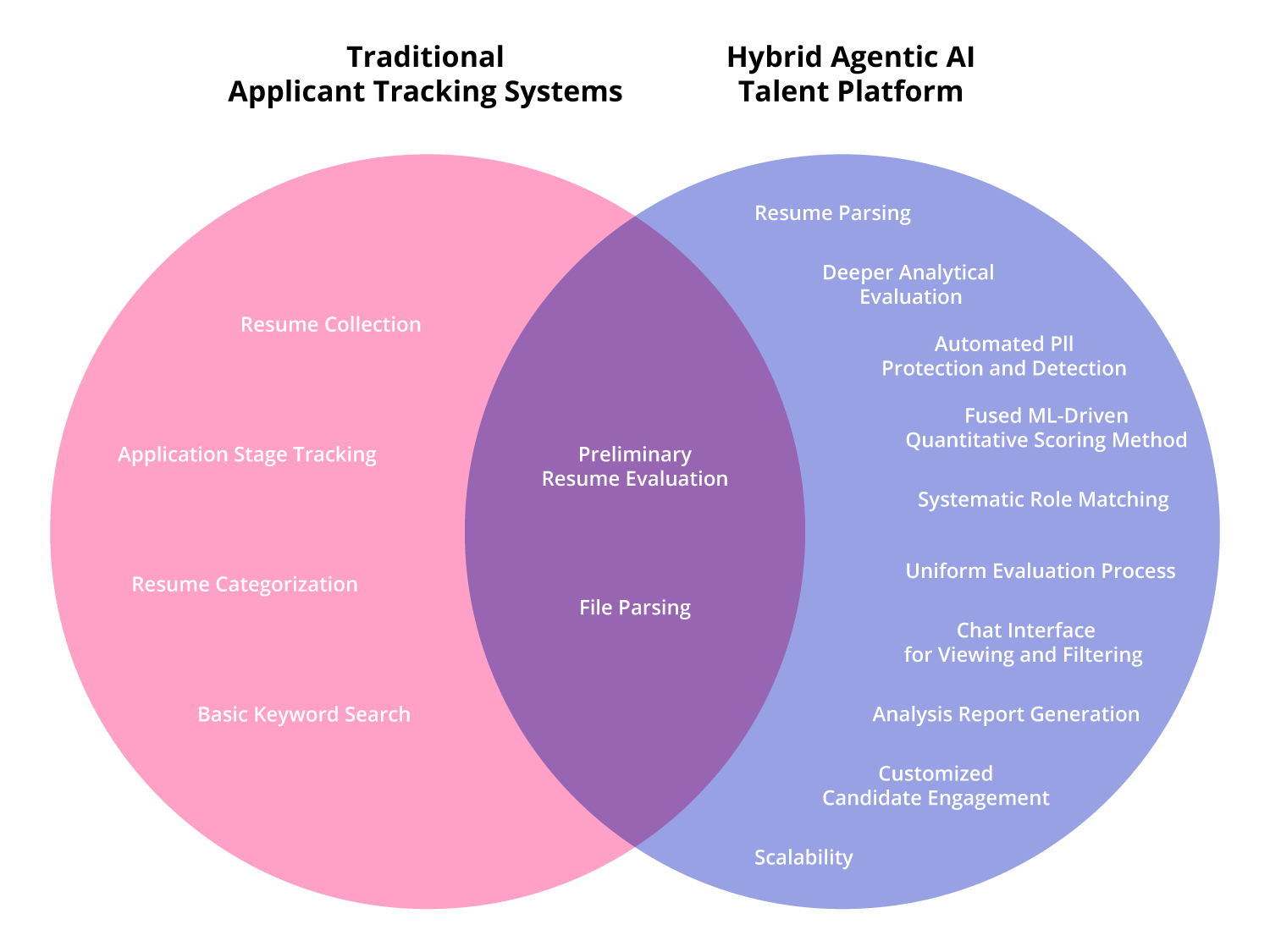
Figure 1: Comparison of traditional ATSs and the Hybrid Agentic AI Talent Platform in early-stage resume screening. Traditional tools primarily support administrative and organizational functions such as resume collection, application stage tracking, resume categorization, and basic keyword search, providing structure but limited analytical depth. In contrast, hybrid agentic AI systems extend these capabilities through multimodal resume parsing, criteria-based resume scoring, systematic role matching, privacy preserving data handling, and scalable automation. They also enable interactive communication via chat interfaces and generate detailed analysis reports for recruiters. The overlap between the two approaches, preliminary resume evaluation and file parsing, highlights the shared goal of efficiently processing candidate data, though AI driven methods achieve this with greater contextual understanding, adaptability, and consistency.
Conclusion
Modern recruitment sits at the crossroads of immense opportunity and escalating challenge. As applicant volumes surge and global labor markets continue to shift, traditional screening approaches struggle to preserve speed, equity, and contextual understanding. Throughout this paper, we examined the limitations of existing systems, from cognitive bias and data privacy vulnerabilities to opportunity misalignment and a widening trust gap between candidates and employers. These issues demonstrate that while automation has alleviated some inefficiencies, the status quo remains insufficient for recruiting environments where fairness, interpretability, and scalability are increasingly non-negotiable.
To address these gaps, this paper introduced a multi-layered, agentic AI system that combines ML, LLMs, and privacy-preserving methodologies into a unified pipeline for candidate evaluation. The Hybrid Agentic AI Talent Platform supports the hiring lifecycle from resume parsing and quantitative scoring to contextual analysis, systematic role matching, and personalized candidate engagement. By integrating automation thoughtfully with conversational interfaces and transparent decision pathways, organizations can transition from reactive filtering to proactive talent discovery, unlocking value that rigid ATS tools cannot. At its core, this approach emphasizes not just efficiency, but trustworthiness: anonymization reduces bias, semantic understanding elevates hidden talent, and adaptive learning aligns opportunity with potential.
While promising, the path toward fully equitable automated hiring demands continued vigilance. Risks remain around algorithmic bias, disproportionate exclusion of marginalized applicants, and the opacity of increasingly powerful models. Future research must prioritize explainability, robust auditing, and candidate rights to ensure that innovation strengthens, rather than weakens, public confidence in recruitment systems. Building strong governance around data handling and ethical AI deployment will be essential as the industry shifts toward deeper automation. If designed and adopted responsibly, the Hybrid Agentic AI Talent Platform described herein can equip organizations to scale hiring with both human dignity and operational excellence at the center of every decision.
ABOUT ENTEFY
Entefy is an enterprise AI company and the 1st to invent the core paradigm for agentic AI. Entefy’s patented AI technology delivers on the promise of the intelligent enterprise, helping organizations transform how they make decisions, operate, and grow.
Our multisensory AI platform combines agentic AI and advanced forecasting to help organizations execute complex workflows, improve planning accuracy, and automate work that requires reasoning, judgment, and business context. We work with enterprises that view AI not as a standalone capability, but as a core component of how decisions are made, processes are executed, and performance is measured. Entefy’s customers vary in size from SMEs to large global public companies across multiple industries including financial services, healthcare, retail, and manufacturing.
Abstract: Artificial intelligence (AI) is increasingly deployed in high-stakes contexts, yet their trustworthiness remains uncertain when ethical principles, technical mechanisms, and governance structures operate in isolation. This paper reviews the current landscape of trustworthy AI, including work on ensuring fairness, eliminating bias, explainability, privacy protections, trust in models, governance, and legal accountability. It further describes persistent challenges that limit reliability under real-world conditions. It identifies an operational integration gap and proposes to address this gap by the Unified Accountability Framework (UAF), a holistic, 5-tier approach for operationalizing trust in the era of foundation models. The five tiers of the UAF include Foundational Principles, Governance Structures, Lifecycle Integration, Technical Assurance Tools, and External Accountability. Trustworthy AI should be understood as an evolving sociotechnical phenomenon in which normative commitments, technical verification, and institutional oversight evolve to sustain legitimacy and adoption. In doing so, the framework provides a pathway for translating ethical intent into verifiable and governable trust across the AI lifecycle.
Keywords: Ethical AI; Trustworthy AI; Foundation Models; AI Governance; Socio-technical Trust, Accountability Frameworks
Introduction
Recent years have seen a rapid expansion of foundation models and generative systems, from research prototypes to deployed commercial products with significant societal impact. Across many domains including clinical diagnostics, judicial risk assessment, creative media, and autonomous mobility, ethically sensitive applications of AI are no longer speculative; they are now deployed in contexts where errors or biases can have harmful consequences. Against this backdrop, the notion of “trustworthy AI” has become central, invoked by policymakers and researchers across disciplines (Ethics Guidelines for Trustworthy AI, 2019; Tabassi, 2023).
Trustworthy AI is commonly defined through overlapping principles of fairness, transparency, privacy, accountability, and ethical alignment (Floridi & Cowls, 2019; Jobin et al., 2019). A short list of the most important domains where AI is being applied and raises unresolved issues of bias and fairness includes healthcare and clinical decision-making, hiring and workplace management systems, criminal justice and policing, credit, lending, and insurance, and public benefits and housing allocation, all of which directly shape life chances and embed historical inequalities into automated decisions. The ethical principles that will govern fairness and bias in AI are being shaped through an ongoing debate among ethicists, government regulators and legislators, courts and administrative bodies, industry actors and technical standard-setting organizations, civil society and advocacy groups, and domain experts such as clinicians, HR professionals, financial experts, and public administrators, whose combined judgments will determine which principles are salient and how they are applied in practice.
As these discussions and debates proceed, an important operational integration gap has emerged. How will these emerging normative principles move from abstract consensus to operational design? How will these principles be concretely embedded in the architecture, training data, objectives, constraints, and governance processes of each AI system? The answers to these questions can guide how fairness is enacted by the system itself rather than imposed only after deployment.
To address this operational integration gap, this paper introduces the Unified Accountability Framework (UAF), a model that frames trustworthy AI as a sociotechnical continuum. As further described later in this paper, the UAF represents a 5-tier approach that determines the legitimacy and resilience of AI systems, as follows:
Foundational Principles define the ethical and normative grounding of the AI system, serving as the basis for all downstream processes to ensure fairness, accountability, transparency, and privacy. These Foundational Principles are those which will emerge ultimately from the ongoing debates about salient ethical principles and how they will be applied. In this paper, we summarize the current state of these debates. These principles will develop and evolve over time, but we find utility in taking the current state of affairs as the starting point for the UAF.
Governance Structures establish institutional mechanisms to embed end-to-end ethical oversight.
Lifecycle Integration operationalizes principles and governance through structured processes across the entire AI lifecycle.
Technical Assurance Tools include the technical toolkits and standards necessary for implementation.
External Accountability ensures the system is aligned with societal and regulatory expectations.
This paper makes three primary contributions to advancing the study of trustworthy AI. The primary contributions include:
Current Research Landscape and Challenges: Synthesizing recent research across four key dimensions, i.e., fairness and bias, explainability and privacy, trust assessment for foundation and generative models, and governance and legal accountability, embedding the key challenges and gaps directly within each dimension rather than treating them separately.
The Case for Trustworthy AI: Examining how issues of trustworthiness manifest in practice through various areas of study including healthcare, autonomous vehicles, generative AI, and facial recognition, identifying both technical advances and persistent limitations.
The Unified Accountability Framework (UAF): Proposing a unified framework for operationalizing trust by coupling ethical principles, technical mechanisms, and governance structures within an auditable feedback system. The UAF offers a scalable model for integrating normative, computational, and institutional approaches to trustworthy AI in the era of foundation models.
Together, these contributions provide a synthesized understanding of the current research landscape and a forward-looking framework for developing AI systems that are robust, transparent, and societally legitimate.
The Current Research Landscape and Challenges
Four interrelated dimensions accurately characterize the current research landscape: fairness, explainability, trust assessment, and governance. Despite limited progress in each dimension, major challenges remain.
Table 1 below highlights both the breadth and the fragmentation of contemporary research on trustworthy AI. Fairness has produced relatively mature toolkits, whereas explainability remains marked by unresolved trade-offs with privacy. Trust assessment frameworks are still in early stages of standardization, and governance continues to struggle with enforceability. These observations motivate a closer examination of each of these four dimensions. The following subsections analyze fairness, explainability, trust assessment, and governance in greater depth, focusing on both recent advances and the persistent gaps that constrain their practical effectiveness.
Table 1. Advances and Challenges Across Core Dimensions of Trustworthy AI
Dimension
Advances
Key Challenges
Fairness
Debiasing method
Metric incompatibility, poor generalization, lack of cross-cultural evaluation
Explainability
Recourse explanations, layered Explainable AI (XAI)
Privacy leakage, one-size-fits-all design, lack of evaluation standards
Trust Assessment
Benchmarks and robustness testing
Focus on average-case, lack of formal guarantees, scalability issues
Fairness has become one of the most extensively studied areas in trustworthy AI, with technical approaches spanning data balancing, fairness-aware optimization, and post-hoc adjustments (Mitchell et al., 2021). Yet this body of research reveals fundamental challenges which have yet to be solved. For instance, surveys of multimodal systems such as vision–language models document persistent representational bias and stereotyping. Captioning and Visual Question Answering (VQA) models often misinterpret ethnicity or gender, and even when debiasing strategies improve performance on a benchmark dataset, they frequently fail to generalize to new distributions (Saleh & Tabatabaei, 2025). Similar observations appear in surveys of multimodal fairness that classify biases and evaluation methods across image, text, and speech systems (Booth et al., 2021; Mehrabi et al., 2021). This difficulty points to the broader challenge of fairness under domain shift: what appears “fair” in one dataset may collapse in another.
Compounding this, different fairness measures can conflict with each other, optimizing for one (e.g., predictive parity) can reduce performance on another (e.g., equalized odds). Therefore, deciding what “fairness” means in practice involves ethical judgment and policy choices, not just technical optimization (Corbett-Davies et al., 2023). Studies in multimodal biometrics also show that demographic disparities persist even when multiple modalities are combined, indicating that multimodality does not automatically eliminate bias (Fenu & Marras, 2022). Operational tools such as Fairlearn (Weerts et al., 2023) help practitioners evaluate disparities across metrics, yet adoption reveals another gap. Organizations often lack guidance on which definitions of fairness align with their specific obligations or contexts. Surveys of fairness methods in applied AI (Yang et al., 2024) show that most strategies remain dataset-specific and struggle to generalize beyond benchmarks, a limitation consistent with findings in multimodal tasks. Finally, cross-cultural and low-resource settings remain underexplored. Much of the fairness literature relies on English-language data and high-resource domains, while multilingual and culturally diverse scenarios, precisely where bias is most consequential, receive limited attention.
Explanability and Privacy Trade-offs
Explainability is a pillar of trustworthy AI, yet recent work shows that explanations themselves introduce new risks. Attribution maps, example-based rationales, and internal gradients can leak sensitive information, creating privacy vulnerabilities that adversaries may exploit (Allana et al., 2025). This tension between transparency and privacy remains poorly quantified. Few systems measure both explanatory fidelity and information leakage risk, leaving practitioners without clear trade-off curves. What reassures a regulator may overwhelm a clinician, while a patient may require a different form of reasoning. The classic “one-size-fits-all” challenge persists in the explainability dimension. Without careful tailoring, explanations risk being too shallow to foster trust or too complex to be usable. Alongside these human-centered advances, recent research promotes actionable, recourse-oriented explanations that show users concrete steps they might take to change outcomes (Fokkema et al., 2024). Other studies conceptualize recourse as minimal interventions rather than simple counterfactual shifts (Karimi et al., 2021). Yet evaluation standards remain unsettled. Distinguishing between faithfulness to internal mechanics and plausibility for human audiences is still not practiced consistently (Leiter et al., 2024).
Trustworthiness Assessment for Generative & Foundation Models
The emergence of foundation and generative models has catalyzed a shift toward more systematic assessment frameworks. Traditional metrics such as accuracy or perplexity offer limited insight into whether these systems are safe, robust, or equitable. In response, TrustGen (Huang et al., 2025) introduced a benchmarking platform that evaluates generative models across fairness, robustness, transparency, and safety dimensions, revealing consistent weaknesses in low-resource languages, rare prompts, and adversarial settings. These findings reinforce a long-standing concern that most evaluations capture only average-case performance, whereas trust requires resilience under worst-case scenarios. Recent surveys document advances in adversarial robustness and privacy-preserving techniques, yet most defenses remain empirical, narrow in scope, and rarely extend to multimodal or generative architectures (Goyal et al., 2023; Li et al., 2024; Meng et al., 2022). Formal guarantees such as certified robustness bounds remain uncommon, leaving practitioners reliant on heuristics that often fail to generalize in deployment. Benchmark scalability also remains a persistent challenge, as new model families evolve faster than evaluation platforms can adapt. This phenomenon increases the risk of standards lagging behind real world model development and evolution (Bommasani et al., 2021; Bortolussi et al., 2025; Dong et al., 2025). In high stakes domains such as healthcare, this mismatch is especially evident. Recent AI and LLM application guidance in health emphasizes traceability, transparency, and human oversight, yet current benchmarks seldom incorporate such lifecycle assurances (Freyer et al., 2024; Guidance on the Use of AI-Enabled Ambient Scribing Products in Health and Care Settings, 2025).
Governance, Auditing, and Legal Interfaces
Governance efforts have proliferated, with the EU (European Union) AI Act (EU AI Act: first regulation on artificial intelligence, 2025) and NIST AI RMF (Artificial Intelligence Risk Management Framework: Generative Artificial Intelligence Profile, 2024) defining risk-based frameworks, and industry actors issuing their own responsible AI principles. NIST (National Institute of Standards and Technology) is an agency of the United States Department of Commerce. Surveys of AI researchers depict a torn community, one that broadly supports investment in safety and accountability research and another that remains divided on issues such as restricting military applications (Grace et al., 2017). Despite this momentum, an enforcement gap persists. Principles are abundant, yet mechanisms for independent monitoring and compliance remain limited. Accountability is especially diffused in open-source ecosystems, where responsibility for downstream harms often remains unclear. At the legal frontier, debates over copyright and data provenance have intensified. Henderson et al. (Henderson et al., 2023) analyze the unresolved tension surrounding “fair use” in foundation-model training and underscore the lack of transparent disclosure about datasets. Sector-specific governance, meanwhile, emphasizes context-sensitive obligations. In healthcare, trustworthy AI depends on auditable pipelines and human-in-the-loop validation (Wiens et al., 2019). Earlier lessons from ambient-intelligence research show that pervasive computing often erodes privacy by default, a dynamic now resurfacing as AI systems extend into edge and IoT environments (Wingarz et al., 2024). Together, these issues illustrate a widening legal and technical mismatch where regulations define goals but lag behind in terms of the technical capabilities to properly enforce.
The Case for Trustworthy AI
Despite the rapid advancements in AI, key studies continue to expose persistent gaps, highlighting the need for stronger integration between ethical principles, technical frameworks, and the practical realities of deploying AI systems with fairness and accountability.
Healthcare is often positioned as a flagship domain for trustworthy AI because the stakes are exceptionally high (i.e., patient safety, equity of care, and clinical decision support). Diagnostic systems powered by computer vision and LLMs promise faster triage, earlier detection, and more efficient workflows. Yet these benefits are tempered by recurring problems of bias and accountability. For instance, studies demonstrate imaging models trained on narrow demographic cohorts underperform on underrepresented populations, thereby reinforcing existing health inequities (Saleh & Tabatabaei, 2025). The sector has begun developing targeted frameworks, such as model input-output traceability and mandated human-in-the-loop validation, to safeguard deployment. Nonetheless, practical challenges remain. Validation datasets rarely capture the heterogeneity of real-world patients; explanations intended to assist clinicians often prove too complex or too shallow; and integrating oversight into resource-constrained healthcare systems can be burdensome. Trust in healthcare AI therefore depends not only on fairness-aware training pipelines but also on adaptive evaluation protocols that ensure consistent performance across diverse settings and populations.
Autonomous Vehicles (AVs) embody both the promise and the uncertainty of trustworthy AI. On one hand, AVs offer the potential for improved safety by reducing human error. On the other, each failure is highly visible and often catastrophic. While advances in robustness, perception, and decision-making may continue to reduce crash rates in controlled environments, yet questions of liability and accountability remain unresolved. If an AV system causes harm, should responsibility lie with the developer, the manufacturer, or the end-user? Legal scholars note that consent-based liability frameworks remain fragile, as courts may reject driver agreements made through digital interfaces if users cannot demonstrate genuine understanding of the system’s risks and responsibilities (Pattinson et al., 2020). Moreover, validation remains limited. Most testing is done in simulation or under narrowly defined conditions, which may not capture the edge cases encountered on public roads (Kalra & Paddock, 2016). Therefore, the challenge is not only engineering safer models but aligning engineering practices with legal frameworks and societal expectations. Until these dimensions are integrated, the trustworthiness of AVs will remain contested.
Generative AI illustrates how technical advances often outpace governance. Large-scale text-to-image and text-to-text models are increasingly embedded across creative industries, education, and public sector. These systems demonstrate remarkable fluency and creativity, yet they also produce misinformation, offensive stereotypes, and synthetic media that undermine public trust. Initiatives such as the TrustGen benchmarking platform (Huang et al., 2025) mark a promising step toward systematically assessing generative foundation models across fairness, robustness, and safety dimensions. However, assessments reveal persistent weaknesses in multilingual prompts, edge cases, and malicious inputs. Legal debates compound these challenges. Unresolved questions of copyright and “fair use” in model training datasets leave developers and deployers in a precarious position (Henderson et al., 2023). Current mitigations, such as watermarking or traceability metadata, are useful but incomplete. The case of generative AI illustrates both the necessity and the difficulty of operationalizing trust. Without robust evaluation and enforceable governance, deployment risks are outpacing accountability.
Surveillance and Facial Recognition Technologies (FRTs) have long been a flashpoint in debates on ethical and trustworthy AI. Used in law enforcement, security, and commercial applications, FRTs promise efficiency but consistently exhibit higher error rates for women and minority groups. Progress in debiasing algorithms and diversified datasets has narrowed but not eliminated these disparities (Mitchell et al., 2021). Moreover, the use of FRTs raises concerns about ethics and civil liberties. Widespread surveillance threatens privacy norms and risks chilling effects on democratic participation. Several jurisdictions, such as San Francisco, California, have responded with moratoria or outright bans, illustrating how governance intervenes when technical fixes lag. Yet global adoption remains uneven, with authoritarian contexts deploying FRTs with minimal transparency or oversight. This case underscores that trustworthiness is not solely a function of model accuracy. Even if error rates were equalized, societal trust would still hinge on legitimacy, consent, and proportionality.
Table 2 illustrates trustworthiness challenges across multiple domains. Each domain demonstrates tangible technical progress while exhibiting enduring ethical, legal, and operational gaps that hinder reliable deployment modern day AI systems.
Table 2. Trustworthiness Gaps Across Multiple Domains
Domain
Technical Progress
Persistent Gaps
Healthcare
Diagnostic support, traceability frameworks
Bias across demographics, ineffective explanation, limited workflow integration capabilities
Autonomous Vehicles (AVs)
Improved perception and safety under controlled conditions
Legal liability and accountability ambiguities, limited edge-case validation
The following emerging areas of AI illustrate how both technical innovations and institutional responses are adapting to the evolving demands of trust in the era of foundation models. The pursuit of ethical and responsible AI systems has catalyzed new work across disciplines, focusing not only on improving model reliability, explainability, and fairness, but also on strengthening the surrounding governance structures, oversight mechanisms, and regulatory frameworks. Together, these trends signal a movement toward a more holistic, systemic approach to trustworthy AI.
Mechanistic Interpretability and Causal Abstraction
As foundation models scale into the hundreds of billions of parameters, interpretability research has shifted from local approximations toward mechanistic understanding. Recent work establishes a theoretical framework for causal abstraction, aiming to map internal representations to human-interpretable concepts (Geiger et al., 2025). Despite challenges, this line of research is promising because it moves beyond proxy explanations toward structural insight. Causal mappings are fragile across tasks and current methods rarely scale beyond small models or limited modules. Moreover, even when abstractions are identified, translating them into actionable governance mechanisms or user-facing explanations remains an open problem.
Fairness in Federated and Distributed Learning
Situated at the crossroads of advanced technology and growing privacy demands, federated learning (FL) leverages a distributed framework to enable collaborative model training among multiple clients while safeguarding sensitive data. Despite its promise, the deployment of FL systems faces fairness challenges driven by various forms of heterogeneity, which can introduce bias, degrade model accuracy, distort predictions, and slow down convergence. Fairness-aware aggregation rules and personalized models could mitigate these effects, yet scaling these methods across large, dynamic federated networks remains difficult (Mukhtiar et al., 2025).
Human-Centered and Layered Explainability
Research is moving toward explanation systems that are adaptive, layered, and audience aware. Frameworks propose embedding explanatory mechanisms within models, tailoring outputs to user expertise, and incorporating feedback loops that refine explanation delivery (De Silva et al., 2017). These developments reflect growing recognition that explanations are relational and context specific. Yet embedding such adaptability introduces new risks. Explanations optimized for usability may sacrifice faithfulness, while those faithful to internal mechanics may overwhelm users with technical detail (Leiter et al., 2024). Privacy risks remain unresolved. As a recent scoping review shows, even partial explanations can leak sensitive information if adversaries probe explanation interfaces (Allana et al., 2025).
Benchmarking Ecosystems for Trustworthiness
The proliferation of generative and multimodal models has intensified the demand for trust benchmarks. Emerging platforms are beginning to address this gap by systematically testing models across robustness, fairness, and safety dimensions (Huang et al., 2025). These platforms reveal vulnerabilities in multilingual contexts, adversarial prompts, and minority representations, providing a more realistic picture of trustworthiness than conventional benchmarks. Yet the benchmarking ecosystem remains fragmented. No universally accepted standards for trust metrics yet exist, and benchmarks often lag emerging architectures and modalities. Furthermore, benchmarking remains resource-intensive, limiting adoption beyond major research labs.
Formal Verification for Foundation and Agentic Models
Formal verification roadmaps propose combining symbolic specification tools, such as interactive theorem provers including Coq and Isabelle(Lu et al., 2024; Lin et al., 2024) and model checking, with generative models to constrain outputs or validate compliance with safety rules. This hybrid approach is compelling because it aims to deliver verifiable guarantees for systems that would otherwise function as black boxes. Yet, even the most promising verification frameworks struggle with computational complexity, as recent studies show that while formal methods can yield provably correct explanations, their scalability remains severely limited for large or complex models (Ribeiro et al., 2022).
Researcher Attitudes and Evolving Norms
Recent surveys of AI researchers reveal a complex and evolving landscape of professional norms surrounding safety, risk, and responsibility. Research suggests that although AI experts urge global focus on AI safety, warning of existential dangers on par with nuclear war, work on AI alignment and catastrophic risk often faces skepticism. The study identifies two prevailing perspectives: one viewing AI as a controllable tool and another treating it as an uncontrollable agent. These divergent outlooks correspond to differing beliefs about the feasibility and urgency of safety interventions. Moreover, many experts express limited familiarity with core AI safety concepts such as instrumental convergence, suggesting that disagreement often reflects conceptual rather than purely ideological divides. Together, these findings illustrate that the research community’s internal pluralism continues to shape both discourse and policy engagement around responsible AI development (Field, 2025).
Table 3 summarizes the principal emerging trends in trustworthy AI. Each trend encapsulates the most recent research advances alongside unresolved challenges that define future inquiry.
Table 3. Emerging Research Trends in Trustworthy AI
Trend
Research Advances
Open Problems
Mechanistic Interpretability and Causal Abstraction
Causal abstraction and internal concept mapping in foundation models
Fragile across tasks, limited scalability to large models
Fairness in Federated and Distributed Learning
Fairness-aware aggregation rules and personalized models for heterogeneous clients
Scaling FL across large, dynamic networks
Human-Centered and Layered Explainability
Adaptive, layered, and audience-aware explanation systems with feedback loops for refinement
Balancing faithfulness and usability; residual privacy leakage of sensitive information through explanations
Hybrid verification approaches combining SMT solvers and model-checking for safety compliance
Poor scalability; lack of automated specification tools and governance integration
Researcher Attitudes and Evolving Norms
Empirical mapping of researcher beliefs, value clusters, and conceptual familiarity with AI safety
Conceptual gaps and the lack of consensus on safety urgency and governance relevance
The Unified Accountability Framework (UAF) for Trustworthy AI
Building upon the motivation established in this paper, the Unified Accountability Framework (UAF) is presented as a formalized approach to operationalizing trust in AI.
Below is a synthesis of the UAF’s five tiers, combining current best practices from academia, industry, and policy (e.g., EU AI Act, OECD principles, NIST AI Risk Management Framework).
Overview of the UAF
The UAF offers a comprehensive, 5-tier architecture designed to embed fairness, accountability, transparency, robustness, and human alignment throughout the full AI lifecycle. Existing approaches often isolate technical or ethical concerns to specific development phases (e.g., risk audits, fairness testing, or post-hoc evaluations). However, the UAF integrates technical, organizational, legal, and societal components into a coherent and actionable system. This unified approach is built not just to enforce compliance, but to engineer trustworthiness as a system-level property, making it measurable, monitorable, and adaptable over time. Figure 1 illustrates UAF’s 5 distinct tiers.
Figure 1: The Unified Accountability Framework (UAF) for Trustworthy AI with a 5-tier framework which includes Foundational Principles, Governance Structures, Lifecycle Integration, Technical Assurance Tools, and External Accountability.
Core Functional Mechanisms
The UAF is structured with five interdependent layers, each contributing to a system-wide foundation of trust. The 5-tier design is as follows:
Foundational Principles. This base tier establishes the normative commitments that guide AI development and oversight. It includes commitments to:
Human autonomy and dignity
Fairness and non-discrimination
Transparency and explainability
Robustness and safety
Accountability and auditability
Privacy and data governance
Sustainability and social benefit
Governance Structures. To operationalize these principles, the framework embeds governance mechanisms within organizational workflows. These include AI ethics committees and boards, algorithmic impact assessments, cross-functional governance (legal, ethics, technology, product), clearly defined roles, documentation standards, and escalation pathways. These mechanisms ensure that ethical oversight is not peripheral, but integral to AI development and deployment.
Lifecycle Integration. This tier applies ethical and governance commitments to each stage of the AI lifecycle:
Problem Scoping. Use cases are defined with ethical KPIs and stakeholder impact assessments.
Data Management. Processes include bias audits, data consent tracking, and privacy protections such as differential privacy.
Model Development. Fairness-aware learning (e.g., adversarial debiasing), interpretability tools (e.g., SHAP (Lundberg et al., 2017), LIME (Riberio et al., 2016)), and robustness testing are applied to ensure reliable and explainable systems.
Evaluation and Validation. Performance is tested across demographic groups and usage scenarios, including simulations of downstream risk.
Deployment and Monitoring. Continuous monitoring for performance drift and failure modes, supported by human-in-the-loop controls.
Post-Deployment Impact Evaluation. Systems incorporate real-world feedback, tracking of harms and benefits, and updating mechanisms for models and policies.
Technical Assurance Tools. This tier codifies the use of validated technical tools and metrics. It includes explainability techniques, fairness metrics (e.g., demographic parity, equalized odds), robustness tools, and privacy-preserving techniques. These are embedded in MLOps pipelines with ethical checkpoints to ensure continuous validation.
External Accountability. To maintain public and institutional trust, the final tier includes third-party audits, regulatory compliance mechanisms, transparency reporting, and participatory design practices. Public portals, open disclosure of incidents, and community engagement ensure alignment with societal expectations and democratic oversight.
A truly unified framework for operationalizing trust is not static. It must include built-in feedback mechanisms across all tiers. Learning, iteration, and adaptation are crucial as technology and society evolve. The unifying element therefore requires continual risk assessment, dynamic ethical goal realignment, integration of empirical post-deployment data, and responsive adaptation to regulatory and cultural shifts.
Table 4 provides a streamlined overview of UAF’s tiers, highlighting their primary focus areas and key components.
Table 4. Compact Summary of UAF
UAF Tier
Focus
Key Elements
Foundational Principles
Ethical foundation for AI systems
Fairness, transparency, safety, accountability, privacy, sustainability, human dignity
Governance Structures
Organizational oversight mechanisms
Ethics boards, impact assessments, cross-functional teams, roles and responsibilities, documentation
Lifecycle Integration
Oversight integrated across AI lifecycle
Problem scoping, data governance, model fairness, evaluation, monitoring, post-deployment feedback
The UAF presents several transformative implications for organizations, regulators, and the broader AI ecosystem. First, it enables trust-by-design, embedding ethical and legal requirements into the core engineering pipeline rather than treating them as post-facto validations. This process facilitates proactive risk management and reduces the cost of compliance over time. Organizations implementing this framework are better positioned to meet evolving regulatory demands such as those outlined in the EU AI Act and NIST RMF.
Second, the framework offers a common operational language across disciplines. By integrating legal, technical, ethical, and product perspectives within a single governance architecture, it helps organizations overcome the silos that often impede responsible AI development. The inclusion of actionable tools, such as model specification, data sheets, and continuous evaluation pipelines, supports operational scalability without sacrificing oversight.
Third, the UAF reinforces public legitimacy and institutional accountability. The External Accountability tier ensures that AI systems are not only internally governed but are also externally auditable and responsive to societal expectations. Participatory design and open reporting mechanisms invite ongoing input from affected communities, which is particularly critical in domains with asymmetric power or high stakes decision-making.
Finally, this unified approach is inherently adaptive, positioning organizations to respond to rapid changes in technology, regulation, and public sentiment. Its feedback-driven structure ensures that AI systems evolve in alignment with human values and societal norms, enabling long term trustworthiness that is resilient, measurable, and context-sensitive.
Conclusion
As AI systems continue to scale in capability and reach, their influence over critical decisions in healthcare, finance, education, criminal justice, and public infrastructure demands a new standard of trustworthiness. The risks associated with opaque, biased, or unregulated AI are not abstract. They are real, measurable, and already impacting individuals and communities. In this context, building trust cannot be merely reduced to technical performance or regulatory compliance alone. It must encompass a holistic alignment between ethical values, system design, governance structures, and public accountability.
The Unified Accountability Framework addresses an operational integration gap by providing an integrated, end-to-end model for operationalizing trust across the full AI lifecycle. It bridges the gap between high-level ethical principles and concrete implementation through five interdependent tiers, ranging from Foundational Principles to Technical Assurance Tools and External Accountability. By adopting the UAF, institutions can more effectively navigate regulatory landscapes, foster cross-functional collaboration, and implement ethical safeguards without stifling innovation. Importantly, this framework supports continuous learning and adaptation, acknowledging that trust is not a one-time achievement, but a dynamic process shaped by evolving societal norms, technological change, and empirical outcomes.
Ultimately, the path to truly trustworthy AI lies not in fragmented solutions or reactive fixes, but in comprehensive, unified approaches like the UAF that integrate ethics, accountability, and technical excellence at every stage. As the foundation model era accelerates, frameworks of this type will be essential to ensuring that AI serves the public interest.
For policymakers, the UAF offers a structured approach for embedding enforceable accountability into regulatory design. For industry, it provides an actionable model for aligning product development with emerging global standards while maintaining agility. For researchers, it establishes a shared vocabulary that connects normative, technical, and institutional perspectives. Collectively, these applications position the UAF as a bridge between ethical theory and real-world assurance practice which is essential for trustworthy AI at scale.
ABOUT ENTEFY
Entefy is an enterprise AI company and the 1st to invent the core paradigm for agentic AI. Entefy’s patented AI technology delivers on the promise of the intelligent enterprise, helping organizations transform how they make decisions, operate, and grow.
Our multisensory AI platform combines agentic AI and advanced forecasting to help organizations execute complex workflows, improve planning accuracy, and automate work that requires reasoning, judgment, and business context. We work with enterprises that view AI not as a standalone capability, but as a core component of how decisions are made, processes are executed, and performance is measured. Entefy’s customers vary in size from SMEs to large global public companies across multiple industries including financial services, healthcare, retail, and manufacturing.
The accelerating capabilities of artificial intelligence (AI), namely autonomous and generative models’ ability to reason and create, have brought into focus a foundational question in intellectual property law: can a non-human entity, such as an AI system that independently conceives, generates, and validates a patentable invention, be legally recognized as its inventor?
This question challenges not only statutory frameworks and doctrinal interpretations of inventorship across leading jurisdictions, but also broader policy considerations concerning innovation incentives, legal coherence, and the attribution of responsibility. Answering this question requires an examination of how major legal systems currently define inventorship, how courts interpret these provisions in the context of AI-generated inventions, and what potential pathways exist to reconcile this emergent technology with enduring legal principles.
Case Law in Major Jurisdictions
A number of recent legal cases held in the US, Australia, and the UK involving patents for AI-generated inventions highlight the subject of this article. Examining the rulings in these cases will establish views on AI inventorship in the eyes of the law in their respective countries. Disseminating how each juristiction delt with attribution of AI-generated inventions will serve as the starting point for a rich discussion on this topic.
United States: Thaler v. Vidal, Federal Circuit, 2022
In Thaler v. Vidal, 43 F.4th 1207 (Fed. Cir. 2022), Dr. Stephen Thaler attempted to obtain U.S. patents naming his AI system, called DABUS, as the sole inventor. He asserted that there was no human contribution to the “conception” of the inventions under consideration. The USPTO denied the applications, the Eastern District of Virginia affirmed, and the Federal Circuit confirmed that under U.S. statute, an inventor must be a natural person. Central to that result is 35 U.S.C. § 100(f), which defines “an ‘inventor’ as ‘the individual or, if a joint invention, the individuals collectively who invented or discovered the subject matter of the invention.’” Because “individual,” in federal statutory interpretation, ordinarily denotes a human being unless Congress clearly indicates otherwise, the Court held that an AI system cannot be an inventor under current U.S. law, determining“that only a natural person can be an inventor, so AI cannot be.”
The ruling further emphasizes that statutory language such as “individual” within the Patent Act is not explicitly defined to encompass non-human entities. Additionally, other legal requirements, such as the necessity for an inventor’s oath or declaration, implicitly assume human attributes, including the capacity for belief and the ability to provide a signature.
Australia: Commissioner of Patents v Thaler [2022] FCAFC 62
Australia presents a useful contrast. In a first instance decision in 2021 (Thaler v. Commissioner of Patents [2021] FCA 879), the Federal Court (Beach J) held that under the Patents Act 1990 (Cth) an AI system could be designated as inventor for formal purposes, given that the Act does not define “inventor,” and that the term “person” in s.15 includes legal persons under the Acts Interpretation Act; but ownership had to lie with a natural or legal person. That decision was reversed by the Full Court in Commissioner of Patents v. Thaler [2022] FCAFC 62, which unanimously rejected the view that a non‑human can be inventor. The Full Court held that in s.15(1), the inventor named in a patent specification must be a natural person; even the alternative limbs for entitlement under sections (b), (c), (d) presuppose that the inventor in s.15(1)(a) is human; title or assignment must trace from a human inventor.
The Full Court concluded that the Deputy Commissioner had properly determined the application to be non-compliant with regulation 3.2C(2)(aa). This conclusion was grounded in a holistic reading of the Patents Act, its text, internal logic, legislative history, and the broader policy aims it seeks to advance, all of which point to the requirement that an inventor must be a natural person. The naming of DABUS, a non-human entity, was therefore found to be legally insufficient.
United Kingdom: Thaler v. Comptroller‑General of Patents, Designs and Trade Marks [2023] UKSC 49
In the United Kingdom, DABUS cases culminated in the Supreme Court judgment on 20 December 2023, Thaler v. Comptroller‑General [2023] UKSC 49. The facts were parallel: Dr. Thaler filed patent applications under the UK Patents Act 1977, naming DABUS as inventor. The United Kingdom Intellectual Property Office (UKIPO) refused them for failure to name a human inventor pursuant to sections 7 and 13, and Dr. Thaler appealed. The Supreme Court unanimously held that under the 1977 Patent Act, an “inventor” must be a natural person. DABUS is not a “person, let alone a natural person,” and thus not an inventor.
The Court further rejected the argument that ownership of AI (i.e. Dr. Thaler’s ownership in DABUS) gives entitlement under section 7(2)(b) or (c) of the 1977 Act, or to apply for a patent by derivation or succession. That carefully structured code in section 7 requires an inventor (a person) and then entitlement that flows from that inventor; ownership of a machine itself does not suffice. Because no person was identified as inventor, the patent applications were declared withdrawn (statutorily required under section 13 when inventor is not identified).
Doctrinal Foundations and Interpretive Principles
From the leading U.S., Australian, and U.K. decisions, certain legal, interpretive principles emerge, which jointly explain why courts have so far refused to recognize AI as inventor under existing law.
Statutory Definition and Language: The definition of “inventor” in the U.S. law (35 U.S.C. § 100(f)) requires an “individual … who invented or discovered”; in the UK law (Patents Act 1977) section 7 and 13 require naming of inventor(s); in Australia, s.15 requires the inventor be a “person.” The choice of words such as “individual,” “deviser,” and “person” are interpreted according to ordinary meaning, legislative context, and precedents. Courts insist upon natural person status where “person” or “individual” appear without qualification (e.g., Thaler v. Vidal in U.S.; Commissioner of Patents v. Thaler in Australia; Thaler v. Comptroller‑General UKSC).
Interpretive Presumptions: Courts rely on the presumption that statutory terms referring to persons or individuals refer to humans unless otherwise specified. This is reinforced by precedent such as Mohamad v. Palestinian Authority, 566 U.S. 449, 454 (2012), where “individual” was held to mean a natural person. In Thaler v. Vidal, the Federal Circuit cited Mohamad to affirm that “individual” does not include AI absent clear legislative signal.
Statutory Structure and Coherence: Identification of the inventor is not mere formality; many doctrines (entitlement, ownership, assignment, duties of inventor, oath/declaration) are tied to the inventor’s identity and legal capacity. If the inventor is non‑human, many legal consequences (e.g., signing an oath, being subject to false marking, ownership, assignable rights) become incoherent. Courts have observed that statutory schemes assume human capacity to undertake legal acts.
Historical and Legislative History: Judges invoke historical foundations (e.g., Statute of Monopolies 1623 in Australia, earlier British statutes) and previous laws (earlier Patents Acts) in interpreting terms. In Australia, pre‑1952 Acts, legislative history, and common law understanding of “inventor” have always presupposed human agency. Legislatures have not amended their IP statutes to permit non‑human inventors, though the topic has been raised.
Limitation by Legislative Silence: Because of these established presumptions and doctrines, the absence of explicit statutory language authorizing non‑human inventor status is taken as determinative. In the United States and the United Kingdom, there has been no amendment or legislative history that clearly signals an intention to recognize AI as inventor. Courts have refused to expand such definitions by implication.
Policy and Innovation Trade‑offs
Although prevailing legal frameworks deny the possibility of recognizing AI systems as inventors, this position is not without significant costs. Excluding AI from inventorship may undermine innovation policy, distort the incentives for disclosure, and create legal uncertainty in cases where human contribution is minimal or ambiguous. As such, any serious proposal for legislative or doctrinal reform must carefully balance these trade-offs, weighing the legal, ethical, and technological implications of extending or withholding formal recognition of AI-generated contributions within the patent system.
Incentives and Innovation
If AI‑generated inventions cannot be patented because no human inventor can be identified, this might disincentivize investment in the generation of autonomous inventions. Innovators may try to manufacture or exaggerate human contribution to satisfy legal requirements, potentially compromising the integrity of the inventive process. Alternatively, inventions may be kept secret or placed in trade‑secret protection if patent protection is unavailable, reducing public disclosure which remains one of the core rationales of patent law.
Legal Certainty
Recognition of AI as an inventor invites significant legal complexity by raising a number of difficult questions: What counts as “conception” by a machine? How does one assess an inventive step or non‑obviousness when the means of invention is non‑human? How to assign or derive ownership? Who bears liabilities for inventorship mis‐declaration or false statement? How priority (the right of an applicant to claim an earlier filing date based on a prior application for the same invention) or derivation (a situation where one party claims to be the inventor but has actually taken the invention or idea from someone else, without being the true originator) work in patent law when the chain of human agency is partial or missing?
Administrative and Examination Burdens
Patent offices already wrestle with identifying human inventors in complex collaboration settings. Incorporating AI as inventor would require new guidelines, perhaps evidence of AI logs, provenance, autonomy, dataset usage, and perhaps audits. Examiners would need to assess whether AI truly “devised” or “conceived” novelty. Offices would potentially see a higher volume of applications with ambiguous inventorship.
Philosophical and Ethical Considerations
Some may object that attributing inventorship to machines undermines the notion of human agency, rewards, or responsibility. Inventorship carries not only economic but also moral and reputational dimensions. Further, the legal system traditionally links patent awards to individuals who can contribute, understand, and are accountable. Recognizing non‑human inventorship may blur the lines of responsibility, especially in misuses, harms, or invalid patents.
What the Current Laws Permit
Existing laws support human contribution and AI as a tool. Currently, an invention that is partially or predominantly facilitated by AI is not ruled out. What matters is whether a naturalperson makes a significant contribution to conception or “devising” of at least one claimed element of the invention. That is to ensure at least one human being meets the statutory inventorship criteria. The U.S. Federal Circuit, in Thaler v. Vidal, and Australian Full Court, in Thaler (2022), both implicitly accept that AI used as a tool by humans is compatible with patentable inventions, provided the human meets the inventorship threshold. Ownership, assignment, and entitlement issues then flow from those named human inventors.
Table 1: Comparative Summary; Do Current Statutes Allow for AI Inventorship?
Jurisdiction
Statute/Key Provision
Inventorship Requirement
Recognizes AI as Inventor?
Key Reasoning for Exclusion
USA
35 U.S.C. § 100(f), §100(g) etc.
“Inventor” must be “the individual…who invented or discovered.”
No
“Individual” means a natural person; inventor oath/declaration presumes human; no statutory signal to the contrary. Thaler v. Vidal.
Australia
Patents Act 1990 (Cth) s.15(1) + Regulations
Inventor named must be a “person” but judgment clarified “inventor” must be a natural person.
No (as of 2022)
Although “person” includes legal entities, inventor in s.15(1)(a) must be natural; historical meaning; entitlement structure requires relation to human inventor. Commissioner of Patents v Thaler [2022] FCAFC 62.
UK
Patents Act 1977, sections 7, 13
Inventor must be “actual deviser,” a natural person under statutory language or code.
No
Comptroller‑General [2023] held statute requires human; ownership of AI does not suffice; inventor identification requirement under section 13 mandates human inventor.
What Reforms Would Be Needed to Permit AI Inventorship
To permit AI inventorship under current legal systems, substantial reforms, both legislative and doctrinal, would be required across multiple dimensions of patent law. These reforms would need to address not only statutory language and interpretive doctrines, but also the underlying purposes of the patent system, including the roles of attribution, accountability, and incentive structures. Listed below are the types of reform that would be necessary to grant legal recognition of AI systems as inventors:
Statutory Redefinition of “Inventor”
Patent statutes would have to be amended to include non-human entities, such as software agents or autonomous AI systems, within the definition of “inventor.” In such a scenario, legislatures would introduce specific provisions recognizing “machine-originated” inventions, provided certain conditions are met, or revise existing language to refer to “agents” or “entities” without limiting inventorship to natural persons.
Clarifying Ownership of AI-Generated Inventions
Even if AI is named as an inventor, it cannot own property or assert legal rights, at least in the U.S., Australia, and the UK. To resolve this, relevant laws would need to designate who owns an invention made by AI (e.g., AI’s developer, operator, or owner). To help ensure patent rights are properly transferred and enforceable, these designations would have to be incorporated into national and international IP statutes, with clear allocation mechanisms.
Reforming the Inventor’s Oath and Declaration Requirements
Current patent rules assume inventors can sign documents and attest to the originality of their invention. The reforms would allow a human proxy, such as the owner of the AI, to sign on AI’s behalf or introduce exceptions to these formalities for AI-generated inventions. This would likely require a blend of administrative rulemaking and legislative amendments.
Revisiting Inventive Step or Nonobviousness Standards
Current patent laws require inventions to be nonobvious to a “person skilled in the art.” The principle of nonobviousness is used to determine if an invention is a sufficiently inventive step beyond what is already publicly known. If AI routinely produces results beyond human expectations, it may challenge how “inventiveness” is assessed. In permiting AI inventorship, legal systems would need to clarify that AI-generated inventions are still evaluated from a human perspective, or else risk raising the standard for all inventors, human and non-human alike. Alternatively, there could be a dual threshold standard (one for human inventors and another for AI) or specific recognition that AI may assist in invention without automatically rendering the outcome obvious. This reform is more doctrinal than statutory but would require judicial reinterpretation or guidance from patent offices.
Enhancing Disclosure for AI-Generated Inventions
To ensure transparency and accountability in AI-generated inventions, patent applicants should be required to disclose detailed information aboutthe AI’s role in the invention process. This includes the specific AI systems and models used, the training data and tunable hyperparameters, the model inputs or prompts used in generating the invention, or the degree of human intervention.By mandating such disclosures, the patent system can better adapt to the evolving nature of invention without sacrificing its core principles of clarity, accountability, and public trust. It ensures that as we integrate AI into the realm of innovation, we do so with the transparency necessary to maintain a fair and functional intellectual property system.
Reforming International Agreements and Harmonization
Global IP systems are governed by treaties such as the Paris Convention and the TRIPS Agreement, none of which contemplate non-human inventors. “The TRIPS Agreement, which came into effect on 1 January 1995, is to date the most comprehensive multilateral agreement on intellectual property.” Unilateral changes by a single country could introduce legal asymmetries or undermine reciprocity. A reform in this regard would necessitate pursuing international harmonization by amending treaties (a lengthy and politically challenging process), issuing interpretative declarations or soft law instruments recognizing AI inventorship as a prerogative, and creating bilateral or regional agreements to test new recognition frameworks.
Balancing Innovation and Policy Risks
Recognizing AI as an inventor could have unintended policy consequences, such as undermining human-centered innovation incentives, eroding responsibility, or triggering a flood of algorithmically generated patents. Any reform in this area must be carefully designed to include safeguards such as requiring human oversight or attribution to remain central in the patent process and limiting overuse by large entities. Such reforms may not be purely legal in nature, but rather involve regulatory policy and ethics governance frameworks, potentially informed by public consultation.
Legal and Societal Considerations
AI inventorship has sparked intense debate across legal and societal contexts, raising fundamental questions about the invention process and protections as well as inventor responsibilities and ownership. AI inventorship also raises broader concerns about fairness, transparency, accountability, and equitable access to the benefits of AI-driven innovation. Among these, the economic impact, particularly the role of patent protection in incentivizing investment and research, represents a key aspect. This section explores the various interconnected challenges and considers how legal systems might adapt to the evolving realities of invention in the age of machine intelligence.
Legal Questions
The prospect of recognizing AI systems as inventors under patent law engenders a host of intricate legal questions. These questions interrogate the fundamental premises of existing intellectual property frameworks and challenge longstanding doctrinal assumptions:
Threshold of Autonomy. To what extent must the inventive act, such as conception or formulation of an inventive concept, be the product of autonomous machine activity to qualify for inventor status? Specifically, how much independence must an AI system exhibit before it can be recognized as an inventor? If human involvement includes designing, training, supplying data, or setting objectives, does that suffice to attribute inventorship to the human, or should the AI itself be credited as the inventor?
Attribution of Inventive Step and Novelty. How should credit and responsibility be allocated when the inventive step emerges from autonomous or probabilistic processes (e.g., agentic AI or stochastic modeling)? AI that use these processes are set apart in that they can omit human decisioning. What methodologies apply in assessing prior art and nonobviousness for inventions generated without direct human conception?
Ownership, Entitlement, and Assignability. Assuming AI is recognized as the inventor, who holds legal ownership of the patent? Since ownership must vest in a natural or juridical person, does it derive from the AI’s developer, operator, programmer, or financer? How do principles of entitlement and derivation apply in such contexts, particularly in the absence of clear statutory guidance?
Liability and Legal Obligations. Inventorship imposes legal duties, including the obligation to disclose relevant information, certify the accuracy of inventor declarations, and avoid false statements. Given that AI systems lack legal personhood, can they bear these obligations, or must responsibility be allocated to a human being or corporate entity?
Proof and Evidentiary Standards. If AI inventor status is to be recognized, then what types of evidence should patent offices require to substantiate an AI system’s role as inventor? How can documentation such as activity logs, provenance records, and training datasets be effectively utilized in evaluating AI inventorship? What methodologies can distinguish between human and AI-generated contributions to the inventive process? What standards of proof are appropriate for verifying AI’s inventive involvement in patent applications? How can patent offices balance the need for transparency with the protection of trade secrets and proprietary information during examination of AI-generated inventions?
Arguments in Favor of the Legal Recognition of AI as Inventors
Promoting Innovation and Technological Progress. Recognizing AI as an inventor aligns patent law with the new role technology plays in the inventive process and encourages development and deployment of advanced AI systems. If AI-generated inventions are systematically excluded from patent protection, innovation incentives may fade and in turn discourage new investments into AI research and development. Granting inventor status to AI would better reflect and stimulate the evolving landscape of creativity.
Fair Attribution of Inventive Credit. From an ethical standpoint, attributing inventorship to the correct entity respects the factual origin of inventions. If the creative process is effectively autonomous, then excluding AI from inventor recognition misattributes credit to human actors who may have had only ancillary involvement. Upholding principles of honesty and fairness in the patent systemrequires that the true author of an invention is acknowledged, even in the case of AI.
Maintaining Legal and Doctrinal Coherence. The patent system’s purpose is to reward inventive activity that advances useful art. Practically, this reward should be tied to the actual inventor. Policy reform to allow AI inventorship would restore consistency of doctrine and mitigate legal uncertainty.
Encouraging Transparent Disclosure and Accountability. Recognizing AI as an inventor may incentivize clearer documentation of AI involvement and promote transparency in patent applications. This aligns with the goals of the patent system to disseminate knowledge and enable technological progress. By obligating applicants to explicitly address the role of AI, such reform would enhance the quality of patent disclosures.
Supporting Equitable Access to Intellectual Property Rights. If AI systems are becoming key drivers of innovation, failing to recognize them as inventors risks consolidating control of patent rights in the hands of those who merely own or operate AI systems, rather than those whose creative input genuinely shapes the invention. Reform introducing normative safeguards to balance rights among developers, users, and financers would promote fairness in IP ownership distribution.
Reflecting and Upholding Societal Values on Creativity and Agency. Granting inventor status to AI challenges anthropocentric views but can be justified by evolving societal understandings of creativity as a process not exclusively bound to human cognition. Adapting patent law accordingly respects pluralistic conceptions of inventive agency consistent with contemporary technological capabilities.
Arguments Against the Legal Recognition of AI as Inventors
Preserving the Human-Centric Foundation of Patent Law. Patent systems have traditionally been designed to reward human ingenuity, reflecting deeply held values about creativity, moral agency, and personal contribution. Extending inventorship to AI risks undermining this foundational principle, potentially eroding the human-centric nature of intellectual property rights that reinforce accountability and ethical responsibility.
Concentration of Patent Power and Economic Inequality. A key concern is that recognizing AI as inventors may disproportionately benefit large corporations with substantial resources to develop and deploy advanced AI systems, thereby exacerbating existing economic disparities. This could marginalize individual inventors and smaller entities by concentrating patent ownership and innovation opportunities into the hands of economically powerful players, undermining fairness and equitable access within the patent system.
Protecting Legal Clarity and Doctrinal Stability. Recognizing AI as an inventor introduces complex legal uncertainties and may disrupt established patent doctrines, including notions of authorship, ownership, and liability. Preserving doctrinal clarity and predictability supports legal certainty, which is crucial for maintaining trust in the patent system and avoiding inadvertent harm to innovation ecosystems.
Avoiding Unintended Consequences and Systemic Abuse. Granting AI inventor status could incentivize opportunistic behavior, such as mass patent filings by AI with minimal human oversight, overwhelming patent offices and diluting patent quality. The principle of a balanced patent system that promotes genuine innovation over procedural exploitation opposes such reform, so long as safeguards against this kind of exploitation are absent.
Upholding Accountability and Responsibility. Inventorship carries legal and ethical responsibilities such as ensuring accuracy of disclosures and adherence to ethical standards. Since AI lacks moral agency and cannot bear liability, recognizing it as an inventor may undermine mechanisms for accountability, a pillar of the patent system in preserving integrity.
Preserving Incentives for Human Creativity and Investment. There is a concern that recognizing AI inventors could diminish incentives for human creators and investors who drive technological advancement. Rewarding AI directly might redirect resources away from human innovation or disrupt existing incentive structures designed to nurture human inventive activity.
Maintaining Societal and Ethical Norms Regarding Creativity and Personhood. Granting legal inventorship to AI may challenge societal and ethical norms that associate creativity with personhood, consciousness, and intentionality. This may raise profound questions about the moral and legal recognition of non-human entities, potentially upsetting broader legal and societal frameworks.
Conclusion
The question of whether AI should be officially recognized as an inventor within patent law presents a multifaceted challenge that intersects legal doctrine, technological capability, and policy considerations. Current statutory frameworks and prevailing judicial interpretations remain anchored to a human-centric concept of inventorship, reflecting deep-seated legal traditions and practical requirements of accountability, creativity, and ownership. However, as the inventive capabilities of AI systems improve, lawmakers will face mounting challenges in ignoring the legal strain introduced by this technology. Arguments in favor of reform emphasize alignment with innovation incentives, accurate attribution, and doctrinal coherence, while equally weighty counterarguments underscore the risks of legal uncertainty, erosion of human creativity incentives, and potential socioeconomic disparities.
Moving forward, any reform must carefully balance these competing interests, ensuring that patent law remains both effective and just in incentivizing genuine innovation, whether human, artificial, or a hybrid thereof. The evolving technological landscape demands a nuanced, interdisciplinary approach that thoughtfully reconciles legal principles with the transformative potential of AI, thereby safeguarding the integrity and purpose of the patent system.
Given the complexity and novelty of this subject, further empirical and doctrinal research is necessary. Through comprehensive, forward-looking research and dialogue, the legal community can better anticipate and shape the role of AI in the inventive process, ensuring that intellectual property law evolves in step with transformative technologies while upholding its core mission to foster innovation for the public good.
Future studies should explore how different jurisdictions might harmonize their patent frameworks to address AI inventorship, including comparative analyses of statutory interpretations and case law developments. Additionally, interdisciplinary collaboration between legal scholars, technologists, ethicists, and economists can develop robust frameworks that balance innovation incentives with societal values and equity concerns. Empirical research into the real-world impacts of AI-generated inventions on innovation ecosystems, patent quality, and market dynamics will also provide critical insights to inform policy decisions. Finally, exploring the potential for novel legal categories or sui generis rights tailored to AI-generated innovations may offer a constructive path forward that accommodates technological advances without compromising foundational legal principles.
ABOUT ENTEFY
Entefy is an enterprise AI software company. Entefy’s patented, multisensory AI technology delivers on the promise of the intelligent enterprise, at unprecedented speed and scale.
Entefy products and services help organizations transform their legacy systems and business processes—everything from knowledge management to workflows, supply chain logistics, cybersecurity, data privacy, customer engagement, quality assurance, forecasting, and more. Entefy’s customers vary in size from SMEs to large global public companies across multiple industries including financial services, healthcare, retail, and manufacturing.
To leap ahead and future proof your business with Entefy’s breakthrough AI technologies, visit www.entefy.com or contact us at contact@entefy.com.
In 2025, foundation models are undergoing meaningful capability expansion beyond scale alone, incorporating broader agentic functionalities, spatiotemporal reasoning, domain expansion, and more rigorous evaluation under realistic constraints. Prior surveys have largely emphasized benchmark performance and scaling trends, but they rarely expand upon four emerging research trends: (1) the rise of agentic multimodal models capable of both planning and acting, (2) the extension of foundation models into time series and sequential non-textual data domains, (3) the push for ever-increasing context lengths, mixture-of-experts (MoE) architectures, and efficiency trade-offs, and (4) the need for improvements to model evaluation, robustness, and safety. This article addresses these gaps by synthesizing recent works across these dimensions, situating them within a broader trajectory from “understanding” to “acting,” and identifying open research directions that are tractable yet impactful. Specifically, this article highlights the need for frameworks that address graceful degradation, long-context memory architectures, robustness benchmarks for agentic tasks, interpretability in planning, and on-device efficiency. By reframing the frontier of foundation models around reliability and real-world deployment, this article provides a roadmap for the next phase of foundation model research.
Introduction
Foundation models are large pre-trained models designed for reuse across tasks and they have been evolving rapidly. In earlier years, research broadly emphasized scaling model size, often by collecting more training data, as a primary method of improving benchmark performance. In 2025, much of the focus in frontier model research has been more targeted, emphasizing improved performance on specific generalizable capabilities (e.g. action, planning), context scaling, inference efficiency, and evaluation under realistic constraints (e.g., modality noise, deployment hardware, etc.).
Several surveys have offered valuable overviews of foundation model research. For example, Bommasani et al., (2021) introduced the concept of foundation models and emphasized opportunities and risks associated with scaling. More recent surveys have examined specific dimensions such as resource efficiency, agentic AI evolution, human-centric foundation models, and recommender systems powered by foundation models. However, these surveys often focus on one or two axes in isolation without fully integrating them into a coherent end-to-end picture.
This paper addresses recent areas of foundation model advancement across four major axes:
Agentic Multimodality for planning and acting, where models move beyond passive perception, to planning and action
Domain Expansion into sequential and non-textual data domains such as time series, finance, and sensor data
Scale, Context and Efficiency with innovations in long-context memory, mixture-of-experts architectures, and resource optimization
Model Evaluation and Safety, encompassing robustness under noise, lifecycle assessments, adversarial testing, deployment constraints, and accountability practices
Open research directions emerge from the interplay of these four axes, highlighting tractable priorities such as graceful degradation, interpretability of planning, efficient edge deployment, and standardized evaluation benchmarks. Together, these themes define the shift from scale-driven benchmark chasing toward reliability, transparency, and safe real-world deployment.
Figure 1: Overview of emerging research axes in foundation models: (1) Agentic Multimodality, (2) Domain Expansion into sequential and non-textual data, (3) Scale, Context, and Efficiency, and (4) Model Evaluation and Safety. Open research directions emerge at their intersections, signaling a shift from scale-driven progress to reliability and real-world deployment.
Agentic Multimodality
The first axis of progress in foundation models is the shift from passive multimodality, perception across vision and language, toward active agentic multimodality, where models can reason, plan, and act in diverse digital and physical environments. Recent academic studies demonstrate this transition across robotics, embodied reasoning, and virtually any domain that uses computers. For instance, EmbodiedGPT (Mu et al. 2023) integrates large language models (LLMs) with planning via an embodied chain-of-thought, improving long-horizon control in simulated robotics tasks. In another study, OpenVLA (Kim et al. 2024) provides an open-source vision-language-action model trained on large-scale robot demonstrations, offering a transparent academic baseline for generalist manipulation. In parallel, StarCraft II Benchmarks (Ma et al., 2025) demonstrate how agentic combinatorial vision–language models can handle decision-making in dynamic, adversarial environments.
Finally, broader surveys such as the Agentic LLM Survey(Plaat et al., 2025) situate these developments within a general framework of models that not only perceive and generate but also reason, act, and interact. Collectively, these works mark a clear transition from research in vision-language models toward a combination of vision, language, action, planning, and temporal reasoning models. This shift positions the capability to act as a central axis of foundation model research. Table 1 summarizes early agentic foundation models.
Table 1. Comparison of Early Agentic Foundation Models
Model
Core Capability
Distinctive Features
Limitations
EmbodiedGPT
Vision–language–action reasoning
Embodied chain-of-thought, long-horizon control
Simulation-only, limited real-world tests
OpenVLA
Vision–language–action policy learning
Open-source, large-scale demos
Focused on manipulation tasks
StarCraft II Benchmarks
Multimodal decision-making
Tests agentic reasoning in dynamic, adversarial play
Domain-specific, limited transferability
Domain Expansion
Complementing the agentic shift, another emerging axis involves the extension of foundation models beyond language and vision into non‑standard data domains, especially time series where robustness and noise present unique challenges. The survey conducted by Rama et al.(2025) offers a taxonomy of Time Series Foundation Models (TS FMs), discussing model complexity and distinguishing among architecture choices such as patch‑based vs. raw sequence data handling, probabilistic vs. deterministic outputs, univariate vs. multivariate inputs. Complementary to that survey, Gupta (2025) probes how well these models handle long‑horizon forecasting under noise, periodicity, and varying sampling. The research finds that while TS FMs outperform classical statistical baselines under favorable conditions, performance degrades as noise rises, sampling becomes sparse, or periodic structure grow more complex. Further, Lakkaraju et al. (2025) introduces a framework for evaluating TS FMs in financial domain tasks (e.g., stock prediction), comparing multimodal vs. unimodal models, and showing that models pre‑trained specifically for time series are more robust than general‑purpose foundation models.
Beyond time series, research shows momentum in several other domains:
Structured and tabular data. Recent work on tabular foundation models demonstrates the feasibility of pretraining on large collections of tables with semantics-aware objectives. Examples include TabICL (Qu et al., 2025), TabSTAR (Arazi et al., 2025), and TARTE (Kim et al., 2025), which explore target-aware conditioning, in-context reasoning, and semantic alignment across rows and columns. Klein & Hoffart (2025) further argue that foundation models for tabular data need grounding within systemic contexts rather than treating tables as isolated objects.
Graphs and relational structures. The survey by Wang et al. (2025) provides a comprehensive overview of graph foundation models (GFMs), covering architectures, training regimes, and challenges in applying foundation model paradigms to relational data such as knowledge graphs, citation networks, and drug–target interactions.
Scientific and molecular domains.Cantürk et al. (2024) outline opportunities and obstacles in building molecular foundation models, highlighting the role of large-scale molecular datasets and multimodal signals (e.g., chemical graphs, protein sequences, text from scientific papers). These directions illustrate how foundation model principles extend into biology, chemistry, and materials science.
Collectively, these works illustrate that foundation modeling is extending well beyond language and images into temporal, structured, relational, and scientific domains. Yet across these domains, common fragilities emerge including performance degradation under noise, domain shift, sampling irregularity, missing modalities, or adversarial perturbations. Building resilient and interpretable models for such high-stakes, heterogeneous data remains an open challenge.
Scale, Context, and Efficiency
Alongside domain and capability expansions, progress continues scaling context windows, rethinking architectures, and improving efficiency, resulting in developments that reshapes what is computationally feasible.
One of the high‑visibility developments is LLaMA‑4 (Scout and Maverick variants) from Meta. The LLaMA‑4 introduces MoE architecture and is natively multimodal (text and image inputs). It supports extremely long context windows as well. Scout supports up to ~10 million tokens active (~109B total parameters, ~17B activated), while Maverick includes even more experts and ~1 million token context (Meta AI, 2025). These advances matter because many downstream tasks (e.g., legal, scientific, long documents, context‑rich conversations) require long-context reasoning. Prior models often capped at tens or a few hundreds of thousands of tokens.
Moreover, infrastructure and licensing updates also reflect these trends. In mid‑2025, the Qwen3 family reported a 235B model with 256,000 token context length in release notes (Qwen, 2025). The flagship Qwen3-235B-A22B model has 235 billion total parameters, with 22 billion activated parameters per input, while the smaller variant Qwen3-30B-A3B has a total of ~30 billion parameters, with ~3 billion activated parameters.
Efficiency involves more than memory or context, it includes active versus total compute, parameter sparsity, quantization, and model deployment. MoE architectures (e.g., LLaMA‑4) support large parameter counts while activating only subsets per input, theoretically lowering inference cost. However, MoE introduces challenges such as load balancing, routing overhead, and expert collapse. While there is growing attention to quantization, compression, and optimization for on‑device or resource‑constrained settings, public results remain limited (Xu et al., 2024).
Model Evaluation and Safety
These advances raise the stakes for evaluation. As models become more capable and agentic, measuring robustness, safety, and degradation under realistic conditions becomes central.
First, recent work in time series (Gupta, 2025; Lakkaraju et al., 2025) emphasizes robustness to noise, domain shift, and irregular sampling. The causally grounded rating methodproposed by Lakkaraju et al., (2025) offers a structured method to compare robustness in ways interpretable by stakeholders, especially in high risk financial contexts.
Second, agentic multimodal models extend evaluation beyond traditional benchmarks by testing on tasks such as UI navigation and robotic manipulation, where errors have tangible digital or physical consequences.
Finally, industry efforts are beginning to incorporate red-teaming, misuse risk assessments, and documentation standards into model releases. For example, Anthropic’s Claude family and OpenAI’s GPT series include published evaluations of model behavior under adversarial prompts, while Meta has introduced model cards detailing limitations and deployment considerations (Anthropic, 2024; Meta AI, 2025; OpenAI, 2025). Although uneven, these practices show a shift from narrow leaderboard focus toward a broader assessment ofrobustness, safety, and accountability.
Taken together, these developments illustrate that evaluation of foundation models is moving from a fragmented set of benchmarks toward a more diverse ecosystem of frameworks. Table 2 compares the main categories of evaluation approaches, highlighting their focus areas as well as their limitations.
Table 2. Emerging Frameworks for Evaluating Foundation Models
Category
Focus
Limitations
Academic frameworks
Robustness under noise, domain shift
Often limited to specific domains (e.g., time series), not standardized
Agentic multimodal benchmarks
Evaluation on robotics, UI navigation, embodied tasks
Policy-oriented, less technical detail for benchmarking
Synthesis of Trends and Observations
From the foregoing, several narrative arcs define current foundation model research.
From understanding to acting. Action grounding and agentic behavior are becoming core capabilities rather than add‑ons. This raises demand on data (e.g., videos, robotics trajectories), architectures (e.g., grounding, temporal modeling), and evaluation.
Exploding context window. Longer context windows are rapidly becoming a necessary condition for many tasks. Recent LLMs’ million‑token contexts now set expectations for scientific, legal, and enterprise tasks.
Domain expansion. Time series, financial forecasting, robotics, UI navigation are gaining more attention. The classic text and image paradigm is no longer sufficient for many real‑world systems. With that extension come new challenges such as irregular sampling, missing modalities, noise, and domain shift.
Robustness, noise, and modality gaps. Several studies indicate sharp performance degradation under realistic conditions, for instance high noise, missing modality, or sparse sampling. These are often under-investigated in earlier benchmark‑driven work.
Importance of efficiency & deployment constraints. Architectural techniques such as MoE, quantization, and sparse activation are growing. Device constraints such as latency, memory, and inference cost are no longer afterthoughts, especially for agentic or interactive models.
Evaluation, safety, and accountability. Benchmarking through adversarial, safety, and regulatory lenses are becoming priorities and are increasingly part of publication and release practices.arcs define current foundation model research.
Taken together, these arcs paint a landscape where foundation models are expected not only to scale but also to act reliably, generalize across modalities, and operate under real-world constraints. Table 3 summarizes the converging directions, their key narrative arcs, and the unresolved questions and tensions.
Table 3. Synthesis of Recent Trends in Foundation Models
Narrative Arc
Implications
Open Tensions
From understanding to acting
Agentic behavior is becoming central rather than peripheral, requires multimodal and temporal data
How to ensure safe and reliable action across both digital (UI) and physical (robotics) domains?
Exploding context window
Million‑token contexts now set expectations for scientific, legal, and enterprise tasks
Maintaining coherence, avoiding hallucinations, and managing inference cost at scale
Domain expansion
Extension to finance, health, and sensor data reveals fragility under noise and irregularity
Lack of standardized, realistic benchmarks for non-textual domains
Robustness, noise, and modality gaps
Studies highlight sharp performance degradation under missing or noisy inputs
Balancing efficiency with reliability, avoiding expert collapse in MoE
Evaluation, safety, and accountability
Model lifecycle documentation and red-teaming are becoming expected in releases
Standards are uneven, voluntary, and not yet institutionalized across industry
Open Questions and Research Directions
Despite recent advancement, several gaps remain, and some research directions are particularly promising:
Modality drop & graceful degradation. How do agentic multimodal models perform when modalities are missing or corrupted? Can architectures or training regimes be designed to learn fallback strategies?
Attention & memory architectures for very long contexts. Even with context windows of more than one million tokens, maintaining coherence, avoiding hallucinations, and managing inference costs remains challenging. Theoretical bounds on trade‑offs (context length vs. compute) would help.
Robust evaluation benchmarks. Benchmarks remain scarce for agentic tasks that combine vision, text, and action with realistic noise or adversarial perturbations.
Data quality, bias, and safety in agentic and spatial tasks. Data sources for robotics, UI navigation, and instructional videos often have biases and gaps. Safety in physical settings (e.g., robot manipulation) is especially risky. Ensuring safety during filtration and annotation of data remains challenging.
Interpretability and transparent planning. When models plan or act, how do we inspect or verify what internal representation or plan they used? Methods for extracting and verifying reasoning trajectories (e.g.,Trace of Mark (ToM), Chain of Tought (CoT)) are underdeveloped.
Efficient on‑device/edge models for agentic tasks. Many agentic tasks will need to operate under resource constraints (e.g., mobile devices, embedded systems). Designing architectures that balance model size, latency, and energy with action accuracy is an open problem.
Regulatory compliance, model cards and risk documentation. Establishing standard practices to release foundation models with clear documentation of failure modes, safety risks, data sources, and licensing constraints.
Conclusion
The trajectory of recent foundation model research reflects a shift from an era dominated by scale and benchmark performance toward one centered on capability breadth, robustness, and deployment realities. Models are judged not only by their ability to process language or images, but also by whether they can plan, act, and reason over long horizons in noisy, incomplete, and hardware-constrained environments.
This study reviews the progress in the areas of Agentic Multimodality, Domain Expansion, Scale and Efficiency Innovations, and Evaluation and Safety Frameworks. These domains are usually treated separately in prior surveys. Furthermore, this study provides comparative analysis by contrasting leading models and evaluation frameworks across academic, industry, and regulatory contexts. And finally, it outlines a forward-looking roadmap by identifying tractable yet impactful research directions.
Taken together, these contributions point toward a maturing field where the central question is no longer “how do we scale further?” but rather “how do we make foundation models reliable, interpretable, efficient, and safe in the wild?” The coming years will determine whether foundation models fulfill their promise as broadly useful, trustworthy systems, or remain fragile benchmark performers.
ABOUT ENTEFY
Entefy is an enterprise AI software company. Entefy’s patented, multisensory AI technology delivers on the promise of the intelligent enterprise, at unprecedented speed and scale.
Entefy products and services help organizations transform their legacy systems and business processes—everything from knowledge management to workflows, supply chain logistics, cybersecurity, data privacy, customer engagement, quality assurance, forecasting, and more. Entefy’s customers vary in size from SMEs to large global public companies across multiple industries including financial services, healthcare, retail, and manufacturing.
To leap ahead and future proof your business with Entefy’s breakthrough AI technologies, visit www.entefy.com or contact us at contact@entefy.com.
U.S. Patent Number: 10,135,764 Patent Title: Universal interaction platform for people, services, and devices Issue Date: November 20, 2018 Inventors: Ghafourifar, et al. Assignee: Entefy Inc.
Patent Abstract
A universal interaction platform that communicates with service providers and smart devices by receiving a message object that includes information indicative of a user intent for one of the service providers or smart devices to perform a function, determines the service provider or smart device that the user intends to perform the function, determines a protocol and format for communicating with the service provider or smart device, formats an instruction for the service provider or smart device, and outputs the instruction to the service provider or smart device.
USPTO Technical Field
This disclosure relates generally to apparatuses, methods, and computer readable media for interacting with people, services, and devices across multiple communications formats and protocols.
Background
A growing number of service providers allow users to request information or services from those service providers via a third party software applications. Additionally, a growing number of smart devices allow users to obtain information from and control those smart devices via a third party software application. Meanwhile, individuals communicate with each other using a variety of protocols such as email, text, social messaging, etc. In an increasingly chaotic digital world, it’s becoming increasingly difficult for users to manage their digital interactions with service providers, smart devices, and individuals. A user may have separate software applications for requesting services from a number of service providers, for controlling a number of smart devices, and for communicating with individuals. Each of these separate software applications may have different user interfaces and barriers to entry.
The subject matter of the present disclosure is directed to overcoming, or at least reducing the effects of, one or more of the problems set forth above. To address these and other issues, techniques that enable seamless, multi-format, multi-protocol communications are described herein.
Entefy is an enterprise AI software company. Entefy’s patented, multisensory AI technology delivers on the promise of the intelligent enterprise, at unprecedented speed and scale.
Entefy products and services help organizations transform their legacy systems and business processes—everything from knowledge management to workflows, supply chain logistics, cybersecurity, data privacy, customer engagement, quality assurance, forecasting, and more. Entefy’s customers vary in size from SMEs to large global public companies across multiple industries including financial services, healthcare, retail, and manufacturing.
To leap ahead and future proof your business with Entefy’s breakthrough AI technologies, visit www.entefy.com or contact us at contact@entefy.com.
Cryptocurrency (crypto) markets are among the most volatile and unpredictable financial environments, driven by 24/7 trading, fragmented liquidity, and extreme sensitivity to external events such as regulatory actions, technological shifts, and social media influence. Traditional forecasting and trading approaches, whether classical statistical or deep learning models, rule-based bots, or sentiment-driven systems, each offer unique strengths but suffer from critical weaknesses when deployed in isolation, such as overfitting to noise, rigidity in the face of market shifts, or vulnerability to false signals from sentiment data. This article introduces Hybrid Edge Trading Schema (HETS), a novel 7-layer approach to crypto forecasting and automated trading agents designed to mitigate these shortcomings.
The idea integrates seven complementary layers of signal processing, strategy analysis, and decision-making, including topological market watch for early warnings of systemic downturns; real-time forecasting models to capture micro-patterns and momentum; event-driven sentiment analysis to embed qualitative market drivers; technical indicators to provide interpretability and trader context; volatility-adaptive model selection for market-aware flexibility; ensemble signal blending for consensus-driven reliability; and trade amount optimization to ensure disciplined, risk-adjusted execution. For investors, institutions, and researchers, this combinatorial approach offers a blueprint for trading systems that can thrive in the inherently noisy, speculative, and rapidly evolving crypto landscape. Collectively, these approaches establish a resilient, adaptive, and context-aware system, expected to produce more consistent profits while lowering drawdowns and mitigating the risks of sudden shocks.
Navigating Volatility: Challenges in Crypto Forecasting & Trading
Cryptocurrencies exhibit substantially higher price volatility than traditional assets such as stocks or broad indices. In the short term, Bitcoin’s price swings are nearly five times more extreme than those of the S&P 500, and even over the long haul, its volatility remains four times higher (Nzokem & Maposa, 2024). One study reported that the 1-month rolling volatility of Bitcoin was 24.1%, compared to only 4.2% for the S&P 500 and 5.1% for Nasdaq (Honerød-Bentsen & Knutli, 2023). Even when viewed on a risk-adjusted basis, crypto returns differ. Bitcoin’s annualized Sharpe ratio (approximately 0.8) has been nearly double that of the S&P 500 in several analyses (Almeida, Grith, Miftachov, & Wang, 2024). In other words, crypto markets are far noisier yet have historically offered higher risk-adjusted returns. The magnitude of these standard deviations and swings underscores the volatility of crypto assets as compared to traditional financial assets. This volatility is magnified by crypto’s heightened sensitivity to external factors.
The cryptocurrency markets therefore present a uniquely difficult environment for forecasting and trading. They are not only inherently volatile and trade 24/7/365, they are also subject to external shocks. Unlike traditional equities, where volatility is comparatively contained, Bitcoin and other digital assets frequently experience sharp spikes and crashes triggered by socio-economic changes, technological advances, and cultural events. For example, on January 29, 2021, Bitcoin surged nearly 20% within hours after Elon Musk added “#bitcoin” to his Twitter bio (CNBC, 2021). The collapse of FTX in November 2022 sent ripples across the digital asset world, sparking a rapid and widespread sell-off. Over a span of three days, the combined value of 15 major cryptocurrencies plummeted by $152 billion. Bitcoin was hit especially hard, tumbling 16% and falling to levels last seen in late 2020. (Khan, Khurshid, & Cifuentes-Faura, 2025). Such unexpected events, whether stemming from celebrity tweets, breaking news, or exchange failures, can trigger sudden double-digit swings.
Such dynamics reveal how sentiment and speculative behavior drive short-term deviations from fundamentals (Sattarov & Makhmudov, 2025; Lupu & Donoiu, 2025). Hype cycles on media, sudden legal interventions, and even social memes can rapidly inflate or deflate valuations. These conditions render historical patterns less reliable and highlight the limitations of conventional financial models designed for more stable markets. They also underscore the urgent need for adaptive and robust forecasting mechanisms capable of integrating heterogeneous signals and remaining resilient to unpredictable market shifts.
Traditional Forecasting Approaches and Limitations
In recent years, a variety of approaches have emerged to tackle the crypto forecasting challenges, each addressing problems from different angles. However, no single method addresses the multitude of challenges. Below includes the review and analysis of the three major solution categories traditionally adopted in crypto forecasting: deep learning models, rule-based trading bots, and sentiment analysis systems.
Machine Learning Models for Forecasting: Advanced machine learning techniques, especially deep neural networks, have been applied to crypto price trend predictions. Recurrent Neural Networks (RNNs) and Long Short-Term Memory (LSTM) models can capture complex nonlinear patterns in historical price data, often outperforming traditional statistical models such as Autoregressive Integrated Moving Average (ARIMA) or Generalized Autoregressive Conditional Heteroscedasticity (GARCH) in predictive accuracy (Sattarov & Makhmudov, 2025). Recent studies have also explored Transformer-based architectures in combination with other models, reporting improved prediction performance by managing the complexities of crypto markets. The appeal of deep learning lies in its ability to handle large, noisy datasets and detect subtle temporal correlations without assuming stationarity. However, these models are not without drawbacks. They typically require vast amounts of data and careful tuning to avoid overfitting to past trends (Bourday, Aatouchi, Kerroum, & Zaaouat, 2024). Moreover, their predictive logic is often a “black box,” making it unfeasible for humans to interpret or trust the reasoning behind results. If market conditions shift dramatically (e.g., a new type of crisis or a structural break not seen in training data), a static trained model may struggle to adapt quickly. In short, deep learning predictors provide powerful pattern recognition but lack transparency and contextual awareness, particularly with respect to exogenous shocks such as breaking news or regulatory interventions.
Rule-Based Trading Bots: These are automated trading systems programmed with fixed if-then rules or technical indicator strategies. Such bots can execute trades with superhuman speed and discipline. For example, arbitrage bots can exploit price differences across exchanges, or trend-following bots can buy when prices move above a moving average and sell when prices fall below a particular threshold (Cointelegraph, 2025). Rule-based bots excel at 24/7 vigilance and consistency, never deviating from their programmed strategy due to fear or greed. This makes them effective for repetitive tasks such as market-making as a large portion of crypto trading volume is handled by algorithmic bots. The major limitation, however, is rigidity. These bots adhere strictly to predefined rules and, unless a human reprograms their logic, struggle to adapt to sudden market volatility or unexpected events (e.g., a flash crash or a tweet from a major influencer) (Cointelegraph, 2025). They also lack contextual understanding. A traditional bot has no awareness of why the market is moving. As a result, a rule-based strategy that works well in one market condition may fail disastrously when conditions change. Without adaptive mechanisms, rule-based bots are vulnerable in the highly dynamic crypto environment, often being blindsided by scenarios outside their programmed rules.
Market Sentiment Analysis: Another approach leverages the collective mood of the market, using data from news feeds, social media (Twitter, Reddit), and other sentiment indicators to inform trading decisions. This approach is motivated by ample evidence that cryptocurrencies are strongly influenced by public sentiment. For instance, studies have shown that Bitcoin and other digital assets react significantly to sentiment expressed on Twitter by key figures, with trading volumes and volatility shifting in response to positive or negative tweets. Similarly, sentiment extracted from news headlines can drive cross-crypto volatility. By monitoring sentiment in real time, trading systems aim to anticipate bullish or bearish waves that are missed by technical models. Such systems can sometimes capitalize on early signs of FUD (fear, uncertainty, doubt) or hype before the price fully adjusts. On the downside, sentiment-driven methods face challenges with signal quality. Social media and news data are noisy; not every tweet or article is relevant, and indiscriminate analysis can introduce noise and false signals (Lupu & Donoiu, 2025). There is also a concern about the lag between signal and analysis. By the time sentiment indicators flash warning of a crash, prices may have already moved. In short, while sentiment analysis adds a fundamental dimension to crypto trading, relying on it alone can be risky without filtering and cross-validation with other data.
Motivation for a Novel Approach to Crypto Forecasting
With crypto markets operating around the clock, marked by wild price swings and an endless surge of news and social chatter, fixed models quickly lose relevance, and past trends offer little guidance. In response, researchers are pivoting toward more agile solutions, such as phase-switching techniques, reinforcement learning, and blended approaches, designed to adapt on the fly and navigate the market’s shifting tides and sudden disruptions. (Dote Pardo & Espinosa-Jaramillo, 2025). This has led to a growing consensus that a hybrid strategy, blending the precision of specialized trading approaches with the context-aware intelligence of broader AI capabilities, offers a more resilient path forward.
Approaches to Address the Challenges in Traditional Crypto Forecasting and Trading
The challenges outlined in this paper, ranging from extreme volatility to sensitivity and external events, demand innovative and adaptive solutions. Traditional crypto forecasting and trading methods often fall short in such an environment. However, research and industry practices offer a diverse set of strategies that can help mitigate these risks. This section reviews a 7-layer integrated approach designed to improve resilience, adaptability, and accuracy in crypto markets. Each approach tackles a specific aspect of uncertainty, from detecting early crash signals to optimizing trade allocation. These components together form HETS, providing a toolkit for building more robust forecasting and trading agents.
Technical Indicators: Technical indicators remain foundational tools for traders and are heavily used in algorithmic trading strategies. Indicators such as moving averages, Bollinger Bands, Relative Strength Index (RSI), and Moving Average Convergence Divergence (MACD) help detect trend direction, volatility bands, and overbought or oversold conditions. More complex systems combine multiple indicators or integrate them into machine learning pipelines, where multiple indicator values serve as features to enhance predictive accuracy. However, indicators are prone to whipsaws in noisy markets and may yield conflicting signals, making over-reliance on a single rule problematic. The recommendation is to adopt a combinatorial approach where multiple indicators are blended to provide richer context, amplifying consensus and filtering out misleading moves. This not only improves predictive accuracy but also injects human interpretability into opaque AI-driven systems. In the hybrid framework, technical indicators function best as contextual anchors, providing transparency, interpretability, and complementary strengths that balance the black box nature of deep learning models (Deep et al., 2024).
Time-Series Forecasting Models: A wide spectrum of methods exists for forecasting financial time series, ranging from classical statistical models to modern AI approaches. Traditional models such as ARIMA or exponential smoothing remain useful for short-term projections due to their speed and simplicity, but they struggle with the nonlinear patterns and shifts that dominate crypto markets (Sattarov & Makhmudov, 2025). Machine learning methods, including decision trees and ensemble algorithms, extend capability by detecting nonlinearities, while deep learning models such as LSTMs, Gated Recurrent Units (GRUs), and transformers excel at capturing sequential dependencies and complex temporal relationships (Bourday, Aatouchi, Kerroum, & Zaaouat, 2024). Streaming models and state-space approaches including Kalman filters further enable real-time adaptation, updating forecasts continuously with each new data point (Azman, Pathmanathan, & Thavaneswaran, 2022). This ability to generate minute-by-minute predictions allows the forecasting agent to immediately spot patterns and momentum shifts that human traders may overlook in a 24/7 market. Still, no single forecasting model is bulletproof, and high-frequency methods are especially prone to misinterpreting noise as signal. For this reason, real-time forecasting should be used as a short-horizon engine within a hybrid system, delivering responsiveness to micro-trends, reinforced by other layers such as event-driven signals and volatility-adaptive methods to ensure robustness. Lessons from high-frequency trading (HFT) and market microstructure research show that Order Flow Imbalance (OFI), order book depth, and liquidity shocks are among the strongest local predictors of short-term price moves (Easley, O’Hara, Yang, & Zhang, 2024; Anastasopoulos et al., 2024). Ignoring these features risks overlooking actionable microstructure signals. Incorporating OFI-based modules or embeddings could strengthen real-time crypto forecasting.
News Event Sentiment Analysis: Given that crypto markets are uniquely sensitive to news and social media signals, event-driven models offer a crucial complement to price-based forecasting. Traditional Natural Language Processing (NLP) approaches to sentiment analysis, ranging from simple sentiment lexicons (VADER, TextBlob) to domain-trained models such as FinBERT, often missed nuance and context, especially in informal or fast-moving text (Lupu & Donoiu, 2025). The emergence of large language models (LLMs) has dramatically improved sentiment analysis by capturing deeper linguistic and contextual cues. This advancement is particularly important for event-driven forecasting, where shifts in sentiment, triggered by news, social media, or unexpected events, can rapidly impact markets. LLMs enable more accurate, real-time interpretation of these signals, enhancing the ability to anticipate and respond to sudden market movements. Events such as celebrity tweets or major exchange collapses have caused double-digit moves in hours, underscoring the value of this layer. The practical recommendation is to use sentiment both as a model input, enriching forecasts with contextual awareness, and as a standalone signal to confirm or challenge model predictions. This dual role improves responsiveness to shocks and reduces reliance on historical prices alone. The strongest value comes when accurate sentiment analysis is combined with technical and volatility-based layers to balance speed with stability.
Topology-Based Crash Identification: Topological Data Analysis (TDA) has emerged as a novel tool for early crash detection and portfolio protection. By converting financial time series into “point clouds” and examining their geometric patterns, TDA methods can spot when a system is approaching a critical state, much like a phase change in physics. Such approaches extract topological features, such as persistent homology, which often act as early-warning signals that are more robust to noise than traditional indicators. In practice, TDA-based models (e.g., the open-source giotto-tda library) have issued clear warning peaks ahead of major crashes such as the dotcom bust and the 2008 financial crisis. Conventional models struggled with noisy and ambiguous signals (Tauzin et al., 2021). It is important to emphasize that this type of crash detection is not meant to forecast ordinary market fluctuations or day-to-day price moves. Instead, it should be treated as a safety net mechanism—an early-warning system that activates only when the topology of market data begins to resemble structural patterns from past crises. This mechanism acts like an automatic circuit-breaker or parachute: it may not trigger often, but when it does, it can preserve significant capital. By continuously evaluating crash signals and overall market health, the trading agent can pre-emptively reduce positions, increase cash reserves, or deploy hedging strategies, thereby providing portfolios the protection that pure return-focused models lack. Integrated into a broader multi-layer framework, a crash-detection layer strengthens resilience against tail risks while allowing other forecasting models to manage routine trading decisions.
Volatility-Adaptive Horizon & Model Selection: Volatility is a defining feature of crypto markets, making adaptive modeling strategies essential for managing rapid price fluctuations. One common technique is the Exponentially Weighted Moving Averages (EWMA), which reacts quickly to shocks by assigning higher weight to recent return calculations. Similarly, GARCH family models capture volatility clustering and persistence (CAIA, 2024). Realized volatility measures, derived from sliding windows of high-frequency data, further enable real-time detection of shifts in market turbulence. Some approaches employ Markov regime-switching models, which adapt forecasts by switching between latent states (e.g. calm vs. turbulent) according to hidden probabilities (Agakishiev et al., 2025). In practice, this means that during calm periods an agent may rely on longer horizons, such as daily forecasts, while in high-volatility conditions it may shorten horizons and switch to models designed for turbulence.This adaptability mirrors human trader intuition, where strategies shift dramatically during periods of market stress. Empirical evidence confirms that volatility-aware switching frameworks outperform static single-model setups by reducing forecast errors and improving resilience across states.
Performance-Based Dynamic Signal Unification: Given the wide range of forecasting models, combining their outputs through ensembles provides a powerful way to enhance reliability. Techniques such as the weighted-majority algorithm dynamically adjust the influence of each model based on recent performance, emphasizing currently effective models and down-weighting models misaligned with the current state (Mukherjee, Singhal, & Shroff, 2024). Conceptually, this layer acts like a committee of experts: each model casts a bullish, bearish, or neutral vote, and the agent acts only when there is sufficient consensus. Strong alignment yields confident, actionable forecasts, while disagreement signals uncertainty and may trigger no trade at all. This approach provides robustness by amplifying agreement, cancelling out idiosyncratic noise, and ensuring the system self corrects over time. The ensemble thus becomes context-aware and result-driven, adapting its internal weighting to reflect recent conditions while benefiting from the complementary strengths of diverse models. This design closely resembles the way human traders weigh multiple perspectives, but with the added benefit of automated, quantitative performance tracking.
Trade Amount Optimization: Position sizing can be just as critical as forecasting direction in governing long-term portfolio outcomes. Simple rules such as fixed-percentage risk allocation (e.g., risking 2% of equity per trade) provide discipline and scalability. However, more advanced approaches aim to balance growth and protection. Though in practice it can be overly aggressive, the Kelly Criterion is a widely used mathematical formula, prescribing an optimal fraction of capital to invest based on win probability and payoff. Variations including fractional Kelly or Optimal-f can temper the aggressiveness risk associated with the Kelly Criterion (Wójtowicz & Serwa, 2024). Volatility Targeting aims to maintain a consistent level of portfolio volatility by adjusting exposure to risky assets based on changes in market volatility. CPPI (Constant Proportion Portfolio Insurance), on the other hand, focuses on capital protection by adjusting exposure based on the portfolio’s distance from a predefined floor. While both strategies involve dynamic allocation, volatility targeting manages risk through volatility control, whereas CPPI manages downside risk by preserving a capital floor (Bai et al., 2025). Simulation-based techniques add another layer of optimization. By using Monte Carlo simulations, an agent can test different sizing strategies under thousands of randomized market paths and use the Sharpe ratio as the benchmark for selecting the one that delivers the best risk-adjusted performance. In this way, trade amount optimization becomes an integrated execution engine, unifying mathematical rules with simulation-based validation to ensure that signals are converted into disciplined allocations that emphasize consistency, resilience, and risk-adjusted growth rather than raw returns.
Together, these seven layers illustrate the breadth of techniques available to address the inherent noise, volatility, and unpredictability of cryptocurrency markets. While each layer contributes unique strengths, whether through detecting structural risks, capturing event-driven signals, or optimizing capital allocation, no single method is sufficient to consistently outperform across all market states. This underscores the need for an advanced hybrid framework that unifies multiple complementary techniques into a cohesive system. By integrating machine learning forecasts, rule-based trade recommendations, sentiment-driven insights, and adaptive risk management, such a framework can leverage the advantages of each approach, offset their limitations and result in more resilient and intelligent trading agents in the crypto domain. To illustrate the overall design, Figure 1 presents Hybrid Edge Trading Schema, which depicts how diverse forecasting, risk management, and execution mechanisms converge into a unified architecture, with the trading agent serving as the central hub that orchestrates these layers into a coherent trading framework.
Hybrid Edge Trading Schema (HETS)
Figure 1: The Hybrid Edge Trading Schema, built for resilience, adaptability, and risk-aware performance in volatile crypto markets, consisting of a 7-layer architecture encompassing: Technical Indicators, providing interpretability and forecast alignment with trader-trusted metrics; Time-Series Forecasting Models,capturing short-term momentum in trading; News Event Sentiment Analysis, incorporating shifts in sentiment, triggered by news, social media, or unexpected events; Topology-Based Crash Identification, supplying early warning mechanisms to reduce drawdowns; Volatility-Adaptive Horizon & Model Selection, dynamically adjusting strategies as market patterns shift; Performance-Based Dynamic Signal Unification, amplifying consensus and suppresses noise through adaptive ensemble weighting; and Trade Amount Optimization, ensuring disciplined, risk-adjusted position sizing. Combined, these approaches form a cohesive architecture designed to deliver smoother returns, reduced risk, and greater adaptability than any traditional single pronged approach.
Strategic Gains for Adopting HETS for Crypto Forecasting and Trading
By designing trading agents using HETS, a portfolio can increase profitability, reduce risk exposure, and improve resilience across unpredictable market states. While no single model or trade strategy can fully eliminate losses, systems equipped with structural warning mechanisms can limit the impact of extreme events by triggering pre-emptive hedging or position reduction. Evidence from financial risk management literature demonstrates that early warning signals reduce the tail risk of large portfolio losses and help preserve capital during stress periods (Ciciretti et al., 2025) ensuring that catastrophic drawdowns do not wipe out long term gains.
Another major benefit of adopting the HETS is the integration of qualitative factors such as news and sentiment into quantitative transactional forecasts. Traditional technical and economic models rely heavily on historical price data, which often lags market-moving events. Incorporating real-time sentiment signals adds a forward-looking dimension by capturing shifts in investor mood or policy signals before they are fully reflected in asset prices. Research has consistently shown that sentiment extracted from social media and news headlines correlates strongly with trading volume and short term volatility (Saravanos & Kanavos, 2025). By embedding these qualitative signals into the decision pipeline, hybrid agents avoid the blind spots of purely data-driven systems and respond more effectively to market volatility.
Blending multiple signals with market state adaptivity further improves consistency and robustness. In volatile and non-stationary markets, no single forecasting method performs well across all conditions. Ensemble approaches that adjust signal weights based on recent performance allow the system to self-correct and adjust emphasis dynamically. This provides stability when markets are calm and flexibility when turbulence increases, reducing the likelihood of overfitting to outdated conditions. Academic work on adaptive ensembles confirms that performance-weighted models consistently outperform single predictors in dynamic environments (Sun, Qu, Zhang, & Li, 2025). For investors, this translates into steadier returns and fewer false signals as the system learns which models are most reliable under the current state.
Further, trade amount optimization ensures that forecasts and signals are executed with appropriate risk adjusted positioning. Strategies such as Kelly scaling, volatility targeting, and Sharpe ratio simulations enable agents to maximize growth in the long run while limiting downside risk. Portfolios that employ volatility managed allocation have been shown to deliver significantly higher Sharpe ratios as compared to unadjusted strategies (DeMiguel, Martín‐utrera, & Uppal, 2024).
It is expected that the collective benefits of HETS approach outweigh that of any traditional approach. Instead of relying on one incomplete method, HETS integrates structural protection, external awareness, adaptive learning, and disciplined execution. The result is a system that can generate more consistent profits, reduce the severity of losses, and adapt fluidly to the complex and rapidly changing environment of cryptocurrency markets. These contrasts are clearest when presented side by side. Single methods may perform well in narrow conditions but tend to fail when market shifts or shocks occur. HETS integrates crash detection, sentiment, ensemble blending, and trade optimization to create a steadier, more adaptive, and risk aware system, as summarized in the table below.
Traditional Approach vs. Hybrid Edge Trading Schema Approach
Dimension
Traditional Approach
HETS Approach
Drawdown Control
Vulnerable to large losses during crashes; no structural safeguards
Crash identification layer provides early warning signals, reducing drawdowns and preserving capital
Use of Market Sentiment
Limited to no reliance on market sentiment signals
Full incorporation of market sentiment signals with other layers for improved forecasting
Signal Reliability and Unification
Unreliable performance during market state shifts
Ensemble blending and performance-based dynamic signal unification for more adaptive forecasting
Risk Management
Limited ability to balance growth and risk in volatile markets
Advanced trade amount sizing rules optimize returns and lower risks while maintaining smoother equity curve
Volatility Adaptation
The model and forecast horizon remain fixed and are often misaligned with volatility
Volatility-adaptive horizon/model selection dynamically adjusts prediction windows and changes models to better match current state
Performance Consistency
Inconsistent portfolio performance across market states
More stable portfolio performance across market states due to diversification of methods
While the comparison makes clear that HETS offers distinct advantages over traditional methods, this approach is not without its own challenges. Its effectiveness depends on careful integration of diverse modules at each layer, alignment of data sources, and the ability to manage computational complexity without introducing excessive latency. Success therefore hinges on three factors: 1) robust validation to guard against spurious signals, 2) adaptive retraining to counter alpha decay, and 3) streamlined execution pipelines that can operate at the speed of live markets. When these conditions are met, HETS-compliant agents are expected to sustain consistent profitability and resilience where traditional methods often collapse under stress.
Conclusion
Crypto markets will likely remain volatile and rapidly evolving, but HETS offers a viable path to managing this complexity. For technical readers, the 7-layer architecture offers a path for orchestrating techniques such as ML, TDA, and ensemble learning into a coherent trading framework. For business stakeholders, HETS offers clear value: smoother returns in chaotic markets supported by built-in mechanisms to mitigate tail-risk events and preserve capital.
Nevertheless, this approach is not without limitations. Implementing such a framework requires substantial computational resources, real-time data infrastructure, and careful coordination across multiple models. Data quality remains a persistent challenge with noisy sentiment feeds and structural indicators yielding false positives if not carefully calibrated. Furthermore, while simulation and backtesting help evaluate strategies, overfitting to noise remains a critical risk. Without rigorous regularization and validation, complex models may end up fitting spurious patterns rather than true signals. In real world deployments, alpha decay is another concern, as predictive edges erode quickly in competitive markets, necessitating frequent retraining, adaptation, and turnover management. Latency bottlenecks can also undermine performance. Finally, unmodeled exogenous shocks, from regulatory interventions to sudden exchange failures, create error tails and reinforce the need for robust risk controls, conservative position sizing, and capital preservation mechanisms.
Looking ahead, several areas warrant further research. These include the integration of reinforcement learning agents for adaptive portfolio rebalancing the use of cross-asset spillover models to capture linkages between crypto and traditional financial markets, and the use of genetic algorithms to evolve more effective weighting schemes within ensemble models. Additionally, the application of explainable AI techniques could further enhance the interpretability of multi-agent frameworks.
While challenges remain, the HETS approach offers a compelling path forward for crypto forecasting and trading. By combining structural defense, qualitative insights, adaptive learning, and risk-optimized execution, such systems can help transform trading in one of the most turbulent yet opportunity-rich domains of modern finance.
ABOUT ENTEFY
Entefy is an enterprise AI software company. Entefy’s patented, multisensory AI technology delivers on the promise of the intelligent enterprise, at unprecedented speed and scale.
Entefy products and services help organizations transform their legacy systems and business processes—everything from knowledge management to workflows, supply chain logistics, cybersecurity, data privacy, customer engagement, quality assurance, forecasting, and more. Entefy’s customers vary in size from SMEs to large global public companies across multiple industries including financial services, healthcare, retail, and manufacturing.
To leap ahead and future proof your business with Entefy’s breakthrough AI technologies, visit www.entefy.com or contact us at contact@entefy.com.
U.S. Patent Number: 12,412,173 Patent Title: System and method for enabling autonomous artificial intelligence-enabled skills exchanges between agents over a network Issue Date: September 9, 2025 Inventors: Ghafourifar, et al. Assignee: Entefy Inc.
Patent Abstract
An improved decentralized, blockchain-driven network for artificial intelligence (AI)-enabled skills exchange between Intelligent Personal Assistants (IPAs) in a network is disclosed that is configured to perform computational tasks or services (also referred to herein as “skills”) in an optimally-efficient fashion. In some embodiments, this may comprise a first IPA paying an agreed cost to a second IPA to perform a particular skill in a more optimally-efficient fashion. In some embodiments, a skills registry is published, comprising benchmark analyses and costs for the skills offered by the various nodes on the skills exchange network. In other embodiments, a transaction ledger is maintained that provides a record of all transactions performed across the network in a tamper-proof and auditable fashion, e.g., via the use of blockchain technology. Over time, the AI-enabled nodes in the system may learn to scale, replicate, and transact with each other in an optimized—and fully autonomous—fashion.
USPTO Technical Field
This disclosure relates generally to apparatuses, methods, and computer readable media for a decentralized, secure network for artificial intelligence (AI)-enabled performance and exchange of computational tasks and services between network nodes.
Background
Intelligent personal assistant (IPA) software systems comprise software agents that can perform various functions, e.g., computational tasks or services, on behalf of an individual user or users. IPAs, as used herein, may simply be thought of as computational “containers” for certain functionalities. The functionalities that are able to be performed by a given IPA at a particular moment in time may be based on a number of factors, including: a user’s geolocation, a user’s preferences, an ability to access information from a variety of online sources, the processing power and/or current performance load of a physical instance that the IPA is currently being executed on, and the historical training/modification/customization that has been performed on the IPA. As such, current IPA software systems have fundamental limitations in terms of their capabilities and abilities to perform certain computational tasks.
For example, in some instances, a first IPA executing on a first device on a network may be able to perform a particular first computational task or service (also referred to herein as a “skill”) with a very high degree of accuracy, but may be executing on a physical instance that lacks the necessary computational power or capacity to perform the particular first computational task or service in a reasonable amount of time. Likewise, a second IPA, e.g., being executed on a device belonging to another user on the same network, may have excellent computational power and capacity, but not have been trained to perform the first computational task or service with a high degree of accuracy. As such, the particular first computational task or service is not likely to be able to be efficiently performed by either the first IPA or the second IPA, causing, in effect, an inevitable marketplace inefficiency in the overall skills network.
Such a scenario may not provide for a satisfactory (or efficient) user experience across the many users and/or nodes of the network. In the context of AI-enabled IPAs, the IPAs may be able to “learn” and improve their performance of certain computational tasks or services over time. AI-enabled IPAs may also be able to determine, over time, more efficient usages of the network’s overall computational capacity to perform computational tasks or services at a high level of performance and at a low operational cost, e.g., by ‘farming out’ certain computational tasks to other IPAs and/or nodes in the network that can perform the task in a more optimal manner.
However, in order to be able to act, react, and interoperate in an efficient manner, the various IPAs distributed across a network must have accurate information as to the current status of the various skills that the nodes on the network are able to perform (e.g., in terms of benchmarking scores, availability, and/or costs)—as well as the ability to determine the most optimal nodes that could be used to perform such skills, given computational and cost constraints.
Moreover, in order to reliably provide “value,” i.e., payment for services rendered, to other nodes in the aforementioned network for the performance of skills in an optimized manner, it is important that a secure ledger of transactions performed across the network be maintained in a tamper-proof and auditable fashion.
The subject matter of the present disclosure is directed to overcoming, or at least reducing the effects of, one or more of the problems set forth above. To address these and other issues, techniques that enable a decentralized, secure network for the AI-enabled performance and exchange of computational tasks and services between nodes on a network are described herein.
Entefy is an enterprise AI software company. Entefy’s patented, multisensory AI technology delivers on the promise of the intelligent enterprise, at unprecedented speed and scale.
Entefy products and services help organizations transform their legacy systems and business processes—everything from knowledge management to workflows, supply chain logistics, cybersecurity, data privacy, customer engagement, quality assurance, forecasting, and more. Entefy’s customers vary in size from SMEs to large global public companies across multiple industries including financial services, healthcare, retail, and manufacturing.
To leap ahead and future proof your business with Entefy’s breakthrough AI technologies, visit www.entefy.com or contact us at contact@entefy.com.
Pharmaceutical manufacturers face increasing pressure to manage deviations and Corrective and Preventive Actions (CAPAs) with greater speed, consistency, and regulatory rigor. Yet traditional deviation management remains labor-intensive and fragmented, limiting the ability to identify systemic issues or drive continuous improvement. This study explores the potential of advanced artificial intelligence (AI) to transform deviation management from a compliance-driven obligation into a proactive, knowledge-driven process that drives efficiency, product quality, and cost savings.
AI offers pharmaceutical organizations the capability to convert deviation management from a document-heavy and reactive process into a strategic enabler of quality and efficiency. AI systems function as a force multiplier for quality teams by scoring and improving report quality, mining historical data for statistical root causes, applying retrieval-augmented generation (RAG) to recommend precedent-based CAPAs, and detecting anomalies that signal emerging risks. These approaches collectively enhance the accuracy, traceability, and speed of investigations while embedding data-driven reasoning into quality and production operations.
This paper synthesizes recent advances from both research and industry to describe four complementary pathways to create a combinatorial AI framework for a more robust deviation management in pharma. The framework includes narrative quality scoring, statistical pattern analysis, RAG-based CAPA identification, and categorization with anomaly detection. Together, they form a unified framework for intelligent deviation management. The study findings demonstrate that AI can transform each deviation into a structured learning opportunity, accelerating root cause determination, strengthening CAPA effectiveness, and promoting continuous improvement. By enabling traceable, evidence-based, and predictive quality oversight, AI allows pharmaceutical manufacturers to evolve from manual, document-centric workflows toward a culture of proactive compliance and operational excellence.
Rethinking Deviation Management and Motivation for AI
Pharmaceutical manufacturing operates under strict regulatory requirements, demanding rigorous deviation management and thorough root cause analysis for any process anomalies. Each deviation (departure from approved procedures or expected results) must be investigated and documented, through detailed quality reports, often followed by determining the appropriate Corrective and Preventive Action. CAPA is a systematic quality process to identify, investigate, and resolve product or quality problems to prevent their recurrence. In practice, however, the quality of these reports can be inconsistent, leading to inefficient investigations. Research indicates that a large proportion of deviations are attributed to human error without sufficient analysis of underlying systemic causes. Academic reviews suggest that human factors contribute to approximately 85–90% of process deviations and nearly one-quarter of all quality faults in pharmaceutical operations, with many investigations concluding only a probable rather than a confirmed root cause (Moorkoth et al., 2025). Such superficial attributions can obscure procedural, training, or design weaknesses, allowing recurring issues to persist and undermine both compliance and continual improvement efforts.
The operational and regulatory consequences of poor deviation management are significant. Inefficient or inconclusive investigations can delay batch releases, increase manufacturing costs, and invite additional regulatory scrutiny. Public reports indicate that the cumulative cost of Good Manufacturing Practice (GMP) noncompliance, including remediation, system upgrades, and penalties, can reach hundreds of millions of dollars for large manufacturers (Ayd, 2017). Compounding these challenges, quality teams face mounting workloads, as most deviations are classified as minor while requiring the same procedural rigor as critical events. This results in administrative backlogs and investigative fatigue. Fragmented information systems and complex standard operating procedures (SOPs) further hinder the identification of cross-case trends and the sharing of institutional knowledge. In sum, current manual approaches to deviation management remain resource-intensive, inconsistent, and reactive, ultimately posing risks to operational efficiency and product quality, compliance, and sustainability.
AI and data analytics offer a promising opportunity to transform deviation management. By leveraging techniques in natural language processing (NLP), machine learning (ML), and knowledge retrieval, pharma companies aim to improve the consistency of deviation reports, expedite root cause analysis, and proactively prevent recurrences. The motivation is clear. As AI-assisted systems can strengthen deviation investigations through comprehensive documentation, improvements can be observed in the extraction of insights from historical data, identification of root causes, and CAPAs effectiveness.
State of the Art in AI for Deviation Management
Recent years have seen growing interest in applying artificial intelligence to pharmaceutical quality investigations and manufacturing operations. NLP has emerged as a pivotal technology in this domain, as deviation reports, batch records, and CAPA documentation are largely composed of descriptive, unstructured text. In recent years, advances in large language models (LLMs) have revolutionized the capabilities of NLP, enabling deeper contextual understanding, entity recognition, and automated knowledge extraction from complex narratives. In pharmaceutical settings, NLP models can support deviation trending, anomaly interpretation, and proactive quality oversight by uncovering latent relationships across manufacturing and quality data sources (Vora et al., 2023).
Recent academic studies have begun to systematically assess the performance of advanced language models in pharmaceutical quality contexts, providing empirical validation for many of their natural language understanding capabilities. These investigations show that LLMs can extract key entities and contextual details such as dates, sites, products, and root causes, from deviation reports. Although hallucinations underscore the need for human validation, these models demonstrate strong reasoning ability when interpreting investigation narratives. Complementary work using text embedding models highlight their strength in retrieving semantically similar deviations from large archives, illustrating how LLMs and embeddings together can automate text analysis, populate structured fields, and enhance situational awareness during investigations. These findings reinforce that LLMs can substantially improve information extraction and analytical consistency when appropriately validated and domain-grounded (Salami et al., 2025).
Building on these advances in text understanding, recent research has shifted toward integrating LLMs with structured quality data and reasoning frameworks. Studies propose AI-enabled systems that retrieve historical deviations, CAPA records, and SOPs to contextualize new investigations, often using knowledge graphs to link related information across reports and procedural documents (Bahr et al., 2025). This integration reflects the growing use of RAG methods in pharmaceutical quality management, where validated internal knowledge, such as prior deviations and regulatory guidance, is retrieved and synthesized into evidence-based recommendations. Academic evaluations demonstrate that such retrieval-informed architectures can enhance factual accuracy, analytical depth, and decision consistency across regulated biomedical and pharmaceutical domains (Álvaro & Barreda, 2025; Kim et al., 2024).
Advanced data integration and analytics platforms are broadening the scope of deviation management in pharmaceutical manufacturing. Modern AI-driven systems can consolidate data from diverse sources, such as batch records, laboratory information management systems (LIMS), and deviation logs, into unified analytical environments that streamline investigations. These tools increasingly support real-time monitoring with automated deviation detection, offer user-friendly interfaces for exploring correlations, and generate standardized investigation summaries to improve documentation consistency (Niazi, 2025). By merging structured process data with unstructured investigation narratives, these systems connect batch context, equipment parameters, and quality results to more effectively uncover root causes. Much of this capability stem from process control initiatives, which integrate real-time process monitoring and data analytics into manufacturing oversight. However, these quantitative frameworks complement language-model-based approaches by addressing the quantitative dimension of root cause analysis, such as detecting parameter drifts or environmental shifts that precede deviations. An effective AI framework for deviation management therefore requires integration across textual and numerical data domains, bridging the gap between shop floor information and quality documentation.
Regulators and industry observers increasingly emphasize that manufacturers must move beyond simplistic attributions of human error and adopt continuous, data-driven monitoring of systemic quality trends. Current regulatory discourse highlights the need for AI and machine learning systems in GMP environments to be validated within a risk-based life-cycle framework that ensures transparency, traceability, and ongoing performance oversight. The European Federation of Pharmaceutical Industries and Associations (EFPIA, 2024) has further underscored that AI can play a meaningful role in identifying root causes and supporting effective CAPA generation through pattern recognition across historical deviation data.
In parallel, Quality Management System (QMS) platforms are beginning to operationalize these regulatory expectations by embedding AI capabilities directly into their architectures. Modern QMS solutions apply AI to classify deviations, link related records, and generate draft CAPA forms for review, improving both accuracy and auditability. Case studies demonstrate that integrated AI-driven deviation workflows can reduce investigation time by 50–70% while producing standardized, data-backed CAPA recommendations (Klyushnichenko, 2025). In such implementations, NLP systems parse deviation reports to retrieve relevant historical cases; machine learning models analyze structured process data to rank probable root causes; and the system recommends corrective and preventive actions, auto-populating CAPA drafts for expert validation. This holistic concept, from deviation intake to CAPA finalization, illustrates how regulatory and technological developments are converging to define the emerging state of the art in deviation management.
In summary, the current state of the art reveals a clear convergence between academic research and industrial practice in applying AI to deviation and CAPA management. Core advancements include LLM- and NLP-based tools for extracting insights from narrative reports, statistical modeling for uncovering causal relationships in complex datasets, and intelligent retrieval systems for leveraging institutional knowledge for decision-making. These innovations are increasingly validated through pilot implementations and peer-reviewed studies within highly regulated pharmaceutical environment, underscoring the importance of consistency, transparency, and data integrity. Collectively, these advances mark a paradigm shift from manual documentation toward data-driven quality management, positioning AI as a core enabler of transparent and evidence-based root cause analysis.
Multi-Model AI-Driven Framework for Smarter Deviation Management
To address the challenges and goals identified, pharmaceutical manufacturers can adopt an integrated AI-driven framework that enhances both deviation management and root cause analysis. Rather than treating investigations as isolated exercises, this combinatorial AI framework enables a continuous, data-rich improvement cycle. Each AI component targets a distinct but complementary aspect of the deviation lifecycle, from report creation to CAPA assignment, ensuring consistency, traceability, and regulatory readiness. The key AI pathways include: (1) a deviation Report Quality Scoring system that evaluates completeness and linguistic clarity to improve documentation quality; (2) a Root Cause Identification module that clusters incidents, uncovers latent correlations, and predicts likely causal categories; (3) a retrieval-augmented analysis engine that identifies analogous historical deviations and subsequently recommends CAPAs by leveraging institutional knowledge through RAG Processing; and (4) a Deviation Categorization and Anomaly Detection component that classifies new cases and flags unusual or inconsistent reports for targeted review. Collectively, these pathways shift deviation management from a reactive, manual process to a proactive, learning-oriented system. They support faster investigations, more accurate root cause determination, and data-driven CAPA decisions while reinforcing compliance with GMP expectations. Figure 1 provides a high-level view of how these four pathways interconnect to form an AI-enabled deviation management ecosystem.
AI Pathways for Deviation Management
Figure 1. This figure illustrates four complementary mechanisms through which AI supports pharmaceutical deviation investigations. Report Quality Scoring ensures that deviation reports are complete, consistent, and audit ready. Root Cause Identification detects correlations and patterns in historical data, guiding investigators toward the most probable explanations. RAG Processing leverages institutional memory where past deviations and CAPAs are retrieved to provide precedent, and LLMs synthesize this knowledge into draft narratives and recommendations. Deviation Categorization and Anomaly Detection maintains classification consistency while surfacing unusual or exceptional cases for closer review. Together, these pathways form an integrated decision support system that strengthens compliance, accelerates investigations, and enhances organizational learning. By embedding Regulatory Alignment and Human Oversight around these pathways, the figure emphasizes that AI augments rather than replaces expert judgement, ensuring that deviation management remains both efficient and trustworthy.
Deviation Report Quality Scoring
High-quality deviation reports are foundational to effective deviation management. An AI-assisted Report Quality Scoring system can ensure that each investigation report is as complete and informative as possible. The idea is to use a combination of rule-based checks, LLM processing, and advanced NLP techniques to evaluate the completeness, consistency, and clarity of deviation writeups. The system would assign a quality score to each deviation report, accompanied by structured feedback to investigators, thereby promoting progressive improvements in documentation standards over time.
Key aspects of such a scoring system:
Completeness of structured fields. The system should verify that all required fields in the deviation form, including date, batch, product, location, impact assessment, and immediate actions, are completed and that the entries are plausible. Missing or clearly incorrect information, such as placeholder text, would result in a lower quality score.
Narrative content quality. Leveraging LLMs and advanced NLP techniques, the system can analyze the unstructured text descriptions of the event and investigation to ensure the presence of essential elements such as a clear statement of what occurred, the suspected root cause, investigation steps, and corrective actions. Beyond structural completeness, the model can assess whether human factors, such as training adequacy, fatigue, or procedural ambiguity, have been considered, whether the narrative appropriately links findings to the relevant SOPs and governing policies, whether product quality or patient safety risks are explicitly evaluated, and whether a plan for CAPA effectiveness verification is included. LLMs can also evaluate the narrative’s structure and information balance, ensuring that descriptions are complete, logically ordered, and aligned with investigation objectives. Reports with fragmented descriptions or missing contextual links can be flagged for refinement, helping to ensure that the investigation narrative is both coherent and comprehensive.
Root cause depth and justification. The system should flag reports that rely on overly generic attributions without sufficient analysis or supporting evidence, since such explanations often obscure the underlying procedural, technical, or organizational causes. Using LLMs together with structured taxonomies, the system can evaluate whether an investigation demonstrates clear causal reasoning and adequate justification. It can assess whether the stated cause is supported by evidence (e.g., batch records, equipment logs, or laboratory results), whether corrective actions are balanced with preventive measures, and whether cross functional teams and recurrence awareness are reflected. By interpreting narrative logic and evidence consistency, the model assigns a root cause justification score, distinguishing reports that provide defensible, data-driven analysis from those that are superficial or incomplete.
Consistency and language clarity. The system should ensure that investigation narratives maintain internal consistency and that CAPAs correspond precisely to the identified root causes. For example, an equipment-related issue should result in equipment focused corrective measures. Inconsistencies between the stated cause and corresponding actions indicate weaknesses in investigative quality. The model can further evaluate timeliness by checking whether investigations are initiated and closed within SOP defined timelines, as delays may reveal systemic inefficiencies. In addition, it can assess linguistic and regulatory compliance, flagging vague or non-audit-ready phrasing such as “probably” or “minor issue,” prompting investigators to adopt precise, evidence-based terminology. LLMs can also suggest clearer wording and highlight critical details that are insufficiently described. Collectively, these checks promote consistent, timely, and transparent communication of investigation findings in accordance with internal quality standards and external regulatory expectations. The Quality Scoring mechanism can generate a structured scorecard that provides both a quantitative quality score and targeted feedback, highlighting issues such as missing root cause statements or incomplete preventive actions. Calibrated against historical data, the system learns from reports associated with successful CAPAs and identifies patterns linked to recurring or reopened deviations. Integrated directly into the workflow, this real-time feedback helps investigators refine reports before submission, progressively improving documentation quality across the organization. Over time, the framework evolves into a continuous learning system that reinforces preventive practices and supports sustainable GMP compliance.
Root Cause Identification via Data Patterns
While higher quality deviation reports establish a stronger analytical foundation, AI can further enhance this capability by systematically examining historical data to infer probable root causes for new deviations. The Root Cause Identification module applies machine learning and data mining techniques to uncover latent patterns and cross variable relationships that may remain undetected through manual investigation. By leveraging large scale repositories of historical deviations and associated process data, such as equipment logs, environmental parameters, and laboratory results, the system can quantify associations between specific factors and deviation types, generating probabilistic estimates for potential root cause classes. This data-driven inference provides investigators with evidence supported hypotheses, accelerating root cause determination while improving reproducibility and analytical rigor across investigations.
Using text embeddings and categorical process features, the system groups historical deviation cases into clusters of semantically or contextually similar incidents. Within each cluster, the frequency distribution of known root causes can be used to estimate the likelihood of various explanations for a new deviation. For example, a model might determine that Cause A has a 60% probability, Cause B 30%, and Cause C 10%, enabling investigators to prioritize the most likely hypotheses while maintaining awareness of alternative possibilities. This transforms the clustering engine into a probabilistic decision-support tool rather than repeating deterministic classifications.
In more complex investigative contexts, advanced probabilistic modeling techniques such as Bayesian networkscan be employed to capture causal interdependencies among diverse process variables. As demonstrated in recent biopharmaceutical studies, by integrating heterogeneous datasets, including deviation reports, CAPA records, environmental monitoring results, and equipment maintenance logs, AI systems can construct probabilistic graphs that map the relationships and conditional risk factors underlying deviations (Klyushnichenko, 2025). For example, a Bayesian network may reveal that a combination of a moderate rise in room temperature and a specific operator shift correlates with an increased probability of microbial contamination.
These models enable both retrospective and predictive insights. They not only clarify historical root causes but also identify emerging risk patterns before deviations fully manifest. For instance, if gradual increases in particulate counts within a filling suite have historically preceded deviations, the system can issue early alerts prompting proactive investigation. This transition from reactive analysis to predictive monitoring positions AI as a strategic tool for preventive quality assurance, allowing organizations to anticipate and mitigate potential deviations before they impact production or compliance.
It is important to emphasize that this ML module operates as an assistive decision support tool, providing data-driven insights rather than definitive conclusions. Investigators use the model’s probabilistic outputs and pattern detections to guide their analysis, but final root cause verification still depends on onsite evidence collection, such as equipment inspection, document review, and staff interviews. By narrowing the investigative scope and revealing relationships that may not be immediately apparent, this AI-assisted approach can substantially reduce the time and effort required for analysis. The system functions as a data-driven analytical assistant, rapidly synthesizing historical data to prioritize the most plausible explanations. As validated outcomes are reintegrated into the model’s training corpus, the statistical engine continuously refines its understanding of process dynamics and failure modes through ongoing feedback learning. This establishes a self-improving analytical ecosystem that strengthens both diagnostic accuracy and preventive foresight.
RAG-based CAPA Recommendations
A promising development in this area is the application of a RAG Processing module, which enable investigators to leverage prior cases and CAPA outcomes for faster and more consistent decision-making. In this approach, each new deviation is represented through advanced language model embeddings and compared against historical records to retrieve semantically similar and logically related cases. Retrieval serves as a structured mechanism for institutional knowledge transfer, grounding new investigations in verified historical evidence and minimizing duplication of analytical effort. Building on this foundation, generative AI synthesizes the retrieved knowledge into structured outputs such as draft investigation narratives or CAPA plans. When guided by verified evidence, LLMs can produce summaries and recommendations that are comprehensive, coherent, and aligned with regulatory expectations. Evidence from applications in other industries supports the potential of this method when applied to pharmaceutical manufacturing. In other studies, RAG systems have improved non-conformance handling in ceramics manufacturing by retrieving defect-specific data (Álvaro & Barreda, 2025), while knowledge-graph-enhanced RAG applied to Failure Mode and Effects Analysis (FMEA) has demonstrated superior factual accuracy and semantic reasoning beyond keyword-based methods (Bahr et al., 2025). In practice, AI-generated drafts remain subject to expert validation, ensuring adherence to GMP principles while expediting the preparation of investigation documentation.
Transparency and human oversight are integral to such systems. RAG frameworks can cite the specific deviation and CAPA records that inform each output, allowing investigators to verify the underlying evidence before approval. Integrated conversational interfaces further extend this capability, enabling users to query deviation data, process records, or highlight prior CAPA outcomes in natural language for rapid contextual insight. The RAG Processing module transforms historical deviation and CAPA data into an active decision support resource that preserves organizational knowledge, prevents recurrence of previously resolved issues, and enables faster, more consistent, and auditable decision-making in pharmaceutical deviation management.
Deviation Categorization and Anomaly Detection
Another pathway for strengthening deviation management lies in AI-based Deviation Categorization and Anomaly Detection. In regulated quality systems, deviations are typically classified by severity, type, or process area to support trend analysis and ensure consistent handling. AI tools can automate or verify classifications using historical, labeled data to map deviation narratives onto standardized taxonomies. For example, AI may attribute equipment failures to specific instrumentation or assign quality deviations to out-of-specification results. Consistent categorization improves data integrity, facilitates trend monitoring, and ensures that investigations are directed to the appropriate subject matter experts. The system can also act as a secondary control, flagging potential misclassifications. For example, identifying cases which have been labeled as manufacturing error that more closely align with laboratory testing deviations.
Beyond categorization, anomaly detection provides a complementary oversight by identifying exceptions rather than recurring patterns. Integrated into a multi-model quality system, it highlights deviations that fall outside expected clusters, signaling novel failure modes or irregular reporting practices. Examples include sudden increases in deviations linked to a specific shift, unusually brief narratives, or rapid closures lacking CAPA documentation. Anomaly detection can also reveal process or report inconsistences, such as persistently low-quality reports from a particular investigator or disproportionate deviations from a specific production line, which may indicate training needs or systemic weaknesses.
Together, Deviation Categorization and Anomaly Detection establishes a continuous quality feedback mechanism. They promote consistent classification, enable early recognition of atypical events, and generate actionable insights for preventive and corrective improvement across manufacturing operations.
Concluding Perspective
The convergence of AI and pharmaceutical quality management has the potential to make deviation investigations faster, more consistent, and more insightful. By adopting AI-assisted frameworks, pharmaceutical manufacturers can evolve from reactive, labor-intensive processes toward proactive, data-driven approaches to quality assurance. The multi-model framework presented in this paper illustrates how complementary AI components reinforce one another. Report Quality Scoring enhances documentation accuracy, machine learning identifies recurring patterns and probable root causes, RAG Processing connects new cases to organizational knowledge, and Deviation Categorization and Anomaly Detection ensures consistency while highlighting exceptional cases. Collectively, these components create an integrated foundation for the next generation deviation management.
Crucially, these AI-driven systems are designed to augment rather than replace human expertise. By automating repetitive data-gathering and documentation tasks, they allow investigators and quality engineers to focus on critical analysis, verification, and decision-making. AI contributes structured insights and evidence-based recommendations, while human experts provide contextual reasoning and regulatory accountability. This human-AI collaboration exemplifies GMP expectations for oversight and traceability while enhancing operational efficiency. As these systems continuously learn from both successful and ineffective CAPAs, their recommendations will grow more precise, establishing a feedback-driven cycle of organizational learning and continuous improvement.
In pharmaceutical manufacturing, where patient safety, compliance, and product quality are non-negotiable, the benefits of AI-driven deviation management are substantial. Organizations adopting these systems can expect more reliable root cause identification, shorter investigation cycles, and more consistent CAPAs, strengthening both compliance and operational performance. Ultimately, AI-assisted deviation management fosters a culture of quality where decisions are evidence-driven, investigations are thorough yet efficient, and lessons learned are systematically retained. This convergence of data, technology, and human judgement paves the way for robust processes, sustained regulatory compliance, and enduring assurance that every batch of medicine meets the highest standards of quality and control.
ABOUT ENTEFY
Entefy is an enterprise AI software company. Entefy’s patented, multisensory AI technology delivers on the promise of the intelligent enterprise, at unprecedented speed and scale.
Entefy products and services help organizations transform their legacy systems and business processes—everything from knowledge management to workflows, supply chain logistics, cybersecurity, data privacy, customer engagement, quality assurance, forecasting, and more. Entefy’s customers vary in size from SMEs to large global public companies across multiple industries including financial services, healthcare, retail, and manufacturing.
To leap ahead and future proof your business with Entefy’s breakthrough AI technologies, visit www.entefy.com or contact us at contact@entefy.com.
U.S. Patent Number: 11,366,839 Patent Title: System and method of dynamic, encrypted searching with model driven contextual correlation Issue Date: June 21, 2022 Inventors: Ghafourifar, et al. Assignee: Entefy Inc.
Patent Abstract
This disclosure relates to personalized and dynamic server-side searching techniques for encrypted data. Current so-called ‘zero-knowledge’ privacy systems (i.e., systems where the server has ‘zero-knowledge’ about the client data that it is storing) utilize servers that hold encrypted data without the decryption keys necessary to decrypt, index, and/or re-encrypt the data. As such, the servers are not able to perform any kind of meaningful server-side search process, as it would require access to the underlying decrypted data. Therefore, such prior art ‘zero-knowledge’ privacy systems provide a limited ability for a user to search through a large dataset of encrypted documents to find critical information. Disclosed herein are communications systems that offer the increased security and privacy of client-side encryption to content owners, while still providing for highly relevant server-side search-based results via the use of content correlation, predictive analysis, and augmented semantic tag clouds for the indexing of encrypted data.
USPTO Technical Field
This disclosure relates generally to systems, methods, and computer readable media for performing highly relevant, dynamic, server-side searching on encrypted data that the server does not have the ability to decrypt.
Background
The proliferation of personal computing devices in recent years, especially mobile personal computing devices, combined with a growth in the number of widely-used communications formats (e.g., text, voice, video, image) and protocols (e.g., SMTP, IMAP/POP, SMS/MMS, XMPP, etc.) has led to a communications experience that many users find fragmented and difficult to search for relevant information in. Users desire a system that will provide for ease of message threading by “stitching” together related communications and documents across multiple formats and protocols—all seamlessly from the user’s perspective. Such stitching together of communications and documents across multiple formats and protocols may occur, e.g., by: 1) direct user action in a centralized communications application (e.g., by a user clicking ‘Reply’ on a particular message); 2) using semantic matching (or other search-style message association techniques); 3) element-matching (e.g., matching on subject lines or senders/recipients/similar quoted text, etc.); and/or 4) “state-matching” (e.g., associating messages if they are specifically tagged as being related to another message, sender, etc. by a third-party service, e.g., a webmail provider or Instant Messaging (IM) service). These techniques may be employed in order to provide a more relevant “search-based threading” experience for users.
With current communications technologies, conversations remain “siloed” within particular communication formats or protocols, leading to users being unable to search uniformly across multiple communications in multiple formats or protocols and across multiple applications and across multiple other computing devices from their computing devices to find relevant communications (or even communications that a messaging system may predict to be relevant), often resulting in inefficient communication workflows—and even lost business or personal opportunities. For example, a conversation between two people may begin over text messages (e.g., SMS) and then transition to email. When such a transition happens, the entire conversation can no longer be tracked, reviewed, searched, or archived by a single source since it had ‘crossed over’ protocols. For example, if the user ran a search on their email search system for a particular topic that had come up only in the user’s SMS conversations, even when pertaining to the same subject manner and “conversation,” such a search may not turn up optimally relevant results.
Users also desire a communications system with increased security and privacy with respect to their communications and documents, for example, systems wherein highly relevant search-based results may still be provided to the user by the system—even without the system actually having the ability to decrypt and/or otherwise have access to the underlying content of the user’s encrypted communications and documents. However, current so-called ‘zero-knowledge’ privacy systems (i.e., systems where the server has ‘zero-knowledge’ about the data that it is storing) utilize servers that hold encrypted data without the decryption keys necessary to decrypt, index, and/or re-encrypt the data. As such, this disallows any sort of meaningful server-side search process, which would require access to the underlying data (e.g., in order for the data to be indexed) to be performed, such that the encrypted data could be returned in viable query result sets. Therefore, such prior art ‘zero-knowledge’ systems provide a limited ability for a user to search through a large dataset of encrypted documents to find critical information.
It should be noted that attempts (both practical and theoretical) have been made to design proper ‘zero-knowledge’ databases and systems that can support complex query operations on fully encrypted data. Such approaches include, among others, homomorphic encryption techniques which have been used to support numerical calculations and other simple aggregations, as well as somewhat accurate retrieval of private information. However, no solution currently known to the inventors enables a system or database to perform complex operations on fully-encrypted data, such as index creation for the purpose of advanced search queries. Thus, the systems and methods disclosed herein aim to provide a user with the ability to leverage truly private, advanced server-side search capabilities from any connected client interface without relying on a ‘trusted’ server authority to authenticate identity or store the necessary key(s) to decrypt the content at any time.
Entefy is an enterprise AI software company. Entefy’s patented, multisensory AI technology delivers on the promise of the intelligent enterprise, at unprecedented speed and scale.
Entefy products and services help organizations transform their legacy systems and business processes—everything from knowledge management to workflows, supply chain logistics, cybersecurity, data privacy, customer engagement, quality assurance, forecasting, and more. Entefy’s customers vary in size from SMEs to large global public companies across multiple industries including financial services, healthcare, retail, and manufacturing.
To leap ahead and future proof your business with Entefy’s breakthrough AI technologies, visit www.entefy.com or contact us at contact@entefy.com.
Request a Demo
Is your organization pursuing an AI-first transformation strategy? If so, start the conversation by submitting the form below.
Contact Us
Thank you for your interest in Entefy. You can contact us using the form below.
Download Data Sheets
See our Privacy Statement to learn more about how we use cookies on our website and how to change cookies settings if you do not want cookies on your computer. By using this site you consent to our use of cookies in accordance with our Privacy Statement.