Generating digital spatiotemporal profiles for the creation, modification, access, and analysis of data

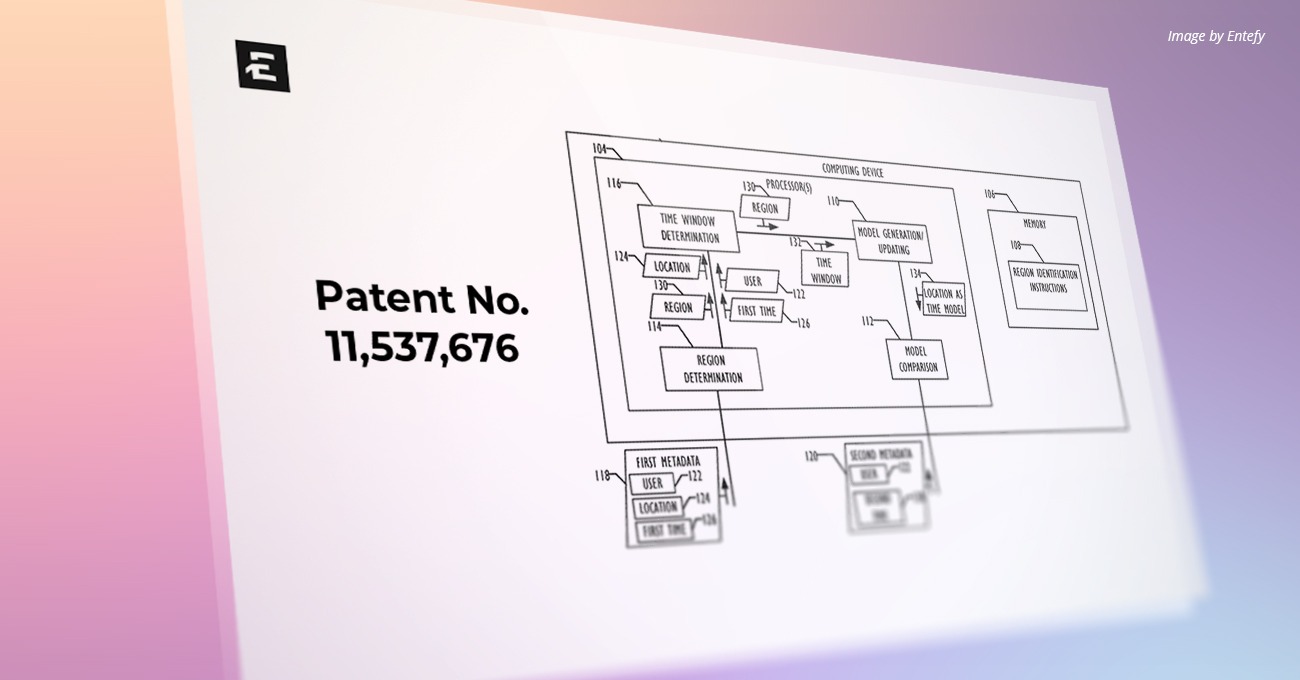
U.S. Patent Number: 11,537,676
Patent Title: Temporal transformation of location-based queries
Issue Date: December 27, 2022
Inventors: Ghafourifar, et al.
Assignee: Entefy Inc.

Patent Abstract

A system and method for transforming location-based data queries into temporal domain by leveraging a location-to-time knowledge conversion graph. In some systems which contain diverse sets of data objects, only certain objects may contain explicit location data, while others may not. Therefore, queriability of this diverse data by location properties would likely yield incomplete results. In some embodiments, this method allows for the transformation and augmentation of a given data query containing location-based filtering properties into a time-region-based lookup, wherein a given location has been assigned to a time region in the given data graph and all data events within that time region may be augmented with location metadata automatically in the knowledge graph. Over time, a system utilizing these embodiments can offer comprehensive location-based data services and insights to a given system or user wherein a diverse set of data objects exists and not all objects contain explicit location information.

USPTO Technical Field

This disclosure relates generally to converting a location-based query to a time-based query.

Background

Many data items are generated with location information embedded as metadata. For example, an image file may include global positioning system (GPS) data indicating where the image file was created. Location data associated with data items may be used for a variety of purposes. For example, an individual may query a system that tracks data items to determine which data items the individual generated while on a trip to Europe. However, some data items may not be associated with location data. Such data items may not be considered by systems and applications that operate on such data based on location, therein reducing the scope or efficacy of location-based queries with regard to retrieval of diverse data in a given system.

Read the full patent here.

ABOUT ENTEFY

Entefy is an enterprise AI software company. Entefy’s patented, multisensory AI technology delivers on the promise of the intelligent enterprise, at unprecedented speed and scale.

Entefy products and services help organizations transform their legacy systems and business processes—everything from knowledge management to workflows, supply chain logistics, cybersecurity, data privacy, customer engagement, quality assurance, forecasting, and more. Entefy’s customers vary in size from SMEs to large global public companies across multiple industries including financial services, healthcare, retail, and manufacturing.

To leap ahead and future proof your business with Entefy’s breakthrough AI technologies, visit www.entefy.com  or contact us at contact@entefy.com.

Intelligent client-side semantic analysis for federated content indexing with user privacy constraints

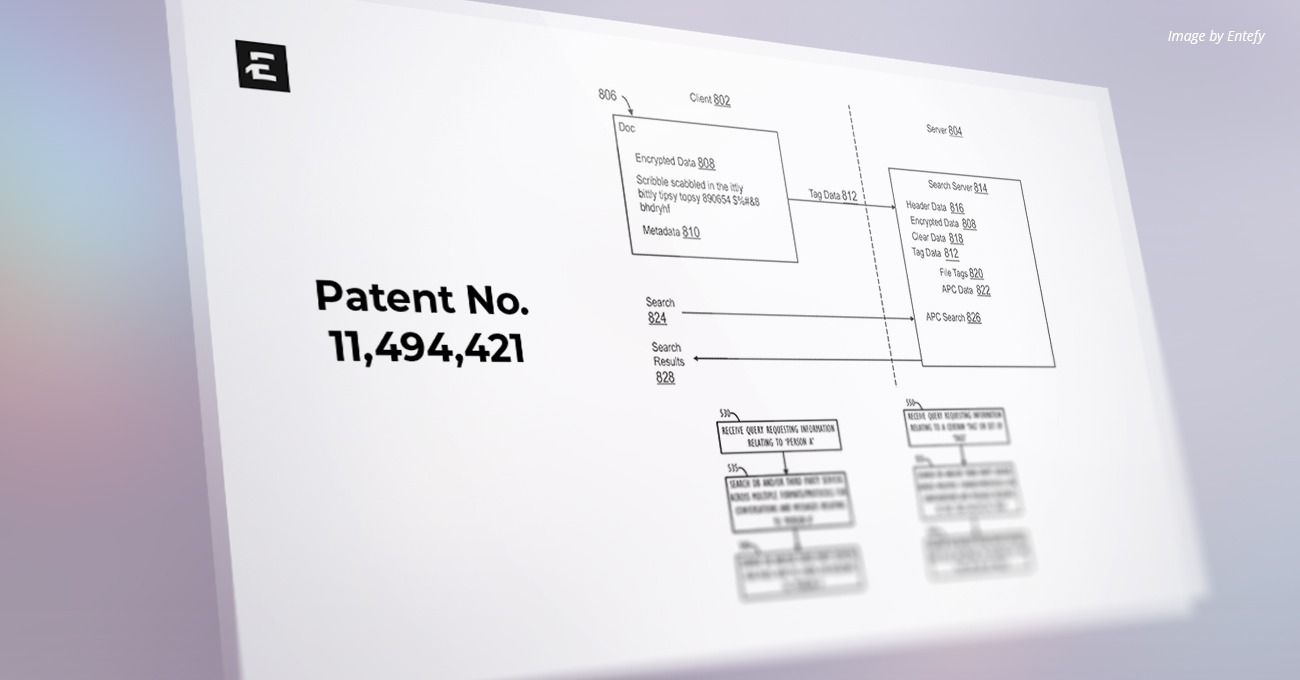
U.S. Patent Number: 11,494,421
Patent Title: System and method of encrypted information retrieval through a context-aware AI engine
Issue Date: November 08, 2022
Inventors: Ghafourifar, et al.
Assignee: Entefy Inc.

Patent Abstract

This disclosure relates to personalized and dynamic server-side searching techniques for encrypted data. Current so-called ‘zero-knowledge’ privacy systems (i.e., systems where the server has ‘zero-knowledge’ about the client data that it is storing) utilize servers that hold encrypted data without the decryption keys necessary to decrypt, index, and/or re-encrypt the data. As such, the servers are not able to perform any kind of meaningful server-side search process, as it would require access to the underlying decrypted data. Therefore, such prior art ‘zero-knowledge’ privacy systems provide a limited ability for a user to search through a large dataset of encrypted documents to find critical information. Disclosed herein are communications systems that offer the increased security and privacy of client-side encryption to content owners, while still providing for highly relevant server-side search-based results via the use of content correlation, predictive analysis, and augmented semantic tag clouds for the indexing of encrypted data.

USPTO Technical Field

This disclosure relates generally to systems, methods, and computer readable media for performing highly relevant, dynamic, server-side searching on encrypted data that the server does not have the ability to decrypt.

Background

The proliferation of personal computing devices in recent years, especially mobile personal computing devices, combined with a growth in the number of widely-used communications formats (e.g., text, voice, video, image) and protocols (e.g., SMTP, IMAP/POP, SMS/MMS, XMPP, etc.) has led to a communications experience that many users find fragmented and difficult to search for relevant information in. Users desire a system that will provide for ease of message threading by “stitching” together related communications and documents across multiple formats and protocols—all seamlessly from the user’s perspective. Such stitching together of communications and documents across multiple formats and protocols may occur, e.g., by: 1) direct user action in a centralized communications application (e.g., by a user clicking ‘Reply’ on a particular message); 2) using semantic matching (or other search-style message association techniques); 3) element-matching (e.g., matching on subject lines or senders/recipients/similar quoted text, etc.); and/or 4) “state-matching” (e.g., associating messages if they are specifically tagged as being related to another message, sender, etc. by a third-party service, e.g., a webmail provider or Instant Messaging (IM) service). These techniques may be employed in order to provide a more relevant “search-based threading” experience for users.

With current communications technologies, conversations remain “siloed” within particular communication formats or protocols, leading to users being unable to search uniformly across multiple communications in multiple formats or protocols and across multiple applications and across multiple other computing devices from their computing devices to find relevant communications (or even communications that a messaging system may predict to be relevant), often resulting in inefficient communication workflows—and even lost business or personal opportunities. For example, a conversation between two people may begin over text messages (e.g., SMS) and then transition to email. When such a transition happens, the entire conversation can no longer be tracked, reviewed, searched, or archived by a single source since it had ‘crossed over’ protocols. For example, if the user ran a search on their email search system for a particular topic that had come up only in the user’s SMS conversations, even when pertaining to the same subject manner and “conversation,” such a search may not turn up optimally relevant results.

Users also desire a communications system with increased security and privacy with respect to their communications and documents, for example, systems wherein highly relevant search-based results may still be provided to the user by the system—even without the system actually having the ability to decrypt and/or otherwise have access to the underlying content of the user’s encrypted communications and documents. However, current so-called ‘zero-knowledge’ privacy systems (i.e., systems where the server has ‘zero-knowledge’ about the data that it is storing) utilize servers that hold encrypted data without the decryption keys necessary to decrypt, index, and/or re-encrypt the data. As such, this disallows any sort of meaningful server-side search process, which would require access to the underlying data (e.g., in order for the data to be indexed) to be performed, such that the encrypted data could be returned in viable query result sets. Therefore, such prior art ‘zero-knowledge’ systems provide a limited ability for a user to search through a large dataset of encrypted documents to find critical information.

It should be noted that attempts (both practical and theoretical) have been made to design proper ‘zero-knowledge’ databases and systems that can support complex query operations on fully encrypted data. Such approaches include, among others, homomorphic encryption techniques which have been used to support numerical calculations and other simple aggregations, as well as somewhat accurate retrieval of private information. However, no solution currently known to the inventors enables a system or database to perform complex operations on fully-encrypted data, such as index creation for the purpose of advanced search queries. Thus, the systems and methods disclosed herein aim to provide a user with the ability to leverage truly private, advanced server-side search capabilities from any connected client interface without relying on a ‘trusted’ server authority to authenticate identity or store the necessary key(s) to decrypt the content at any time.

Read the full patent here.

ABOUT ENTEFY

Entefy is an enterprise AI software company. Entefy’s patented, multisensory AI technology delivers on the promise of the intelligent enterprise, at unprecedented speed and scale.

Entefy products and services help organizations transform their legacy systems and business processes—everything from knowledge management to workflows, supply chain logistics, cybersecurity, data privacy, customer engagement, quality assurance, forecasting, and more. Entefy’s customers vary in size from SMEs to large global public companies across multiple industries including financial services, healthcare, retail, and manufacturing.

To leap ahead and future proof your business with Entefy’s breakthrough AI technologies, visit www.entefy.com  or contact us at contact@entefy.com.

Intelligent organizing messages by topic across conversation threads within multi-participant digital communication systems

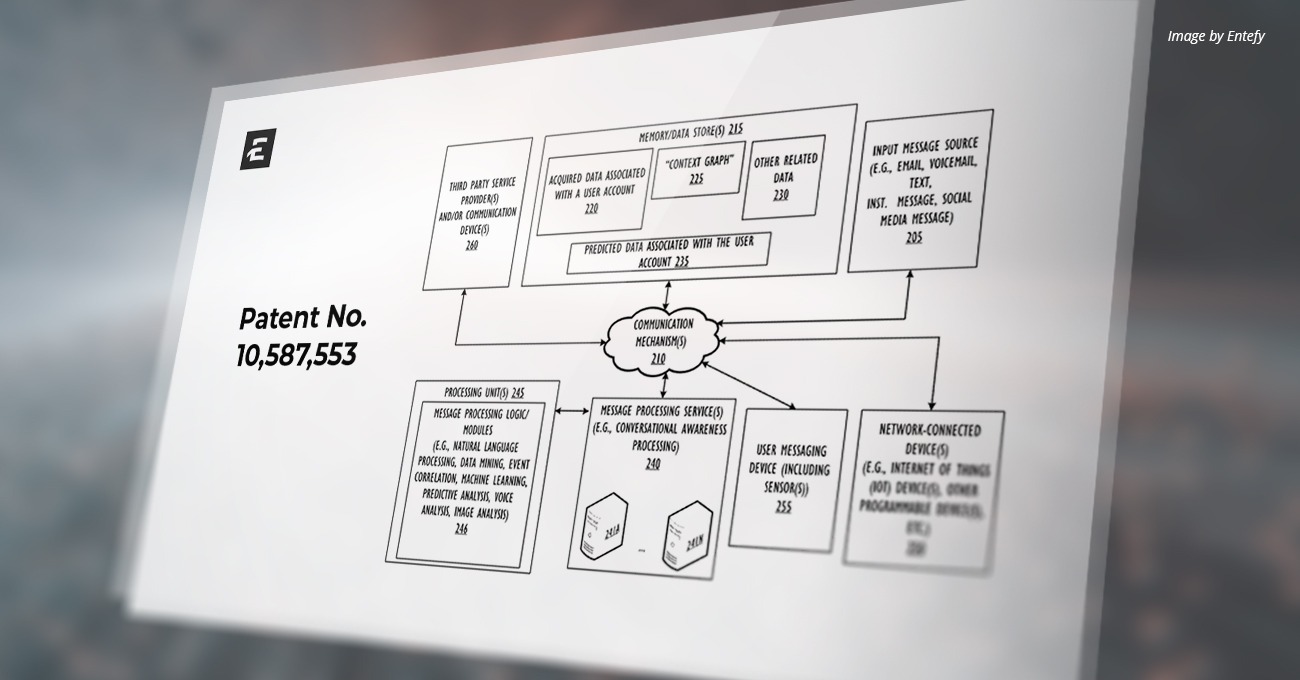
U.S. Patent Number: 10,587,553
Patent Title: Methods and systems to support adaptive multi-participant thread monitoring
Issue Date: March 10, 2020
Inventors: Ghafourifar, et al.
Assignee: Entefy Inc.

Patent Abstract

Disclosed are apparatuses, methods, and computer readable media for improved message presentation to a user with respect to correlation of messages in a multi-participant message thread. Conversational awareness may be determined by analyzing contents of individual messages and assigning them to an existing context or creating a new context. Association of messages to contexts allows for grouping related messages related to their subject matter. Further, analysis of individual users within a multi-party communication stream (e.g., a thread with a group of participants) can be used to report previous and predict future user activity of a specific user. Groups of different sizes have been determined to sometimes have different participation dynamics. For example, people communicate differently in small groups versus large groups and within a given group, individual participation dynamics can be further analyzed. Disclosed systems learn and leverage this communication dynamic.

USPTO Technical Field

This disclosure relates generally to apparatuses, methods, and computer readable media for improved interaction of users with receipt and response to multi-protocol message events. More particularly, this disclosure relates to providing a communication system to analyze multi-user message activity to provide contextual conversational information for multi-party message threads. The conversational awareness being determined, in part, by analyzing contents of individual messages and their relationship to other messages using a history and knowledge base of the other messages.

Background

Modern consumer electronics are capable of enabling the transmission of messages using a variety of different communication protocols. More specifically, text messages (such as SMS/MMS, Instant Messages (IMs), etc.) and emails represent the vast majority of direct communications between users. Each of these mechanisms support electronic exchange of information between users or groups of users. In some cases, information is simply “posted” and may not be directly related to any particular message thread. In other cases, information may be directed to a user such that a “reply” or further communication is expected. In short, today’s technologies provide a multi-protocol input of information to users and it is largely up to the recipient to determine what to do with the information (e.g., comment, reply, ignore, pass on to another party).

(4) One problem associated with existing (and possibly future) methods of exchanging messages between parties is that messages are received in a largely stand-alone fashion. Using today’s available communication techniques, each individual message lacks a context relationship with other messages and does not take into account a conversational awareness to present to the user. At best, messages may represent a thread of related communications that are only connected to each other because of a common subject line. Further, often in a long thread of messages (e.g., many distinct messages under the same subject line), becomes less relevant to a particular subject as the topics in the body of the messages change to different topics. In cases where there are multiple participants in a given thread of messages the communications may evolve through many different topics. That is, a message may be sent to a group of people, and as different people in the group contribute to the message thread, they may change the direction of the topic being “discussed” in the messages. Using current techniques, a user is not given any indication of the changes in topic over time.

(5) Further, different groups of people interact differently in different sized groups. In a small group of four people, everyone may feel comfortable with contributing to the discussion. However, these same four people within a larger group (e.g., 16 people) may feel less inclined to join in and submit messages to the thread. This dynamic may increase as the number of people in the group increases. Alternatively, some people, for a variety of different reasons, may not be intimidated or reserved within a large group message thread and “contribute” more often than others. Sometimes, the people that contribute more often offer important information for the group, while other times, people “contribute” non-important information and feel compelled to put messages into the thread. Current techniques of multi-party communications do not have any way to classify or differentiate these different types of users or classes of user behavior. This can lead to each participant in the thread being treated similarly in terms of how messaging applications may notify, display, remind, and otherwise indicate the messaging activity in a given group conversation to a given user participant. Additionally, sometimes the thread splinters into groups of people discussing different topics that not everyone may be genuinely participating in nor care about. This divergence may be related (or caused by) the length of time that a particular message thread is active and the number of active participants. The longer a message thread is active the more likely it may be to diverge and the context of the messages may be more accurately representative of multiple smaller and shorter communications hidden within the context of the larger and longer message thread. It would be beneficial to provide users visibility into this situation to make them more productive and efficient when dealing with long (as in time) and large (as in number of participants and/or number of messages) message threads. Similarly, it would be beneficial to provide a system with visibility into this information so as to enable predictive analytics, machine learning, and other data processing techniques to discover behavior patterns which may be of value to a given user or group of users in a given conversation.

(6) Another problem associated with today’s messaging techniques is their relative inability to provide relevant predictive and reactive solutions to a user’s messages based on the way different users interact in multi-participant message threads. Generally, the user’s type of interaction within the thread is completely ignored when messages are delivered. If a user’s interaction history were taken into account, it may be possible to provide a visual indication to other users of the importance or non-importance of portions of the thread. Further, a visual indication may alert a user to splintered conversations within a larger communication stream. Recognition of these situations and determination of visual clues for users may be performed using the techniques of this disclosure.

(7) The subject matter of the present disclosure is directed to overcoming, or at least reducing the effects of, one or more of the problems set forth above. To address these and other issues, techniques that process a multi-participant message thread based on the content of individual messages and attributes of different participants are described herein. Disclosed techniques also allow for grouping of messages into chunks of messages more related to each other than other messages in a message stream. Additionally, disclosed techniques allow for providing visual clues, via an interface to users participating within these multi-participant threads, to increase user’s awareness to the above described occurrences.

Read the full patent here.

ABOUT ENTEFY

Entefy is an enterprise AI software company. Entefy’s patented, multisensory AI technology delivers on the promise of the intelligent enterprise, at unprecedented speed and scale.

Entefy products and services help organizations transform their legacy systems and business processes—everything from knowledge management to workflows, supply chain logistics, cybersecurity, data privacy, customer engagement, quality assurance, forecasting, and more. Entefy’s customers vary in size from SMEs to large global public companies across multiple industries including financial services, healthcare, retail, and manufacturing.

To leap ahead and future proof your business with Entefy’s breakthrough AI technologies, visit www.entefy.com  or contact us at contact@entefy.com.
An intelligent Optimal Decision Engine (ODE) for automated protocol selection during group messaging in multi-protocol digital communication systems

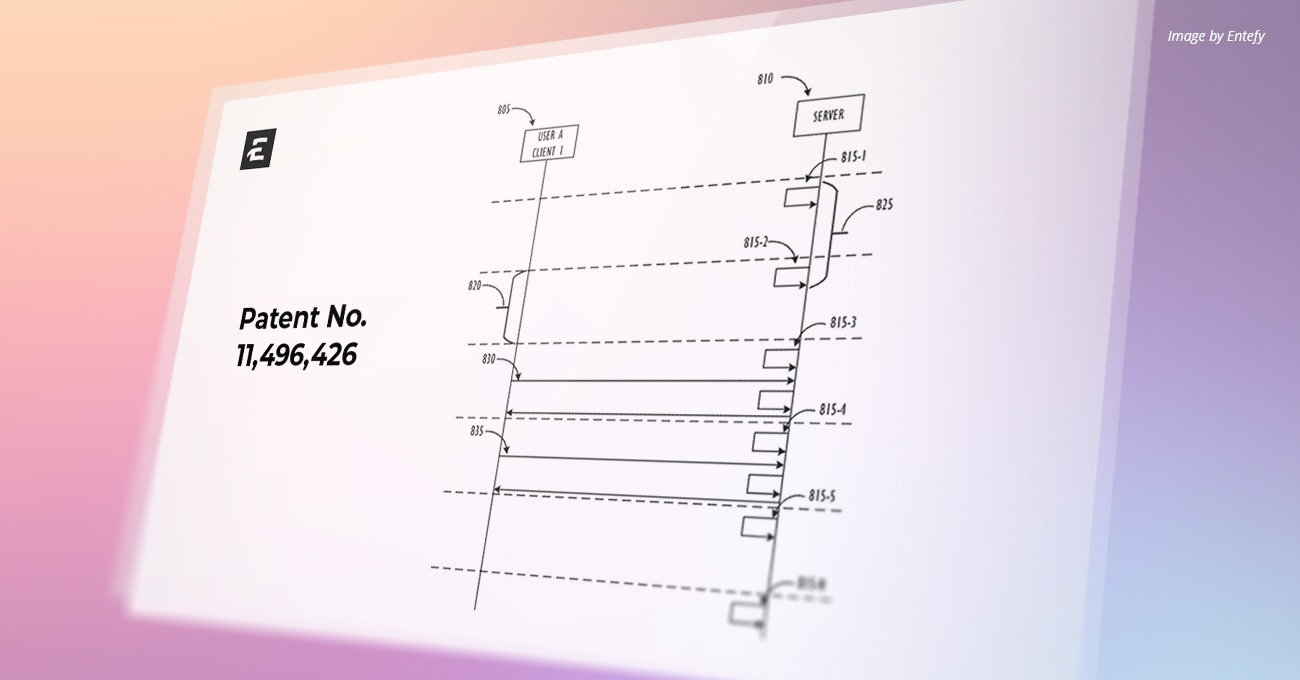
U.S. Patent Number: 11,496,426
Patent Title: Apparatus and method for context-driven determination of optimal cross-protocol communication delivery
Issue Date: November 08, 2022
Inventors: Ghafourifar, et al.
Assignee: Entefy Inc.

Patent Abstract

This disclosure relates generally to apparatus, methods, and computer readable media for composing communications for computing devices across multiple formats and multiple protocols. More particularly, but not by way of limitation, this disclosure relates to apparatus, methods, and computer readable media to permit computing devices, e.g., smartphones, tablets, laptops, and the like, to send communications in a number of pre-determined and/or ‘determined-on-the-fly’ optimal communications formats and/or protocols. Determinations of optimal delivery methods may be intelligently based on the sender individually or the relationship with the sender in the context of a group of recipients—including the format of the incoming communication, the preferred format of the recipient and/or sender, and an optimal format for a given communication message. The techniques disclosed herein allow communications systems to become ‘message-centric’ or ‘people-centric,’ as opposed to ‘protocol-centric,’ eventually allowing consideration of message protocol to fall away entirely for the sender of the communication.

USPTO Technical Field

This disclosure relates generally to apparatuses, methods, and computer readable media for composing communications for computing devices across multiple communications formats and protocols as intelligently determined using one or more context factors to determine the optimal delivery method for the communications.

Background

The proliferation of personal computing devices in recent years, especially mobile personal computing devices, combined with a growth in the number of widely-used communications formats (e.g., text, voice, video, image) and protocols (e.g., SMTP, IMAP/POP, SMS/MMS, XMPP, etc.) has led to a communications experience that many users find fragmented and restrictive. Users desire a system that will provide ease of communication by sending an outgoing message created in whatever format was convenient to the composer, with delivery options to one or more receivers in whatever format or protocol that works best for them—all seamlessly from the composer’s and recipient(s)’s perspective. With current communications technologies that remain “protocol-centric”—as opposed to “message-centric” or “people-centric”—such ease of communication is not possible.

In the past, users of communications systems first had to choose a communication format and activate a corresponding application or system prior to composing a message or selecting desired recipient(s). For example, if a person wanted to call someone, then he or she would need to pick up a telephone and enter the required phone number or directory in order to connect. If a person wanted to email a colleague, that person would be required to launch an email application before composing and sending the email. Further, while long-form text might be the most convenient format at the time for the composer, long-form text may not be convenient for the receiver—resulting in a delayed receipt of and/or response to the message by the receiver. With the multi-format communication composition techniques described herein, however, the user flow is much more natural and intuitive. First, the ‘Sender’ (e.g., a registered user of the multi-format, multi-protocol communication system), can select the desired recipient(s). Then, the Sender may compose the outgoing message (in any format, such as text, video recording, or audio recording). Next, the system (or the Sender, in some embodiments) intelligently chooses the delivery protocol for the communication, e.g., whether the communication is going to be sent via email, SMS, IM, or social media, etc. Finally, the outgoing message is converted into the desired outgoing message format (either by the Sender’s client device or a central communications system server) and sent to the desired recipient(s) via the chosen delivery protocol(s).

According to the multi-format communication composition techniques described herein, the emphasis in the communication interface is on the “who” and the “what” of the communication—but not the “how.” The multi-format communication composition system described herein takes care of the “how”—including an ‘Optimal’ option, as determined by a dedicated service in the central communication server, such as a service referred to herein as the ‘Optimal Decision Engine,’ which may be employed to deliver the outgoing communication to the desired recipient(s) in the most preferred way, e.g., either through preferences that the recipient(s) has specified via his or her profile in a multi-format communications network or through the communication protocol information regarding the desired recipient that is stored in the Sender’s contact list.

The subject matter of the present disclosure is directed to overcoming, or at least reducing the effects of, one or more of the problems set forth above. To address these and other issues, techniques that enable seamless, multi-format communications via a single user interface are described herein.

Read the full patent here.

ABOUT ENTEFY

Entefy is an enterprise AI software company. Entefy’s patented, multisensory AI technology delivers on the promise of the intelligent enterprise, at unprecedented speed and scale.

Entefy products and services help organizations transform their legacy systems and business processes—everything from knowledge management to workflows, supply chain logistics, cybersecurity, data privacy, customer engagement, quality assurance, forecasting, and more. Entefy’s customers vary in size from SMEs to large global public companies across multiple industries including financial services, healthcare, retail, and manufacturing.

To leap ahead and future proof your business with Entefy’s breakthrough AI technologies, visit www.entefy.com  or contact us at contact@entefy.com.
AI agent context-sharing architecture to balance specificity and scope during interactions with and between AI agents

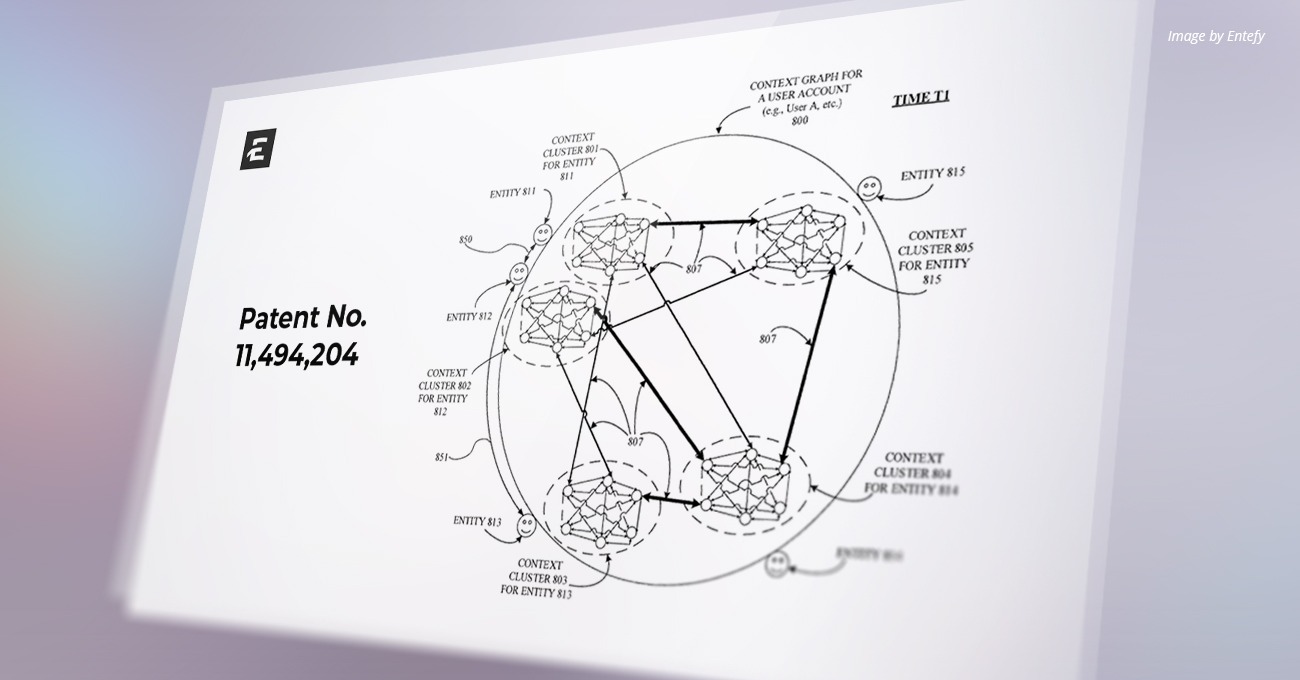
U.S. Patent Number: 11,494,204
Patent Title: Mixed-grained detection and analysis of user life events for context understanding
Issue Date: November 08, 2022
Inventors: Alston Ghafourifar
Assignee: Entefy Inc.

Patent Abstract

Techniques for resolving multiple user requests from multiple user accounts by an interactive interface are described. An interactive interface can obtain a first multi-dimensional context graph for a first user account and a second context graph for a second user account. Each graph comprises correlated contexts related to the user account. The interface can also receive a first user request associated with the first user account and a second user request associated with the second user account; determine, based on the first graph, a first current context and one or more first previous contexts for the first user request; determine, based on the second graph, a second current context and one or more second previous contexts for the second user request; determine one or more interrelationships between the first and the second graphs; and resolve the user requests based on the contexts and the interrelationships.

USPTO Technical Field

Embodiments described herein relate to interactive interfaces (e.g., intelligent personal assistants (IPAs), virtual assistants, knowledge navigators, chatbots, command-response engines, other software/hardware agents capable of performing actions on behalf of or for an entity, etc.). More particularly, embodiments described herein relate to one or more techniques of correlating clusters of contexts (context clusters”) of a user account that corresponds to an entity for use by an intelligent interactive interface (“intelli-interface”) to perform actions on behalf of or for the user account.

Background

Modern consumer electronics are capable of enabling interactive interfaces (e.g., intelligent personal assistants (IPAs), virtual assistants, knowledge navigators, chatbots, command-response engines, other software/hardware agents capable of performing actions on behalf of or for an entity, etc.) to perform actions on behalf of or for user accounts that correspond to entities. That is, these interfaces can receive requests (in the form of inputs) from an entity (e.g., a person, a service, a smart device, etc.) and respond to the requests accordingly. For example, at least one currently available interactive interface can respond to a user’s request received via input (e.g., text input, voice input, gesture input, etc.) for nearby restaurants with a list of establishments within a predetermined location of the user. The output can be provided to the user as textual output, image output (e.g., graphics, video, etc.), audio output, haptic output, tactile output, any combination thereof, or any other known output.

One problem associated with some interactive interfaces is their inability to multi-task—that is, some interactive interfaces cannot receive multiple user requests that are ambiguous or contextually unrelated, manage the multiple user requests concurrently, and resolve the multiple user requests. For example, some typical interactive interfaces cannot receive a first request to “find nearby restaurants” and a second user request to “find nearby bookstores”, manage the requests concurrently, and resolve both user requests. In this example, none of the user requests are resolved before the other one is received. Consequently, these types of interactive interfaces can only receive and resolve a single request before being able to receive (and resolve) another request. This leads to one-purpose-one-action type of interactive interfaces that require users to follow restrictive patterns of usage in order to migrate from one task to another, which can contribute to or cause user dissatisfaction.

Another problem associated with some interactive interfaces is their relative inability to provide relevant predictive and reactive solutions to a user’s requests based on the user’s context. This may be because traditional techniques of context derivation are not precise enough. For example, at least one typical context derivation technique relies on time-based principles. Generally, these time-based approaches can be based on temporal locality principles or spatial locality principles. Stated differently, at least one typical context derivation technique bases its context determinations exclusively on time-based data, such as recent locations or recent interactions, as a way of developing an insight into a user’s context. Such a technique can yield inaccurate predictions, which can cause interactive interfaces relying on this context derivation technique to generate irrelevant solutions to user requests. Irrelevant solutions can contribute to or cause user dissatisfaction.

Yet another problem associated with some interactive interfaces is their inability to partition knowledge used for servicing user requests into manageable data sets. This is exemplified when user context determinations are considered at either a fine-grained context level (e.g., the user is currently at a location with a latitude and longitude of 48.869701, 2.307909, etc.) or a more broadly defined level (e.g., the user is currently on planet Earth, etc.). An incorrect context determination can limit the functionality of an interactive interface that is designed to provide relevant predictive and reactive solutions to a user’s requests. Too fine-grained or narrow a context and the interactive interface will lack enough data to provide relevant and/or reliable solutions to a user’s requests. Too broadly defined or high level a context and the interactive interface will also lack enough data to accurately provide relevant and/or reliable solutions to a user’s requests. For example, if a user asks his interactive interface to suggest items to buy during a trip to a local grocery store and the user has provided the assistant with the following data: underwear, paper towels, and a flashlight. Without a technique for determining the user’s proper context and feeding the determined technique to the interactive interface, irrelevant suggestions may be output to the user by the interactive interface.

The problems discussed above can cause an interactive interface to operate inefficiently because it has to perform multiple attempts in order to resolve a single user request. This inefficient operation can, in turn, result in wasted computational resources. For example, computational resources that would otherwise not be necessary may be needed by an interactive assistant to service a single user request due to errors. Waste includes, but is not limited to, processing power for performing and/or repeating the performance of queries or transactions associated with resolving user requests and storage memory space for storing data about the incorrect or improper resolutions of user requests.

For at least the reasons set forth in this section of the present disclosure, some interactive interfaces remain sub-optimal.

Read the full patent here.

ABOUT ENTEFY

Entefy is an enterprise AI software company. Entefy’s patented, multisensory AI technology delivers on the promise of the intelligent enterprise, at unprecedented speed and scale.

Entefy products and services help organizations transform their legacy systems and business processes—everything from knowledge management to workflows, supply chain logistics, cybersecurity, data privacy, customer engagement, quality assurance, forecasting, and more. Entefy’s customers vary in size from SMEs to large global public companies across multiple industries including financial services, healthcare, retail, and manufacturing.

To leap ahead and future proof your business with Entefy’s breakthrough AI technologies, visit www.entefy.com  or contact us at contact@entefy.com.