System and method of applying multiple adaptive privacy control layers to multi-channel bitstream data

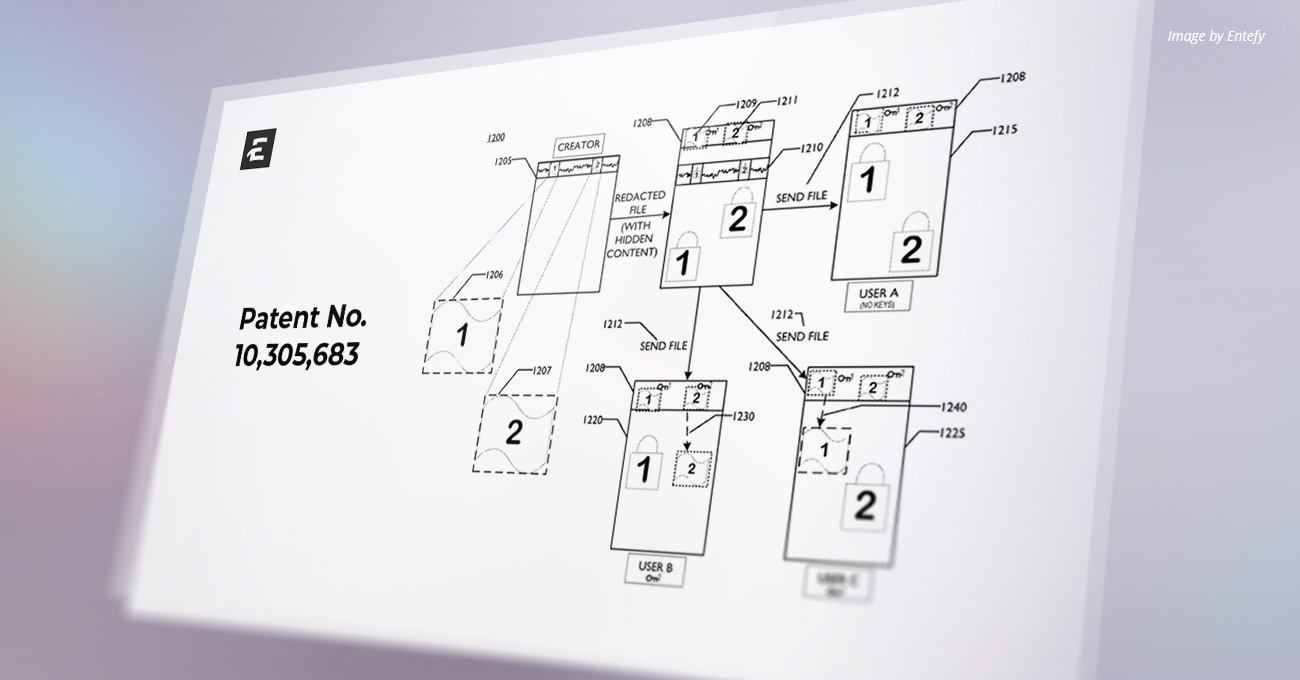
U.S. Patent Number: 10,305,683
Patent Title: System and method of applying multiple adaptive privacy control layers to multi-channel bitstream data
Issue Date: May 28, 2019
Inventors: Ghafourifar, et al.
Assignee: Entefy Inc.

Patent Abstract

Disclosed are systems to apply customized permission settings to protect particular portions of a document, and, in particular, documents that are of bitstream datatypes containing multiple channels of audio, encoded or not encoded. The custom access permission settings may be implemented by obfuscating the protected portions of the original bitstream and then embedding “secret,” e.g., hidden and/or encrypted, versions of the obfuscated portions in parts of the data structure of the original file, e.g., in the form of “layers” that are held within audio stream containers such as channels. The content of the individual encrypted audio stream containers may then be decrypted according to each recipient’s permissions and layered on top of the obfuscated portions of the encoded media file before being rendered to the recipient.

USPTO Technical Field

This disclosure relates generally to systems, methods, and computer readable media for concealing information within encoded media files which may be distributed over a network and playable by recipients in a wide array of standardized software applications. More particularly, this disclosure is relates to Adaptive Privacy Controls for concealing information within audio files and audio bitstreams. Access permission settings for such audio files may be implemented by embedding one or more “secret,” e.g., hidden and/or encrypted, information portions in such encoded media file types, e.g., in the form of layers of audio information.

Background

The proliferation of personal computing devices in recent years, especially mobile personal computing devices, combined with a growth in the number of widely-used communications formats (e.g., text, voice, video, image) and protocols (e.g., SMTP, IMAP/POP, SMS/MMS, XMPP, etc.) has led to increased concerns regarding the safety and security of documents and messages that are sent over networks. Users desire a system that provides for the setting of custom, e.g., user-defined, access permissions for all or part of a file, including audio files that may or may not have been encoded using compression techniques.

Read the full patent here.

ABOUT ENTEFY

Entefy is an enterprise AI software company. Entefy’s patented, multisensory AI technology delivers on the promise of the intelligent enterprise, at unprecedented speed and scale.

Entefy products and services help organizations transform their legacy systems and business processes—everything from knowledge management to workflows, supply chain logistics, cybersecurity, data privacy, customer engagement, quality assurance, forecasting, and more. Entefy’s customers vary in size from SMEs to large global public companies across multiple industries including financial services, healthcare, retail, and manufacturing.

To leap ahead and future proof your business with Entefy’s breakthrough AI technologies, visit www.entefy.com  or contact us at contact@entefy.com.

Tiered object detection model workflow sequencing and service activation on diverse GPU compute resources in a multi-node infrastructure

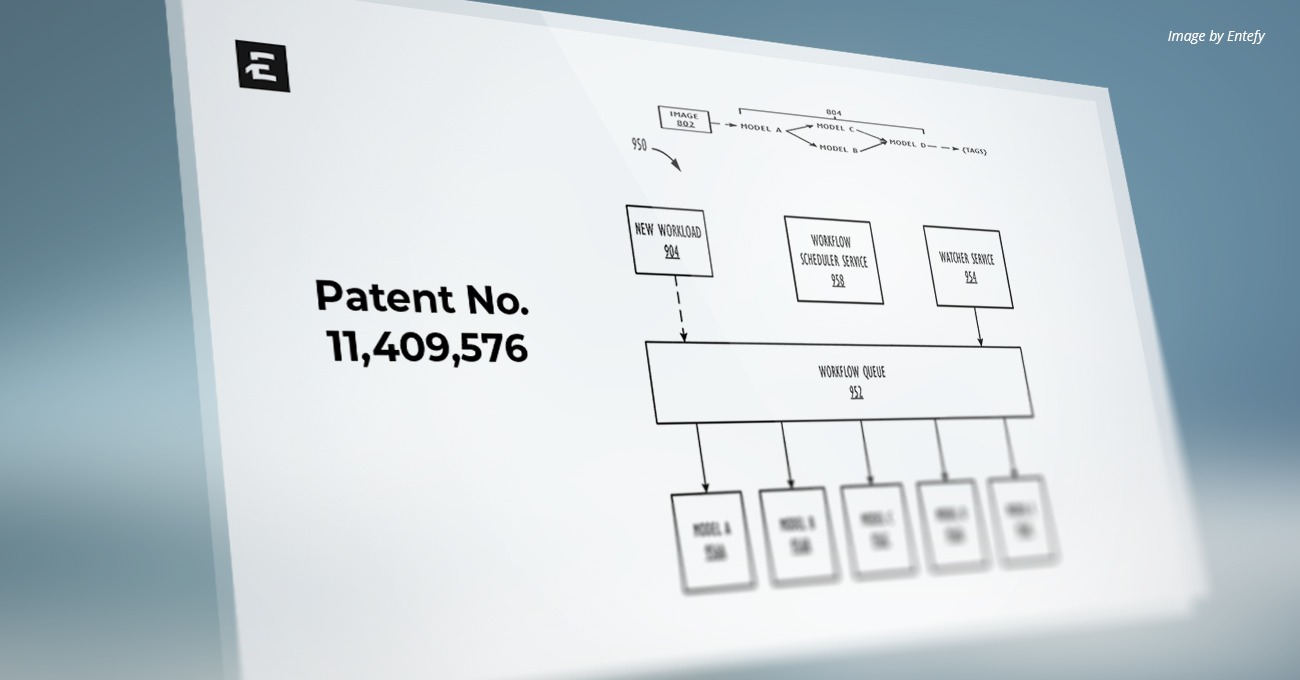
U.S. Patent Number: 11,409,576
Patent Title: Dynamic distribution of a workload processing pipeline on a computing infrastructure
Issue Date: August 09, 2022
Inventors: Alston Ghafourifar
Assignee: Entefy Inc.

Patent Abstract

Disclosed are systems, methods, and computer readable media for automatically assessing and allocating virtualized resources (such as central processing unit (CPU) and graphics processing unit (GPU) resources). In some embodiments, this method involves a computing infrastructure receiving a request to perform a workload, determining one or more workflows for performing the workload, selecting a virtualized resource, from a plurality of virtualized resources, wherein the virtualized resource is associated with a hardware configuration, and wherein selecting the virtualized resources is based on a suitability score determined based on benchmark scores of the one or more workflows on the hardware configuration, scheduling performance of at least part of the workload on the selected virtualized resource, and outputting results of the at least part of the workload.

USPTO Technical Field

This disclosure relates generally to apparatuses, methods, and computer readable media for predicting and allocating computing resources for workloads.

Background

Modern computing infrastructures allow computational resources to be shared through one or more networks, such as the internet. For example, a cloud computing infrastructure may enable users, such as individuals and/or organizations, to access shared pools of computing resources, such as servers, both virtual and real, storage devices, networks, applications, and/or other computing based services. Remote services allow users to access computing resources on demand remotely in order to perform a variety computing functions. These functions may include computing data. For example, cloud computing may provide flexible access to computing resources without accruing up-front costs, such as purchasing computing devices, networking equipment, etc. and investing time in establishing a private network infrastructure. Utilizing remote computing resources, users are able to focus on their core functionality rather than optimizing data center operations.

With today’s communications networks, examples of cloud computing services a user may access includes software as a service (SaaS), platform as a service (PaaS), and infrastructure as a service (IaaS) technologies. SaaS is a delivery model that provides software as a service rather than an end product, while PaaS acts an extension of SaaS that goes beyond providing software services by offering customizability and expandability features to meet a user’s needs. Another example of cloud computing service includes infrastructure as a service (IaaS), where APIs are provided to access various computing resources, such as raw block storage, file or object level storage, virtual local area networks, firewalls, load balancers, etc. Service systems may handle requests for various resources using virtualized resources (VRs). VRs allows for hardware resources, such as servers, to be pooled for use by the service systems. These VRs may be configured using pools of hypervisors for virtual machines (VMs) or through containerization.

Containerization, or containers, are generally a logical packaging mechanism of resources for running an application which are abstracted out from the environment in which they are actually run. Multiple containers generally may be run directly on top of a host OS kernel and each container generally contains the resources, such as storage, memory, and APIs needed to run a particular application the container is set up to run. In certain cases, containers may be resized by adding or removing resources dynamically to account for workloads or a generic set of resources may be provided to handle different applications. As containers are created on and managed by a host system at a low level, they can be spawned very quickly. Containers may be configured to allow access to host hardware, such as central processing units (CPUs) or graphics processing units (GPUs), for example, through low-level APIs included with the container. Generally, containers may be run in any suitable host system and may be migrated from one host system to another as hardware and software compatibility is handled by the host and container layers. This allows for grouping containers to optimize use of the underlying host system. A host controller may also be provided to optimize distribution of containers across hosts.

Modern CPUs may be configured to help distribute CPU processing load across multiple processing cores, therefore allowing multiple computing tasks to execute simultaneously and reduce overall real or perceived processing time. For example, many CPUs include multiple independent and asynchronous cores, each capable of handling different tasks simultaneously. Generally, GPUs, while having multiple cores, can be limited in their ability to handle multiple different tasks simultaneously. A typical GPU can be characterized as a processor which can handle a Single Instruction stream with Multiple Data streams (SIMD) whereas a typical multi-core CPU can be characterized as a processor which can handle Multiple Instruction streams with Multiple Data streams (MIMD). A multi-core CPU or a cluster of multiple CPUs can also be characterized as parallelized SIMD processor(s), thereby in effect simulating a MIMD architecture.

A SIMD architecture is generally optimized to perform processing operations for simultaneous execution of the same computing instruction on multiple pieces of data, each processed using a different core. A MIMD architecture is generally optimized to perform processing operations which requires simultaneous execution of different computing instructions on multiple pieces of data, regardless of whether executing processes are synchronized. As such, SIMD processors, such as GPUs, typically perform well with discrete, highly parallel, computational tasks spread across as many of the GPU cores as possible and making use of a single instruction stream. Many GPUs have specific hardware and firmware limitations in place to limit the ability for the GPU cores to be separated, or otherwise virtualized, thereby reinforcing the SIMD architecture paradigm. CPUs typically have little or no such limitation, thereby making the process of dividing GPU processing time across multiple tasks difficult as compared to CPUs. Rather than attempting this, IaaS providers with GPU resources may need to provide more physical GPUs to handle GPU processing requests and possibly even dedicated GPUs for certain processes, for example, artificial intelligence (AI) workloads, even if the actual computational capacity of that infrastructure far out-strips the GPU compute demand, leading to inflated capital and operating costs associated with offering GPU resources in an IaaS, PaaS, SaaS, or other product or cloud infrastructure offering.

In the case of GPU-heavy workloads such as those demanded by certain AI-enabled offerings, not all AI workloads are the same and hardware optimal for running one AI workload may not be rightly-sized for another AI workload.

Virtualization techniques have emerged throughout the past decades to optimize the utilization of hardware resources such as CPUs by efficiently allowing computing tasks to be spread across multiple cores, CPUs, clusters, etc. However, such virtualization is generally not available or non-performant for GPUs and this can lead to higher operating costs and increased application or platform latency. What is needed is a technique for appropriately scaling a workflow pipeline to handle high-density processing operations (such as AI operations) which require frequent utilization of GPUs during processing.

Read the full patent here.

ABOUT ENTEFY

Entefy is an enterprise AI software company. Entefy’s patented, multisensory AI technology delivers on the promise of the intelligent enterprise, at unprecedented speed and scale.

Entefy products and services help organizations transform their legacy systems and business processes—everything from knowledge management to workflows, supply chain logistics, cybersecurity, data privacy, customer engagement, quality assurance, forecasting, and more. Entefy’s customers vary in size from SMEs to large global public companies across multiple industries including financial services, healthcare, retail, and manufacturing.

To leap ahead and future proof your business with Entefy’s breakthrough AI technologies, visit www.entefy.com  or contact us at contact@entefy.com.

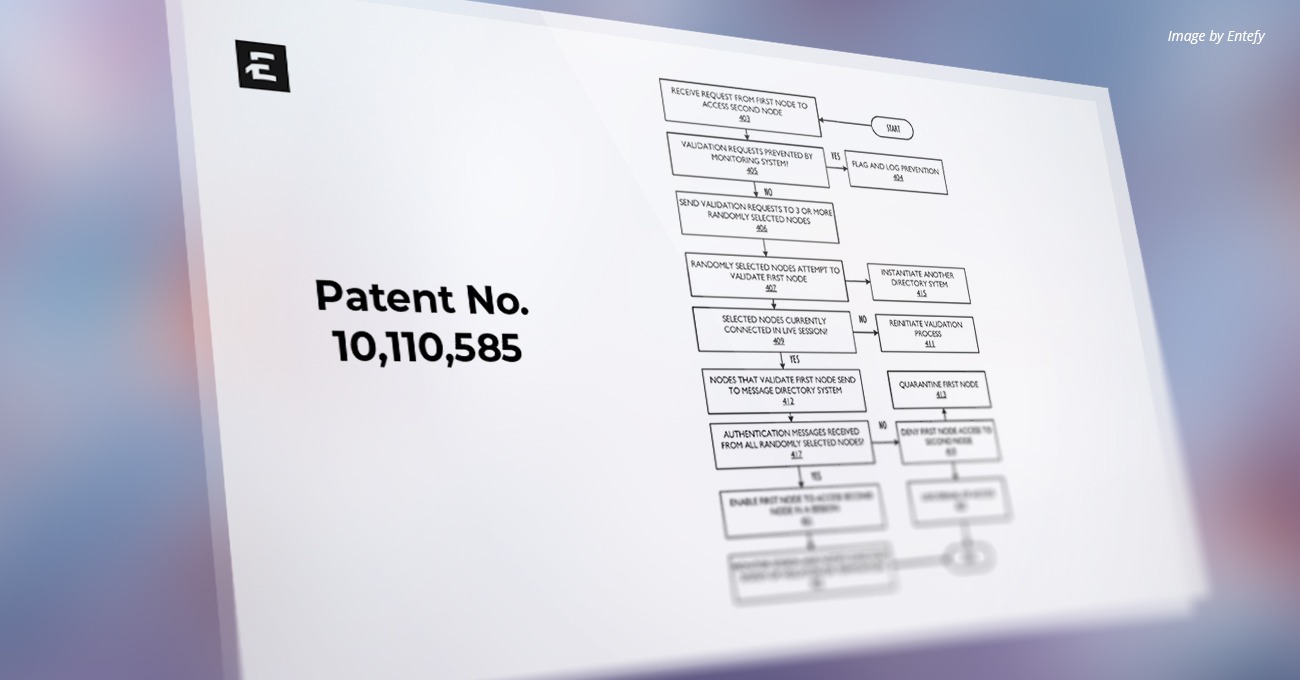
Expanded multi-party authentication system optimized for zero-trust environments

U.S. Patent Number: 10,110,585
Patent Title: Universal interaction platform for people, services, and devices
Issue Date: October 23, 2018
Inventors: Ghafourifar, et al.
Assignee: Entefy Inc.

Patent Abstract

A zero-trust network and methods of using same are disclosed. The network includes a plurality of nodes, some of which are user devices, such as mobile phones, some of which are computer servers. One or more of the nodes includes a directory system. When a server receives an access request by a user device or other node, the directory system is notified of the request. The directory system will contact a number of randomly selected nodes, and if any one of the nodes does not recognize the requesting device, the requesting device will be denied access. If every queried node is able to authenticate the requesting device, the directory system creates a session for the first device to access the server. The directory system can grant access by providing the server and device reciprocating keys. After the session ends, the accessed node is assigned a new identifier.

USPTO Technical Field

This disclosure relates generally to computer network security. More specifically, this disclosure relates to systems, methods, and computer readable media for multi-party authentication for access permissions in a distributed system without a central trusted authority.

Background

The vast majority of software-based systems rely heavily on the assumption that a server and any client application are designed to interact with a “trusted” resource and therefore, the information and directives which are sent to and from the server are assumed to be “trusted” by the client. In some systems, this could constitute all aspects of the product, whereas in other more secure systems that facilitate end-to-end encryption schemes or possess limited client-server communication, the trusted authority is expected to reliably connect one peer to another for an anonymous key exchange, thus maintaining the privacy of data shared between each peer. In both cases, the central, otherwise trusted authority is still vulnerable to compromise and therefore, the assumption of a “trusted” resource, while traditionally necessary, is an inherent point of vulnerability when designing for system integrity. Further, compromise can occur by exploiting such vulnerabilities via external and internal penetration. Internal compromise is exceptionally difficult to protect against because, it requires that a system or set of processes does not trust itself, a system admin, server, or other authorizing party. This could be made to be analogous to the challenges with a body detecting and fighting cancer since the primary difficult results in detection and containment of one’s own cells. In a server system, these internal parties can, through malice, compromise, or negligence, violate the integrity of the trusted server, having likely been put in a position to be a trusted resource within an otherwise secure network.

The subject matter of the present disclosure is directed at overcoming, or at least reducing, the effects of one or more of the problems set forth above.

Read the full patent here.

ABOUT ENTEFY

Entefy is an enterprise AI software company. Entefy’s patented, multisensory AI technology delivers on the promise of the intelligent enterprise, at unprecedented speed and scale.

Entefy products and services help organizations transform their legacy systems and business processes—everything from knowledge management to workflows, supply chain logistics, cybersecurity, data privacy, customer engagement, quality assurance, forecasting, and more. Entefy’s customers vary in size from SMEs to large global public companies across multiple industries including financial services, healthcare, retail, and manufacturing.

To leap ahead and future proof your business with Entefy’s breakthrough AI technologies, visit www.entefy.com  or contact us at contact@entefy.com.
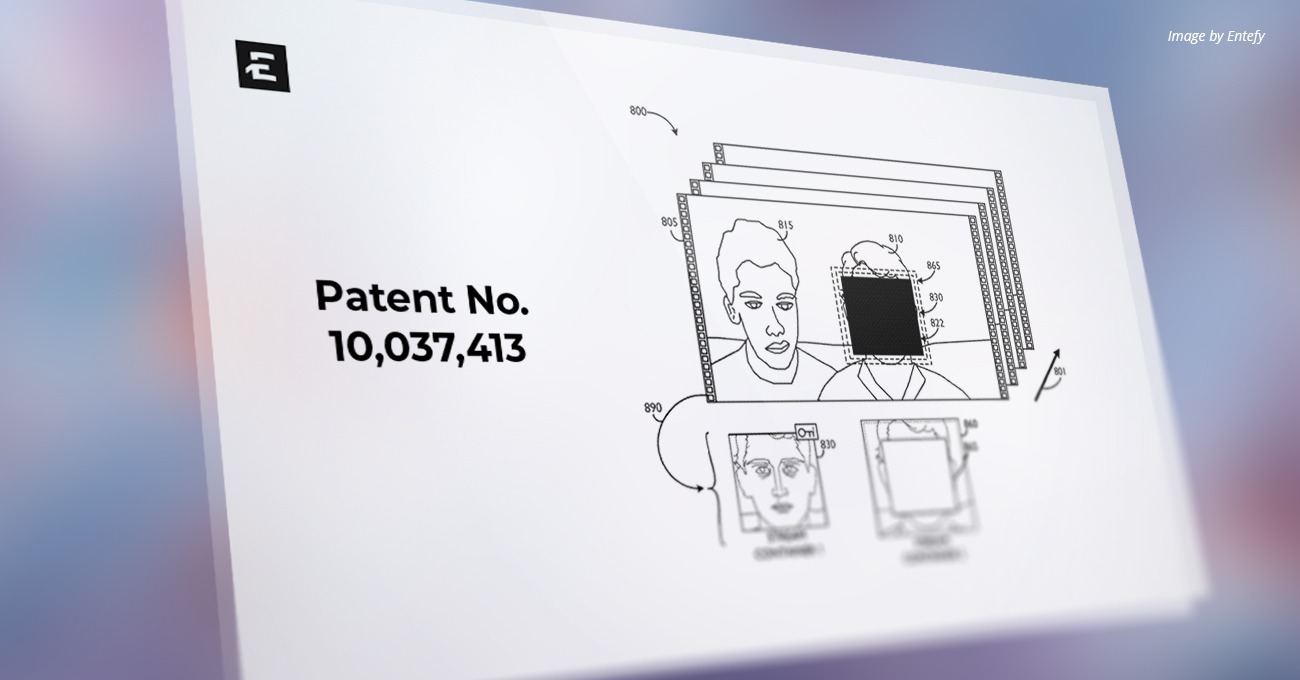
Adaptive Privacy Control (APC) engine for embedding multiple privacy layers within multi-channel encoded media files

U.S. Patent Number: 10,037,413
Patent Title: System and method of applying multiple adaptive privacy control layers to encoded media file types
Issue Date: July 23, 2018
Inventors: Ghafourifar, et al.
Assignee: Entefy Inc.

Patent Abstract

Disclosed are systems to apply customized permission settings to protect particular regions of a document, and, in particular, documents that are of a lossy′ encoded media file type, e.g., an MPEG video format. The custom access permission settings may be implemented by obfuscating the protected regions of the original file and then embedding “secret,” e.g., hidden and/or encrypted, versions of the obfuscated regions in parts of the data structure of the original file, e.g., in the form of “layers” that are held within video stream containers. The content of the individual encrypted video stream containers may then be decrypted according to each recipient’s permissions and layered on top of the obfuscated regions of the encoded media file before being displayed to the recipient. In some embodiments, additional layers of video may be used to reduce the appearance of aliasing around borders of the protected regions of the encoded media file.

USPTO Technical Field

This disclosure relates generally to systems, methods, and computer readable media for applying user-defined access permission settings to encoded media files in lossy file formats, e.g., MPEG video, which files may then be disseminated over a network and playable by recipients in a wide array of standardized software applications. More particularly, the access permission settings may be implemented by embedding one or more “secret,” e.g., hidden and/or encrypted, information portions in such encoded media file types, e.g., in the form of layers of video information.

Background

The proliferation of personal computing devices in recent years, especially mobile personal computing devices, combined with a growth in the number of widely-used communications formats (e.g., text, voice, video, image) and protocols (e.g., SMTP, IMAP/POP, SMS/MMS, XMPP, etc.) has led to increased concerns regarding the safety and security of documents and messages that are sent over networks. Users desire a system that provides for the setting of custom, e.g., user-defined, access permissions for all or part of a file, including files that have been encoded using lossy compression. A ‘lossy’ file, as used herein, refers to a file (or file format) that is compressed using inexact approximation methods (e.g., partial data discarding methods). As such, lossy compression techniques may be used to reduce data size for storage, handling, and transmitting content. However, because lossy compression reduces a file by permanently discarding certain information (e.g., redundant information), when the file is decompressed, it is not decompressed to 100% of the original. Lossy compression is generally used for multimedia files, e.g., images files, such as JPEG files, video files, such as MPEG files, and/or sound files, such as MP3 files—where a certain amount of information loss will not be detected by most users—and can result in significant gains in file size reduction or performance.

Certain lossy file types may also be described as “single-layered.” For example, in the case of a JPEG image, all the image content information may be stored in the form of a “byte array.” In order to change the appearance (e.g., color) of any pixels in the JPEG image, an editing or modification tool would need to modify or replace the particular information in the byte array corresponding to the region of pixels that are to be changed. Thus, the image data is said to be stored in a “single layer,” as there is no way to alter certain pixel regions in the JPEG image via the layering of new pixel information over the top of the original pixel information. By contrast, more complex image file types that support multiple image layers, e.g., PNG images, offer the ability to store image information in distinct layers which may, e.g., be ‘stacked’ in different orders, individually adjusted for opacity/transparency, or individually moved, rotated, shown, hidden, etc. before composition and display to a viewer. Due to the use of multiple layers, these changes to the image may be made and/or ‘unmade’ without undoing, overwriting, or otherwise degrading the quality of any of the underlying image information in a layer that happens to not be currently shown to the viewer.

Likewise, certain lossy file types for storing encoded multimedia, e.g., the various MPEG video formats, may also provide the ability to support “multi-layered” functionality. For example, through the use of Video Object Planes (VOPs) in certain encoded video files, multiple streams of video data (e.g., each represented in its own VOP) may be rendered simultaneously within the same video frame. A VOP, as used herein, comprises a stream of video data encoding picture information related to a specific region(s) or object(s) of interest that may be interacted with independently before being composited into the final video frames that are rendered for display. As with the PNG image layers discussed above, VOPs within a video frame may be ‘stacked’ on top of the ‘background’ video content in different orders, and can be individually adjusted by a given rendering engine with regard to opacity/transparency, or individually moved, rotated, shown, hidden, etc. before rendering and display to a viewer.

In some embodiments described herein, VOPs (or other parts of the video’s file structure), which are generically referred to herein as “stream containers,” may be used to hold isolated video bitstreams that an authorized encoded media viewing application may interpret and/or use in ways other than simple playback, as will be discussed in further detail below. For example, according to some embodiments described herein, the video bitstreams held in one or more of the stream containers packaged in the video’s file structure may need to be decrypted before being played back. In still other embodiments, the view of the video bitstreams held in one or more of the stream containers packaged in the video’s file structure may be adjusted before being rendered and displayed to a viewer, e.g., by adjusting the dimensions of the video bitstream that are actually made viewable to the viewer.

Lossy file types may also contain multiple “header,” or metadata, properties. These header properties may be used to store alternate contents such as metadata or other random information. Some lossy file types may also allow for the storage of multiple “layers” of media information within the same file, or even full encoding of other files or portions of files within the same file (e.g., in the case of VOPs within an MPEG file), such as in the embodiments described herein. Such a system would allow customized privacy settings to be specified for different recipients, e.g., recipients at various levels of social distance from the user sending the document or message (e.g., public, private, followers, groups, Level-1 contacts, Level-2 contacts, Level-3 contacts, etc.). Such a system may also allow the user to apply customized privacy settings and encryption keys differently to particular parts of a lossy file, e.g., making one or more parts of the lossy file available only to a first class of users, or by making other parts of the lossy file available to the first class of users and a second class of users, all while preventing access to parts of lossy file by users who do not have the requisite access privileges.

Thus, a system for providing access permission setting through Adaptive Privacy Controls (APC) is described herein. APC, as used herein, will refer to a user-controllable or system-generated, intelligent privacy system that can limit viewing, editing, and re-sharing privileges for lossy files, for example, image files and other multimedia files that include a lossy compression (including encoded multimedia file types), wherein changes made to the content of such ‘lossy’ files may not be reliably reversed or dynamically changed—as would be necessary according to prior art techniques attempting to implement the kinds of fine-grained access permission setting methods disclosed herein. Other embodiments of APC systems will, of course, be able to handle the setting of access permissions for recipients of lossless file formats, as well. In summary, APC systems, as used herein, allow users to share whatever information they want with whomever they want, while keeping others from accessing the same information, e.g., via hiding and/or encryption processes that can be initiated by user command or via system intelligence, even on lossy file types, and even when more than one region (including overlapping regions) in an encoded multimedia file have been selected by a user for APC-style protection. APC access permission settings may be applied to individuals, pre-defined groups, and/or ad-hoc groups. Customized encryption keys may further be applied to particular parties or groups of parties to enhance the security of the permission settings.

APC may be used to apply privacy settings to only particular portions of a lossy file, for example, a particular portion of a JPEG image or a frame (or series of frames) from an MPEG video. For example, User A may be a family member who may be authorized to see an entire JPEG image or MPEG video, but User B and other users may be mere acquaintances, who are only authorized to see a redacted portion or portions of the JPEG image or MPEG video. For example, the entire JPEG image or MPEG video file would be viewable to User A, but only a redacted portion or portions (e.g., everything but the face of the subject(s) in the image) would be available to the User B and other users when viewing the JPEG image or MPEG video file in an authorized viewing application.

According to some embodiments disclosed herein, a standard, i.e., “unauthorized,” viewing application, e.g. an image viewer or video player, would also be able to open the redacted version of the JPEG image or MPEG video file; it simply may not “know” where to look within the multimedia file’s structure for the “true” content from the redacted portion or portions of the JPEG image or MPEG video file. According to still other embodiments, even if an unauthorized viewing application were able to find the “true” content from the redacted portion or portions “hidden” within the file structure of the JPEG image or MPEG video (e.g., in the case of VOPs), the redacted portion or portions may be encrypted, and the unauthorized viewing application would not possess the necessary decryption keys to decrypt the encrypted redacted portion or portions. Moreover, the unauthorized viewing application also would not know where to “place” the encrypted portion or portions back within the image to reconstruct the original, i.e., unredacted, JPEG image or MPEG video in a seamless fashion.

Thus, according to some embodiments, the network-based, user-defined, APC controls for lossy file types or files (e.g., encoded media file types, such as MPEG) may include access permission systems, methods, and computer readable media that provide a seamless, intuitive user interface (e.g., using touch gestures or mouse input) allowing a user to: “block out” particular regions or areas of interest in a lossy file; hide (and optionally encrypt) such “blocked out” regions within parts the lossy file’s data structure; and then send the lossy file to particular recipients or groups of recipients with customized access permission settings, which settings may be specified on a per-recipient or per-group basis, and that either allow or do not allow a given recipient to locate the protected regions (if hidden) and decrypt such protected regions (if encrypted), so that the original lossy file may be reconstructed by the recipient.

Read the full patent here.

ABOUT ENTEFY

Entefy is an enterprise AI software company. Entefy’s patented, multisensory AI technology delivers on the promise of the intelligent enterprise, at unprecedented speed and scale.

Entefy products and services help organizations transform their legacy systems and business processes—everything from knowledge management to workflows, supply chain logistics, cybersecurity, data privacy, customer engagement, quality assurance, forecasting, and more. Entefy’s customers vary in size from SMEs to large global public companies across multiple industries including financial services, healthcare, retail, and manufacturing.

To leap ahead and future proof your business with Entefy’s breakthrough AI technologies, visit www.entefy.com  or contact us at contact@entefy.com.
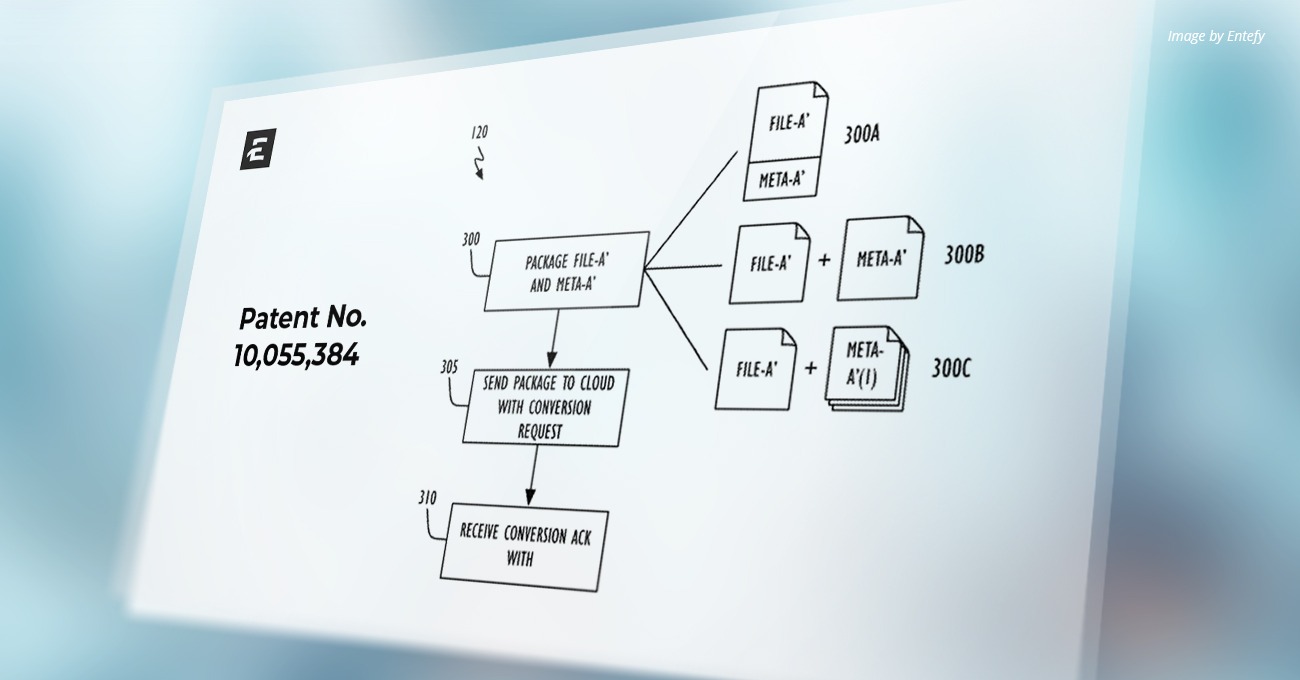
System and method of client-based synchronized document collaboration across a network with zero-knowledge principles

U.S. Patent Number: 10,055,384
Patent Title: Advanced zero-knowledge document processing and synchronization
Issue Date: August 21, 2018
Inventors: Ghafourifar, et al.
Assignee: Entefy Inc.

Patent Abstract

Techniques disclosed herein decouple a document’s structure from its general content wherein the structure is retained in plaintext (both at a client device and in a server system) and the data is retained in cyphertext, and where the cloud-based server system is not tasked with the saving or management of the relevant cryptographic keys. Because the network- or cloud-based server system has “zero-knowledge” about the document’s data content or the relevant cryptographic keys, an attack on the server system does not put the security of the document’s data at risk. In addition, the network- or cloud-based server system may be used to perform the computationally intensive tasks of converting the document between a first format (often associated with a full-function document processing application not supported by the client device) and a second format (easily displayed and manipulated by a client device).

USPTO Technical Field

This disclosure relates generally to cloud-based computing. More particularly, but not by way of limitation, this disclosure relates to a zero-knowledge approach to cloud-based document processing.

Background

As the world’s computing ecosystem evolves toward a “cloud-based” environment, more and more users (individual and corporate) will generate, edit and distribute documents on-line. At least one web-based editing program allows users to create, share and edit documents through a network. This program allows users to upload a number of differently formatted text-based documents into the system. From there, such documents are converted into the format used by the on-line editing program. Once this process is completed multiple users can work on the same document in real-time, editing content and altering the document’s structure from any location with Internet access (e.g., adding text, adjusting margins, adding or changing headers and footers, and inserting or deleting pictures). When the cloud-based document is ready for publication, it may be output or exported in any number of formats such as Microsoft Corporation’s Word or Rich Text format (RTF), the Apache Software Foundation’s OpenOffice format, Adobe System’s portable document format (PDF) or HyperText Markup Language (HTML) format. Products that enable cloud-based document preparation and/or collaboration between multiple users are implemented using a central server computer system to perform various transmission and conversion functions so that client applications, at each end-user, can view and edit document content in real-time. In doing so, the potentially highly sensitive content of these documents is necessarily exposed to the central server (that is, such systems are not “zero-knowledge”). This exposure creates a vulnerability for user privacy and system security.

Read the full patent here.

ABOUT ENTEFY

Entefy is an enterprise AI software company. Entefy’s patented, multisensory AI technology delivers on the promise of the intelligent enterprise, at unprecedented speed and scale.

Entefy products and services help organizations transform their legacy systems and business processes—everything from knowledge management to workflows, supply chain logistics, cybersecurity, data privacy, customer engagement, quality assurance, forecasting, and more. Entefy’s customers vary in size from SMEs to large global public companies across multiple industries including financial services, healthcare, retail, and manufacturing.

To leap ahead and future proof your business with Entefy’s breakthrough AI technologies, visit www.entefy.com  or contact us at contact@entefy.com.
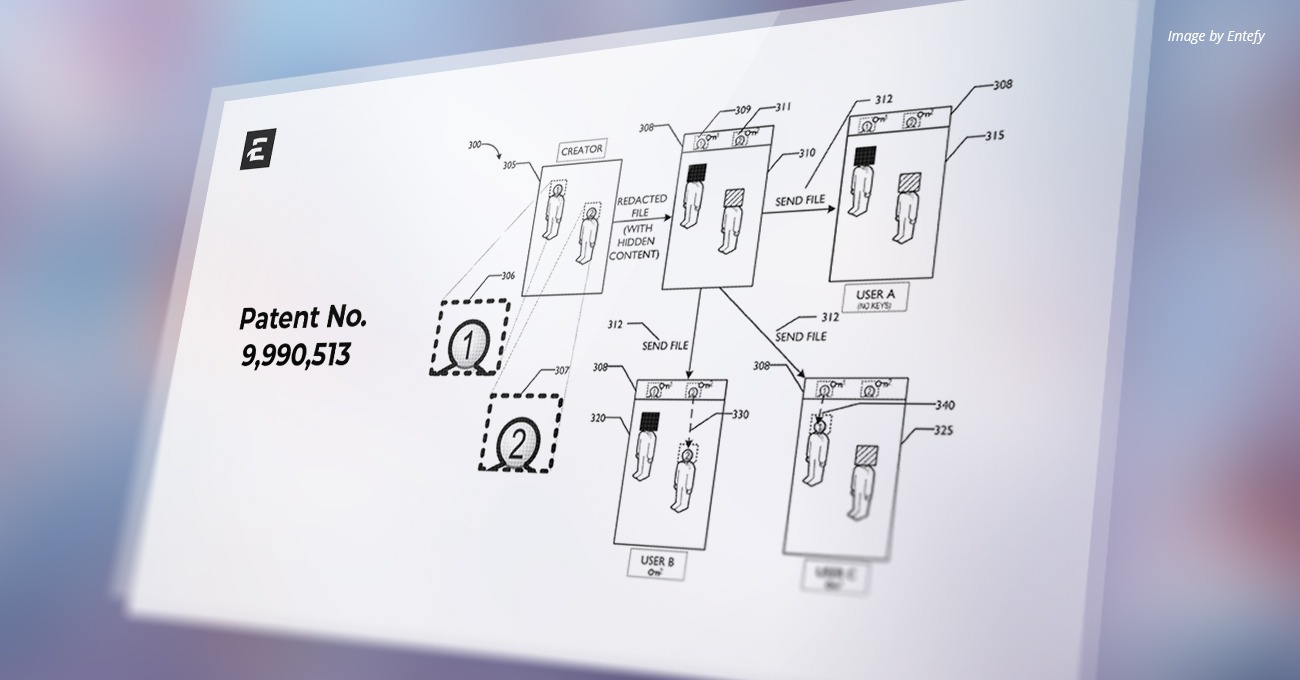
Adaptive Privacy Control (APC) engine optimized for use with lossy file types

U.S. Patent Number: 9,990,513
Patent Title: System and method of applying adaptive privacy controls to lossy file types
Issue Date: June 05, 2018
Inventors: Alston Ghafourifar
Assignee: Entefy Inc.

Patent Abstract

The proliferation of personal computing devices in recent years, especially mobile personal computing devices, combined with a growth in the number of widely-used communications formats has led to increased concerns regarding the safety and security of documents and messages that are sent over networks. Users desire a system that provides for the setting of custom access permissions at a file-level or sub-file-level. Such a system may allow the user to apply customized privacy settings (and, optionally, encryption keys) differently to particular portions of a document—even if the document is of a ‘lossy’ file type, e.g., a JPEG image. According to some embodiments, the custom access permission settings may be implemented by obfuscating portions of the original file and then embedding “secret,” e.g., hidden and/or encrypted, versions of the obfuscated portions in parts of the data structure of the original lossy file before transmitting the file to the desired recipients.

USPTO Technical Field

This disclosure relates generally to systems, methods, and computer readable media for applying user-defined access permission settings to files in lossy file formats, those files may then be disseminated over a network. More particularly, the access permission settings may be implemented by embedding “secret,” e.g., hidden and/or encrypted, information in such lossy file formats.

Background

The proliferation of personal computing devices in recent years, especially mobile personal computing devices, combined with a growth in the number of widely-used communications formats (e.g., text, voice, video, image) and protocols (e.g., SMTP, IMAP/POP, SMS/MMS, XMPP, etc.) has led to increased concerns regarding the safety and security of documents and messages that are sent over networks. Users desire a system that provides for the setting of custom, e.g., user-defined access permissions for a lossy file or part of the lossy file that comprises less than the entire file through a communications network. A ‘lossy’ file, as used herein, refers to a file (or file format) that is compressed using inexact approximation methods (e.g., partial data discarding methods). As such, lossy compression techniques may be used to reduce data size for storage, handling, and transmitting content. However, because lossy compression reduces a file by permanently discarding certain information (e.g., redundant information), when the file is decompressed, it is not decompressed to 100% of the original. Lossy compression is generally used for multimedia files, e.g., images files, such as JPEG files or PNG files, video files, and/or sound files—where a certain amount of information loss will not be detected by most users and can result in significant gains in file size reduction or performance.

Lossy files may contain header properties. These header properties may be used to store alternate contents such as metadata, random information, or even full encoding of other files or portions of files, such as in the embodiments described herein. Such a system would allow customized privacy settings to be specified for different recipients, e.g., recipients at various levels of social distance from the user sending the document or message (e.g., public, private, followers, groups, Level-1 contacts, Level-2 contacts, Level-3 contacts, etc.). Such a system may also allow the user to apply customized privacy settings and encryption keys differently to particular parts of a lossy file, e.g., making one or more parts of the lossy file available only to a first class of users, or by making other parts of the lossy file available to the first class of users and a second class of users, all while preventing access to parts of lossy file by users who do not have the requisite access privileges.

Thus, a system for providing access permission setting through Adaptive Privacy Controls (APC) is described herein. APC, as used herein, will refer to a user-controllable or system-generated, intelligent privacy system that can limit viewing, editing, and re-sharing privileges for lossy files, for example, image files and other multimedia files that include a lossy compression, wherein changes made to the content of such ‘lossy’ files may not be reliably reversed or dynamically changed—as would be necessary according to prior art techniques attempting to implement the kinds of fine-grained access permission setting methods disclosed herein. Other embodiments of APC systems will, of course, be able to handle the setting of access permissions for recipients of lossless file formats, as well. In summary, APC systems, as used herein, allow users to share whatever information they want with whomever they want, while keeping others from accessing the same information, e.g., via hiding and/or encryption processes that can be initiated by user command or via system intelligence, even on lossy file types. APC access permission settings may be applied to individuals, pre-defined groups, and/or ad-hoc groups. Customized encryption keys may further be applied to particular parties or groups of parties to enhance the security of the permission settings.

APC may be used to apply privacy settings to only particular portions of a lossy file, for example, a particular portion of a JPEG image. For example, User A may be a family member who may be authorized to see an entire JPEG image, but User B and other users may be mere acquaintances, who are only authorized to see a redacted portion or portions of the JPEG image. For example, the entire JPEG image file would be viewable to User A, but only a redacted portion or portions of the JPEG image (e.g., everything but the face of the subject(s) in the image) would be available to the User B and other users when viewing the JPEG image file in an authorized viewing application.

According to some embodiments disclosed herein, a standard, i.e., “unauthorized,” JPEG viewing application would also be able to open the redacted version of the JPEG image file; it simply would not “know” where to look within the JPEG image file for the “true” content from the redacted portion or portions of the JPEG image file. According to still other embodiments, even if an unauthorized JPEG viewing application were able to find the “true” content from the redacted portion or portions “hidden” within the file structure of the JPEG image, the redacted portion or portions may be encrypted, and the unauthorized JPEG viewing application would not possess the necessary decryption keys to decrypt the encrypted redacted portion or portions. Moreover, the unauthorized JPEG viewing application also would not know where to “place” the encrypted portion or portions back within the image to reconstruct the original, i.e., unredacted, JPEG image in a seamless fashion.

Thus, according to some embodiments, the network-based, user-defined, APC controls for lossy file types or files (e.g., JPEG images) may include access permission systems, methods, and computer readable media that provide a seamless, intuitive user interface (e.g., using touch gestures or mouse input) allowing a user to: “block out” particular portions or areas of interest in a lossy file; hide (and optionally encrypt) such “blocked out” portions within parts the lossy file’s data structure; and then send the lossy file to particular recipients or groups of recipients with customized access permission settings, which settings may be specified on a per-recipient basis and that either allow or do not allow a given recipient to locate the hidden portions and (if necessary) decrypt such hidden portions so that the original lossy file may be reconstructed by the recipient.

Read the full patent here.

ABOUT ENTEFY

Entefy is an enterprise AI software company. Entefy’s patented, multisensory AI technology delivers on the promise of the intelligent enterprise, at unprecedented speed and scale.

Entefy products and services help organizations transform their legacy systems and business processes—everything from knowledge management to workflows, supply chain logistics, cybersecurity, data privacy, customer engagement, quality assurance, forecasting, and more. Entefy’s customers vary in size from SMEs to large global public companies across multiple industries including financial services, healthcare, retail, and manufacturing.

To leap ahead and future proof your business with Entefy’s breakthrough AI technologies, visit www.entefy.com  or contact us at contact@entefy.com.
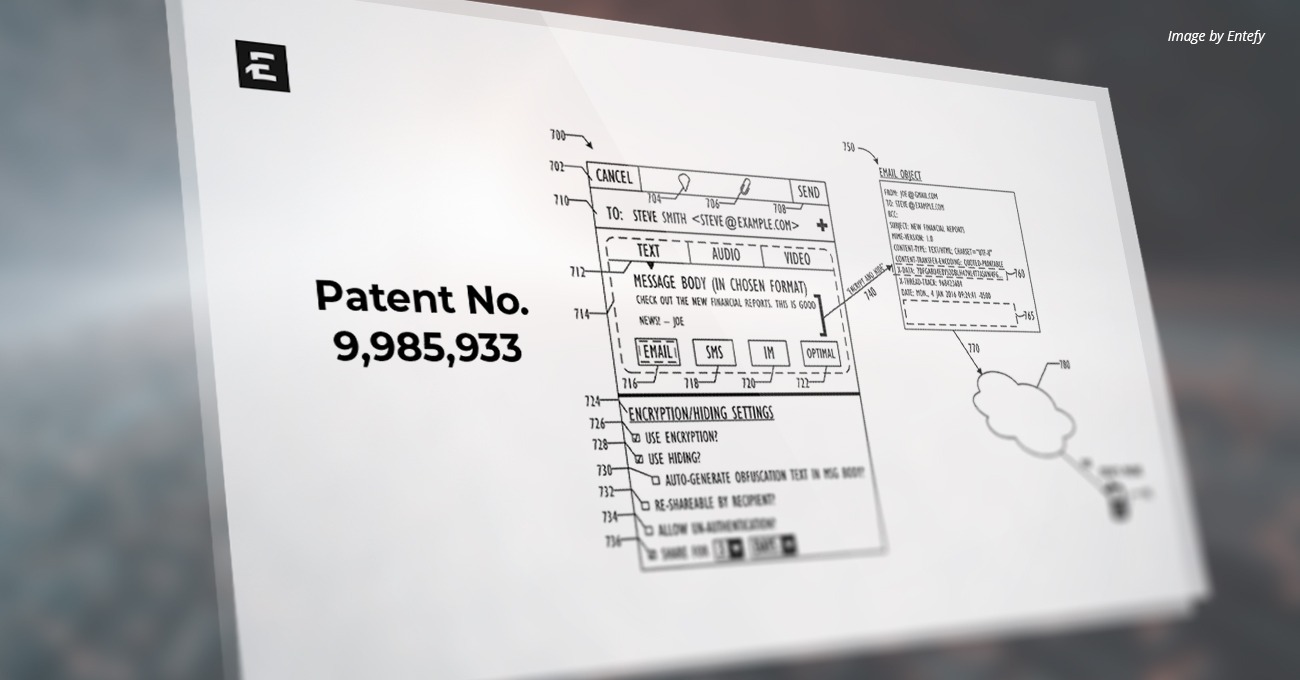
Sending and receiving secret messages over a network using the Adaptive Privacy Control (APC) engine

U.S. Patent Number: 9,985,933
Patent Title: System and method of applying adaptive privacy controls to lossy file types
Issue Date: June 05, 2018
Inventors: Alston Ghafourifar
Assignee: Entefy Inc.

Patent Abstract

The proliferation of personal computing devices in recent years, especially mobile personal computing devices, has led to increased concerns regarding the safety and security of documents and messages that are sent over networks. Users desire a system that provides for the setting of custom, content-agnostic, permissions at a message, document, and/or sub-document-level through communications networks. Such a system may allow users to apply customized privacy settings and encryption keys differently to particular parts of documents and/or messages. Such a system may also allow the user to manipulate outgoing message objects of pre-existing formats, so as to “hide” the encrypted document and/or message content within one or more portions of the message object that are not displayed in existing message viewer applications, e.g., metadata fields or unused headers. As such, only authorized message viewing applications may know where to look for (and have the necessary keys to decrypt) such hidden content.

USPTO Technical Field

This disclosure relates generally to systems, methods, and computer readable media for determining user-defined, content-agnostic document and message access permission through a network and for sending such documents and messages in a “secret,” e.g., hidden and/or encrypted, fashion over a network.

Background

The proliferation of personal computing devices in recent years, especially mobile personal computing devices, combined with a growth in the number of widely-used communications formats (e.g., text, voice, video, image) and protocols (e.g., SMTP, IMAP/POP, SMS/MMS, XMPP, etc.) has led to increased concerns regarding the safety and security of documents and messages that are sent over networks. Users desire a system that provides for the setting of custom, e.g., user-defined, content-agnostic permissions at a message-, document-, and/or sub-document—(i.e., a part of the document that comprises less than the entire document) level through a communications network. Such a system would allow customized privacy settings to be specified at various levels of social distance from the user sending the document or message (e.g., public, private, followers, groups, Level-1 contacts, Level-2 contacts, Level-3 contacts, etc.). Such a system may also allow the user to apply customized privacy settings and encryption keys differently to particular parts of a document, e.g., making a first part of a document available only to a first class of users and other parts of the document available to the first class of users and a second class of users.

Thus, a system for providing Adaptive Privacy Controls (APC) is described herein. APC comprises a user-controllable or system-generated, intelligent privacy system that can limit viewing, editing, and re-sharing privileges for files and other digital objects of all types stored in a compatible system (e.g., message objects, user profile fields, documents, etc.). APC allows users to share whatever information they want with whomever they want, while keeping others from accessing such information via assorted rights management techniques and/or encryption processes that can be initiated by user command or via system intelligence on entire objects or portions of objects. APC techniques may be applied to individuals, pre-defined groups, and/or ad-hoc groups. Customized encryption keys may further be applied to particular parties or groups of parties to enhance the security of the access permission settings.

APC may also be used to apply privacy settings to only particular parts of a document. For example, User A in an organization may need to see the entire content of the organization’s annual report drafts, but other users in the organization may only need to see a version that has sensitive financial/pro-forma data redacted. For example, pages 1-20 of the annual report would be available to User A, but only pages 1-19 would be available to the other users.

Thus, according to some embodiments, the network-based, user-defined, content-agnostic (i.e., agnostic as to both format and subject matter) document and message access permission setting systems, methods, and computer readable media described herein may provide a seamless, intuitive user interface (e.g., using touch gestures or mouse input) allowing a user to block out particular areas of interest in a document or message from particular recipients or groups of recipients, as well as to specify privacy and access permission settings for a single document or message—or across all documents owned by the user.

According to other embodiments, the document and message access permission setting systems, methods, and computer readable media described herein may also provide an interface allowing a user to manipulate an outgoing message object, so as to “hide” the “secret” message content that has had the aforementioned specific permissions applied to it (e.g., encrypted content) within one or more portions of the message object that are not displayed in existing message viewer applications, such as hidden metadata fields or unused headers. This interface allows the “secret,” i.e., hidden (and/or encrypted) content to be delivered using existing message formats (e.g., Multipurpose Internet Mail Extensions, or “MIME”) and delivery protocols (e.g., Simple Mail Transfer Protocol, or “SMTP”) and to be viewed using existing message viewers (e.g., webmail clients)—while still protecting (and hiding) the actual secret content from the recipient. Using these techniques, no recipient (even an intended recipient) would be able to view the actual content of the message object using the existing message viewer application.

According to such systems, methods, and computer readable media, only an authorized message viewing application would have both the instructions and knowledge of where in the message to look for the secret hidden content, as well as the necessary decryption keys to decrypt the hidden content. As such, the “hidden and encrypted” message object may be stored, archived, exported, etc. using the infrastructure of an existing communication channel (e.g., a webmail provider’s servers) and may even be forwarded to other users, while still respecting the sender’s original intent that only the intended recipients be able to view the message’s secret content, i.e., by using an authorized message viewing application.

Moreover, the ‘message body’ field of the message object may be intentionally ‘blanked’ out and/or filled with auto-generated obfuscation text, such that, when viewed outside an authorized client message viewing application (e.g., in an existing message viewer) or when viewed by an unintended recipient, there is either no indication that any real content is even present in the message (i.e., if no information has been stored in the ‘message body’ field, that is, it has been ‘blanked’ out), or the content that is displayed in the existing message viewer is intentionally obfuscating text (i.e., text that has nothing to do with the actual content of the message, but that would not ‘tip off’ an unintended recipient that there was any ‘true’ content that s/he was not seeing in the message). In other embodiments, the system may generate one or more obfuscation media objects (e.g., images, video, audio, etc.) to include in the ‘message body’ field of the message object, rather than obfuscation text.

The subject matter of the present disclosure is directed to overcoming, or at least reducing the effects of, one or more of the problems set forth above. To address these and other issues, techniques that enable the setting of user-defined, content-agnostic permissions at a message-, document-, and/or sub-document-level through a communications network, as well as techniques to ‘hide’ encrypted content within existing message objects’ data structures such that the true content is only viewable within authorized message viewing applications, are described herein.

Read the full patent here.

ABOUT ENTEFY

Entefy is an enterprise AI software company. Entefy’s patented, multisensory AI technology delivers on the promise of the intelligent enterprise, at unprecedented speed and scale.

Entefy products and services help organizations transform their legacy systems and business processes—everything from knowledge management to workflows, supply chain logistics, cybersecurity, data privacy, customer engagement, quality assurance, forecasting, and more. Entefy’s customers vary in size from SMEs to large global public companies across multiple industries including financial services, healthcare, retail, and manufacturing.

To leap ahead and future proof your business with Entefy’s breakthrough AI technologies, visit www.entefy.com  or contact us at contact@entefy.com.
Intelligent selection of protocol and delivery time in multi-protocol digital communication systems

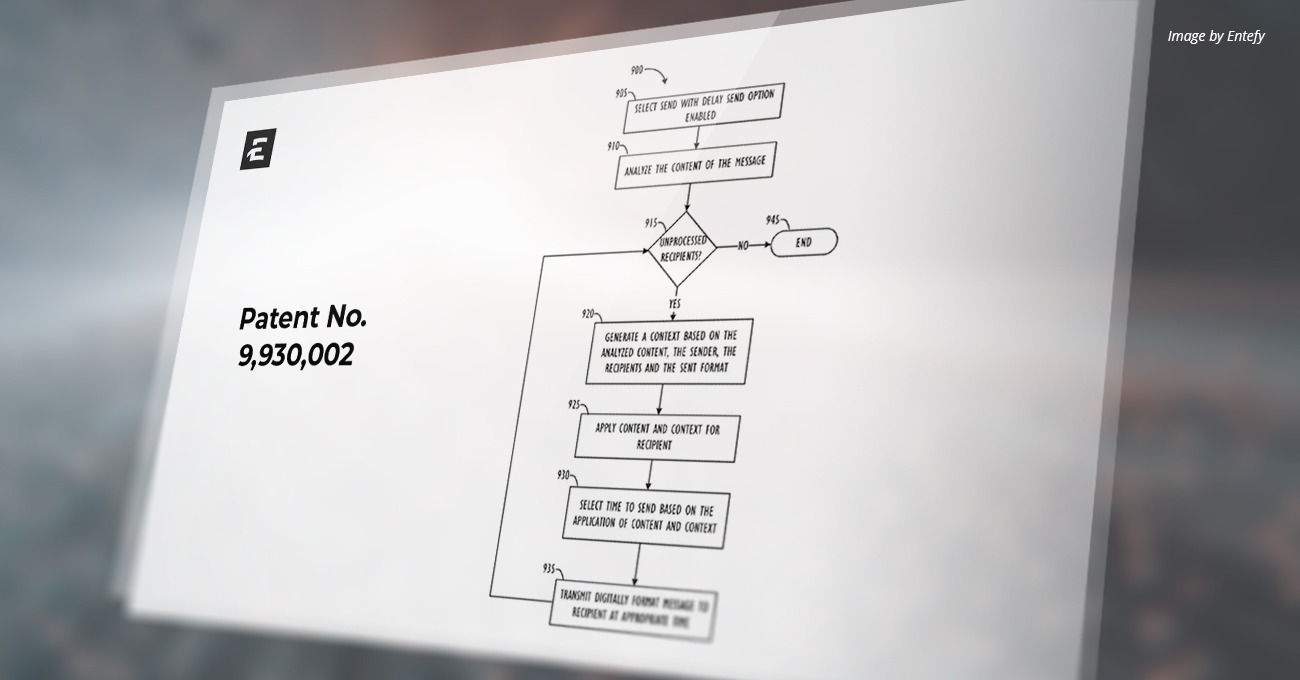
U.S. Patent Number: 9,930,002
Patent Title: Apparatus and method for intelligent delivery time determination for a multi-format and/or multi-protocol communication
Issue Date: March 27, 2018
Inventors: Ghafourifar, et al.
Assignee: Entefy Inc.

Patent Abstract

This disclosure relates generally to apparatus, methods, and computer readable media for composing communications for computing devices across multiple formats and multiple protocols. More particularly, but not by way of limitation, this disclosure relates to apparatus, methods, and computer readable media to permit computing devices, e.g., smartphones, tablets, laptops, and the like, to send communications in a number of pre-determined and/or ‘determined-on-the-fly’ communications formats and/or protocols at one or more determined delivery times via a single, seamless user interface. The determined delivery time of any message to any recipient may be intelligently determined individually for each recipient, e.g., by using one or more context factors to assess optimal delivery times for each recipient. The techniques disclosed herein allow communications systems to become ‘message-centric’ or ‘people-centric,’ as opposed to ‘protocol-centric,’ allowing the message protocol and delivery time to be abstracted from the sender of the communication, if the sender so desires.

USPTO Technical Field

This disclosure relates generally to apparatuses, methods, and computer readable media for composing communications for computing devices across multiple communications formats and protocols wherein the time of send/delivery of any message or group of message to any recipient or group of recipients can be intelligently determined using one or more context factors to assess optimal transaction time for each party involved.

Background

The proliferation of personal computing devices in recent years, especially mobile personal computing devices, combined with a growth in the number of widely-used communications formats (e.g., text, voice, video, image) and protocols (e.g., SMTP, IMAP/POP, SMS/MMS, XMPP, etc.) has led to a communications experience that many users find fragmented and restrictive. Users desire a system that will provide ease of communication by sending an outgoing message created in whatever format was convenient to the composer, with delivery options to one or more receivers in whatever format or protocol (and at whatever time) works best for them—all seamlessly from the composer’s and recipient(s)’s perspective. With current communications technologies that remain “protocol-centric”—as opposed to “message-centric” or “people-centric”—such ease of communication is not possible.

In the past, users of communications systems first had to choose a communication format and activate a corresponding application or system prior to composing a message or selecting desired recipient(s). For example, if a person wanted to call someone, then he or she would need to pick up a telephone and enter the required phone number or directory in order to connect. If a person wanted to email a colleague, that person would be required to launch an email application before composing and sending email, etc. Further, while long-form text might be the most convenient format at the time for the composer, long-form text may not be convenient for the receiver—resulting in a delayed receipt of and/or response to the message by the receiver. With the multi-format communication composition techniques described herein, however, the user flow is much more natural and intuitive. First, the ‘Sender’ (a registered user of the multi-format, multi-protocol communication system), can select the desired recipient(s). Then, the Sender may compose the outgoing message (in any format such as text, video recording, audio recording). Next, the system (or the Sender, in some embodiments) intelligently chooses the delivery protocol for the communication, e.g., whether the communication is going to be sent via email, SMS, IM, or social media, etc. Finally, the outgoing message is converted into the desired outgoing message format (either by the Sender’s client device or a central communications system server) and sent to the desired recipient(s) via the chosen delivery protocol(s) at the determined time(s).

According to the multi-format communication composition techniques described herein, the emphasis in the communication interface is on the “who” and the “what” of the communication—but not the “how.” The multi-format communication composition system described herein takes care of the “how”—including an ‘Optimal’ option, as determined by the ‘Optimal Decision Engine’ which may be employed to deliver the outgoing communication to the desired recipient(s) in the most preferred way, e.g., either through preferences that the recipient(s) has specified via his or her profile in a multi-format communications network or through the communication protocol information regarding the desired recipient that is stored in the sender’s contact list, and at a preferred time(s).

The subject matter of the present disclosure is directed to overcoming, or at least reducing the effects of, one or more of the problems set forth above. To address these and other issues, techniques that enable seamless, multi-format and multi-protocol communications via a single user interface are described herein.

Read the full patent here.

ABOUT ENTEFY

Entefy is an enterprise AI software company. Entefy’s patented, multisensory AI technology delivers on the promise of the intelligent enterprise, at unprecedented speed and scale.

Entefy products and services help organizations transform their legacy systems and business processes—everything from knowledge management to workflows, supply chain logistics, cybersecurity, data privacy, customer engagement, quality assurance, forecasting, and more. Entefy’s customers vary in size from SMEs to large global public companies across multiple industries including financial services, healthcare, retail, and manufacturing.

To leap ahead and future proof your business with Entefy’s breakthrough AI technologies, visit www.entefy.com  or contact us at contact@entefy.com.
Multi-protocol, multi-format group messaging system with intelligent thread management and protocol selection

U.S. Patent Number: 9,843,543
Patent Title: Apparatus and method for multi-format and multi-protocol group messaging
Issue Date: December 12, 2017
Inventors: Ghafourifar, et al.
Assignee: Entefy Inc.

Patent Abstract

This disclosure relates generally to apparatuses, methods, and computer readable media for composing communications for computing devices across multiple formats and multiple protocols. More particularly, but not by way of limitation, this disclosure relates to apparatuses, methods, and computer readable media to permit computing devices, e.g., smartphones, tablets, laptops, and the like, to send encrypted or unencrypted group communications in a number of pre-determined and/or ‘determined-on-the-fly’ communications formats and/or protocols. Correlation of messages comprising secure group communications across multi-format multi-protocol may be determined by tracking message groups and mapping aliases across protocols. The techniques disclosed herein allow communications systems to become ‘message-centric’ or ‘people-centric’ as opposed to ‘protocol-centric,’ eventually allowing consideration of message protocol and security mechanisms to fall away entirely for the sender of the communication.

USPTO Technical Field

This disclosure relates generally to apparatuses, methods, and computer readable media for composing communications for computing devices across multiple communications formats and protocols.

Background

The proliferation of personal computing devices in recent years, especially mobile personal computing devices, combined with a growth in the number of widely-used communications formats (e.g., text, voice, video, image) and protocols (e.g., SMTP, IMAP/POP, SMS/MMS, XMPP, etc.) has led to a communications experience that many users find fragmented and restrictive. Users desire a system that will provide ease of communication by sending an outgoing message created in whatever format was convenient to the composer, with delivery options to one or more receivers in whatever format or protocol that works best for them—all seamlessly from the composer’s and recipient(s)’s perspective. With current communications technologies that remain “protocol-centric”—as opposed to “message-centric”—such ease of communication is not possible.

In the past, users of communications systems first had to choose a communication format before composing a message or selecting desired recipient(s). For example, a user must pick up a telephone before calling someone, or a user must launch a text or email application before composing the text or email, etc. And, while text might be the most convenient format at the time for the composer, text may not be convenient for the receiver—resulting in a delayed receipt of the message by the receiver. With the multi-format communication composition techniques described herein, however, the user flow is much more natural and intuitive. First, the user can select the desired recipient(s). Then, the user may compose the outgoing message (in any format). Next, the system (or the user, in some embodiments) chooses the delivery protocol for the communication, e.g., whether the communication is going to be sent via email, SMS, IM, or social media, etc. Finally, the outgoing message is converted into the desired outgoing message format (either by the user’s client device or a central communications system server) and sent to the desired recipient(s) via the chosen delivery protocol(s).

According to the multi-format communication composition techniques described herein, the emphasis in the communication interface is on the “who” and the “what” of the communication—but not the “how.” The multi-format communication composition system described herein takes care of the “how”—including an ‘Optimal’ option, which may be employed to deliver the outgoing communication to the desired recipient(s) in the most preferred way, e.g., either through preferences that the recipient has specified via his or her profile in a multi-format communications network or through the communication protocol information regarding the desired recipient that is stored in the sender’s contact list. This system could use information such as calendar information showing whether the recipient is in a meeting, recipient position or motion information (e.g., whether the recipient is driving, walking, sleeping, etc.), or historic communication patterns as a way to determine format or protocol.

Messages sent through the multi-format communications network described herein may reach participants of the group in traditional formats or protocols or, with ‘on-network’ recipients, in their preferred format or protocol. With group messages in particular, users desire a system wherein the incoming messages adapt seamlessly to the preferred format and/or protocol of the respective recipient, while maintaining desired levels of security and/or encryption.

The subject matter of the present disclosure is directed to overcoming, or at least reducing the effects of, one or more of the problems set forth above. To address these and other issues, techniques that enable seamless, multi-format secure group communications via a single user interface are described herein.

Read the full patent here.

ABOUT ENTEFY

Entefy is an enterprise AI software company. Entefy’s patented, multisensory AI technology delivers on the promise of the intelligent enterprise, at unprecedented speed and scale.

Entefy products and services help organizations transform their legacy systems and business processes—everything from knowledge management to workflows, supply chain logistics, cybersecurity, data privacy, customer engagement, quality assurance, forecasting, and more. Entefy’s customers vary in size from SMEs to large global public companies across multiple industries including financial services, healthcare, retail, and manufacturing.

To leap ahead and future proof your business with Entefy’s breakthrough AI technologies, visit www.entefy.com  or contact us at contact@entefy.com.
Automatic protocol selection and message transformation in multi-protocol digital communication systems

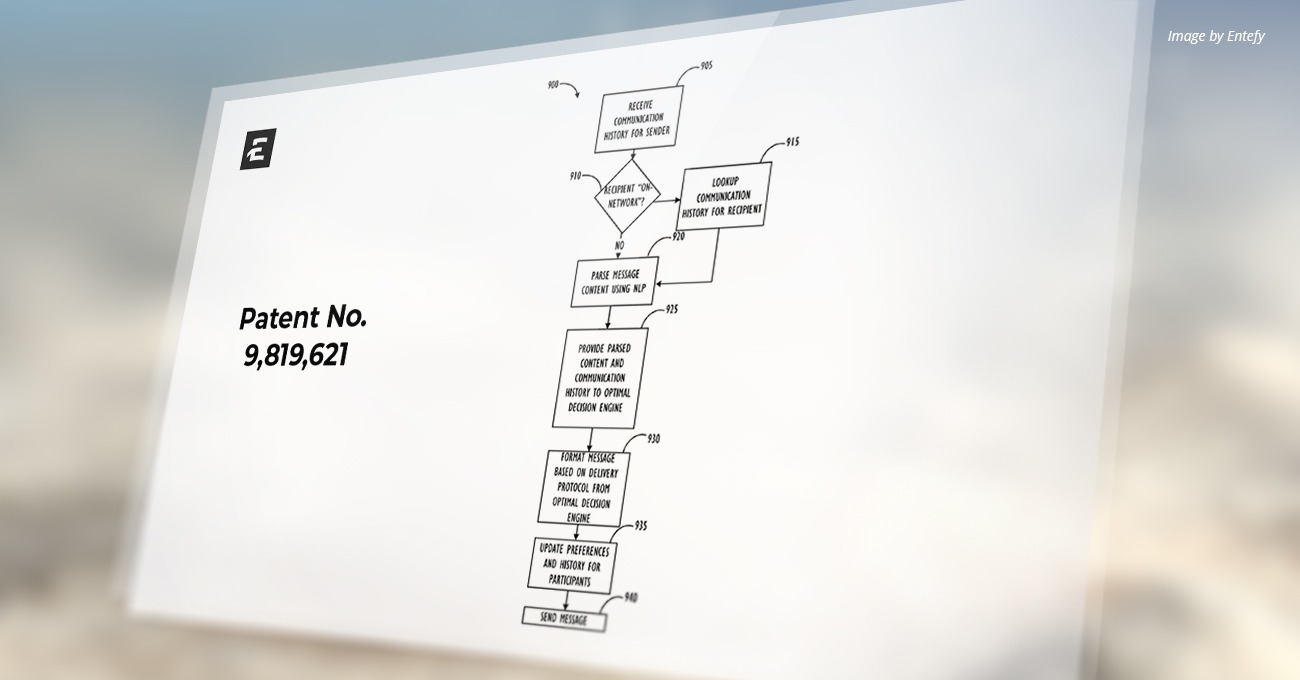
U.S. Patent Number: 9,819,621
Patent Title: Apparatus and method for optimized multi-format communication delivery protocol prediction
Issue Date: November 14, 2017
Inventors: Ghafourifar, et al.
Assignee: Entefy Inc.

Patent Abstract

This disclosure relates generally to apparatus, methods, and computer readable media for composing communications for computing devices across multiple formats and multiple protocols. More particularly, but not by way of limitation, this disclosure relates to apparatus, methods, and computer readable media to permit computing devices, e.g., smartphones, tablets, laptops, and the like, to send communications in a number of pre-determined and/or ‘determined-on-the-fly’ optimal communications formats and/or protocols. Determinations of optimal delivery methods may be intelligently based on the sender individually or the relationship with the sender in the context of a group of recipients—including the format of the incoming communication, the preferred format of the recipient and/or sender, and an optimal format for a given communication message. The techniques disclosed herein allow communications systems to become ‘message-centric’ or ‘people-centric,’ as opposed to ‘protocol-centric,’ eventually allowing consideration of message protocol to fall away entirely for the sender of the communication.

USPTO Technical Field

This disclosure relates generally to apparatuses, methods, and computer readable media for composing communications for computing devices across multiple communications formats and protocols as intelligently determined using one or more context factors to determine the optimal delivery method for the communications.

Background

The proliferation of personal computing devices in recent years, especially mobile personal computing devices, combined with a growth in the number of widely-used communications formats (e.g., text, voice, video, image) and protocols (e.g., SMTP, IMAP/POP, SMS/MMS, XMPP, etc.) has led to a communications experience that many users find fragmented and restrictive. Users desire a system that will provide ease of communication by sending an outgoing message created in whatever format was convenient to the composer, with delivery options to one or more receivers in whatever format or protocol that works best for them—all seamlessly from the composer’s and recipient(s)’s perspective. With current communications technologies that remain “protocol-centric”—as opposed to “message-centric” or “people-centric”—such ease of communication is not possible.

In the past, users of communications systems first had to choose a communication format and activate a corresponding application or system prior to composing a message or selecting desired recipient(s). For example, if a person wanted to call someone, then he or she would need to pick up a telephone and enter the required phone number or directory in order to connect. If a person wanted to email a colleague, that person would be required to launch an email application before composing and sending the email. Further, while long-form text might be the most convenient format at the time for the composer, long-form text may not be convenient for the receiver—resulting in a delayed receipt of and/or response to the message by the receiver. With the multi-format communication composition techniques described herein, however, the user flow is much more natural and intuitive. First, the ‘Sender’ (e.g., a registered user of the multi-format, multi-protocol communication system), can select the desired recipient(s). Then, the Sender may compose the outgoing message (in any format, such as text, video recording, or audio recording). Next, the system (or the Sender, in some embodiments) intelligently chooses the delivery protocol for the communication, e.g., whether the communication is going to be sent via email, SMS, IM, or social media, etc. Finally, the outgoing message is converted into the desired outgoing message format (either by the Sender’s client device or a central communications system server) and sent to the desired recipient(s) via the chosen delivery protocol(s).

According to the multi-format communication composition techniques described herein, the emphasis in the communication interface is on the “who” and the “what” of the communication—but not the “how.” The multi-format communication composition system described herein takes care of the “how”—including an ‘Optimal’ option, as determined by a dedicated service in the central communication server, such as a service referred to herein as the ‘Optimal Decision Engine,’ which may be employed to deliver the outgoing communication to the desired recipient(s) in the most preferred way, e.g., either through preferences that the recipient(s) has specified via his or her profile in a multi-format communications network or through the communication protocol information regarding the desired recipient that is stored in the Sender’s contact list.

The subject matter of the present disclosure is directed to overcoming, or at least reducing the effects of, one or more of the problems set forth above. To address these and other issues, techniques that enable seamless, multi-format communications via a single user interface are described herein.

Read the full patent here.

ABOUT ENTEFY

Entefy is an enterprise AI software company. Entefy’s patented, multisensory AI technology delivers on the promise of the intelligent enterprise, at unprecedented speed and scale.

Entefy products and services help organizations transform their legacy systems and business processes—everything from knowledge management to workflows, supply chain logistics, cybersecurity, data privacy, customer engagement, quality assurance, forecasting, and more. Entefy’s customers vary in size from SMEs to large global public companies across multiple industries including financial services, healthcare, retail, and manufacturing.

To leap ahead and future proof your business with Entefy’s breakthrough AI technologies, visit www.entefy.com  or contact us at contact@entefy.com.