

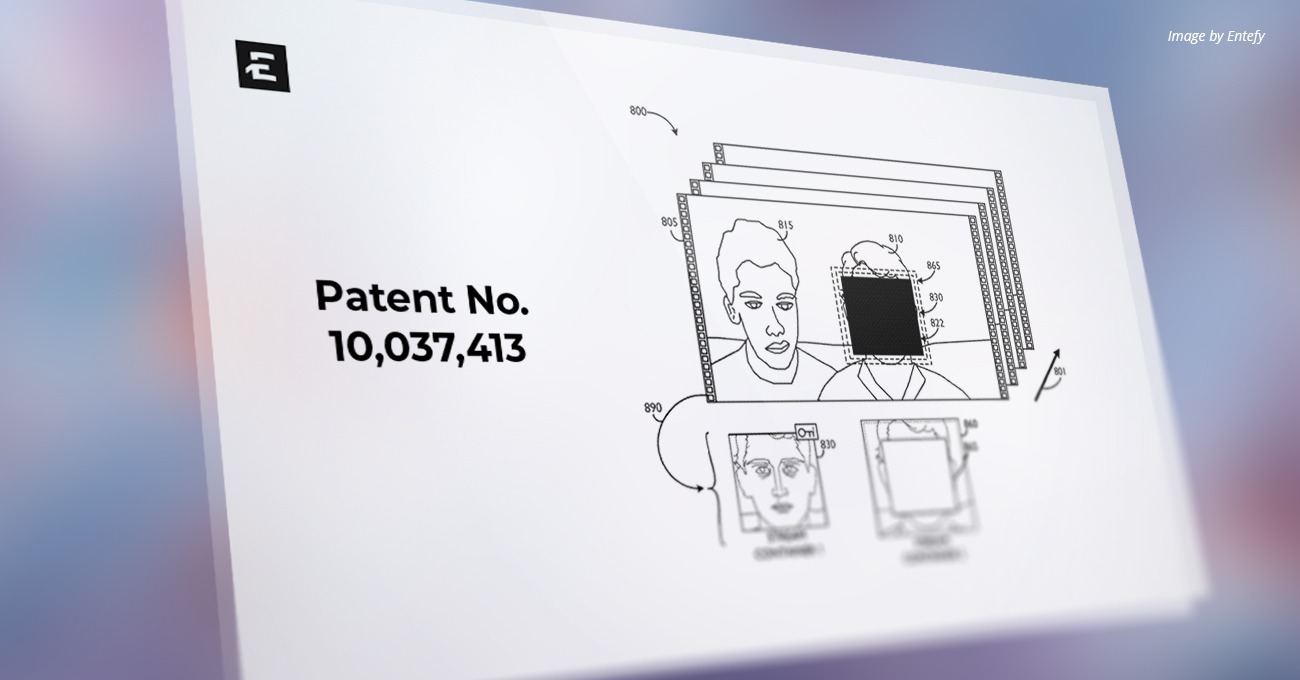
Adaptive Privacy Control (APC) engine for embedding multiple privacy layers within multi-channel encoded media files

U.S. Patent Number: 10,037,413
Patent Title: System and method of applying multiple adaptive privacy control layers to encoded media file types
Issue Date: July 23, 2018
Inventors: Ghafourifar, et al.
Assignee: Entefy Inc.

Patent Abstract

Disclosed are systems to apply customized permission settings to protect particular regions of a document, and, in particular, documents that are of a lossy′ encoded media file type, e.g., an MPEG video format. The custom access permission settings may be implemented by obfuscating the protected regions of the original file and then embedding “secret,” e.g., hidden and/or encrypted, versions of the obfuscated regions in parts of the data structure of the original file, e.g., in the form of “layers” that are held within video stream containers. The content of the individual encrypted video stream containers may then be decrypted according to each recipient’s permissions and layered on top of the obfuscated regions of the encoded media file before being displayed to the recipient. In some embodiments, additional layers of video may be used to reduce the appearance of aliasing around borders of the protected regions of the encoded media file.

USPTO Technical Field

This disclosure relates generally to systems, methods, and computer readable media for applying user-defined access permission settings to encoded media files in lossy file formats, e.g., MPEG video, which files may then be disseminated over a network and playable by recipients in a wide array of standardized software applications. More particularly, the access permission settings may be implemented by embedding one or more “secret,” e.g., hidden and/or encrypted, information portions in such encoded media file types, e.g., in the form of layers of video information.

Background

The proliferation of personal computing devices in recent years, especially mobile personal computing devices, combined with a growth in the number of widely-used communications formats (e.g., text, voice, video, image) and protocols (e.g., SMTP, IMAP/POP, SMS/MMS, XMPP, etc.) has led to increased concerns regarding the safety and security of documents and messages that are sent over networks. Users desire a system that provides for the setting of custom, e.g., user-defined, access permissions for all or part of a file, including files that have been encoded using lossy compression. A ‘lossy’ file, as used herein, refers to a file (or file format) that is compressed using inexact approximation methods (e.g., partial data discarding methods). As such, lossy compression techniques may be used to reduce data size for storage, handling, and transmitting content. However, because lossy compression reduces a file by permanently discarding certain information (e.g., redundant information), when the file is decompressed, it is not decompressed to 100% of the original. Lossy compression is generally used for multimedia files, e.g., images files, such as JPEG files, video files, such as MPEG files, and/or sound files, such as MP3 files—where a certain amount of information loss will not be detected by most users—and can result in significant gains in file size reduction or performance.

Certain lossy file types may also be described as “single-layered.” For example, in the case of a JPEG image, all the image content information may be stored in the form of a “byte array.” In order to change the appearance (e.g., color) of any pixels in the JPEG image, an editing or modification tool would need to modify or replace the particular information in the byte array corresponding to the region of pixels that are to be changed. Thus, the image data is said to be stored in a “single layer,” as there is no way to alter certain pixel regions in the JPEG image via the layering of new pixel information over the top of the original pixel information. By contrast, more complex image file types that support multiple image layers, e.g., PNG images, offer the ability to store image information in distinct layers which may, e.g., be ‘stacked’ in different orders, individually adjusted for opacity/transparency, or individually moved, rotated, shown, hidden, etc. before composition and display to a viewer. Due to the use of multiple layers, these changes to the image may be made and/or ‘unmade’ without undoing, overwriting, or otherwise degrading the quality of any of the underlying image information in a layer that happens to not be currently shown to the viewer.

Likewise, certain lossy file types for storing encoded multimedia, e.g., the various MPEG video formats, may also provide the ability to support “multi-layered” functionality. For example, through the use of Video Object Planes (VOPs) in certain encoded video files, multiple streams of video data (e.g., each represented in its own VOP) may be rendered simultaneously within the same video frame. A VOP, as used herein, comprises a stream of video data encoding picture information related to a specific region(s) or object(s) of interest that may be interacted with independently before being composited into the final video frames that are rendered for display. As with the PNG image layers discussed above, VOPs within a video frame may be ‘stacked’ on top of the ‘background’ video content in different orders, and can be individually adjusted by a given rendering engine with regard to opacity/transparency, or individually moved, rotated, shown, hidden, etc. before rendering and display to a viewer.

In some embodiments described herein, VOPs (or other parts of the video’s file structure), which are generically referred to herein as “stream containers,” may be used to hold isolated video bitstreams that an authorized encoded media viewing application may interpret and/or use in ways other than simple playback, as will be discussed in further detail below. For example, according to some embodiments described herein, the video bitstreams held in one or more of the stream containers packaged in the video’s file structure may need to be decrypted before being played back. In still other embodiments, the view of the video bitstreams held in one or more of the stream containers packaged in the video’s file structure may be adjusted before being rendered and displayed to a viewer, e.g., by adjusting the dimensions of the video bitstream that are actually made viewable to the viewer.

Lossy file types may also contain multiple “header,” or metadata, properties. These header properties may be used to store alternate contents such as metadata or other random information. Some lossy file types may also allow for the storage of multiple “layers” of media information within the same file, or even full encoding of other files or portions of files within the same file (e.g., in the case of VOPs within an MPEG file), such as in the embodiments described herein. Such a system would allow customized privacy settings to be specified for different recipients, e.g., recipients at various levels of social distance from the user sending the document or message (e.g., public, private, followers, groups, Level-1 contacts, Level-2 contacts, Level-3 contacts, etc.). Such a system may also allow the user to apply customized privacy settings and encryption keys differently to particular parts of a lossy file, e.g., making one or more parts of the lossy file available only to a first class of users, or by making other parts of the lossy file available to the first class of users and a second class of users, all while preventing access to parts of lossy file by users who do not have the requisite access privileges.

Thus, a system for providing access permission setting through Adaptive Privacy Controls (APC) is described herein. APC, as used herein, will refer to a user-controllable or system-generated, intelligent privacy system that can limit viewing, editing, and re-sharing privileges for lossy files, for example, image files and other multimedia files that include a lossy compression (including encoded multimedia file types), wherein changes made to the content of such ‘lossy’ files may not be reliably reversed or dynamically changed—as would be necessary according to prior art techniques attempting to implement the kinds of fine-grained access permission setting methods disclosed herein. Other embodiments of APC systems will, of course, be able to handle the setting of access permissions for recipients of lossless file formats, as well. In summary, APC systems, as used herein, allow users to share whatever information they want with whomever they want, while keeping others from accessing the same information, e.g., via hiding and/or encryption processes that can be initiated by user command or via system intelligence, even on lossy file types, and even when more than one region (including overlapping regions) in an encoded multimedia file have been selected by a user for APC-style protection. APC access permission settings may be applied to individuals, pre-defined groups, and/or ad-hoc groups. Customized encryption keys may further be applied to particular parties or groups of parties to enhance the security of the permission settings.

APC may be used to apply privacy settings to only particular portions of a lossy file, for example, a particular portion of a JPEG image or a frame (or series of frames) from an MPEG video. For example, User A may be a family member who may be authorized to see an entire JPEG image or MPEG video, but User B and other users may be mere acquaintances, who are only authorized to see a redacted portion or portions of the JPEG image or MPEG video. For example, the entire JPEG image or MPEG video file would be viewable to User A, but only a redacted portion or portions (e.g., everything but the face of the subject(s) in the image) would be available to the User B and other users when viewing the JPEG image or MPEG video file in an authorized viewing application.

According to some embodiments disclosed herein, a standard, i.e., “unauthorized,” viewing application, e.g. an image viewer or video player, would also be able to open the redacted version of the JPEG image or MPEG video file; it simply may not “know” where to look within the multimedia file’s structure for the “true” content from the redacted portion or portions of the JPEG image or MPEG video file. According to still other embodiments, even if an unauthorized viewing application were able to find the “true” content from the redacted portion or portions “hidden” within the file structure of the JPEG image or MPEG video (e.g., in the case of VOPs), the redacted portion or portions may be encrypted, and the unauthorized viewing application would not possess the necessary decryption keys to decrypt the encrypted redacted portion or portions. Moreover, the unauthorized viewing application also would not know where to “place” the encrypted portion or portions back within the image to reconstruct the original, i.e., unredacted, JPEG image or MPEG video in a seamless fashion.

Thus, according to some embodiments, the network-based, user-defined, APC controls for lossy file types or files (e.g., encoded media file types, such as MPEG) may include access permission systems, methods, and computer readable media that provide a seamless, intuitive user interface (e.g., using touch gestures or mouse input) allowing a user to: “block out” particular regions or areas of interest in a lossy file; hide (and optionally encrypt) such “blocked out” regions within parts the lossy file’s data structure; and then send the lossy file to particular recipients or groups of recipients with customized access permission settings, which settings may be specified on a per-recipient or per-group basis, and that either allow or do not allow a given recipient to locate the protected regions (if hidden) and decrypt such protected regions (if encrypted), so that the original lossy file may be reconstructed by the recipient.

Read the full patent here.

ABOUT ENTEFY

Entefy is an enterprise AI software company. Entefy’s patented, multisensory AI technology delivers on the promise of the intelligent enterprise, at unprecedented speed and scale.

Entefy products and services help organizations transform their legacy systems and business processes—everything from knowledge management to workflows, supply chain logistics, cybersecurity, data privacy, customer engagement, quality assurance, forecasting, and more. Entefy’s customers vary in size from SMEs to large global public companies across multiple industries including financial services, healthcare, retail, and manufacturing.

To leap ahead and future proof your business with Entefy’s breakthrough AI technologies, visit www.entefy.com  or contact us at contact@entefy.com.
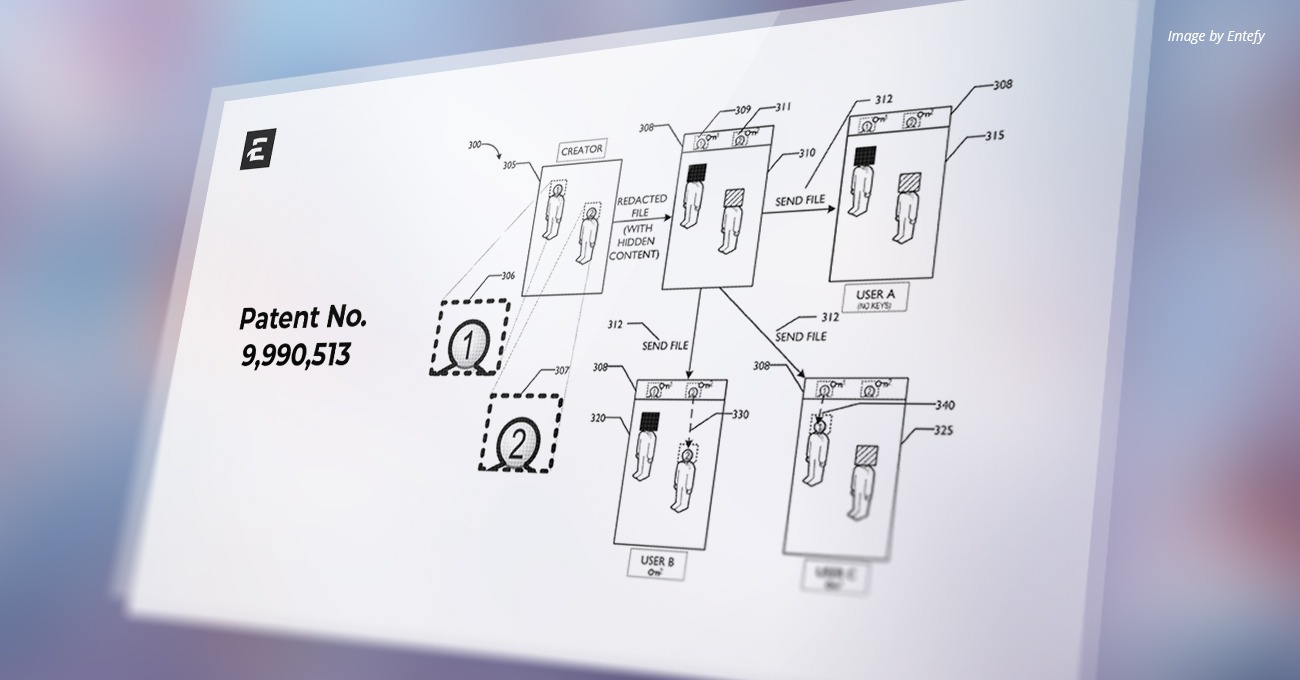
Adaptive Privacy Control (APC) engine optimized for use with lossy file types

U.S. Patent Number: 9,990,513
Patent Title: System and method of applying adaptive privacy controls to lossy file types
Issue Date: June 05, 2018
Inventors: Alston Ghafourifar
Assignee: Entefy Inc.

Patent Abstract

The proliferation of personal computing devices in recent years, especially mobile personal computing devices, combined with a growth in the number of widely-used communications formats has led to increased concerns regarding the safety and security of documents and messages that are sent over networks. Users desire a system that provides for the setting of custom access permissions at a file-level or sub-file-level. Such a system may allow the user to apply customized privacy settings (and, optionally, encryption keys) differently to particular portions of a document—even if the document is of a ‘lossy’ file type, e.g., a JPEG image. According to some embodiments, the custom access permission settings may be implemented by obfuscating portions of the original file and then embedding “secret,” e.g., hidden and/or encrypted, versions of the obfuscated portions in parts of the data structure of the original lossy file before transmitting the file to the desired recipients.

USPTO Technical Field

This disclosure relates generally to systems, methods, and computer readable media for applying user-defined access permission settings to files in lossy file formats, those files may then be disseminated over a network. More particularly, the access permission settings may be implemented by embedding “secret,” e.g., hidden and/or encrypted, information in such lossy file formats.

Background

The proliferation of personal computing devices in recent years, especially mobile personal computing devices, combined with a growth in the number of widely-used communications formats (e.g., text, voice, video, image) and protocols (e.g., SMTP, IMAP/POP, SMS/MMS, XMPP, etc.) has led to increased concerns regarding the safety and security of documents and messages that are sent over networks. Users desire a system that provides for the setting of custom, e.g., user-defined access permissions for a lossy file or part of the lossy file that comprises less than the entire file through a communications network. A ‘lossy’ file, as used herein, refers to a file (or file format) that is compressed using inexact approximation methods (e.g., partial data discarding methods). As such, lossy compression techniques may be used to reduce data size for storage, handling, and transmitting content. However, because lossy compression reduces a file by permanently discarding certain information (e.g., redundant information), when the file is decompressed, it is not decompressed to 100% of the original. Lossy compression is generally used for multimedia files, e.g., images files, such as JPEG files or PNG files, video files, and/or sound files—where a certain amount of information loss will not be detected by most users and can result in significant gains in file size reduction or performance.

Lossy files may contain header properties. These header properties may be used to store alternate contents such as metadata, random information, or even full encoding of other files or portions of files, such as in the embodiments described herein. Such a system would allow customized privacy settings to be specified for different recipients, e.g., recipients at various levels of social distance from the user sending the document or message (e.g., public, private, followers, groups, Level-1 contacts, Level-2 contacts, Level-3 contacts, etc.). Such a system may also allow the user to apply customized privacy settings and encryption keys differently to particular parts of a lossy file, e.g., making one or more parts of the lossy file available only to a first class of users, or by making other parts of the lossy file available to the first class of users and a second class of users, all while preventing access to parts of lossy file by users who do not have the requisite access privileges.

Thus, a system for providing access permission setting through Adaptive Privacy Controls (APC) is described herein. APC, as used herein, will refer to a user-controllable or system-generated, intelligent privacy system that can limit viewing, editing, and re-sharing privileges for lossy files, for example, image files and other multimedia files that include a lossy compression, wherein changes made to the content of such ‘lossy’ files may not be reliably reversed or dynamically changed—as would be necessary according to prior art techniques attempting to implement the kinds of fine-grained access permission setting methods disclosed herein. Other embodiments of APC systems will, of course, be able to handle the setting of access permissions for recipients of lossless file formats, as well. In summary, APC systems, as used herein, allow users to share whatever information they want with whomever they want, while keeping others from accessing the same information, e.g., via hiding and/or encryption processes that can be initiated by user command or via system intelligence, even on lossy file types. APC access permission settings may be applied to individuals, pre-defined groups, and/or ad-hoc groups. Customized encryption keys may further be applied to particular parties or groups of parties to enhance the security of the permission settings.

APC may be used to apply privacy settings to only particular portions of a lossy file, for example, a particular portion of a JPEG image. For example, User A may be a family member who may be authorized to see an entire JPEG image, but User B and other users may be mere acquaintances, who are only authorized to see a redacted portion or portions of the JPEG image. For example, the entire JPEG image file would be viewable to User A, but only a redacted portion or portions of the JPEG image (e.g., everything but the face of the subject(s) in the image) would be available to the User B and other users when viewing the JPEG image file in an authorized viewing application.

According to some embodiments disclosed herein, a standard, i.e., “unauthorized,” JPEG viewing application would also be able to open the redacted version of the JPEG image file; it simply would not “know” where to look within the JPEG image file for the “true” content from the redacted portion or portions of the JPEG image file. According to still other embodiments, even if an unauthorized JPEG viewing application were able to find the “true” content from the redacted portion or portions “hidden” within the file structure of the JPEG image, the redacted portion or portions may be encrypted, and the unauthorized JPEG viewing application would not possess the necessary decryption keys to decrypt the encrypted redacted portion or portions. Moreover, the unauthorized JPEG viewing application also would not know where to “place” the encrypted portion or portions back within the image to reconstruct the original, i.e., unredacted, JPEG image in a seamless fashion.

Thus, according to some embodiments, the network-based, user-defined, APC controls for lossy file types or files (e.g., JPEG images) may include access permission systems, methods, and computer readable media that provide a seamless, intuitive user interface (e.g., using touch gestures or mouse input) allowing a user to: “block out” particular portions or areas of interest in a lossy file; hide (and optionally encrypt) such “blocked out” portions within parts the lossy file’s data structure; and then send the lossy file to particular recipients or groups of recipients with customized access permission settings, which settings may be specified on a per-recipient basis and that either allow or do not allow a given recipient to locate the hidden portions and (if necessary) decrypt such hidden portions so that the original lossy file may be reconstructed by the recipient.

Read the full patent here.

ABOUT ENTEFY

Entefy is an enterprise AI software company. Entefy’s patented, multisensory AI technology delivers on the promise of the intelligent enterprise, at unprecedented speed and scale.

Entefy products and services help organizations transform their legacy systems and business processes—everything from knowledge management to workflows, supply chain logistics, cybersecurity, data privacy, customer engagement, quality assurance, forecasting, and more. Entefy’s customers vary in size from SMEs to large global public companies across multiple industries including financial services, healthcare, retail, and manufacturing.

To leap ahead and future proof your business with Entefy’s breakthrough AI technologies, visit www.entefy.com  or contact us at contact@entefy.com.
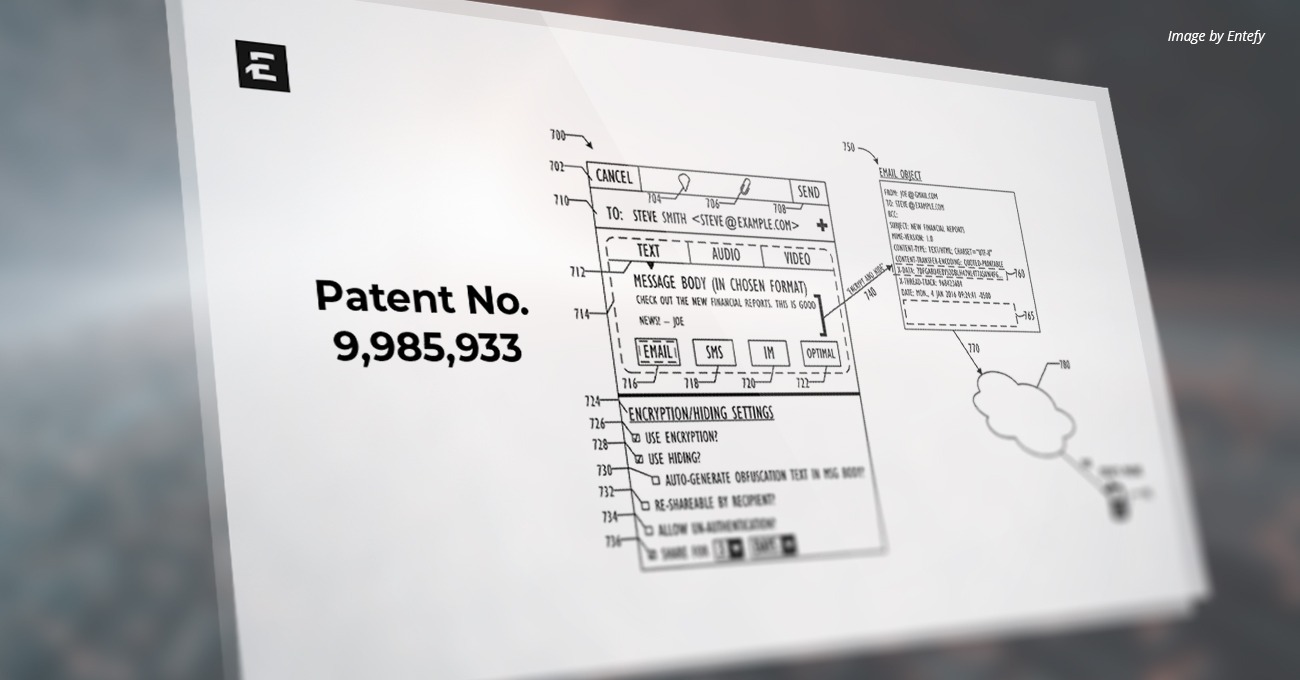
Sending and receiving secret messages over a network using the Adaptive Privacy Control (APC) engine

U.S. Patent Number: 9,985,933
Patent Title: System and method of applying adaptive privacy controls to lossy file types
Issue Date: June 05, 2018
Inventors: Alston Ghafourifar
Assignee: Entefy Inc.

Patent Abstract

The proliferation of personal computing devices in recent years, especially mobile personal computing devices, has led to increased concerns regarding the safety and security of documents and messages that are sent over networks. Users desire a system that provides for the setting of custom, content-agnostic, permissions at a message, document, and/or sub-document-level through communications networks. Such a system may allow users to apply customized privacy settings and encryption keys differently to particular parts of documents and/or messages. Such a system may also allow the user to manipulate outgoing message objects of pre-existing formats, so as to “hide” the encrypted document and/or message content within one or more portions of the message object that are not displayed in existing message viewer applications, e.g., metadata fields or unused headers. As such, only authorized message viewing applications may know where to look for (and have the necessary keys to decrypt) such hidden content.

USPTO Technical Field

This disclosure relates generally to systems, methods, and computer readable media for determining user-defined, content-agnostic document and message access permission through a network and for sending such documents and messages in a “secret,” e.g., hidden and/or encrypted, fashion over a network.

Background

The proliferation of personal computing devices in recent years, especially mobile personal computing devices, combined with a growth in the number of widely-used communications formats (e.g., text, voice, video, image) and protocols (e.g., SMTP, IMAP/POP, SMS/MMS, XMPP, etc.) has led to increased concerns regarding the safety and security of documents and messages that are sent over networks. Users desire a system that provides for the setting of custom, e.g., user-defined, content-agnostic permissions at a message-, document-, and/or sub-document—(i.e., a part of the document that comprises less than the entire document) level through a communications network. Such a system would allow customized privacy settings to be specified at various levels of social distance from the user sending the document or message (e.g., public, private, followers, groups, Level-1 contacts, Level-2 contacts, Level-3 contacts, etc.). Such a system may also allow the user to apply customized privacy settings and encryption keys differently to particular parts of a document, e.g., making a first part of a document available only to a first class of users and other parts of the document available to the first class of users and a second class of users.

Thus, a system for providing Adaptive Privacy Controls (APC) is described herein. APC comprises a user-controllable or system-generated, intelligent privacy system that can limit viewing, editing, and re-sharing privileges for files and other digital objects of all types stored in a compatible system (e.g., message objects, user profile fields, documents, etc.). APC allows users to share whatever information they want with whomever they want, while keeping others from accessing such information via assorted rights management techniques and/or encryption processes that can be initiated by user command or via system intelligence on entire objects or portions of objects. APC techniques may be applied to individuals, pre-defined groups, and/or ad-hoc groups. Customized encryption keys may further be applied to particular parties or groups of parties to enhance the security of the access permission settings.

APC may also be used to apply privacy settings to only particular parts of a document. For example, User A in an organization may need to see the entire content of the organization’s annual report drafts, but other users in the organization may only need to see a version that has sensitive financial/pro-forma data redacted. For example, pages 1-20 of the annual report would be available to User A, but only pages 1-19 would be available to the other users.

Thus, according to some embodiments, the network-based, user-defined, content-agnostic (i.e., agnostic as to both format and subject matter) document and message access permission setting systems, methods, and computer readable media described herein may provide a seamless, intuitive user interface (e.g., using touch gestures or mouse input) allowing a user to block out particular areas of interest in a document or message from particular recipients or groups of recipients, as well as to specify privacy and access permission settings for a single document or message—or across all documents owned by the user.

According to other embodiments, the document and message access permission setting systems, methods, and computer readable media described herein may also provide an interface allowing a user to manipulate an outgoing message object, so as to “hide” the “secret” message content that has had the aforementioned specific permissions applied to it (e.g., encrypted content) within one or more portions of the message object that are not displayed in existing message viewer applications, such as hidden metadata fields or unused headers. This interface allows the “secret,” i.e., hidden (and/or encrypted) content to be delivered using existing message formats (e.g., Multipurpose Internet Mail Extensions, or “MIME”) and delivery protocols (e.g., Simple Mail Transfer Protocol, or “SMTP”) and to be viewed using existing message viewers (e.g., webmail clients)—while still protecting (and hiding) the actual secret content from the recipient. Using these techniques, no recipient (even an intended recipient) would be able to view the actual content of the message object using the existing message viewer application.

According to such systems, methods, and computer readable media, only an authorized message viewing application would have both the instructions and knowledge of where in the message to look for the secret hidden content, as well as the necessary decryption keys to decrypt the hidden content. As such, the “hidden and encrypted” message object may be stored, archived, exported, etc. using the infrastructure of an existing communication channel (e.g., a webmail provider’s servers) and may even be forwarded to other users, while still respecting the sender’s original intent that only the intended recipients be able to view the message’s secret content, i.e., by using an authorized message viewing application.

Moreover, the ‘message body’ field of the message object may be intentionally ‘blanked’ out and/or filled with auto-generated obfuscation text, such that, when viewed outside an authorized client message viewing application (e.g., in an existing message viewer) or when viewed by an unintended recipient, there is either no indication that any real content is even present in the message (i.e., if no information has been stored in the ‘message body’ field, that is, it has been ‘blanked’ out), or the content that is displayed in the existing message viewer is intentionally obfuscating text (i.e., text that has nothing to do with the actual content of the message, but that would not ‘tip off’ an unintended recipient that there was any ‘true’ content that s/he was not seeing in the message). In other embodiments, the system may generate one or more obfuscation media objects (e.g., images, video, audio, etc.) to include in the ‘message body’ field of the message object, rather than obfuscation text.

The subject matter of the present disclosure is directed to overcoming, or at least reducing the effects of, one or more of the problems set forth above. To address these and other issues, techniques that enable the setting of user-defined, content-agnostic permissions at a message-, document-, and/or sub-document-level through a communications network, as well as techniques to ‘hide’ encrypted content within existing message objects’ data structures such that the true content is only viewable within authorized message viewing applications, are described herein.

Read the full patent here.

ABOUT ENTEFY

Entefy is an enterprise AI software company. Entefy’s patented, multisensory AI technology delivers on the promise of the intelligent enterprise, at unprecedented speed and scale.

Entefy products and services help organizations transform their legacy systems and business processes—everything from knowledge management to workflows, supply chain logistics, cybersecurity, data privacy, customer engagement, quality assurance, forecasting, and more. Entefy’s customers vary in size from SMEs to large global public companies across multiple industries including financial services, healthcare, retail, and manufacturing.

To leap ahead and future proof your business with Entefy’s breakthrough AI technologies, visit www.entefy.com  or contact us at contact@entefy.com.
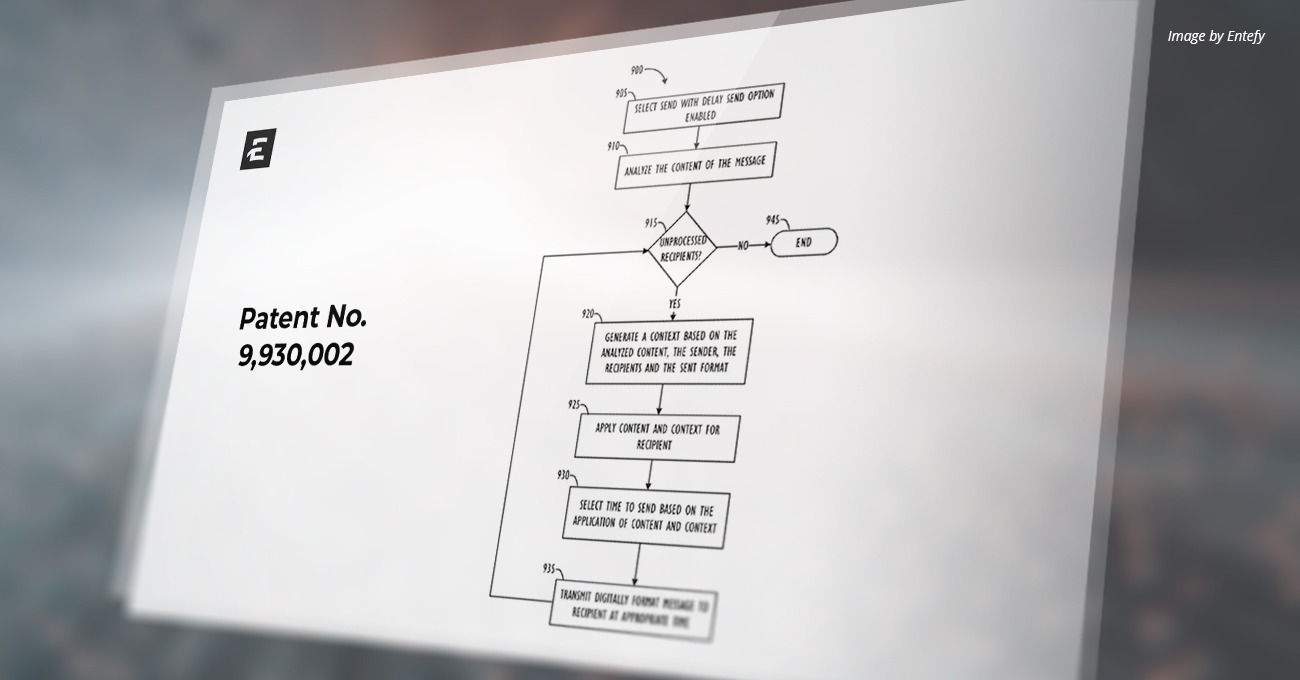
Intelligent selection of protocol and delivery time in multi-protocol digital communication systems

U.S. Patent Number: 9,930,002
Patent Title: Apparatus and method for intelligent delivery time determination for a multi-format and/or multi-protocol communication
Issue Date: March 27, 2018
Inventors: Ghafourifar, et al.
Assignee: Entefy Inc.

Patent Abstract

This disclosure relates generally to apparatus, methods, and computer readable media for composing communications for computing devices across multiple formats and multiple protocols. More particularly, but not by way of limitation, this disclosure relates to apparatus, methods, and computer readable media to permit computing devices, e.g., smartphones, tablets, laptops, and the like, to send communications in a number of pre-determined and/or ‘determined-on-the-fly’ communications formats and/or protocols at one or more determined delivery times via a single, seamless user interface. The determined delivery time of any message to any recipient may be intelligently determined individually for each recipient, e.g., by using one or more context factors to assess optimal delivery times for each recipient. The techniques disclosed herein allow communications systems to become ‘message-centric’ or ‘people-centric,’ as opposed to ‘protocol-centric,’ allowing the message protocol and delivery time to be abstracted from the sender of the communication, if the sender so desires.

USPTO Technical Field

This disclosure relates generally to apparatuses, methods, and computer readable media for composing communications for computing devices across multiple communications formats and protocols wherein the time of send/delivery of any message or group of message to any recipient or group of recipients can be intelligently determined using one or more context factors to assess optimal transaction time for each party involved.

Background

The proliferation of personal computing devices in recent years, especially mobile personal computing devices, combined with a growth in the number of widely-used communications formats (e.g., text, voice, video, image) and protocols (e.g., SMTP, IMAP/POP, SMS/MMS, XMPP, etc.) has led to a communications experience that many users find fragmented and restrictive. Users desire a system that will provide ease of communication by sending an outgoing message created in whatever format was convenient to the composer, with delivery options to one or more receivers in whatever format or protocol (and at whatever time) works best for them—all seamlessly from the composer’s and recipient(s)’s perspective. With current communications technologies that remain “protocol-centric”—as opposed to “message-centric” or “people-centric”—such ease of communication is not possible.

In the past, users of communications systems first had to choose a communication format and activate a corresponding application or system prior to composing a message or selecting desired recipient(s). For example, if a person wanted to call someone, then he or she would need to pick up a telephone and enter the required phone number or directory in order to connect. If a person wanted to email a colleague, that person would be required to launch an email application before composing and sending email, etc. Further, while long-form text might be the most convenient format at the time for the composer, long-form text may not be convenient for the receiver—resulting in a delayed receipt of and/or response to the message by the receiver. With the multi-format communication composition techniques described herein, however, the user flow is much more natural and intuitive. First, the ‘Sender’ (a registered user of the multi-format, multi-protocol communication system), can select the desired recipient(s). Then, the Sender may compose the outgoing message (in any format such as text, video recording, audio recording). Next, the system (or the Sender, in some embodiments) intelligently chooses the delivery protocol for the communication, e.g., whether the communication is going to be sent via email, SMS, IM, or social media, etc. Finally, the outgoing message is converted into the desired outgoing message format (either by the Sender’s client device or a central communications system server) and sent to the desired recipient(s) via the chosen delivery protocol(s) at the determined time(s).

According to the multi-format communication composition techniques described herein, the emphasis in the communication interface is on the “who” and the “what” of the communication—but not the “how.” The multi-format communication composition system described herein takes care of the “how”—including an ‘Optimal’ option, as determined by the ‘Optimal Decision Engine’ which may be employed to deliver the outgoing communication to the desired recipient(s) in the most preferred way, e.g., either through preferences that the recipient(s) has specified via his or her profile in a multi-format communications network or through the communication protocol information regarding the desired recipient that is stored in the sender’s contact list, and at a preferred time(s).

The subject matter of the present disclosure is directed to overcoming, or at least reducing the effects of, one or more of the problems set forth above. To address these and other issues, techniques that enable seamless, multi-format and multi-protocol communications via a single user interface are described herein.

Read the full patent here.

ABOUT ENTEFY

Entefy is an enterprise AI software company. Entefy’s patented, multisensory AI technology delivers on the promise of the intelligent enterprise, at unprecedented speed and scale.

Entefy products and services help organizations transform their legacy systems and business processes—everything from knowledge management to workflows, supply chain logistics, cybersecurity, data privacy, customer engagement, quality assurance, forecasting, and more. Entefy’s customers vary in size from SMEs to large global public companies across multiple industries including financial services, healthcare, retail, and manufacturing.

To leap ahead and future proof your business with Entefy’s breakthrough AI technologies, visit www.entefy.com  or contact us at contact@entefy.com.

Multi-protocol, multi-format group messaging system with intelligent thread management and protocol selection

U.S. Patent Number: 9,843,543
Patent Title: Apparatus and method for multi-format and multi-protocol group messaging
Issue Date: December 12, 2017
Inventors: Ghafourifar, et al.
Assignee: Entefy Inc.

Patent Abstract

This disclosure relates generally to apparatuses, methods, and computer readable media for composing communications for computing devices across multiple formats and multiple protocols. More particularly, but not by way of limitation, this disclosure relates to apparatuses, methods, and computer readable media to permit computing devices, e.g., smartphones, tablets, laptops, and the like, to send encrypted or unencrypted group communications in a number of pre-determined and/or ‘determined-on-the-fly’ communications formats and/or protocols. Correlation of messages comprising secure group communications across multi-format multi-protocol may be determined by tracking message groups and mapping aliases across protocols. The techniques disclosed herein allow communications systems to become ‘message-centric’ or ‘people-centric’ as opposed to ‘protocol-centric,’ eventually allowing consideration of message protocol and security mechanisms to fall away entirely for the sender of the communication.

USPTO Technical Field

This disclosure relates generally to apparatuses, methods, and computer readable media for composing communications for computing devices across multiple communications formats and protocols.

Background

The proliferation of personal computing devices in recent years, especially mobile personal computing devices, combined with a growth in the number of widely-used communications formats (e.g., text, voice, video, image) and protocols (e.g., SMTP, IMAP/POP, SMS/MMS, XMPP, etc.) has led to a communications experience that many users find fragmented and restrictive. Users desire a system that will provide ease of communication by sending an outgoing message created in whatever format was convenient to the composer, with delivery options to one or more receivers in whatever format or protocol that works best for them—all seamlessly from the composer’s and recipient(s)’s perspective. With current communications technologies that remain “protocol-centric”—as opposed to “message-centric”—such ease of communication is not possible.

In the past, users of communications systems first had to choose a communication format before composing a message or selecting desired recipient(s). For example, a user must pick up a telephone before calling someone, or a user must launch a text or email application before composing the text or email, etc. And, while text might be the most convenient format at the time for the composer, text may not be convenient for the receiver—resulting in a delayed receipt of the message by the receiver. With the multi-format communication composition techniques described herein, however, the user flow is much more natural and intuitive. First, the user can select the desired recipient(s). Then, the user may compose the outgoing message (in any format). Next, the system (or the user, in some embodiments) chooses the delivery protocol for the communication, e.g., whether the communication is going to be sent via email, SMS, IM, or social media, etc. Finally, the outgoing message is converted into the desired outgoing message format (either by the user’s client device or a central communications system server) and sent to the desired recipient(s) via the chosen delivery protocol(s).

According to the multi-format communication composition techniques described herein, the emphasis in the communication interface is on the “who” and the “what” of the communication—but not the “how.” The multi-format communication composition system described herein takes care of the “how”—including an ‘Optimal’ option, which may be employed to deliver the outgoing communication to the desired recipient(s) in the most preferred way, e.g., either through preferences that the recipient has specified via his or her profile in a multi-format communications network or through the communication protocol information regarding the desired recipient that is stored in the sender’s contact list. This system could use information such as calendar information showing whether the recipient is in a meeting, recipient position or motion information (e.g., whether the recipient is driving, walking, sleeping, etc.), or historic communication patterns as a way to determine format or protocol.

Messages sent through the multi-format communications network described herein may reach participants of the group in traditional formats or protocols or, with ‘on-network’ recipients, in their preferred format or protocol. With group messages in particular, users desire a system wherein the incoming messages adapt seamlessly to the preferred format and/or protocol of the respective recipient, while maintaining desired levels of security and/or encryption.

The subject matter of the present disclosure is directed to overcoming, or at least reducing the effects of, one or more of the problems set forth above. To address these and other issues, techniques that enable seamless, multi-format secure group communications via a single user interface are described herein.

Read the full patent here.

ABOUT ENTEFY

Entefy is an enterprise AI software company. Entefy’s patented, multisensory AI technology delivers on the promise of the intelligent enterprise, at unprecedented speed and scale.

Entefy products and services help organizations transform their legacy systems and business processes—everything from knowledge management to workflows, supply chain logistics, cybersecurity, data privacy, customer engagement, quality assurance, forecasting, and more. Entefy’s customers vary in size from SMEs to large global public companies across multiple industries including financial services, healthcare, retail, and manufacturing.

To leap ahead and future proof your business with Entefy’s breakthrough AI technologies, visit www.entefy.com  or contact us at contact@entefy.com.
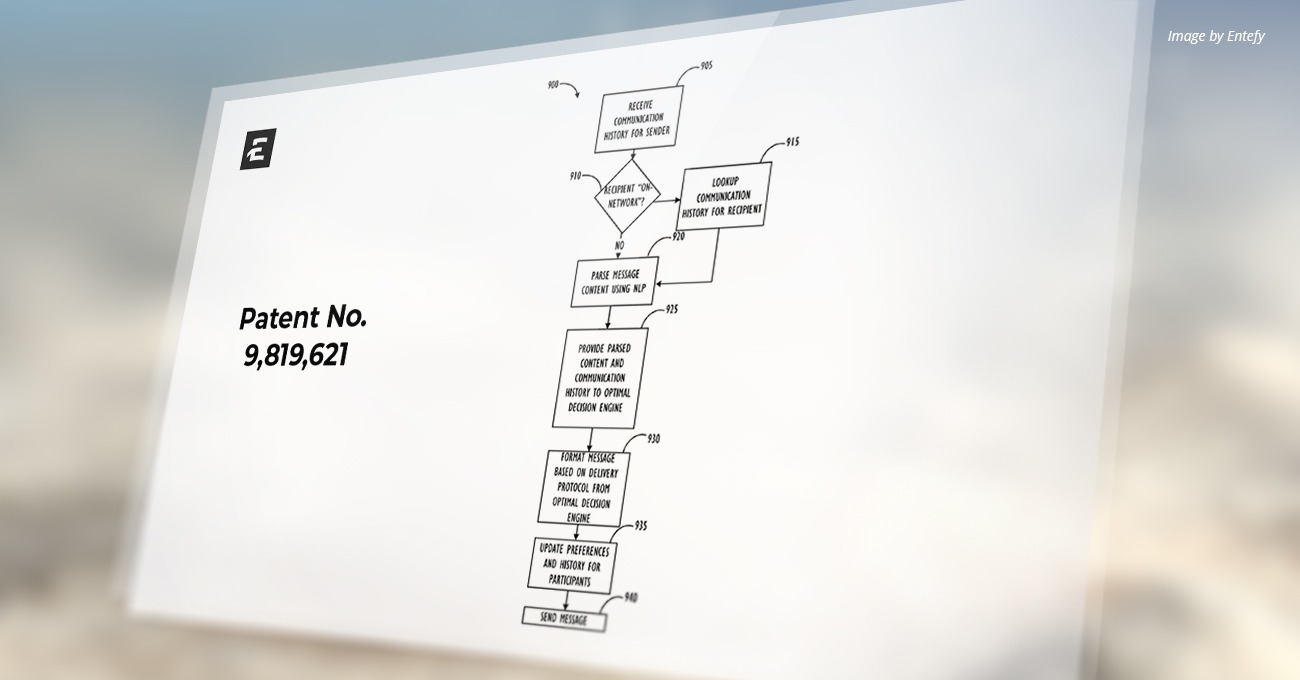
Automatic protocol selection and message transformation in multi-protocol digital communication systems

U.S. Patent Number: 9,819,621
Patent Title: Apparatus and method for optimized multi-format communication delivery protocol prediction
Issue Date: November 14, 2017
Inventors: Ghafourifar, et al.
Assignee: Entefy Inc.

Patent Abstract

This disclosure relates generally to apparatus, methods, and computer readable media for composing communications for computing devices across multiple formats and multiple protocols. More particularly, but not by way of limitation, this disclosure relates to apparatus, methods, and computer readable media to permit computing devices, e.g., smartphones, tablets, laptops, and the like, to send communications in a number of pre-determined and/or ‘determined-on-the-fly’ optimal communications formats and/or protocols. Determinations of optimal delivery methods may be intelligently based on the sender individually or the relationship with the sender in the context of a group of recipients—including the format of the incoming communication, the preferred format of the recipient and/or sender, and an optimal format for a given communication message. The techniques disclosed herein allow communications systems to become ‘message-centric’ or ‘people-centric,’ as opposed to ‘protocol-centric,’ eventually allowing consideration of message protocol to fall away entirely for the sender of the communication.

USPTO Technical Field

This disclosure relates generally to apparatuses, methods, and computer readable media for composing communications for computing devices across multiple communications formats and protocols as intelligently determined using one or more context factors to determine the optimal delivery method for the communications.

Background

The proliferation of personal computing devices in recent years, especially mobile personal computing devices, combined with a growth in the number of widely-used communications formats (e.g., text, voice, video, image) and protocols (e.g., SMTP, IMAP/POP, SMS/MMS, XMPP, etc.) has led to a communications experience that many users find fragmented and restrictive. Users desire a system that will provide ease of communication by sending an outgoing message created in whatever format was convenient to the composer, with delivery options to one or more receivers in whatever format or protocol that works best for them—all seamlessly from the composer’s and recipient(s)’s perspective. With current communications technologies that remain “protocol-centric”—as opposed to “message-centric” or “people-centric”—such ease of communication is not possible.

In the past, users of communications systems first had to choose a communication format and activate a corresponding application or system prior to composing a message or selecting desired recipient(s). For example, if a person wanted to call someone, then he or she would need to pick up a telephone and enter the required phone number or directory in order to connect. If a person wanted to email a colleague, that person would be required to launch an email application before composing and sending the email. Further, while long-form text might be the most convenient format at the time for the composer, long-form text may not be convenient for the receiver—resulting in a delayed receipt of and/or response to the message by the receiver. With the multi-format communication composition techniques described herein, however, the user flow is much more natural and intuitive. First, the ‘Sender’ (e.g., a registered user of the multi-format, multi-protocol communication system), can select the desired recipient(s). Then, the Sender may compose the outgoing message (in any format, such as text, video recording, or audio recording). Next, the system (or the Sender, in some embodiments) intelligently chooses the delivery protocol for the communication, e.g., whether the communication is going to be sent via email, SMS, IM, or social media, etc. Finally, the outgoing message is converted into the desired outgoing message format (either by the Sender’s client device or a central communications system server) and sent to the desired recipient(s) via the chosen delivery protocol(s).

According to the multi-format communication composition techniques described herein, the emphasis in the communication interface is on the “who” and the “what” of the communication—but not the “how.” The multi-format communication composition system described herein takes care of the “how”—including an ‘Optimal’ option, as determined by a dedicated service in the central communication server, such as a service referred to herein as the ‘Optimal Decision Engine,’ which may be employed to deliver the outgoing communication to the desired recipient(s) in the most preferred way, e.g., either through preferences that the recipient(s) has specified via his or her profile in a multi-format communications network or through the communication protocol information regarding the desired recipient that is stored in the Sender’s contact list.

The subject matter of the present disclosure is directed to overcoming, or at least reducing the effects of, one or more of the problems set forth above. To address these and other issues, techniques that enable seamless, multi-format communications via a single user interface are described herein.

Read the full patent here.

ABOUT ENTEFY

Entefy is an enterprise AI software company. Entefy’s patented, multisensory AI technology delivers on the promise of the intelligent enterprise, at unprecedented speed and scale.

Entefy products and services help organizations transform their legacy systems and business processes—everything from knowledge management to workflows, supply chain logistics, cybersecurity, data privacy, customer engagement, quality assurance, forecasting, and more. Entefy’s customers vary in size from SMEs to large global public companies across multiple industries including financial services, healthcare, retail, and manufacturing.

To leap ahead and future proof your business with Entefy’s breakthrough AI technologies, visit www.entefy.com  or contact us at contact@entefy.com.
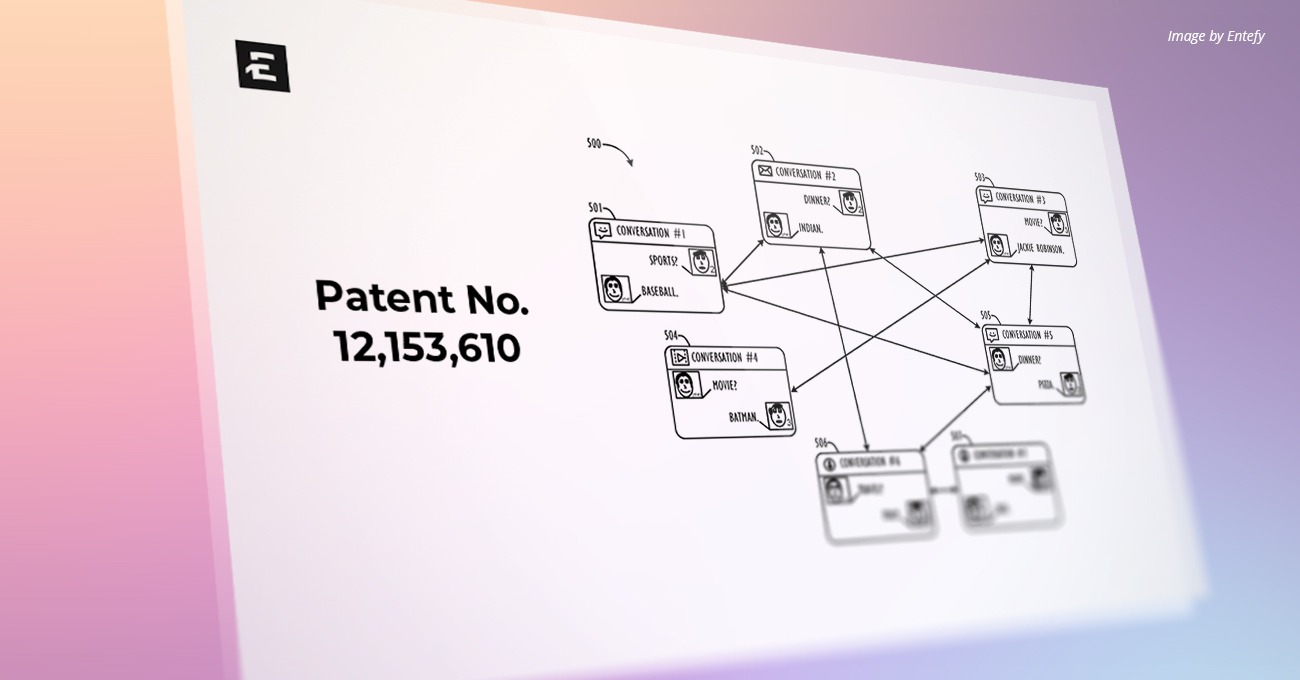
AI-driven tag cloud generation for privacy-preserving server-side search in zero-knowledge communication systems

U.S. Patent Number: 12,153,610
Patent Title: System and method of information retrieval from encrypted data files through a context-aware metadata AI engine
Issue Date:
November 26, 2024
Inventors:
Ghafourifar, et al.
Assignee: Entefy Inc.

Patent Abstract

This disclosure relates to personalized and dynamic server-side searching techniques for encrypted data. Current so-called ‘zero-knowledge’ privacy systems (i.e., systems where the server has ‘zero-knowledge’ about the client data that it is storing) utilize servers that hold encrypted data without the decryption keys necessary to decrypt, index, and/or re-encrypt the data. As such, the servers are not able to perform any kind of meaningful server-side search process, as it would require access to the underlying decrypted data. Therefore, such prior art ‘zero-knowledge’ privacy systems provide a limited ability for a user to search through a large dataset of encrypted documents to find critical information. Disclosed herein are communications systems that offer the increased security and privacy of client-side encryption to content owners, while still providing for highly relevant server-side search-based results via the use of content correlation, predictive analysis, and augmented semantic tag clouds for the indexing of encrypted data.

USPTO Technical Field

This disclosure relates generally to systems, methods, and computer readable media for performing highly relevant, dynamic, server-side searching on encrypted data that the server does not have the ability to decrypt.

Background

The proliferation of personal computing devices in recent years, especially mobile personal computing devices, combined with a growth in the number of widely-used communications formats (e.g., text, voice, video, image) and protocols (e.g., SMTP, IMAP/POP, SMS/MMS. XMPP, etc.) has led to a communications experience that many users find fragmented and difficult to search for relevant information in. Users desire a system that will provide for ease of message threading by “stitching” together related communications and documents across multiple formats and protocols-all seamlessly from the user’s perspective. Such stitching together of communications and documents across multiple formats and protocols may occur, e.g., by: 1) direct user action in a centralized communications application (e.g., by a user clicking ‘Reply’ on a particular message); 2) using semantic matching (or other search-style message association techniques); 3) element-matching (e.g., matching on subject lines or senders/recipients/similar quoted text, etc.); and/or 4) “state-matching” (e.g., associating messages if they are specifically tagged as being related to another message, sender, etc. by a third-party service, e.g., a webmail provider or Instant Messaging (IM) service). These techniques may be employed in order to provide a more relevant “search-based threading” experience for users.

With current communications technologies, conversations remain “siloed” within particular communication formats or protocols, leading to users being unable to search uniformly across multiple communications in multiple formats or protocols and across multiple applications and across multiple other computing devices from their computing devices to find relevant communications (or even communications that a messaging system may predict to be relevant), often resulting in inefficient communication workflows—and even lost business or personal opportunities. For example, a conversation between two people may begin over text messages (e.g., SMS) and then transition to email. When such a transition happens, the entire conversation can no longer be tracked, reviewed, searched, or archived by a single source since it had ‘crossed over’ protocols. For example, if the user ran a search on their email search system for a particular topic that had come up only in the user’s SMS conversations, even when pertaining to the same subject manner and “conversation,” such a search may not turn up optimally relevant results.

Users also desire a communications system with increased security and privacy with respect to their communications and documents, for example, systems wherein highly relevant search-based results may still be provided to the user by the system-even without the system actually having the ability to decrypt and/or otherwise have access to the underlying content of the user’s encrypted communications and documents. However, current so-called ‘zero-knowledge’ privacy systems (i.e., systems where the server has ‘zero-knowledge’ about the data that it is storing) utilize servers that hold encrypted data without the decryption keys necessary to decrypt, index, and/or re-encrypt the data. As such, this disallows any sort of meaningful server-side search process, which would require access to the underlying data (e.g., in order for the data to be indexed) to be performed, such that the encrypted data could be returned in viable query result sets. Therefore, such prior art ‘zero-knowledge’ systems provide a limited ability for a user to search through a large dataset of encrypted documents to find critical information.

It should be noted that attempts (both practical and theoretical) have been made to design proper ‘zero-knowledge’ databases and systems that can support complex query operations on fully encrypted data. Such approaches include, among others, homomorphic encryption techniques which have been used to support numerical calculations and other simple aggregations, as well as somewhat accurate retrieval of private information. However, no solution currently known to the inventors enables a system or database to perform complex operations on fully-encrypted data, such as index creation for the purpose of advanced search queries. Thus, the systems and methods disclosed herein aim to provide a user with the ability to leverage truly private, advanced server-side search capabilities from any connected client interface without relying on a ‘trusted’ server authority to authenticate identity or store the necessary key(s) to decrypt the content at any time.

Read the full patent here.

ABOUT ENTEFY

Entefy is an enterprise AI software company. Entefy’s patented, multisensory AI technology delivers on the promise of the intelligent enterprise, at unprecedented speed and scale.

Entefy products and services help organizations transform their legacy systems and business processes—everything from knowledge management to workflows, supply chain logistics, cybersecurity, data privacy, customer engagement, quality assurance, forecasting, and more. Entefy’s customers vary in size from SMEs to large global public companies across multiple industries including financial services, healthcare, retail, and manufacturing.

To leap ahead and future proof your business with Entefy’s breakthrough AI technologies, visit www.entefy.com  or contact us at contact@entefy.com.
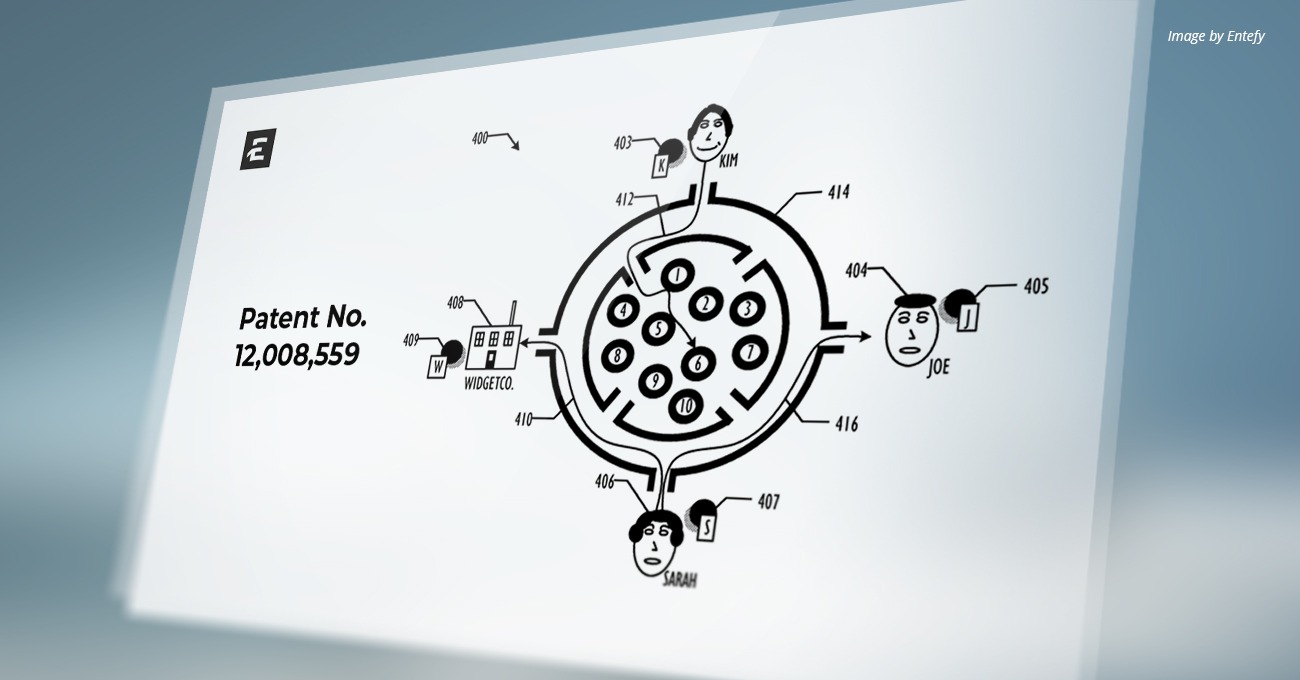
A distributed multi-AI agent network architecture for optimizing agent collaboration and tool execution with federated ledger transactions

U.S. Patent Number: 12,008,559
Patent Title: Decentralized blockchain for artificial intelligence-enabled multi-party skills exchanges over a network
Issue Date: June 11, 2024
Inventors: Ghafourifar, et al.
Assignee: Entefy Inc.

Patent Abstract

An improved decentralized, blockchain-driven network for artificial intelligence (AI)-enabled skills exchange between Intelligent Personal Assistants (IPAs) in a network is disclosed that is configured to perform computational tasks or services (also referred to herein as “skills”) in an optimally-efficient fashion. In some embodiments, this may comprise a first IPA paying an agreed cost to a second IPA to perform a particular skill in a more optimally-efficient fashion. In some embodiments, a skills registry is published, comprising benchmark analyses and costs for the skills offered by the various nodes on the skills exchange network. In other embodiments, a transaction ledger is maintained that provides a record of all transactions performed across the network in a tamper-proof and auditable fashion, e.g., via the use of blockchain technology. Over time, the AI-enabled nodes in the system may learn to scale, replicate, and transact with each other in an optimized—and fully autonomous—fashion.

USPTO Technical Field

This disclosure relates generally to apparatuses, methods, and computer readable media for a decentralized, secure network for artificial intelligence (AI)-enabled performance and exchange of computational tasks and services between network nodes.

Background

Intelligent personal assistant (IPA) software systems comprise software agents that can perform various functions, e.g., computational tasks or services, on behalf of an individual user or users. IPAs, as used herein, may simply be thought of as computational “containers” for certain functionalities. The functionalities that are able to be performed by a given IPA at a particular moment in time may be based on a number of factors, including: a user’s geolocation, a user’s preferences, an ability to access information from a variety of online sources, the processing power and/or current performance load of a physical instance that the IPA is currently being executed on, and the historical training/modification/customization that has been performed on the IPA. As such, current IPA software systems have fundamental limitations in terms of their capabilities and abilities to perform certain computational tasks.

For example, in some instances, a first IPA executing on a first device on a network may be able to perform a particular first computational task or service (also referred to herein as a “skill”) with a very high degree of accuracy, but may be executing on a physical instance that lacks the necessary computational power or capacity to perform the particular first computational task or service in a reasonable amount of time. Likewise, a second IPA, e.g., being executed on a device belonging to another user on the same network, may have excellent computational power and capacity, but not have been trained to perform the first computational task or service with a high degree of accuracy. As such, the particular first computational task or service is not likely to be able to be efficiently performed by either the first IPA or the second IPA, causing, in effect, an inevitable marketplace inefficiency in the overall skills network.

Such a scenario may not provide for a satisfactory (or efficient) user experience across the many users and/or nodes of the network. In the context of AI-enabled IPAs, the IPAs may be able to “learn” and improve their performance of certain computational tasks or services over time. AI-enabled IPAs may also be able to determine, over time, more efficient usages of the network’s overall computational capacity to perform computational tasks or services at a high level of performance and at a low operational cost, e.g., by ‘farming out’ certain computational tasks to other IPAs and/or nodes in the network that can perform the task in a more optimal manner.

However, in order to be able to act, react, and interoperate in an efficient manner, the various IPAs distributed across a network must have accurate information as to the current status of the various skills that the nodes on the network are able to perform (e.g., in terms of benchmarking scores, availability, and/or costs)—as well as the ability to determine the most optimal nodes that could be used to perform such skills, given computational and cost constraints.

Moreover, in order to reliably provide “value,” i.e., payment for services rendered, to other nodes in the aforementioned network for the performance of skills in an optimized manner, it is important that a secure ledger of transactions performed across the network be maintained in a tamper-proof and auditable fashion.

The subject matter of the present disclosure is directed to overcoming, or at least reducing the effects of, one or more of the problems set forth above. To address these and other issues, techniques that enable a decentralized, secure network for the AI-enabled performance and exchange of computational tasks and services between nodes on a network are described herein.

Read the full patent here.

ABOUT ENTEFY

Entefy is an enterprise AI software company. Entefy’s patented, multisensory AI technology delivers on the promise of the intelligent enterprise, at unprecedented speed and scale.

Entefy products and services help organizations transform their legacy systems and business processes—everything from knowledge management to workflows, supply chain logistics, cybersecurity, data privacy, customer engagement, quality assurance, forecasting, and more. Entefy’s customers vary in size from SMEs to large global public companies across multiple industries including financial services, healthcare, retail, and manufacturing.

To leap ahead and future proof your business with Entefy’s breakthrough AI technologies, visit www.entefy.com  or contact us at contact@entefy.com.
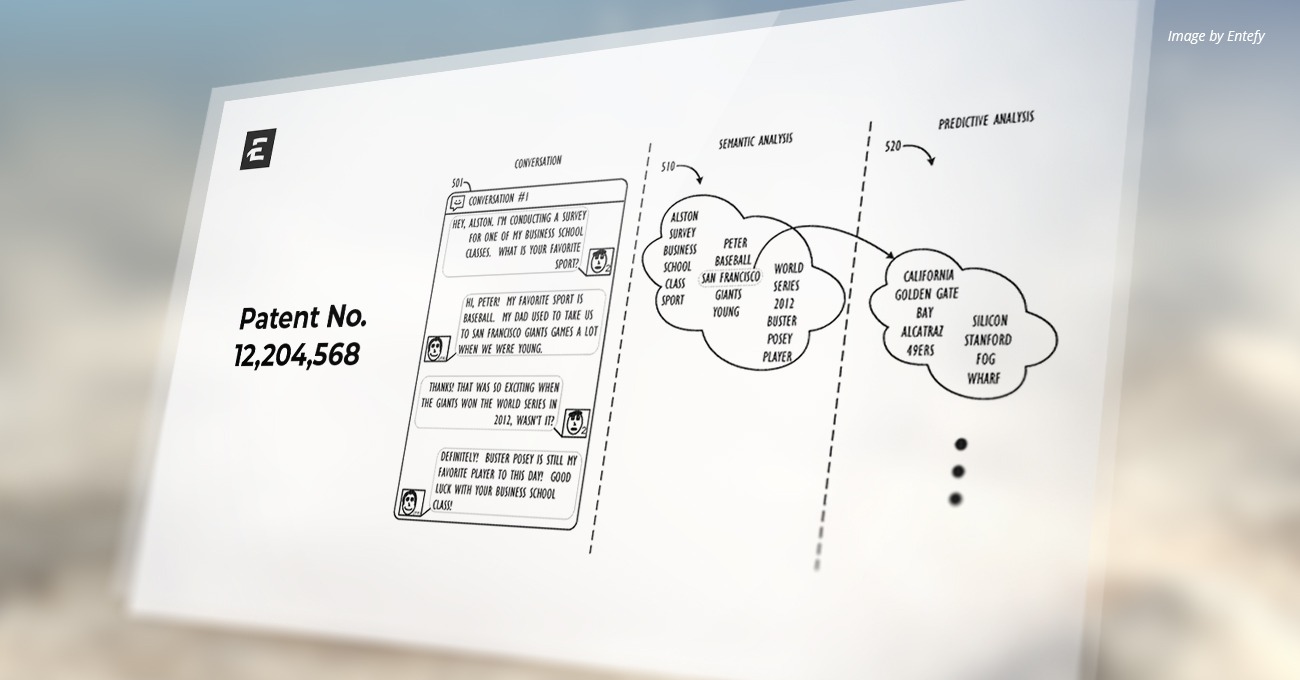
Context-aware message association for cross-platform communication

U.S. Patent Number: 12,204,568
Patent Title: System and method of context-based predictive content tagging for segmented portions of encrypted multimodal data
Issue Date:
January 21, 2025
Inventors:
Ghafourifar, et al.
Assignee:
Entefy Inc.

Patent Abstract

This disclosure relates to systems, methods, and computer readable media for performing multi-format, multi-protocol message threading in a way that is most beneficial for the individual user. Users desire a system that will provide for ease of message threading by “stitching” together related communications in a manner that is seamless from the user’s perspective. Such stitching together of communications across multiple formats and protocols may occur, e.g., by: 1) direct user action in a centralized communications application (e.g., by a user clicking ‘Reply’ on a particular message); 2) using semantic matching (or other search-style message association techniques); 3) element-matching (e.g., matching on subject lines or senders/recipients/similar quoted text, etc.); and 4) “state-matching” (e.g., associating messages if they are specifically tagged as being related to another message, sender, etc. by a third-party service, e.g., a webmail provider or Instant Messaging (IM) service).

USPTO Technical Field

This disclosure relates generally to systems, methods, and computer readable media for message threading across multiple communications formats and protocols.

Background

The proliferation of personal computing devices in recent years, especially mobile personal computing devices, combined with a growth in the number of widely-used communications formats (e.g., text, voice, video, image) and protocols (e.g., SMTP, IMAP/POP, SMS/MMS, XMPP, YMSG, etc.) has led to a communications experience that many users find fragmented and difficult to search for relevant information in. Users desire a system that will provide for ease of message threading by “stitching” together related communications across multiple formats and protocols—all seamlessly from the user’s perspective. Such stitching together of communications across multiple formats and protocols may occur, e.g., by: 1) direct user action in a centralized communications application (e.g., by a user clicking ‘Reply’ on a particular message); 2) using semantic matching (or other search-style message association techniques); 3) element-matching (e.g., matching on subject lines or senders/recipients/similar quoted text, etc.); and 4) “state-matching” (e.g., associating messages if they are specifically tagged as being related to another message, sender, etc. by a third-party service, e.g., a webmail provider or Instant Messaging (IM) service.

With current communications technologies, conversations remain “siloed” within particular communication formats or protocols, leading to users being unable to search across multiple communications in multiple formats or protocols and across multiple applications on their computing devices to find relevant communications (or even communications that a messaging system may predict to be relevant), often resulting in inefficient communication workflows—and even lost business or personal opportunities. For example, a conversation between two people may begin over text messages (e.g., SMS) and then transition to email. When such a transition happens, the entire conversation can no longer be tracked, reviewed, searched, or archived by a single source since it had ‘crossed over’ protocols. For example, if the user ran a search on their email search system for a particular topic that had come up only in the user’s SMS conversations, such a search may not turn up optimally relevant results.

Further, a multi-format, multi-protocol, communication threading system, such as is disclosed herein, may also provide for the semantic analysis of conversations. For example, for a given set of communications between two users, there may be only a dozen or so keywords that are relevant and related to the subject matter of the communications. These dozen or so keywords may be used to generate an “initial tag cloud” to associate with the communication(s) being indexed. The initial tag cloud can be created based on multiple factors, such as the uniqueness of the word, the number of times a word is repeated, phrase detection, etc. These initial tag clouds may then themselves be used to generate further an expanded “predictive tag cloud,” based on the use of Markov chains or other predictive analytics based on established language theory techniques and data derived from existing communications data in a centralized communications server. These initial tag clouds and predictive tag clouds may be used to improve message indexing and provide enhanced relevancy in search results. In doing so, the centralized communications server may establish connections between individual messages that were sent/received using one or multiple communication formats or protocols and that may contain information relevant to the user’s initial search query.

The subject matter of the present disclosure is directed to overcoming, or at least reducing the effects of, one or more of the problems set forth above. To address these and other issues, techniques that enable seamless, multi-format, multi-protocol communication threading are described herein.

Read the full patent here.

ABOUT ENTEFY

Entefy is an enterprise AI software company. Entefy’s patented, multisensory AI technology delivers on the promise of the intelligent enterprise, at unprecedented speed and scale.

Entefy products and services help organizations transform their legacy systems and business processes—everything from knowledge management to workflows, supply chain logistics, cybersecurity, data privacy, customer engagement, quality assurance, forecasting, and more. Entefy’s customers vary in size from SMEs to large global public companies across multiple industries including financial services, healthcare, retail, and manufacturing.

To leap ahead and future proof your business with Entefy’s breakthrough AI technologies, visit www.entefy.com  or contact us at contact@entefy.com.
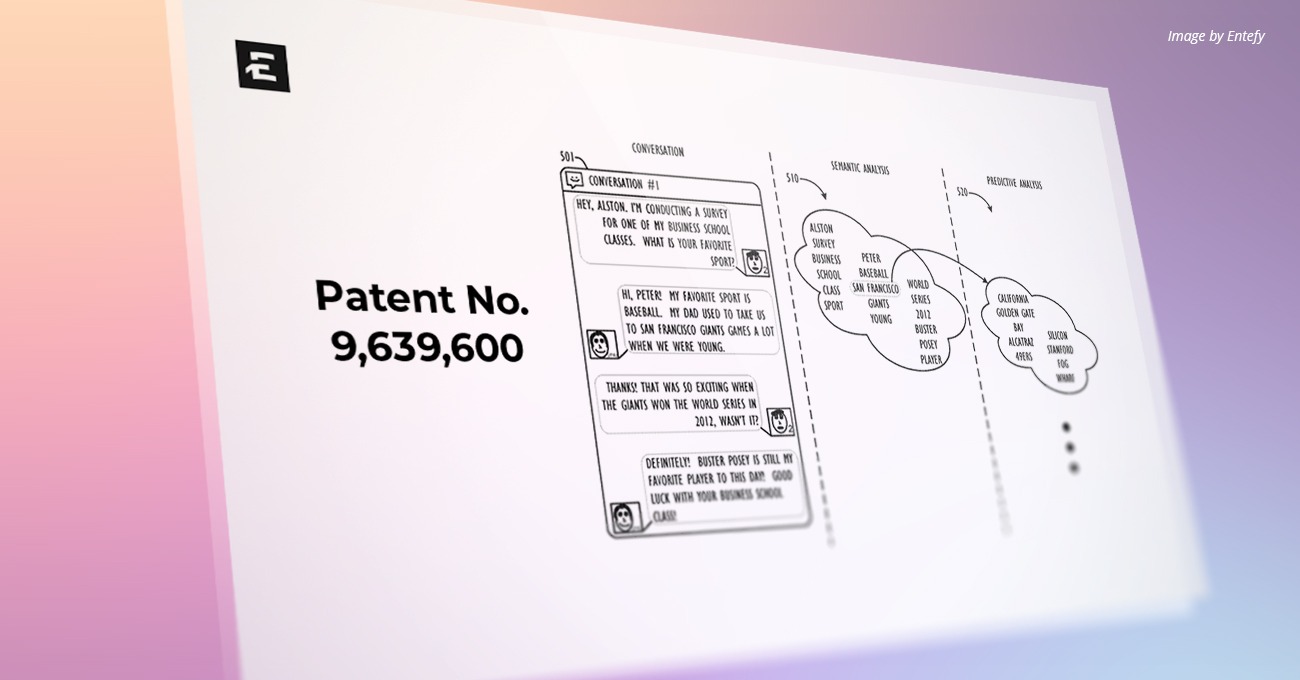
AI-based personalized message threading with a multi-protocol, multi-format digital communication system

U.S. Patent Number: 9,639,600
Patent Title: System and method of personalized message threading for a multi-format, multi-protocol communication system
Issue Date: May 02, 2017
Inventors: Alston Ghafourifar
Assignee: Entefy Inc.

Patent Abstract

This disclosure relates to systems, methods, and computer readable media for performing multi-format, multi-protocol personalized message threading in a way that is most beneficial for the individual user. Users desire a system that will provide for ease of message threading by “stitching” together related communications in a manner that is seamless from the user’s perspective. Such stitching together of communications across multiple formats and protocols—in conjunction with the use of contextual learning techniques and/or personalized index search parameter weighting techniques—may facilitate the providing of personalized query result sets to users of such systems. Personalized results may be based, at least in part, on, e.g.: 1) historic patterns of user communications; 2) index search parameter weight adjustments made by the system at regular or semi-regular time intervals; and/or 3) index search parameter weight adjustments made by the system that are based on contextual knowledge acquired from analyzing user communications.

USPTO Technical Field

This disclosure relates generally to systems, methods, and computer readable media for message threading across multiple communications formats and protocols.

Background

The proliferation of personal computing devices in recent years, especially mobile personal computing devices, combined with a growth in the number of widely-used communications formats (e.g., text, voice, video, image) and protocols (e.g., SMTP, IMAP/POP, SMS/MMS, XMPP, YMSG, etc.) has led to a communications experience that many users find fragmented and difficult to search for relevant information in. Users desire a system that will provide for ease of message threading by “stitching” together related communications across multiple formats and protocols—all seamlessly from the user’s perspective. Such stitching together of communications across multiple formats and protocols may occur, e.g., by: 1) direct user action in a centralized communications application (e.g., by a user clicking ‘Reply’ on a particular message); 2) using semantic matching (or other search-style message association techniques); 3) element-matching (e.g., matching on subject lines or senders/recipients/similar quoted text, etc.); and/or 4) “state-matching” (e.g., associating messages if they are specifically tagged as being related to another message, sender, etc. by a third-party service, e.g., a webmail provider or Instant Messaging (IM) service). These techniques may be employed in order to provide a more relevant “search-based threading” experience for users.

With current communications technologies, conversations remain “siloed” within particular communication formats or protocols, leading to users being unable to search uniformly across multiple communications in multiple formats or protocols and across multiple applications and across multiple other computing devices from their computing devices to find relevant communications (or even communications that a messaging system may predict to be relevant), often resulting in inefficient communication workflows—and even lost business or personal opportunities. For example, a conversation between two people may begin over text messages (e.g., SMS) and then transition to email. When such a transition happens, the entire conversation can no longer be tracked, reviewed, searched, or archived by a single source since it had ‘crossed over’ protocols. For example, if the user ran a search on their email search system for a particular topic that had come up only in the user’s SMS conversations, even when pertaining to the same subject manner and “conversation” such a search may not turn up optimally relevant results.

Further, a multi-format, multi-protocol, communication threading system, such as is disclosed herein, may also provide for the semantic analysis of conversations. For example, for a given set of communications between two users, there may be only a dozen or so keywords that are relevant and related to the subject matter of the communications, as determined by one or a number of associated algorithms designed to detect keyword importance. These dozen or so keywords may be used to generate an “initial tag cloud” to associate with the communication(s) being indexed. The initial tag cloud can be created based on multiple factors, such as the uniqueness of the word, the number of times a word is repeated, phrase detection, etc. These initial tag clouds may then themselves be used to generate further an expanded “predictive tag cloud,” based on the use of Markov chains or other predictive analytics based on established language theory techniques and data derived from existing communications data in a centralized communications server, including unique data derived from the communication patterns of one and/or multiple users utilizing the centralized communications server when interacting with one and/or multiple other users and non-users of the centralized communications server. These initial tag clouds and predictive tag clouds may be used to improve message indexing and provide enhanced relevancy in search results. In doing so, the centralized communications server may establish connections between individual messages that were sent/received using one or multiple communication formats or protocols and that may contain information relevant to the user’s initial search query.

The subject matter of the present disclosure is directed to overcoming, or at least reducing the effects of, one or more of the problems set forth above. To address these and other issues, techniques that enable seamless, multi-format, multi-protocol communication threading are described herein.

Read the full patent here.

ABOUT ENTEFY

Entefy is an enterprise AI software company. Entefy’s patented, multisensory AI technology delivers on the promise of the intelligent enterprise, at unprecedented speed and scale.

Entefy products and services help organizations transform their legacy systems and business processes—everything from knowledge management to workflows, supply chain logistics, cybersecurity, data privacy, customer engagement, quality assurance, forecasting, and more. Entefy’s customers vary in size from SMEs to large global public companies across multiple industries including financial services, healthcare, retail, and manufacturing.

To leap ahead and future proof your business with Entefy’s breakthrough AI technologies, visit www.entefy.com  or contact us at contact@entefy.com.