

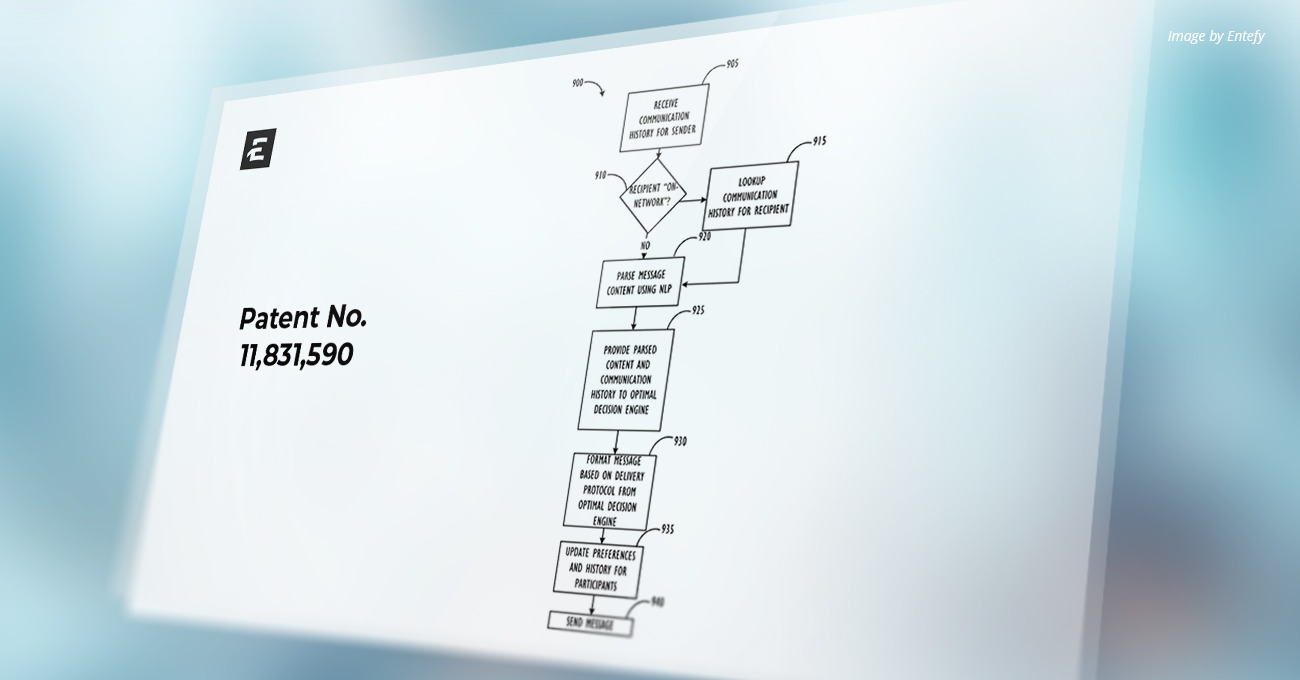
U.S. Patent Number: 11,831,590
Patent Title: Apparatus and method for context-driven determination of optimal cross-protocol communication delivery
Issue Date: November 28, 2023
Inventors: Ghafourifar, et al.
Assignee: Entefy Inc.
Patent Abstract
This disclosure relates generally to apparatus, methods, and computer readable media for composing communications for computing devices across multiple formats and multiple protocols. More particularly, but not by way of limitation, this disclosure relates to apparatus, methods, and computer readable media to permit computing devices, e.g., smartphones, tablets, laptops, and the like, to send communications in a number of pre-determined and/or ‘determined-on-the-fly’ optimal communications formats and/or protocols. Determinations of optimal delivery methods may be intelligently based on the sender individually or the relationship with the sender in the context of a group of recipients—including the format of the incoming communication, the preferred format of the recipient and/or sender, and an optimal format for a given communication message. The techniques disclosed herein allow communications systems to become ‘message-centric’ or ‘people-centric,’ as opposed to ‘protocol-centric,’ eventually allowing consideration of message protocol to fall away entirely for the sender of the communication.
USPTO Technical Field
This disclosure relates generally to apparatuses, methods, and computer readable media for composing communications for computing devices across multiple communications formats and protocols as intelligently determined using one or more context factors to determine the optimal delivery method for the communications.
Background
The proliferation of personal computing devices in recent years, especially mobile personal computing devices, combined with a growth in the number of widely-used communications formats (e.g., text, voice, video, image) and protocols (e.g., SMTP, IMAP/POP, SMS/MMS, XMPP, etc.) has led to a communications experience that many users find fragmented and restrictive. Users desire a system that will provide ease of communication by sending an outgoing message created in whatever format was convenient to the composer, with delivery options to one or more receivers in whatever format or protocol that works best for them—all seamlessly from the composer’s and recipient(s)’s perspective. With current communications technologies that remain “protocol-centric”—as opposed to “message-centric” or “people-centric”—such ease of communication is not possible.
In the past, users of communications systems first had to choose a communication format and activate a corresponding application or system prior to composing a message or selecting desired recipient(s). For example, if a person wanted to call someone, then he or she would need to pick up a telephone and enter the required phone number or directory in order to connect. If a person wanted to email a colleague, that person would be required to launch an email application before composing and sending the email. Further, while long-form text might be the most convenient format at the time for the composer, long-form text may not be convenient for the receiver—resulting in a delayed receipt of and/or response to the message by the receiver. With the multi-format communication composition techniques described herein, however, the user flow is much more natural and intuitive. First, the ‘Sender’ (e.g., a registered user of the multi-format, multi-protocol communication system), can select the desired recipient(s). Then, the Sender may compose the outgoing message (in any format, such as text, video recording, or audio recording). Next, the system (or the Sender, in some embodiments) intelligently chooses the delivery protocol for the communication, e.g., whether the communication is going to be sent via email, SMS, IM, or social media, etc. Finally, the outgoing message is converted into the desired outgoing message format (either by the Sender’s client device or a central communications system server) and sent to the desired recipient(s) via the chosen delivery protocol(s).
According to the multi-format communication composition techniques described herein, the emphasis in the communication interface is on the “who” and the “what” of the communication—but not the “how.” The multi-format communication composition system described herein takes care of the “how”—including an ‘Optimal’ option, as determined by a dedicated service in the central communication server, such as a service referred to herein as the ‘Optimal Decision Engine,’ which may be employed to deliver the outgoing communication to the desired recipient(s) in the most preferred way, e.g., either through preferences that the recipient(s) has specified via his or her profile in a multi-format communications network or through the communication protocol information regarding the desired recipient that is stored in the Sender’s contact list.
The subject matter of the present disclosure is directed to overcoming, or at least reducing the effects of, one or more of the problems set forth above. To address these and other issues, techniques that enable seamless, multi-format communications via a single user interface are described herein.
Read the full patent here.
ABOUT ENTEFY
Entefy is an enterprise AI software company. Entefy’s patented, multisensory AI technology delivers on the promise of the intelligent enterprise, at unprecedented speed and scale.
Entefy products and services help organizations transform their legacy systems and business processes—everything from knowledge management to workflows, supply chain logistics, cybersecurity, data privacy, customer engagement, quality assurance, forecasting, and more. Entefy’s customers vary in size from SMEs to large global public companies across multiple industries including financial services, healthcare, retail, and manufacturing.
To leap ahead and future proof your business with Entefy’s breakthrough AI technologies, visit www.entefy.com or contact us at contact@entefy.com.