

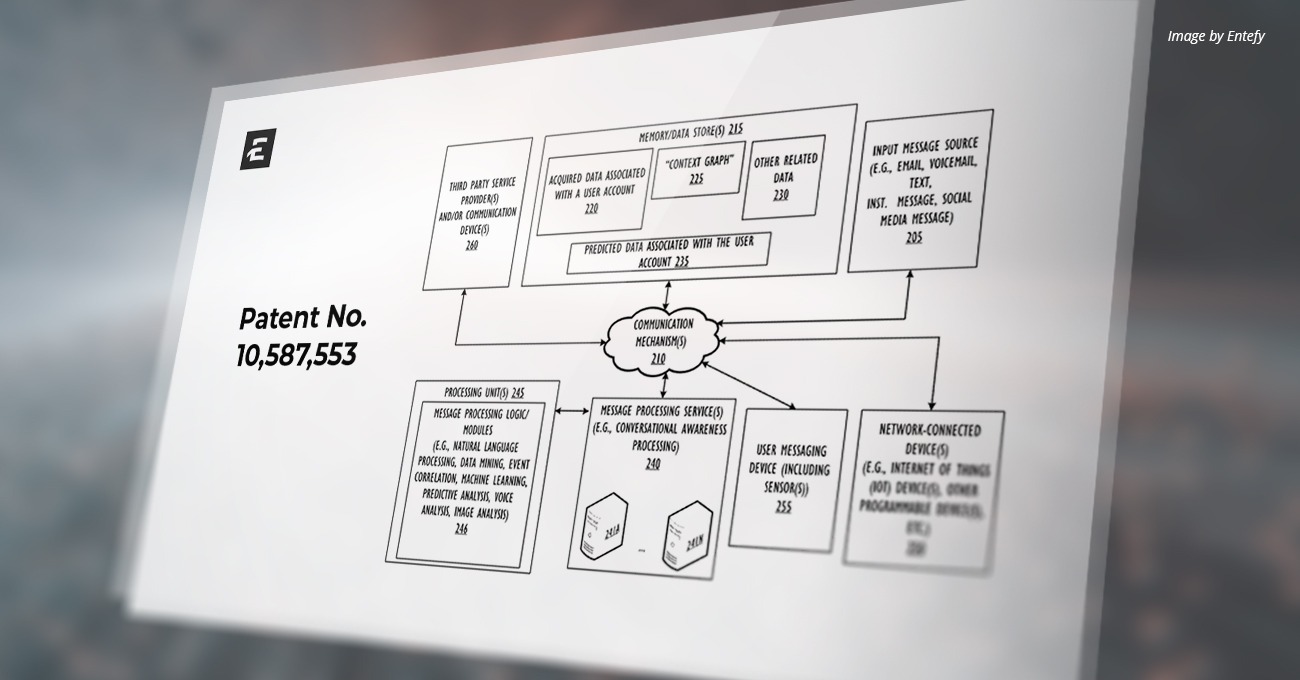
U.S. Patent Number: 10,587,553
Patent Title: Methods and systems to support adaptive multi-participant thread monitoring
Issue Date: March 10, 2020
Inventors: Ghafourifar, et al.
Assignee: Entefy Inc.
Patent Abstract
Disclosed are apparatuses, methods, and computer readable media for improved message presentation to a user with respect to correlation of messages in a multi-participant message thread. Conversational awareness may be determined by analyzing contents of individual messages and assigning them to an existing context or creating a new context. Association of messages to contexts allows for grouping related messages related to their subject matter. Further, analysis of individual users within a multi-party communication stream (e.g., a thread with a group of participants) can be used to report previous and predict future user activity of a specific user. Groups of different sizes have been determined to sometimes have different participation dynamics. For example, people communicate differently in small groups versus large groups and within a given group, individual participation dynamics can be further analyzed. Disclosed systems learn and leverage this communication dynamic.
USPTO Technical Field
This disclosure relates generally to apparatuses, methods, and computer readable media for improved interaction of users with receipt and response to multi-protocol message events. More particularly, this disclosure relates to providing a communication system to analyze multi-user message activity to provide contextual conversational information for multi-party message threads. The conversational awareness being determined, in part, by analyzing contents of individual messages and their relationship to other messages using a history and knowledge base of the other messages.
Background
Modern consumer electronics are capable of enabling the transmission of messages using a variety of different communication protocols. More specifically, text messages (such as SMS/MMS, Instant Messages (IMs), etc.) and emails represent the vast majority of direct communications between users. Each of these mechanisms support electronic exchange of information between users or groups of users. In some cases, information is simply “posted” and may not be directly related to any particular message thread. In other cases, information may be directed to a user such that a “reply” or further communication is expected. In short, today’s technologies provide a multi-protocol input of information to users and it is largely up to the recipient to determine what to do with the information (e.g., comment, reply, ignore, pass on to another party).
(4) One problem associated with existing (and possibly future) methods of exchanging messages between parties is that messages are received in a largely stand-alone fashion. Using today’s available communication techniques, each individual message lacks a context relationship with other messages and does not take into account a conversational awareness to present to the user. At best, messages may represent a thread of related communications that are only connected to each other because of a common subject line. Further, often in a long thread of messages (e.g., many distinct messages under the same subject line), becomes less relevant to a particular subject as the topics in the body of the messages change to different topics. In cases where there are multiple participants in a given thread of messages the communications may evolve through many different topics. That is, a message may be sent to a group of people, and as different people in the group contribute to the message thread, they may change the direction of the topic being “discussed” in the messages. Using current techniques, a user is not given any indication of the changes in topic over time.
(5) Further, different groups of people interact differently in different sized groups. In a small group of four people, everyone may feel comfortable with contributing to the discussion. However, these same four people within a larger group (e.g., 16 people) may feel less inclined to join in and submit messages to the thread. This dynamic may increase as the number of people in the group increases. Alternatively, some people, for a variety of different reasons, may not be intimidated or reserved within a large group message thread and “contribute” more often than others. Sometimes, the people that contribute more often offer important information for the group, while other times, people “contribute” non-important information and feel compelled to put messages into the thread. Current techniques of multi-party communications do not have any way to classify or differentiate these different types of users or classes of user behavior. This can lead to each participant in the thread being treated similarly in terms of how messaging applications may notify, display, remind, and otherwise indicate the messaging activity in a given group conversation to a given user participant. Additionally, sometimes the thread splinters into groups of people discussing different topics that not everyone may be genuinely participating in nor care about. This divergence may be related (or caused by) the length of time that a particular message thread is active and the number of active participants. The longer a message thread is active the more likely it may be to diverge and the context of the messages may be more accurately representative of multiple smaller and shorter communications hidden within the context of the larger and longer message thread. It would be beneficial to provide users visibility into this situation to make them more productive and efficient when dealing with long (as in time) and large (as in number of participants and/or number of messages) message threads. Similarly, it would be beneficial to provide a system with visibility into this information so as to enable predictive analytics, machine learning, and other data processing techniques to discover behavior patterns which may be of value to a given user or group of users in a given conversation.
(6) Another problem associated with today’s messaging techniques is their relative inability to provide relevant predictive and reactive solutions to a user’s messages based on the way different users interact in multi-participant message threads. Generally, the user’s type of interaction within the thread is completely ignored when messages are delivered. If a user’s interaction history were taken into account, it may be possible to provide a visual indication to other users of the importance or non-importance of portions of the thread. Further, a visual indication may alert a user to splintered conversations within a larger communication stream. Recognition of these situations and determination of visual clues for users may be performed using the techniques of this disclosure.
(7) The subject matter of the present disclosure is directed to overcoming, or at least reducing the effects of, one or more of the problems set forth above. To address these and other issues, techniques that process a multi-participant message thread based on the content of individual messages and attributes of different participants are described herein. Disclosed techniques also allow for grouping of messages into chunks of messages more related to each other than other messages in a message stream. Additionally, disclosed techniques allow for providing visual clues, via an interface to users participating within these multi-participant threads, to increase user’s awareness to the above described occurrences.
Read the full patent here.
ABOUT ENTEFY
Entefy is an enterprise AI software company. Entefy’s patented, multisensory AI technology delivers on the promise of the intelligent enterprise, at unprecedented speed and scale.
Entefy products and services help organizations transform their legacy systems and business processes—everything from knowledge management to workflows, supply chain logistics, cybersecurity, data privacy, customer engagement, quality assurance, forecasting, and more. Entefy’s customers vary in size from SMEs to large global public companies across multiple industries including financial services, healthcare, retail, and manufacturing.
To leap ahead and future proof your business with Entefy’s breakthrough AI technologies, visit www.entefy.com or contact us at contact@entefy.com.