

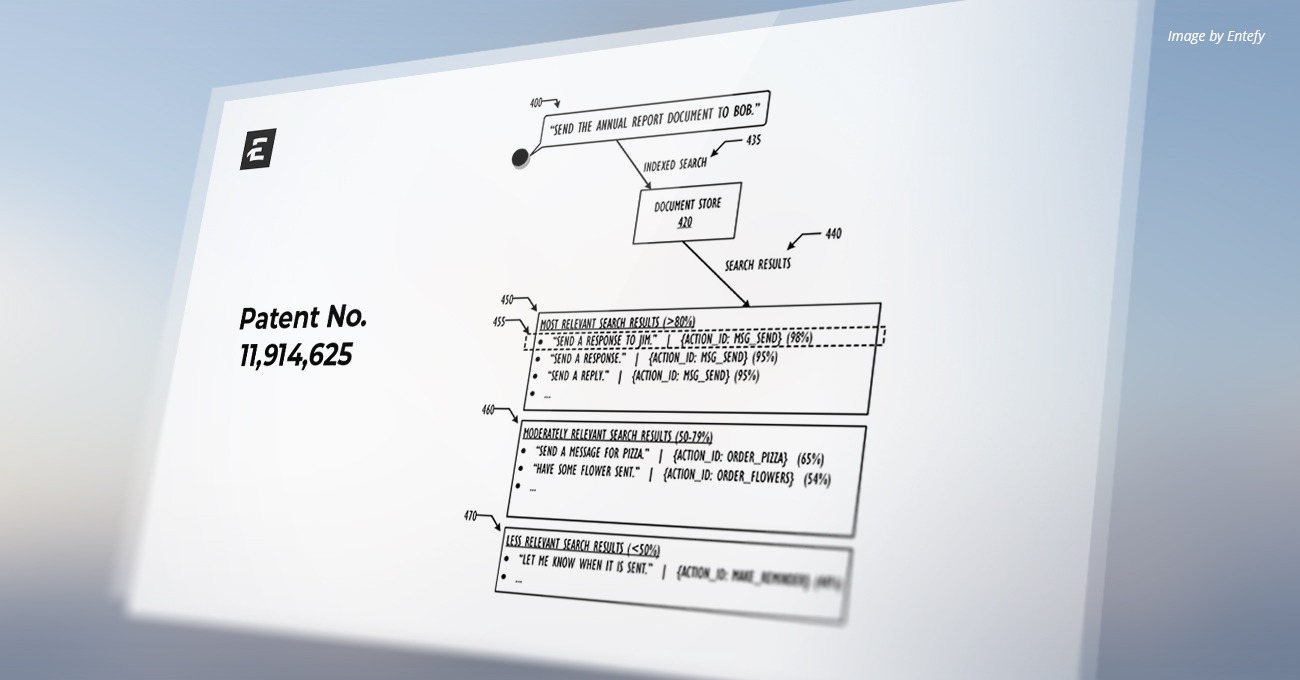
U.S. Patent Number: 11,914,625
Patent Title: Search-based natural language intent determination
Issue Date: February 27, 2024
Inventors: Ghafourifar, et al.
Assignee: Entefy Inc.
Patent Abstract
Improved intelligent personal assistant (IPA) software agents are disclosed that are configured to interact with various people, service providers, files, and/or smart devices. More particularly, this disclosure relates to an improved Natural Language Processing (NLP) Intent Determination Service (IDS) that is able to determine the likely best action to take in response to generic user commands and queries. The improved NLP IDS disclosed is said to be ‘search-based’ because, rather than attempt to parse incoming user commands and queries up front, the incoming user commands and queries are searched against a pre-generated database of exemplary user commands (e.g., having associated action or parsing identifiers) to determine the most relevant search result(s). The associated system actions and known grammar/parsing rules of the most relevant search result(s) may then be used to process the incoming user command or query—without having to actually parse the incoming user command or query from scratch.
USPTO Technical Field
This disclosure relates generally to apparatuses, methods, and computer readable media for improved natural language processing (NLP) intent determination, e.g., for use with intelligent personal assistant software agents that are configured to interact with people, services, and devices across multiple communications formats and protocols.
Background
Intelligent personal assistant (IPA) software systems comprise software agents that can perform various tasks or services on behalf of an individual user. These tasks or services may be based on a number of factors, including: spoken word or verbal input from a user, textual input from a user, gesture input from a user, a user’s geolocation, a user’s preferences, a user’s social contacts, and an ability to access information from a variety of online sources, such as via the World Wide Web. However, current IPA software systems have fundamental limitations in natural language processing, natural language understanding (NLU), and so-called “intent determination” in practical applications.
For example, in some systems, language context and action possibilities gleaned from user commands may be constrained ‘up front’ by identifying the specific service that the user is sending the command to before attempting to perform any NLP/NLU—thus increasing the accuracy of results and significantly reducing the amount of processing work needed to understand the commands. However, this strategy may not provide a satisfactory user experience in the context of AI-enabled IPAs, wherein the user may often engage in macro-level ‘conversations’ with his or her device via a generic query to a single IPA ‘persona’ that is capable of interacting with many third-party services, APIs, file, document, and/or systems. In such situations, it becomes more complex and challenging for the IPA to reliably direct the user’s commands to the appropriate data, interface, third-party service, etc.—especially when a given command may seemingly apply with equal validity to two or more known third-party interfaces or services that the IPA software agent is capable of interfacing with. For example, the command, “Send {item}.” may apply with seemingly equal validity to a native text messaging interface, a native email client, a third-party messaging interface, a flower delivery service, etc.
Moreover, it is quite computationally expensive to attempt to parse the grammar of each incoming user command or query ‘up front,’ i.e., to attempt to determine the intent of the user’s command and/or which specific services, APIs, file, document, or system the user intends for his command to be directed to. Computationally-expensive parsing may also be used to determine how certain words or phrases in the user’s command depend on, relate to, or modify other words or phrases in the user’s command, thereby giving the system a greater understanding of the user’s actual intent.
NLP systems may be used to attempt to glean the true intent of a user’s commands, but the success of such systems is largely dependent upon the training set of data which has been used to train the NLP system. NLP also requires computationally-intensive parsing to determine what parts of the user’s command refer to intents, which parts refer to entities, which parts refer to attributes, etc., as well as which entities and attributes are dependent upon (or are modifying) which intents.
The subject matter of the present disclosure is directed to overcoming, or at least reducing the effects of, one or more of the problems set forth above. To address these and other issues, techniques that enable a more computationally-efficient, so-called ‘search-based,’ NLP intent determination system are described herein.
Read the full patent here.
ABOUT ENTEFY
Entefy is an enterprise AI software company. Entefy’s patented, multisensory AI technology delivers on the promise of the intelligent enterprise, at unprecedented speed and scale.
Entefy products and services help organizations transform their legacy systems and business processes—everything from knowledge management to workflows, supply chain logistics, cybersecurity, data privacy, customer engagement, quality assurance, forecasting, and more. Entefy’s customers vary in size from SMEs to large global public companies across multiple industries including financial services, healthcare, retail, and manufacturing.
To leap ahead and future proof your business with Entefy’s breakthrough AI technologies, visit www.entefy.com or contact us at contact@entefy.com.